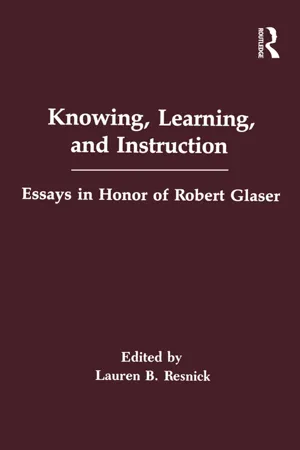
Celebrating the 20th anniversary of the Learning Research and Development Center (LRDC) at the University of Pittsburgh, these papers present the most current and innovative research on cognition and instruction. Knowing, Learning, and Instruction pays homage to Robert Glaser, founder of the LRDC, and includes debates and discussions about issues of fundamental importance to the cognitive science of instruction.
- 522 pages
- English
- ePUB (mobile friendly)
- Available on iOS & Android
eBook - ePub
About this book
Information
Topic
EducationSubtopic
Education General1
Introduction
Lauren Β. Resnick
Learning Research and Development Center University of Pittsburgh
Learning Research and Development Center University of Pittsburgh
This book appears at a moment of new challenges and opportunities for instructional theory. A maturing cognitive science now provides stronger theoretical and methodological frameworks for the study of knowledge and learning than have been available heretofore. We can now approach questions of instruction with a solid base of information about how knowledge and process interact to produce competent performance and with a flexible array of methods for examining learning in those disciplines—practical or academic—we might wish to teach. Current cognitive theory emphasizes three interrelated aspects of learning that, together, call for forms of instructional theory very different from those that grew out of earlier associationist and behaviorist psychologies. First, learning is a process of knowledge construction, not of knowledge recording or absorption. Second, learning is knowledge-dependent; people use current knowledge to construct new knowledge. Third, learning is highly tuned to the situation in which it takes place.
Constructivism. Cognitive theories tell us that learning occurs not by recording information but by interpreting it. Effective learning depends on the intentions, self-monitoring, elaborations, and representational constructions of the individual learner. The traditional view of instruction as direct transfer of knowledge does not fit this constructivist perspective. We need instead instructional theories that place the learner's constructive mental activity at the heart of any instructional exchange, that treat instruction as an intervention in an ongoing knowledge construction process. This does not mean, however, that students can be left to discover everything for themselves. Instruction must provide information for learners' knowledge construction processes. It must constrain those processes so that they will result in knowledge that is both true and powerful—true in the sense of describing the world well or according well with the theories of a discipline and powerful in the sense of being lasting and finding diverse occasions for use. At the same time, instruction must stimulate active knowledge construction processes among people who may initially doubt their own ability for or right to do independent thinking. Where necessary, instruction must also directly teach knowledge construction strategies.
Knowledge-Dependent Learning. In an influential article, Robert Glaser (1984) assembled extensive evidence suggesting that both reasoning and learning are knowledge-driven. Those who are knowledge-rich reason more profoundly. They also elaborate as they study and thereby learn more effectively. Knowledge thus begets knowledge. Since that 1984 article, more evidence of the knowledge-dependence of thinking and learning has appeared. New research, some of it discussed in this volume (see Voss, Blais, Means, Greene, & Ahwesh, chap. 7; Chi & Bassok, chap. 8), has documented processes by which people elaborate items of knowledge and devise relationships among them that enable formulation of wider arguments and explanations. This research often highlights marked individual differences in people's tendency and ability to engage in these elaborative processes. Such differences may depend partly on prior knowledge and partly on habits of engaging with intellectual questions. The phenomenon of knowledge-dependent learning poses urgent questions for a theory of instruction. If learning depends on elaboration and extension of prior knowledge, should instruction expend its resources directly adding to that knowledge so people can reason and elaborate more effectively or on teaching them to reason and interpret information so they can more easily acquire new knowledge for themselves? Is it possible to teach reasoning without knowledge or knowledge without reasoning? If not, if the two are inextricably linked, how is it possible to break the cycle in which the knowledge-rich become still richer and the knowledge-poor remain poor?
Situated Knowledge. Traditional instructional theory assumes that knowledge and skill can be analyzed into component parts that function in the same way no matter where they are used. This assumption is the foundation for the building-from-the-bottom approach that characterizes most current school and technical instruction. Complexity, which overloads humans' limited attentional capacities, is initially avoided in favor of teaching separate components that presumably can be combined later without difficulty. Such instruction typically begins with basic elements or the facts of a knowledge domain. These are taught and practiced to some reliable level of performance. It is assumed that students will later be able to use these basics as the starting point for thinking and reasoning processes and for building more complex concepts and skills.
Cognitive theory today offers strong reasons to consider such bottom-up instruction suspect. First, we know that human memory for isolated facts is very limited. Knowledge is retained only when embedded in some organizing structure. Thus, students who learn many separate facts are unlikely to retain their knowledge beyond the period of test-taking—a much noticed, worrisome feature of the current educational system. Second, we now recognize that skills and knowledge are not independent of the contexts— mental, physical, and social—in which they are used. Instead, they are attuned to, even part of, the environments in which they are practiced. A new challenge for instruction is to develop ways of organizing learning that permit skills to be practiced in the environments in which they will be used. Such contextualized practice is needed both to tune skills and knowledge to their environments of use and to provide motivation for practicing abilities that in isolation might seem purposeless or meaningless.
Responding to these questions and challenges, cognitive scientists are examining and developing various new approaches to instruction. The chapters in this volume explore theory and data relevant to several constructivist methods of helping people create correct and powerful forms of knowledge; they examine the problem of cultivating more powerful processes of knowledge construction; and they probe the question of how to contextualize learning. I consider each of these before introducing the individual chapters.
Bootstrapping Knowledge Construction
The fact that learning depends heavily on what people already know poses a fundamental problem for instruction. Without special intervention, the knowledge rich would grow greatly in knowledge, the knowledge poor very little. Those most in need of instructional help, therefore, need special boosters for their knowledge construction efforts—extra help in identifying critical elements of their own knowledge and in learning from what others may tell or show them. It may be helpful to recast the traditional instructional question of how to convey information as a problem of cognitive bootstrapping—beginning a climb without firmly established prior knowledge, yet behaving as if one had the knowledge. Current cognitive instructional theory suggests various approaches to bootstrapping knowledge construction.
Texts That Support the Construction of Situation Models
Theories of mental models (Gentner & Stevens, 1983; Johnson-Laird, 1983) are central to cognitive science's search for ways of characterizing the relationship between thinking and the external reality to which thought and its symbols refer. To learn about something, to come to understand it, is, in current cognitive science parlance, to construct a mental model. How can we best assist learners in their process of constructing powerful and accurate mental representations of situations?
Many events, situations, and phenomena of interest to the curious and attentive person cannot be directly experienced, so deliberate instruction has an especially large role to play in helping people extend their knowledge. Instruction can make available historical events, situations that no longer exist but are of continuing cultural interest and importance. Or, the material of instructional interest may be contemporary, but so geographically removed or socially inaccessible that it cannot be directly experienced. Such is the case, for example, with events in other countries or activities of a social group to which one does not have access.
Written texts are among the time-tested ways of providing information that cannot be directly experienced. Considerable attention has been devoted to discovering how to make texts more effective as instructional vehicles. In the past most such research has focused on structural features of texts (e.g., organizational structure, grammatical complexity, vocabulary) or on adjuncts to texts (e.g., questions or headings) that might affect the ways in which they were read. Today, however, researchers are not only asking what general characteristics of texts enhance learning, but also exactly what kind of information is presented in them and what prior knowledge is presupposed. This research focuses explicitly on how to develop texts that facilitate learners' construction of particular kinds of situation models (see Kintsch, chap. 2 in this volume). Different situation models may be enhanced by different kinds of text designs, and the effectiveness of these designs will interact with the knowledge that the learner has available as a starting point for constructing a new model (Beck & McKeown, chap. 3 in this volume). Related research extends the notion of facilitative instructional presentations to include teachers' explanations and students' responses to them (see Leinhardt, chap. 4 in this volume).
Tapping Implicit Knowledge
People do not come as empty vessels to learning. In almost any domain, even beginners carry with them ideas of how things work and frameworks for interpreting new information. These ideas may come from everyday experience, which forms the basis for a large repertoire of mental models that correspond to frequently encountered physical and social phenomena. Most often these models remain implicit. People are sometimes unaware of having them but, nevertheless, use them as frameworks for interpreting situations and acting in them.
Sometimes implicitly held models contain core principles and constraints that can effectively help people to learn a formal system. This is the case in mathematics, where research has revealed that children and unschooled adults gain substantial knowledge about basic principles of number and arithmetic from informal experience (Gelman & Greeno, chap. 5 in this volume; Resnick, 1986). These principles, however, are rarely invoked in the course of school arithmetic learning. Substantial evidence now exists that children attempt to construct calculation procedures on the basis of examples that do not adequately constrain their constructions (Van Lehn, 1985). As a result, they invent systematic but incorrect procedures that have come to be known as buggy algorithms or malrules. Research is beginning to explore the idea that mathematics learning can be enhanced by instruction that taps children's implicit models of the number system, bringing these principles into discussion and explicitly linking them to the formal mathematics being taught. Students of cognition and instruction face the challenge of identifying for many domains the implicit principles that might play this constraining role in learning and devising ways to make school learning as sensitive to these principles as possible.
Implicitly held mental models can also contradict new ideas being taught and interfere with learning. There is substantial and growing evidence that in many fields of science (perhaps most dramatically in physics) basic scientific concepts are in fundamental epistemological conflict with many commonplace everyday conceptions. As a result, people's everyday conceptions of natural phenomena do little to support, and may actually hinder, learning modern scientific constructs. In many domains of knowledge, learning new theoretical systems may require individual mental reorganizations of knowledge similar to the reorganizations that sciences themselves undergo. Much attention is currently focused on the potential role of contradiction in making people aware of their implicit models and in stimulating reformulation of them. According to current instructional theories, recognition of contradictions can be provoked either by confrontations with data that disconfirm a current belief, or by confrontations with contradictory beliefs and predictions of others, especially peers. Some investigators now recognize, however, that contradiction of current beliefs may lead to discomfort with one's own present conceptions, without necessarily leading one toward a more scientifically appropriate new construct (e.g., Johsua & Dupin, 1987). A current challenge is to find various ways to bootstrap new theory construction without ignoring the existence and power of prior conceptions.
Objectifying Theoretical Constructs
Theoretical systems are difficult to learn, partly because they refer to entities with no direct correspondents in sensory experience. Learning mathematics, physical and social sciences requires an understanding of such theoretical systems. Theoretical systems in physics, for example, include entities such as forces, vectors, and inertia that serve to explain phenomena but cannot actually be observed. In economics the concept of a market imposes order upon observations of supply, demand, and price fluctuations, but the market itself cannot be directly seen. In mathematics, too, entities such as numbers and operations are mental constructions, not perceptible phenomena. Instruction in domains in which theoretical entities play a central role requires attention to helping students construct not only mental models of situations, but also mental models of theories. Ordinary inductive processes cannot be relied on for constructing theoretical models, because the entities that comprise these models cannot be directly observed.
One promising approach to bootstrapping learners' construction of theoretical constructs is creating means of objectifying constructs, that is, building physical displays that allow explicit representation of key theoretical constructs. Such displays afford public and, therefore, discussable referents for key theoretical constructs (see Nesher, chap. 6 in this volume). It becomes possible, then, to manipulate these objects, observe the effects, and apply processes analogous to inductive learning to the problem of building theoretical constructs. In exploring the possibilities for objectifying theoretical constructs, cognitive scientists have been borrowing ideas from mathematics, where there has traditionally been an interest in creating concrete or graphic representations of basic entities in the mathematical system (cf. Dienes & Golding, 1971). At the same time, they have been using the new representational capacities of computers to construct representations that behave as theoretical objects would under perfect theoretical assumptions. White (in press) and Roschelle (1987), for example, have created computer systems in which objects move in accordance with Newtonian principles, and graphical representations of vectors can be used to control or predict these motions. By supporting conversation about theoretical constructs that students do not yet fully understand, such programs allow students to enter a knowledge culture in which the target theoretical constructs play a role. The graphic displays ensure that individuals talk about the same thing, and that the object of their discussion behaves as it should within the to-be-learned theoretical system.
A related line of work has explored the role of analogies in helping students construct new explanatory systems. For certain topics (e.g., basic electricity), there has been extensive exploration of the strengths and weaknesses of different kinds of analogies. Each analogy highlights certain theoretical features and makes it difficult to appreciate others (cf. Gentner, 1983). Research on analogies in instruction makes it clear that simply presenting analogies is often insufficient to bootstrap theory construction. Analogies are instructionally effective only when the learner is prepared to accept the idea that two systems or situations are similar in some fundamental way. If students believe, for example, that a spring, with its obvious elasticity, and a board that appears solid and inelastic are fundamentally different, showing them a spring analogy will not help them understand that a board exerts an upward force on an object that rests on it. Clement (1987) has been exploring the role of "bridging analogies"—situations midway between a source and a target system—that can help students understand how two apparently different systems are, in fact, related. Effective use of analogies often requires extensive discussion and dialogic development of ideas. Through such talk, people tune and refine each other's mental models, creating a culturally shared set of representations and theories. Research on the process of tuning and refining theoretical models through discussion and explanation is increasingly attracting cognitive scientists' attention.
Teaching Processes of Knowledge Constru...
Table of contents
- Cover
- Half Title
- Title
- Copyright
- Contents
- List of Contributors
- Preface
- 1 Introduction
- 2 Learning From Text
- 3 Expository Text for Young Readers: The Issue of Coherence
- 4 Development of an Expert Explanation: An Analysis of a Sequence of Subtraction Lessons
- 5 On the Nature of Competence: Principles for Understanding in a Domain ©
- 6 Microworlds in Mathematical Education: A Pedagogical Realism
- 7 Informal Reasoning and Subject Matter Knowledge in the Solving of Economics Problems by Naive and Novice Individuals
- 8 Learning From Examples via Self-Explanations
- 9 What Kind of Knowledge Transfers?
- 10 There are Generalized Abilities and One of Them is Reading
- 11 Toward Intelligent Systems for Testing
- 12 Intentional Learning as a Goal of Instruction
- 13 Guided, Cooperative Learning and Individual Knowledge Acquisition
- 14 Cognitive Apprenticeship: Teaching the Crafts of Reading, Writing, and Mathematics
- Author Index
- Subject Index
Trusted by 375,005 students
Access to over 1.5 million titles for a fair monthly price.
Study more efficiently using our study tools.
Frequently asked questions
Yes, you can cancel anytime from the Subscription tab in your account settings on the Perlego website. Your subscription will stay active until the end of your current billing period. Learn how to cancel your subscription
No, books cannot be downloaded as external files, such as PDFs, for use outside of Perlego. However, you can download books within the Perlego app for offline reading on mobile or tablet. Learn how to download books offline
We are an online textbook subscription service, where you can get access to an entire online library for less than the price of a single book per month. With over 1.5 million books across 990+ topics, we’ve got you covered! Learn about our mission
Look out for the read-aloud symbol on your next book to see if you can listen to it. The read-aloud tool reads text aloud for you, highlighting the text as it is being read. You can pause it, speed it up and slow it down. Learn more about Read Aloud
Yes! You can use the Perlego app on both iOS and Android devices to read anytime, anywhere — even offline. Perfect for commutes or when you’re on the go.
Please note we cannot support devices running on iOS 13 and Android 7 or earlier. Learn more about using the app
Please note we cannot support devices running on iOS 13 and Android 7 or earlier. Learn more about using the app
Yes, you can access Knowing, Learning, and instruction by Lauren Resnick in PDF and/or ePUB format, as well as other popular books in Education & Education General. We have over 1.5 million books available in our catalogue for you to explore.