- 233 pages
- English
- ePUB (mobile friendly)
- Available on iOS & Android
eBook - ePub
About this book
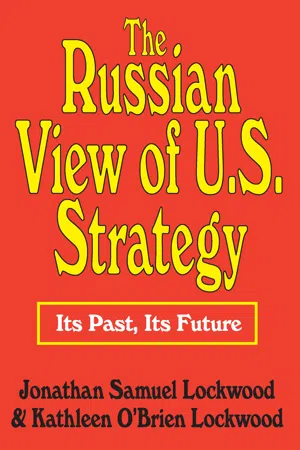
Soviet perceptions of U.S. strategy remained remarkably consistent from the post-Stalin period through the collapse of communism in Eastern Europe and the Soviet Union itself. The consistency of the Soviet tendency to engage in the 'mirror-image' fallacy in their analyses of U.S. doctrine and strategic intentions has profound implications for the future relationship of the U.S. and the now-independent republics. This authoritative volume analyzes the Soviet/Russian perspectives of U.S. strategic evolution from the declaration of the 'massive retaliation' doctrine of 1954 through the Soviet collapse of 1991.The Soviets considered the growth of their strategic nuclear arsenal as the main factor giving them political leverage over U.S. foreign policy and predicted that a defense policy based on strategic defense would be the most effective deterrent from a Soviet perspective. Now the Russian military and political leadership places a high value on strategic nuclear forces in terms of political leverage and prestige.Building upon a wide variety of international sources, the Lockwoods offer a penetrating assessment of how the present Russian perspective will affect political relationships, not only with the U.S. and the West, but also among the independent republics. This factor will become ever more critical as they vie for decentralized versus unified control of what was the Soviet nuclear arsenal under the shadow of the collapsing economies. The authors also introduce a new theory concerning the future impact of ballistic missile defense on operational warfare in light of the U.S. experience in Operation Desert Storm. The Russian View of U.S. Strategy provides a comprehensive historical context and an up-to-date appraisal of an uncertain and potentially volatile development in U.S.-Russian relations. It will be of interest to historians, policymakers, and military analysts.
Information
Part I
DOCTRINAL OVERVIEW
1
The Development of U.S. Strategic Doctrine
The term “massive retaliation” first came into vogue as a result of a speech made by then Secretary of State John Foster Dulles on January 12, 1954, in which he stated that “local defenses must be reinforced by the further deterrent of massive retaliatory power.” This marked the first official enunciation of an official strategic doctrine by an American administration. Dulles’s statement, remarkable enough by itself, gained further importance from other statements within the context of his speech, which implied that primary reliance would be placed on strategic power for deterring local aggression.1
Actually, the idea of massive retaliation as a strategic doctrine did not originate with Dulles’ statement in 1954. Prior to his speech, the Eisenhower administration had in 1953 inaugurated the so-called “New Look,” which was a strategic program based largely on economic considerations. Not wishing to spend enormous sums of money for defense for fear of damaging the national economy in the long run, the administration decided that severe budget constraints should be placed on the military in general. In addition, the main effort was to be made in developing strategic air power in hopes of maximizing deterrence at minimum cost.2
The strategic rationale behind massive retaliation was also fairly straightforward. Its deterrent value rested “upon a great capacity to retaliate, instantly, by means and at places of our own choosing.”3 This stressed the importance of seizing and retaining the strategic initiative, a distinctively military consideration. Deterrence would be achieved by forcing the Soviet Union to consider the possibility that any local aggression they initiated might provoke a nuclear response by U.S. strategic air power on cities in the Soviet heartland.4
The major difficulties of the massive retaliation doctrine as a credible strategy were twofold. The first difficulty lay in the reasoning behind the doctrine itself. A doctrine of massive retaliation served mainly to deter a direct attack against the United States itself, and in retrospect arguably acted as a deterrent against a Soviet invasion of Western Europe. However, for conflicts short of such magnitude, it was clear that the Soviets were not completely convinced of the credibility of the American threat. The outstanding example of this was the Korean War. Well before the formal declaration of massive retaliation, the Korean conflict was a precedent that rejected the tenets of that doctrine. Not only had the United States not seized the strategic initiative in that conflict, it deliberately sought to keep the conflict limited by deliberately not attempting to carry the war beyond the bounds of the Korean peninsula to the Soviet Union, or even to the Peoples Republic of China (PRC). Given such a precedent, the declaration of massive retaliation in 1954 made little sense other than as a repudiation of engaging again in Korean-style intervention in response to local aggression. Nevertheless, the Soviets did not consider this threat credible enough to prevent them from intervening in Hungary in 1956 or from indulging in “saber rattling” exercises in the Suez and Berlin crises.5
The credibility of massive retaliation depended heavily on the belief that the United States would remain relatively invulnerable to retaliatory strikes by the Soviet Union. While the United States had an atomic monopoly from 1945 to 1949, this belief was well founded. However, once the Soviet Union had begun to develop and stockpile atomic and hydrogen bombs, it possessed the makings of a strategic deterrent, no matter how few and unreliable the early means of delivery might be. Even though Soviet bombers of the mid-to late 1950s could only have reached the continental United States on oneway missions, this alone nullified the basic assumption of massive retaliation— the assumption that the United States could launch a major nuclear attack on the Soviet Union and emerge totally unscathed.6 Once the United States’ leadership realized this, there was a gradual move toward the advocacy of “tactical” use of lower-yield nuclear weapons as a more “believable” response to local aggression.7
The other major problem with massive retaliation was that the United States did not actually have, at least until the late 1950s, the capacity to inflict a decisive degree of absolute damage on the Soviet Union. Until the acquisition of the B-52 bomber in 1955, the workhorse of U.S. strategic air power was the B-29, followed by the B-36 and B-47 medium-range bombers, all of which had to be based overseas in Great Britain and Western Europe in order to be within range of the Soviet heartland. The preponderance of U.S. strategic air power in relative terms arguably would not have been enough by itself to prevent the Soviet Army from occupying Western Europe, thus depriving the United States of most of its bases.8 And there is little doubt that the Soviet Union could have done so if war occurred, since NATO forces were insufficient in number to be much more than a “trip-wire” to verify the fact of invasion.
The predominant attitude behind the strategy of massive retaliation was one that saw the nuclear weapon as an absolute weapon, capable of deciding the outcome of a war by itself. As will be seen in a subsequent chapter, the Soviets did not agree with this view. In order for U.S. strategic doctrine to have any credibility, it was necessary to have means for dealing with Soviet sponsored aggression that could not be adequately deterred by strategic air power alone. It was thus that the doctrine of limited war evolved.
The U.S. Rationale for Limited War
In the October 1957 issue of Foreign Affairs, the Secretary of State, John Foster Dulles, announced a modification in the strategic doctrine of the United States. Instead of a doctrine of pure massive retaliation, the new concept was later to be known as “graduated deterrence.”9 Subsumed under this concept was the use of limited war as an instrument of the policy of “containment.”10 Dulles characterized the need for additional nuclear deterrence on a smaller scale in an article where he stated:
However, the United States has not been content to rely upon a peace which could be preserved only by a capacity to destroy vast segments of the human race. Such a concept is acceptable only as a last alternative.…
In the future it may be thus feasible to place less reliance upon deterrence of vast retaliatory power. It may be possible to defend countries by nuclear weapons so mobile, or so placed, as to make military invasion with conventional weapons a hazardous attempt. Thus … the nations which are around the Sino-Soviet perimeter can possess an effective defense against full scale conventional attack and thus confront any aggressor with the choice between failing or himself initiating nuclear war against the defending country.…11
There were several important considerations that justified the development of a doctrine of limited war. Henry Kissinger, in his book, Nuclear Weapons and Foreign Policy, published in 1958, listed the following three reasons:
- Limited war represents the only means for preventing the Soviet bloc, at an acceptable cost, from overrunning the peripheral areas of Eurasia.
- A wide range of military capabilities may spell the difference between defeat and victory in an all-out war.
- Intermediate applications of U.S. power offer the best chance to bring about strategic changes favorable to the United States.12
The employment of limited wars, as explained by Kissinger, provided a means for the United States to enforce its policy of containment as an acceptable cost. Although the massive retaliation doctrine had done an acceptable job of deterring a Soviet attack on the United States or western Europe, it was becoming less and less effective against lesser forms of aggression because of the growing Soviet capability to retaliate against the United States.13 Under the massive retaliation doctrine, the United States could respond to limited acts of aggression only with either inaction or all-out war. Massive retaliation relied primarily on the credibility of the U.S. threat to strike the Soviet homeland in order to reduce the change of local aggression ever occurring, which would permit the U.S. to spend minimal amounts of her resources on the strengthening of conventional forces.14 Once the Soviets had developed an intercontinental ballistic missile (ICBM) capability, this threat was less believable because of increased U.S. vulnerability to retaliation. An alternative to either waging all-out war or simply doing nothing was therefore needed in order to strengthen U.S. deterrent power.
A limited war strategy required a wider range of military capabilities than under the massive retaliation doctrine, capabilities that Kissinger argued could provide victory even in the event of an all-out war. Since it was possible that a nuclear exchange might result in the exhaustion of the strategic stockpiles of both sides, a premium would then be placed on other elements of military power in order to decide the victor. A capacity to wage limited war would therefore be valuable in the event of escalation to general war as well as in fighting limited wars. This reasoning would subsequently provide the basis for the even broader requirements of the later doctrine of flexible response.
Limited war was not supposed to replace the threat of massive retaliation. Instead, the idea was to shift the risk of initiating an all-out war with the Soviet Union by using the U.S. capability for massive retaliation as a “shield” against Soviet initiation of nuclear war. This would enable the U.S. to fight local actions on its own terms, inflicting local reverses against attempted Soviet gains.
Such a strategy was not without its weaknesses, however; although it reduced the chances of escalation to general nuclear war, it increased the likelihood of local aggression. This was because the Soviets, since they did not have to fear the threat of massive retaliation if they initiated a local war, would therefore be less discouraged from engaging in less risky forms of conflict. On the other hand, though the massive retaliation strategy theoretically minimized the chance that a local act of aggression would ever occur (assuming, of course, that the Soviets believed the threat to be completely credible), it also maximized the probability of escalation to general nuclear war. Given the fact that the massive retaliation strategy was becoming less effective, the necessity of engaging in local conflicts in order to enforce containment was a more palatable choice.
Limited war, then, involved the imposition on oneself of limited means in order to attain correspondingly limited goals. This strategy became readily accepted in the United States, mainly because the thought of actually having to employ nuclear weapons in an all-out conflict had become an unthinkable prospect, according to analysts such as Bernard Brodie.15 The concept of limited war was the first step taken by the United States in the direction of more limited uses of military power in order to support a foreign policy of containment. It would remain the centerpiece of the subsequently declared doctrine of flexible response during the Kennedy administration.
The U.S. Doctrine of Flexible Response
The principles of flexible response were formally declared by Defense Secretary Robert S. McNamara in a speech before the American Bar Association on February 17, 1962.16 The real doctrine of flexible response, however, can be said to have been laid by General Maxwell D. Taylor. In his book, The Uncertain Trumpet, first published in 1959, Taylor postulated a U.S. need to have the capability to “react across the entire spectrum of possible challenge.” The reasoning behind Taylor’s assertion was that “it is just as necessary to deter or win quickly a limited war as to deter general war. Otherwise, the limited war which we cannot win quickly may result in our piecemeal attrition or involvement in an expanding conflict.”17 Taylor’s motivation was also a more realistic effort on behalf of the recently neglected active Army. By formulating a strategic doctrine that recognized that the nuclear boundary was too easily reached, he could cause more attention to be given to building up conventional f...
Table of contents
- Cover Page
- Title Page
- Copyright Page
- Contents
- Acknowledgments
- Introduction
- Part 1 Doctrinal Overview
- Part 2 Massive Retaliation Period (1954–1960)
- Part 3 Flexible Response Period (1961–1968)
- Part 4 Realistic Deterrence Period (1969–1982)
- Part 5 From Strategic Defense Initiative To The Collapse Of Communism (1983–1991)
- Appendix A Comparison of US/USSR ICBM/SLBM/Bomber Deployments 1960–1991
- Appendix B Chronology of Major Events Involving Use of Soviet Military Power 1954–1991
- Appendix C The Impact of Ballistic Missile Defense on Operational Warfare
- Selected Bibliography
- Index
Trusted by 375,005 students
Access to over 1.5 million titles for a fair monthly price.
Study more efficiently using our study tools.
Frequently asked questions
Yes, you can cancel anytime from the Subscription tab in your account settings on the Perlego website. Your subscription will stay active until the end of your current billing period. Learn how to cancel your subscription
No, books cannot be downloaded as external files, such as PDFs, for use outside of Perlego. However, you can download books within the Perlego app for offline reading on mobile or tablet. Learn how to download books offline
Perlego offers two plans: Essential and Complete
- Essential is ideal for learners and professionals who enjoy exploring a wide range of subjects. Access the Essential Library with 800,000+ trusted titles and best-sellers across business, personal growth, and the humanities. Includes unlimited reading time and Standard Read Aloud voice.
- Complete: Perfect for advanced learners and researchers needing full, unrestricted access. Unlock 1.5M+ books across hundreds of subjects, including academic and specialized titles. The Complete Plan also includes advanced features like Premium Read Aloud and Research Assistant.
We are an online textbook subscription service, where you can get access to an entire online library for less than the price of a single book per month. With over 1.5 million books across 990+ topics, we’ve got you covered! Learn about our mission
Look out for the read-aloud symbol on your next book to see if you can listen to it. The read-aloud tool reads text aloud for you, highlighting the text as it is being read. You can pause it, speed it up and slow it down. Learn more about Read Aloud
Yes! You can use the Perlego app on both iOS and Android devices to read anytime, anywhere — even offline. Perfect for commutes or when you’re on the go.
Please note we cannot support devices running on iOS 13 and Android 7 or earlier. Learn more about using the app
Please note we cannot support devices running on iOS 13 and Android 7 or earlier. Learn more about using the app
Yes, you can access The Russian View of U.S. Strategy by Jonathan Samuel Lockwood in PDF and/or ePUB format, as well as other popular books in Politics & International Relations & European History. We have over 1.5 million books available in our catalogue for you to explore.