![]()
Part 1
![]()
1
On the built environment — the urban influence
M. Santamouris
Department of Applied Physics, University of Athens
SOME BASIC NOTES ON THE BUILT ENVIRONMENT
Buildings provide shelter and places of retreat for human beings, while also defining our well being and helping to determine our quality of life. As Winston Churchill said, ‘We shape our dwellings and afterwards our dwellings shape our lives’. The same is true of the streets, estates, villages, towns and cities where we live.1 In addition to the social impact of buildings, the economic impact is also very important. The building industry has a pivotal place in the economy and is one of the biggest economic sectors. In Europe alone, business related to building represents a yearly turnover of the order of US $460 billion.2
The built environment is not just the collection of buildings; it is also the physical result of various economic, social and environmental processes, which are strongly related to the standards and needs of society. Economic pressures determine the built environment in which we live,1 and these in turn are influenced by:
•the property and labour markets, investment and equity, household income and the production and distribution of goods;
•social aspects related to culture, security, identity, accessibility and basic needs;
•environmental influences related to the use of land, energy and materials.
Social, economic and environmental parameters should not be seen as isolated influences, but viewed in an integrated way and with consideration of the strong interrelationship with the other factors mentioned. As stated by Brugmann,3 cities are integrated systems that facilitate the delivery of a wide range of services and activities. Synergies among these issues generate stress in the built environment and, in most cases, the solution to one problem is the cause of another. This integrated approach become clearer when the built environment is considered in terms of stocks, flows and patterns, as defined by the Expert Group on the Urban Environment.4 Stocks include buildings, land, open spaces, streets and other tangible features; patterns involve all spatial and temporal patterns in urban and rural forms, neighborhood design and street layouts; while flows include all pressures of urbanization, pressures on rural communities, household trends, demands for energy, transport, materials, waste, etc. The interrelated nature of almost all of the above aspects is evident, and perturbation of just one parameter may affect the other parts of the system in a way that is not easy to predict.
In particular, development of the urban environment has serious effects on the global environmental quality. Major concerns are the quality of air, increase in temperature, acoustic quality and traffic congestion. Buildings are related to global changes in the increase of urban temperatures, the rate of energy consumption, the increased use of raw materials, pollution and the production of waste, conversion of agricultural to developed land, loss of biodiversity, water shortages, etc.
Population growth in countries under development and improved standards of life in the developed world intensify environmental problems. As stated by the World Resources Institute and United Nations Environmental Programme:5
In the wealthiest cities of the developed world, environmental problems are related not so much to rapid growth as to profligate resource consumption. An urban dweller in New York consumes approximately three times more water and generates eight times more garbage than does a resident in Bombay. The massive energy demand of wealthy cities contributes a major share of greenhouse gas emissions.
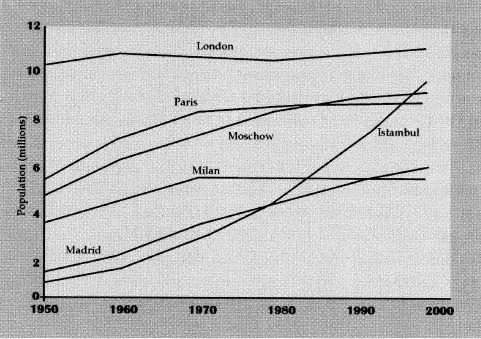
Cities are increasingly expanding their boundaries and populations, and ‘from the climatological point of view, human history is defined as the history of urbanization’. The increased industrialization and urbanization of recent years have dramatically affected the number of the urban buildings, with major effects on the energy consumption of this sector. It is expected that 700 million people will have moved to urban areas during the final decade of this century. The number of urban dwellers rose from 600 million in 1950 to 2 billion in 1986 and, if this growth continues, more than half of the world's population will live in cities by the end of the century, whereas a hundred years ago, only 14% lived in cities and even in 1950, less than 30% of the world's population was urban.6 Current and projected urban populations, by region as reported by the United Nations,7 are given in Figure 1.1.
Figure 1.1. Current and projects urban populations by region
(source: United Nations)
Improving living standards increase the space requirements per person. It is characteristic that in the USA, between 1950 and 1990, the floor-space requirements per person doubled.8 Very important variations in housing floor space per person also exist in Europe because of social and economic differences. Moscow has 11.6 m2 net living space per person, while Paris has 28.2, Oslo 47.2 and Zurich 50.6 m2 per person.9 Today, at least 170 cities each have more than one million inhabitants. It is estimated that, in the USA, 90% of the population will be living in, or around, urban areas by the year 2000,10 while other estimates show that urban populations will f...