- 246 pages
- English
- ePUB (mobile friendly)
- Available on iOS & Android
eBook - ePub
About this book
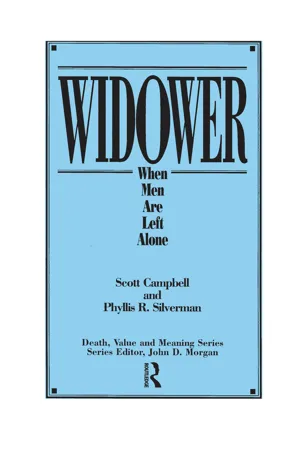
In "Widower: When Men are Left Alone", a journalist and a social worker explore the grief process as men experience it. The book contains the oral histories of twenty men, ranging in age from 30 to 94, who have lost their wives to a range of causes including cancer, alcohol, murder, and suicide. Taken together, the stories guide the reader through the journey of widowhood, from the raw despair of the early weeks to the resolved perspective thirteen years later, offered by the only true authority on the subject - the men who have survived it.
Information
Introduction to this New Edition
Phyllis R. Silverman, Ph.D.
We are pleased this book is being reissued. Many who have read it, both bereaved and professionals, have told us how useful it was to them, and we think the experience of each of the men we wrote about in the first edition is still valid today. In the same way, the original introduction still stands; it is as relevant now as it was when it was first written.
What is new is that there is a growing interest in the psychology of men, and a greater acknowledgment and acceptance by men of their feelings and needs. There is a growing literature, both popular and professional, that reports on male experiences. This literature provides the reader with a fuller sense of what men really feel and experience, their weaknesses and their strengths, their sameness and their differences, in the fullness of their humanity. The first printing of this book is part of that literature. The occasion of reissuing it provides us with the opportunity to document some of the research that informed our original thinking, as well as subsequent work.
In the past few years, the men's movement—represented by such writers as Keith Thompson [1], Robert Bly [2] and Sam Keen [3]—has been trying to give men alternatives to what is called the John Wayne neurosis. (That is, that the ideal male is a strong, silent type who never gives voice to his feelings except in occasional violence, when pushed too far.) The focus of most of the work from this movement is on helping men get in touch with their feelings, to accept the gentle nurturant side of themselves. But the writings of the men's movement seem to overlook the positive relationships in men's lives. Many men are well married, in relationships that in their own way they nourish and in which they are nourished. The men's movement talks little about marriages that work (nor do they deal with what men do when a wife dies).
Sam Keen writes about this deficiency. He says that
a strange forgetfulness seem to affect much of recent writing and thinking about men's liberation. The men's movement has allowed us to talk about how much men have been wounded by the missing father, how we long for the father we never knew, how insecure we feel because our fathers never initiated us into manhood, but strangely the family is never mentioned . . . the family remains on the outer edge of men's circle of values [3, p. 223].
He reminds us that "a man or a woman without an abiding investment in family, children and generations yet to come is a straw blowing in the wind" [3, p. 223].
Widower is an important book because it reminds us of the importance of the family for men, and the importance of their wives in their lives. It is a book about men's attachments and connections to others, as well as to their selves, attachments that evolve and change.
But Widower is not a book about men only; women will recognize themselves in many of these stories. And while we recognize the limitations of the way men have been socialized in our society [3, 4], as well as the limitations in the way women are socialized [5, 6], there is much to be learned from each way. When we see differences between people— some of which are based on gender, some not, and most of which cannot be easily categorized [3, 7]—we need to appreciate and understand those differences, to look to them for models and directions that give people choices suitable to their life conditions, and who they are as people.
In writing this book, we learned about many creative ways men used to express what they were experiencing and to adapt to their situation. Many of the widowers we talked to did not become the new ideal of the expressive, emotive male, yet they made accommodations that allowed them to move ahead in meaningful and gratifying ways with their lives. What we are interested in is helping people develop options so that they can make accommodations and live the next stages in their life cycles to the fullest. To accomplish this, we need to look in greater depth at the diversity among people. The men in this book teach us about this in the way they make meaningful relationships and mourn the loss of these relationships: we see that there is no one way.
We emphasize the importance of diversity in how these men dealt with their loss in part as a reaction to what is considered "good grief" in our society [8]. In spite of research which questions this model, it continues to dominate popular thinking. We continue to hear mourners being told "you will get over it" and "time will heal," as if grief is an illness. An intense period of mourning is encouraged during which feelings of sadness, angst, anger, confusion, and disorientation are permitted expression, but people are expected to be done with their grief in a relatively short period of time. It is assumed that this can be achieved when they have ventilated all these feelings—as if there is a specific amount of feeling and once it is expressed all the feelings will go away [9]—and mourners should then be able to move on with their lives. Mourners who do not show their feelings and cannot move on quickly are thought to be adapting poorly and are at risk of developing subsequent emotional problems [10-15].
However, not only is this time-limited activity impossible to achieve, but the expression of feelings is only a small part of the mourning process. With time, mourners begin to recognize the fullness of what is lost and its meaning for the way they live in their lives [13, 16-17]. Grieving, then, is a complicated situation [18]. As Jacobs et al. wrote, "grief is not simply a decreasing state of emotions but a complex, evolving process" [19].
Another aspect of the process is how the bereaved deals with his relationship to the deceased. Often the literature talks of "letting go of the past" in order to move into the future [20], but recent research indicates that in order to move into the future, it is necessary to integrate the past into the present [21-23]. In order to do this, most people adopt some system to provide a continuity between life and death—for example, a belief in life after death or in honoring one's ancestors [24], or symbols of immortality such as living memorials to the deceased [25]. While talking about the deceased and making a place for her in the present is often frowned upon by others who have not yet had a personal experience with the death of someone close, mourners usually seem to find a place in their lives for the deceased, to remain in some way connected. Men sometimes marry women their wives knew.
Various models have been proposed for understanding the complexity of the mourning process. Stroebe and Stroebe developed a model they call the "deficit model of partner loss" [26]. This model allows them to include in the analysis the role of the relationship to the deceased, the role of situational demands and individual coping resources. Demi also developed a similar model to allow for analysis of all the factors that impact on the individual mourner's reactions [27], Bowlby [28], Silverman [29], Parkes [30], and Marris [21] characterized bereavement as a period of transition and change. Worden focuses on the tasks the bereaved must deal with in order to cope with the loss [31]. Part of grieving is the need to recognize the many changes associated with the death—not only has a person died, but with her goes a wav of life and a relationship, as well [32].
Whatever model we choose, we see that bereavement is in fact a social, cultural and historical experience as well as a psychological one [14, 26], How people grieve is in part dictated by the culture of the society, expressed through its customs and traditions [14, 33], which are a reflection of how the society understands the place of death in the life cycle. In our rational Western society, many mourning rituals have fallen into disuse [35], often leaving a social vacuum in their place [36], thus limiting the opportunities for others to provide comfort and solace to the mourner.
We would characterize the period after the death of a spouse as an expected life cycle transition [29, 30]. To the extent that mourning is ever over, it occurs when the bereaved person is able to move into the next stage of his or her life cycle. During this transition period people learn new skills, new ways of managing their lives, and often develop a new sense of self.
The remainder of this introduction is devoted to how men do that. It is divided into two sections relating to some common themes talked about by the men whose stories are told in Widower. These themes provide a framework for organizing the literature. The first theme to be discussed is that of "Men as Mourners." In it, we examine further what has been written about the consequence of the death of a wife for men. The second theme, "Peers, Friends and Social Support," deals with the sense of aloneness these men experience and ways in which they find help.
Men as Mourners
As we have said, this is not a book in which we are concerned with comparing the responses of men and women, but it is always easier to understand a phenomenon when it is compared to something else.
Much of the research on widowhood has been "outcome research" that is concerned with the consequences of the loss on the subsequent physical and mental health of the bereaved. Stroebe and Stroebe reviewed research findings on these consequences to determine what differences, if any, existed between outcomes for widowers and widows [10]. They found that partner loss tends to be associated with higher mental illness rates for widowers, higher rates of serious illness and more physical disabilities than for widows. Other negative consequences that have been identified are higher death rates in olde...
Table of contents
- Cover
- Title
- Copyright
- Dedication
- Contents
- INTRODUCTION TO THIS NEW EDITION
- WHAT HAPPENS TO MEN WHEN THEIR MATES DIE
- GEORGE: The First Few Months Dealing with anger and disbelief, with the lack of carnal comfort and with inept expressions of sympathy
- SAM AND JIM: Relying on Religion and Work The values and dangers of familiar structures
- JAN: A Murder in the Family The strength of the tribe and, of solitude, coping with the children's loss, and making a quick realliance
- HANK: When a Wife Takes Her Own Life Coming to grips with suicide through a "replacement wife" as grieving agent
- MARK: Widowed Under Thirty Generational differences, and the danger of escaping depression by making a quick recommitment
- RANDY: Turning to the Bottle Bereavement as a catalyst for self destruction and resurrection
- KARL: Finding New Friends Turning to people outside your circle and finding you have something new to offer
- JAKE, FRAN, MIKE, AND JERRY: Keeping Company A transcript of a bereavement group
- BILL: When Your Wife is Your Whole Life In the process of re-peopling your life, sometimes a psychiatrist can help
- JOE: Married for Life, and Longer Living in the past even when you're active in the present
- GORDON: Ambivalence in Bereavement The complications of grieving a wife who slowly destroyed herself can inhibit efforts to start a new life
- MURRAY: Anticipatory Grief The incremental mourning of long-term, illness, the difficulty of talking about it, and finally taking advantage of new freedoms
- DEREK: Assisted Suicide The special challenge of sharing responsibility for a wife's death
- ROGER: A Transformation of Values In seeking the wisdom of other widowers, finding new wisdom in one's self
- LOU: Enjoying Life After Death Learning to be happy again, alone but not lonely, without feeling guilty
- PETER: The Ultimate Transcendence Overcoming the limitations of society and of the self to grow into a new kind of man—developmentally, psychologically, emotionally, and spiritually
- WHEN MEN ARE LEFT ALONE
- SELF-HELP ORGANIZATIONS AND READINGS
Trusted by 375,005 students
Access to over 1.5 million titles for a fair monthly price.
Study more efficiently using our study tools.
Frequently asked questions
Yes, you can cancel anytime from the Subscription tab in your account settings on the Perlego website. Your subscription will stay active until the end of your current billing period. Learn how to cancel your subscription
No, books cannot be downloaded as external files, such as PDFs, for use outside of Perlego. However, you can download books within the Perlego app for offline reading on mobile or tablet. Learn how to download books offline
Perlego offers two plans: Essential and Complete
- Essential is ideal for learners and professionals who enjoy exploring a wide range of subjects. Access the Essential Library with 800,000+ trusted titles and best-sellers across business, personal growth, and the humanities. Includes unlimited reading time and Standard Read Aloud voice.
- Complete: Perfect for advanced learners and researchers needing full, unrestricted access. Unlock 1.5M+ books across hundreds of subjects, including academic and specialized titles. The Complete Plan also includes advanced features like Premium Read Aloud and Research Assistant.
We are an online textbook subscription service, where you can get access to an entire online library for less than the price of a single book per month. With over 1.5 million books across 990+ topics, we’ve got you covered! Learn about our mission
Look out for the read-aloud symbol on your next book to see if you can listen to it. The read-aloud tool reads text aloud for you, highlighting the text as it is being read. You can pause it, speed it up and slow it down. Learn more about Read Aloud
Yes! You can use the Perlego app on both iOS and Android devices to read anytime, anywhere — even offline. Perfect for commutes or when you’re on the go.
Please note we cannot support devices running on iOS 13 and Android 7 or earlier. Learn more about using the app
Please note we cannot support devices running on iOS 13 and Android 7 or earlier. Learn more about using the app
Yes, you can access Widower by Scott Campbell,Phyllis Silverman in PDF and/or ePUB format, as well as other popular books in Medicine & Mental Health in Psychology. We have over 1.5 million books available in our catalogue for you to explore.