Presenting a powerful and stimulating approach to writing, "Location Writing" allows children to escape the confines of the classroom and develop written responses to their environment. The book features: activities covering prose, poetry, non-fiction and faction; examples of written work by both children and professional writers; detailed lesson plans and ideas; advice on establishing writers' trails; cross-curricular links; and lists of resources and suggestions for location writing around the UK.
- 126 pages
- English
- ePUB (mobile friendly)
- Available on iOS & Android
eBook - ePub
About this book
Trusted by 375,005 students
Access to over 1.5 million titles for a fair monthly price.
Study more efficiently using our study tools.
Information
Print ISBN
9781843120452
Subtopic
Education General1
The School Environment: A Writers’ Trail
The school environs are an obvious place for location writing and if there are school grounds it makes sense to develop them as a learning resource. A writers’ trail can be set up and ideally this should have eight or ten stopping points where children can be stimulated to write in a variety of genres. Each point on the trail should then have a range of activities to suit children of different ages and abilities. Some of the ideas for writing will come from the children themselves: initially a small group of older children can act as trail coordinators, making suggestions as to where the stopping points should be located and the kind of writing that might be pursued there.
Points on the trail can be given interesting names to aid identification, names which may promote ideas for writing themselves. For example:
1. Lily Pad Pond
2. Treetop Hill
3. Crusoe’s Cabin (gardener’s hut)
4. Dragon Ash (site of bonfire)
5. Bramble Bench (a meeting place)
6. Ivy Archway
7. The Dark Den (back copse shelter)
8. The Hurricane Tree
9. The Gateway to Adventure
10. The ‘Y’ Tree (tree shaped like the letter Y)
11. The Burial Mound (raised area of grass in shape of oval)
12. The Quiet Area
(From the trail at Chesworth Junior School, Horsham)
Consider first how your trail will be routed. Are there obvious starting and finishing points? The following are ideas of locations for points along a trail.
1.1 THE SCHOOL BUILDING
Perhaps the school building itself might be a starting point.
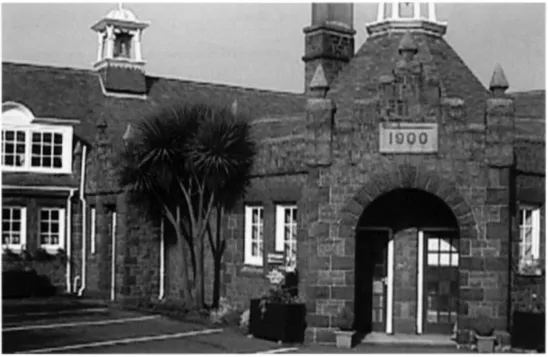
Amherst School, Guernsey
Lesson One
The Making of our School.
Learning Objective
To identify the different purposes of instructional texts, for example, recipes and the use of imperative verbs.
Resources
Recipe books, examples of poems, jotters, the school building.
Task
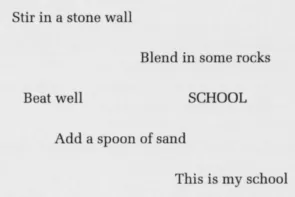
Discuss the words used when explaining the method for a recipe. For example, mix, stir, blend, and beat. Make a list on the board. Take the children outside to look at the school building and tell them they are going to write a poem about their school, setting it out like a recipe. Children make notes in their jotters about the materials used, the shapes they see and objects in the playground.
Using the recipe words, together with their notes, invite the children to suggest some lines for a poem. Write them on the board, emphasising that the first words need to be verbs, such as beat, blend, mix and so on.
Let the children work on their own or in pairs to write their own poem.
Differentiated Task
Lower ability groups could draw part of the school building or playground and add words and short sentences around the picture.
Extension Activities
This format can be used on any building or at any location.
Cross-curricular Links
ICT – poems can be typed and a digital image of the school inserted.
A Place for a Story
Talk about the importance of place in stories. Can children think of books that they have read which have a very strong sense of place? Are there any interesting parts of the school that might be included on the trail as stimulus for story writing?
Many ideas for stories occur when someone asks the question, ‘What if…?’
What if a snowman came alive?
What if you could walk through a door at the back of a wardrobe and discover a fantastic land?
Are there any ‘What ifs’ that might start stories connected with the school building? The following are examples of places that might be used as trail points, particularly if the school is an older building.
The School Bell
In an old school building there may be a school bell. What if the school bell rang at midnight?
Alternatively write a list poem:
When the school bell rang at midnight …
The sky cracked open and light slipped through.
The shadows hugged each other.
The silence dissolved into peals of laughter …
For an idea of setting out this poem and a poem on a similar theme see ‘In the 13th Hour’ (Catapults & Kingfishers by Pie Corbett and Brian Moses, OUP, p. 97).
The Cellar
Perhaps there is a cellar. Describe the cellar steps and doorway. Write down five words or phrases that show what it looks like or how it makes children feel.
Talk about urban myths and the ways in which these can spread. Are there any school myths connected with the cellar? If not, start one up!
Is there a locked door? A locked door serves two purposes: it is locked to prevent anyone getting in; it is locked to stop something getting out!
Would anyone dare to enter the cellar at night?
In Gowie Corby Plays Chicken by Gene Kemp (Puffin), Gowie is dared to spend the night in a ruined cellar under his school.
The Boiler House
Describe the boiler house. Again, write down words and phrases that show us what it looks like or how it makes children feel.
Ideas for a story could include the boiler house ghost, someone imprisoned there, aliens planning their invasion of Earth from the school boiler house, the nasty head-teacher’s lair …
A Turret/Attic Rooms
Who lives in the turret? Invite children’s suggestions. Maybe the occupant is an old sea captain staring out of the window and remembering the days when he was captain of a ship. Maybe an ancient headteacher or a wizard. What would the turret room look like?
What would the occupant of the room see as he stared down from his turret, on the tops of trees, at the people and traffic below? What would he be thinking about? Who would he be remembering?
Read the Gregory Harrison poem, ‘Alone in the Grange’. Children might use this poem as a m...
Table of contents
- Cover
- Title Page
- Copyright Page
- Contents
- Acknowledgements
- Introduction
- Section 1: The School Environment: A Writers’ Trail
- Section 2: Castles, Houses and Ancient Monuments
- Section 3: The Seashore
- Section 4: Countryside
- Section 5: Parks and Gardens
- Section 6: Further Ideas for Location Writing
- Resources
- Further Reading
Frequently asked questions
Yes, you can cancel anytime from the Subscription tab in your account settings on the Perlego website. Your subscription will stay active until the end of your current billing period. Learn how to cancel your subscription
No, books cannot be downloaded as external files, such as PDFs, for use outside of Perlego. However, you can download books within the Perlego app for offline reading on mobile or tablet. Learn how to download books offline
Perlego offers two plans: Essential and Complete
- Essential is ideal for learners and professionals who enjoy exploring a wide range of subjects. Access the Essential Library with 800,000+ trusted titles and best-sellers across business, personal growth, and the humanities. Includes unlimited reading time and Standard Read Aloud voice.
- Complete: Perfect for advanced learners and researchers needing full, unrestricted access. Unlock 1.5M+ books across hundreds of subjects, including academic and specialized titles. The Complete Plan also includes advanced features like Premium Read Aloud and Research Assistant.
We are an online textbook subscription service, where you can get access to an entire online library for less than the price of a single book per month. With over 1.5 million books across 990+ topics, we’ve got you covered! Learn about our mission
Look out for the read-aloud symbol on your next book to see if you can listen to it. The read-aloud tool reads text aloud for you, highlighting the text as it is being read. You can pause it, speed it up and slow it down. Learn more about Read Aloud
Yes! You can use the Perlego app on both iOS and Android devices to read anytime, anywhere — even offline. Perfect for commutes or when you’re on the go.
Please note we cannot support devices running on iOS 13 and Android 7 or earlier. Learn more about using the app
Please note we cannot support devices running on iOS 13 and Android 7 or earlier. Learn more about using the app
Yes, you can access Location Writing by Caroline Davey,Brian Moses in PDF and/or ePUB format. We have over 1.5 million books available in our catalogue for you to explore.