- 431 pages
- English
- ePUB (mobile friendly)
- Available on iOS & Android
eBook - ePub
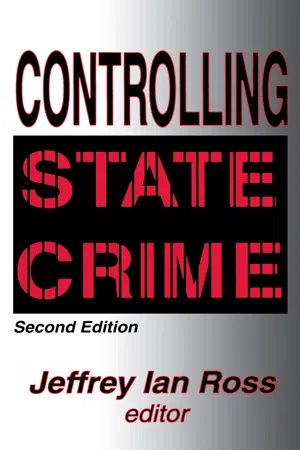
Controlling State Crime
About this book
Academic research on state crime has focused on the illegal actions of individuals and organizations (i.e., syndicates and corporations). Interchangeably labeled governmental crime, delinquency, illegality, or lawlessness, official deviance and misconduct, crimes of obedience, and human rights violations, state crime has largely been considered in relation to insurgent violence or threats to national security. Generally, it has been seen as a phenomenon endemic to authoritarian countries in transitional and lesser developed contexts. We need look no further than today's headlines to see the evidence of state crime. Rwanda, where government troops massacred countless Hutus and Tutsis, governmental atrocities in Kosovo, at the hands of the Yugoslavian Army, and East Timor where both individuals and property have been decimated, largely perpetrated by the Indonesian military.The study of how to control state crime has been difficult. There are definitional, conceptual, theoretical, and methodological problems, as well as difficulties in designing of practical methods to abolish, combat, control or resist this type of behavior. Jeffrey Ian Ross reviews these shortcomings, then develops a preliminary model of ways to control state crime. His intention is stimulating scholarly research and debate, but also encouraging progressive-minded policymakers and practitioners who work for governmental and nongovernmental organizations. The hope is that they will reflect upon the methods they advocate or use to minimize state transgressions. This new edition will be of compelling interest to students of political science and criminology, as well as general readers interested in human rights, state crime, and world affairs.
Information
Can States Commit Crimes? The Limits of Formal International Law
Luis F. Molina*
In a strict sense, the term state crime is almost, but not quite, an oxymoron, a legal absurdity. A crime is, tautologically, a wrongful act only insofar as it is a violation of criminal law that is punishable by a state,1 and sovereign states have generally been unwilling to expose themselves to sanction by other countries or by international tribunals. Under only two treaties have states contemplated ceding their sovereignty to an international body that would have the authority to identify and prosecute international crimes.2 Under no circumstance has any state agreed to international criminal prosecution, although individuals who have acted in their official capacities have been prosecuted before international tribunals. Moreover, despite some recent impetus encouraging identification and prosecution of state crimes under formal international law, it is unlikely that international prosecutorial courts to assess state reponsibility for criminal conduct will be created in the foreseeable future.
Nonetheless, there are actions perpetrated by state authorities that are normatively criminal, and despite problems in enforcement, the international community is not entirely without recourse. A broad range of measures, including legal ones, are available to respond to reprehensible actions by states against individuals. At the international level, these legal measures are chiefly provided through international criminal justice and human rights instruments under the auspices of human rights bodies and initiatives.
In this chapter, I will first show that international condemnation of states allowing or promoting consensually reprehensible acts has not been achieved through recourse to a formal international legal system. Second, to overcome the implications of the definitional and practical problems embedded in a concept of “state crime,” including international enforcement, I outline some forces that provide a philosophical basis for a circumvention of these problems. Third, I describe situations in which human rights procedures, not criminal proceedings, have effectively addressed normatively criminal acts by violative states.3 Finally, I discuss existing formal legal and human rights-based international developments and instruments which may eventually form part of a comprehensive approach to curtail state actions that are both crimes and human rights violations. These approaches are useful in themselves and could also serve as complementary strategies if an international criminal tribunal were eventually established.
The Identification of International Criminals
Rather than hold states criminally responsible for international criminal acts, the trend in international criminal law since World War II has been the opposite: to hold individuals internationally accountable for wrongful acts, even if state governments are thought to be culpable.4
States as Juridical Subjects: Can States Commit Crimes?
There are clear doctrinal constraints on the use of international law to deal with crimes committed by states. As a result, states have not been subject to prosecution for their criminal actions by international law (Munch, 1986:127).
The doctrine of sovereignty is the principal tenet of international law, and politically constructed entities identified as sovereign states are its primary focus (MacLean, 1989).5 The legal rights and duties of states are predicated on the doctrine of sovereignty, according to which states are independent and have an equal status as participants in the international forum. As such, international law is comprised of rules which states agree will be valid. Under international law, states are accountable6 for their actions according either to treaty or customary international law.7 Under a treaty, obligations are binding on a state once the government of that state has ratified the treaty. Therefore, the state clearly controls the treaty obligations it undertakes. One example of a treaty according to which certain states have ceded jurisdiction in cases between themselves is the Statute of the International Court of Justice, and there are regional examples as well.
The second method of accountability, norms of customary international law, emerge through the acts of states. However, before a norm of customary international law is recognized, the community of states through consistent and uniform practice, based on a conscious duty to act, must accept the particular custom.8 However, a state will not be bound by a rule of customary international law if it shows its opposition to the rule from the time of the rule’s inception. This self-definition is rooted in the principle of nonintervention, articulated in Article 2(7) of the Charter of the United Nations (hereafter “Charter”) which stipulates that:
[n]othing contained in the present Charter shall authorize the United Nations to intervene in matters which are essentially within the domestic jurisdiction of any state or shall require the Members to submit such matters to settlement under the present Charter; but this principle shall not prejudice the application of enforcement measures under Chapter VII.9
The International Court of Justice
The International Court of Justice (ICJ), popularly called the World Court, was established under the Statute of the International Court of Justice, an annex of the Charter of the United Nations in 1945, and is the most important authority for the resolution of disputes between states.10 However, it has no criminal jurisdiction, and even if it did, there is no international law enforcement authority (Article 59). Further, an important precondition of any dispute brought before the ICJ, flowing from the doctrine of state sovereignty, is that states involved in a dispute must consent to the jurisdiction of the World Court.11 In recent years, the most publicized example of the need for consent was demonstrated when the United States rescinded its declaration of compulsory jurisdiction during the World Court’s consideration of Nicaragua v. United States, although the ICJ went on to render its decision anyway (ICJ, 1986:14).12 Likely because of the requirement for consent, the World Court gave judgments on only fifty-one cases, and offered twenty-one advisory opinions, in the period 1946-1990 (ICJ, 1990: 3-6).13
The Individual as an International Criminal
The decision to hold individuals criminally responsible under international law was first formulated in the Moscow Declaration of 1943 (UN War Crimes Commission, 1948: 270), codified in Article 7 of the Nürnberg Charter,14 and articulated during opening statements at the Nürnberg Trials by the U.S. chief of Counsel, Justice Robert H. Jackson, who stated,
Crimes against international law are committed by men, not by abstract entities, and only by punishing individuals who commit such crimes can the provisions of international law be enforced.15
Hence the effects of the Charter of Nürnberg Tribunal and the judgments against individuals that followed it were profound:
[they] proclaimed the criminality of offenses against humanity, i.e. of such offenses against the fundamental rights of man to life and liberty, even if committed in obedience to the law of the State. To that extent, in a different sphere, positive law has recognised the individual as endowed, under international law, with rights the violation of which is a criminal act. (Harris, 1991:146).
Since World War II, multilateral conventions provide the basis to find individuals responsible for acts that are internationally defined as crimes. As a result of these multilateral treaties, a large number of states have identified crimes, including genocide, slavery, apartheid, torture, and “terrorist” offenses such as aircraft hijacking, attacks on diplomats, and hostage-taking.16 These conventions are evidence of a general consensus by states that certain criminal acts damage values held by the international community, and that individual perpetrators should be prosecuted in the country where the offenses took place, or be extradited to a state that has the jurisdiction to prosecute them for these offenses under national law. Because states have not been able to agree on direct enforcement mechanisms, for example, an international criminal court, Bassiouni terms the duty of a signatory state to prosecute or extradite the “indirect enforcement system” in international criminal law (Bassiouni, 1986: 1-6). This indirect enforcement system is an imperfect one, however, because it depends on the inclusion of specific “prosecute or extradite” provisions in international criminal law conventions, and not on some overarching principle or practice of international law acceptable to all states.
The treaties that identify international crimes potentially permit all states to prosecute individuals for these offenses under national criminal law. The notion is that if enough states cooperate to exercise their own national criminal jurisdictions, which for some crimes may extend beyond territorial venue according to the conventions, individuals responsible for certain serious forms of transnational crime will not go unpunished. However, one exceptional addition to the reliance on national criminal justice systems to curtail transnational crime can be found in Article IV of the Convention on the Prevention and Punishment of the Crime of Genocide: “[pjersons committing genocide or any of the other acts enumerated in Article III shall be punished, whether they are constitutionally responsible rulers, public officials or private individuals.” Further, the treaty goes on to specify that “[pjersons charged with genocide ... shall be tried by a competent tribunal of the State in the territory of which the Act was committed, or by such international penal tribunal as may have jurisdiction with respect to those Contracting Parties which shall have accepted its jurisdiction” (United Nations, 1948, emphasis added). Bassiouni explains the conundrum as follows:
[t]he only convention that refers to an international criminal court is the Genocide Convention, which provides only for the jurisdiction of an international criminal court for the crime of genocide in the event that such a court exists, but it does not require or mandate the establishment of such a court. (1987:10)17
At the same time, this unique treaty provision leaves open the possibility, on an international level, of deciding whether officials of a given state are guity of genocide, but does not mention prosecution of the state itself.
The preference for pursuing individual accountability at the international level is also demonstrated through the development of the Draft Code of Crimes Against the Peace and Security of Mankind (hereafter “Draft Code”).16 For various reasons, the Draft Code received little attention from 1950, when it was submitted to the In...
Table of contents
- Cover Page
- Title Page
- Copyright Page
- Contents
- Introduction to the Second Edition
- Foreword
- Acknowledgments
- Controlling State Crime: Toward an Integrated Structural Model*
- A State Action May Be Nasty But Is Not Likely to Be a Crime
- State Crime or Governmental Crime: Making Sense of the Conceptual Confusion*
- Controlling State Crimes by National Security Agencies
- Controlling Crimes by the Military
- State Crime by the Police and Its Control*
- Control and Prevention of Crimes Committed by State-Supported Educational Institutions*
- Crimes of the Capitalist State Against Labor*
- Preventing State Crimes Against the Environment during Military Operations: The 1977 Environmental Modification Treaty*
- Leon Hurwitz
- A New Role for the International Court of Justice: Adjudicator of International and State Transnational Crimes*
- Can States Commit Crimes? The Limits of Formal International Law
- Eliminating State Crime by Abolishing the State
- The Future of Controlling State Crime: Where Do We Go from Here?*
- Contributors
- Index
Trusted by 375,005 students
Access to over 1.5 million titles for a fair monthly price.
Study more efficiently using our study tools.
Frequently asked questions
Yes, you can cancel anytime from the Subscription tab in your account settings on the Perlego website. Your subscription will stay active until the end of your current billing period. Learn how to cancel your subscription
No, books cannot be downloaded as external files, such as PDFs, for use outside of Perlego. However, you can download books within the Perlego app for offline reading on mobile or tablet. Learn how to download books offline
We are an online textbook subscription service, where you can get access to an entire online library for less than the price of a single book per month. With over 1.5 million books across 990+ topics, we’ve got you covered! Learn about our mission
Look out for the read-aloud symbol on your next book to see if you can listen to it. The read-aloud tool reads text aloud for you, highlighting the text as it is being read. You can pause it, speed it up and slow it down. Learn more about Read Aloud
Yes! You can use the Perlego app on both iOS and Android devices to read anytime, anywhere — even offline. Perfect for commutes or when you’re on the go.
Please note we cannot support devices running on iOS 13 and Android 7 or earlier. Learn more about using the app
Please note we cannot support devices running on iOS 13 and Android 7 or earlier. Learn more about using the app
Yes, you can access Controlling State Crime by Jeffrey Ross,Jeffrey Ian Ross in PDF and/or ePUB format, as well as other popular books in Politics & International Relations & Human Rights. We have over 1.5 million books available in our catalogue for you to explore.