- 199 pages
- English
- ePUB (mobile friendly)
- Available on iOS & Android
eBook - ePub
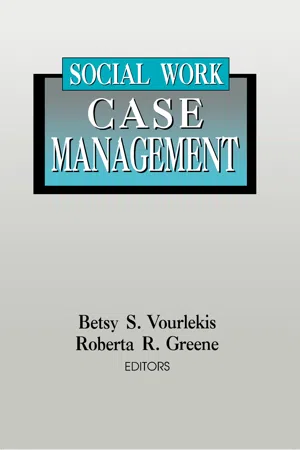
Social Work Case Management
About this book
This new practice text provides a series of readings focusing on case management in a number of fields and in a variety of settings with different client populations. Each chapter examines a major component of case management practice by presenting information about an innovative program from a different location around the country. In conjunction, these readings provide a road map to social work case management.In addition to offering up-to-date practice approaches and examining the functions and skills of case management in depth, the authors provide the policy information needed for putting this traditional form of social work practice into today's service delivery context.
Information
Chapter 1
The Policy and Professional Context of Case Management Practice
Betsy S. Vourlekis
As society has grown more diverse and the U.S. health and social services systems more complex, ensuring at-risk populations appropriate, timely, coordinated, and cost-effective care has become an ever greater concern. Increasingly, policymakers, agency administrators, and direct-services practitioners are turning to case management as the method of choice for delivering services to clients and their families with complex, multiple problems or disabilities.
The explosive interest in case management as a component of system design and delivery for the human services confronts the profession of social work with a challenge. The attention to and concern with access, fragmentation, service gaps, and need for individualized care and planning resonate deeply with social work practice values and certainly with the social worker’s day-to-day practice experience. It is exciting and gratifying to witness widespread policy and program recognition of what have been social work’s traditional focus and functions.
However, this same public policy interest in case management, leading to rapid deployment of case-managed service systems, has resulted in multiple models of case management—including some that appear remote from traditional social work. This interest has occasioned professional turf fighting over ownership of the role as well as widespread use of paraprofessionals and volunteers. It has raised inflated expectations with respect to what case management can achieve.
For social work practitioners embarking on practice careers, the excitement, opportunities, and professional challenges case management offers are readily apparent. Effective social work case management practice requires a comprehensive view of the scope, purposes, and extent of case management today, and a realistic understanding of the important concerns about case management that have been raised within the social work profession. With such a view and understanding, social workers will be in a position to recognize and shape important new avenues for practice—opportunities to link valued functions and roles to major human services delivery initiatives—and to carry out their case management practice with enhanced professional identification.
Scope of Case Management
Case management has been defined as:
a set of logical steps and a process of interaction within a service network which assure that a client receives needed services in a supportive, effective, efficient, and cost effective manner. (Weil et al. 1985, p. 2)
Although definitions abound, and case management is widely described and thought of as both a system and a service, it is, as in the preceding definition, typically defined in terms of the outcomes it is expected to achieve. These outcomes include improving access to services, fixing responsibility for coordinating and monitoring care, ensuring optimal care and care outcomes, and, increasingly, cost-effectiveness and cost control. Policymakers are often far clearer about the desired outcomes than they are about the mechanism to achieve them. Thus, case management is often an ambiguous and poorly understood process that is hitched to an ambitious set of expectations. This is a good recipe for popularity, but also for eventual disillusionment.
The interest in case management as a component of the delivery of human services is pervasive. It cuts across the public and private sectors and all fields of practice. Settings utilizing case management have expanded to include schools, health and mental health clinics, hospitals, businesses, major insurance companies, and trust departments of banks, which are setting up case management as an additional component to their financial services. Case management is being used extensively with the frail elderly and the deinstitutionalized mentally ill, developmentally disabled children and adults, pregnant teenagers, and homeless people. It is now being implemented widely with acquired immunodeficiency syndrome (AIDS) patients and their families. No longer only a feature of programs serving “special populations,” case management has become a component of major health insurance benefit administration, affecting millions of beneficiaries. Because of this widespread interest, there is a compelling practical demand for case management (sometimes called “care coordination”) services.
Federally Funded Programs
The 1970s gave rise to major program initiatives using case management systems. Beginning in 1972, Medicare waivers (Section 222 of the Social Security Amendments, P.L. 92-603) authorized research and demonstration projects in the provision of community-based care for the frail elderly as an alternative to costly institutional care. Similar demonstrations were authorized by Medicaid (Section 1115, P.L. 92-603). Case management was a required component of demonstration projects to facilitate client access to appropriate services in what had come to be acknowledged as a fragmented and bewildering health and social services delivery system (Austin et al. 1985).
Deinstitutionalization litigation and increasing attention directed to the deficiencies of community mental health centers in meeting the needs of chronically mentally ill people were part of the impetus leading to the National Institute of Mental Health (NIMH) community support programs in the late 1970s. These programs introduced case management as a component of service delivery to the mentally ill for the purpose of accessing services, coordinating treatment efforts, and providing continuity of care to a patient population with long-term needs. More recently, NIMH studied case management with the chronically mentally ill and the homeless in an effort to identify special attributes of effective practice and to disseminate these models widely to the field. Social workers are frequently providers and supervisors of what is being called “intensive case management” (Rog, Andranovich, & Rosenblum 1987, p. 8).
Similar needs for individualized, coordinated care with case accountability lodged in one place gave rise to mandated case management service components in serving the developmentally disabled (Developmental Disabilities Act of 1970, P.L. 91-517), the elderly (Older Americans Act, revisions of 1978, P.L. 95-478), and children with special needs (Education for All Handicapped Children Act of 1975, P.L. 94-142). In the child welfare system, federal legislation in 1980 emphasizing family reunification and mandating permanency planning for children in foster care (Federal Adoption Assistance and Child Welfare Act of 1980, P.L. 96-272) included requirements for case planning and case review.
Medicaid amendments in the 1980s have continued to expand the utilization of case management in state programs. In 1981, case management systems were permitted as part of the Community and Home Based Waiver provision (Section 2176, Omnibus Budget Reconciliation Act of 1981, P.L. 96-499). This waiver was intended to allow more flexibility in providing community-based care in lieu of costly institutionalization. Faced with escalating nursing home costs, states were eager to find lower cost alternatives. States were further encouraged to use case management in Medicaid in 1985 when case management was authorized as a new optional service. States may now incorporate case management into their state Medicaid plans, designating which populations will be offered the service (Consolidated Omnibus Budget Reconciliation Act, P.L. 99-272). Under Medicaid, case management is defined as “services which will assist individuals eligible under the plan in gaining access to needed medical, social, educational and other services” [Section 1915(g)(2), Social Security Act].
By 1988, 19 states had approved Medicaid state plan amendments for case management to targeted groups. Six additional states had submitted plan amendments that were awaiting approval. States reported that social workers and nurses were the most frequently used providers of case management services (National Governors’ Association 1988).
Other important federal legislation of the 1980s included case management provisions. Revisions to the Older Americans Act of 1984 (P.L. 98-459) added new responsibilities for case management to Area Agencies on Aging. Case management as part of community-based care for the chronically mentally ill now is mandated for anyone receiving public funds or services in Title V, State Comprehensive Mental Health Services Plan, of the Omnibus Health Act of 1986 (P.L. 99-660; National Association of State Mental Health Program Directors 1986). Comprehensive legislation to meet the needs of homeless people (Stuart B. McKinney Homeless Assistance Act of 1987, P.L. 100-79) passed in 1987 designates block grant funds to states to provide services, including case management, to homeless people who are chronically mentally ill. Funding for health care grant programs in the same legislation provides for reimbursement to states for case management as an optional component. The nation’s new welfare law, the Family Support Act of 1988 (P.L. 100-485), recognizes case management as an important tool in the coordination and monitoring of education and training services for welfare recipients. State agencies have the option of requiring that a case manager be assigned to each family participating in the job opportunities and basic skills training programs (Harris 1989).
Legislation in 1990 continued to incorporate case management opportunities. Medicaid provisions authorized 100 million dollars for community-based services for the developmentally disabled. AIDS legislation (Ryan White Comprehensive AIDS Resources Emergency Act of 1990, P.L. 100-381) included three major service initiatives, each capable of funding case management services, among others. Over 200 million dollars was authorized for (1) emergency funds to cities with the highest AIDS and HIV incidence, (2) block grants to states for comprehensive planning and service delivery, and (3) early intervention services for persons who are HIV-positive.
Case-Managed Health and Mental Health Care
In addition to the use of case management in publicly funded programs, the 1980s have witnessed its adoption as an anticipated tool of cost containment in private health and mental health benefit plans. Managed health and mental health care is now the norm, whether provided through traditional managed-care settings such as health maintenance organizations (HMOs), or through employer self-insured or third-party payer indemnity plans. The skyrocketing costs of health benefits paid by employers have provided the impetus to intercede between consumer and provider to manage access and utilization of services. Private, for-profit companies now offer case management services to employers and insurers, and most major insurance companies have built-in case management components.
Currently, social workers have not been involved extensively in these case management systems, although increasingly they are being employed as mental health benefit managers. However, the model of case management and the exuberant claims for cost savings attached to it, are having a powerful impact on both the public’s and policymakers’ understanding of case management.
Case management in the managed health care context has been defined as
a systematic approach to identifying high-cost patients, assessing potential opportunities to coordinate their care, developing treatment plans that improve quality and control costs, and managing patients’ total care to ensure optimum outcomes. (Fisher 1987, p. 287)
The extent to which this model of case management is or will be compatible with generic social work practice remains to be seen. However, the importance of advocacy is acknowledged, education of patient and family is stressed, and interpersonal skills to motivate clients are viewed as necessary (Fisher 1987).
Private Case Management
The private practice of case management, or case management provided on a fee-for-service basis to privately paying clients, is a small but growing arena. The client’s wish for access to and coordination of services is the primary goal, although presumably a cost-conscious consumer is interested in the value received. Cost accountability, to the extent any exists, is between the client and the provider. According to one recent survey, social workers are the most frequently employed professional in privately delivered case management (Secord 1987). Although private case management services are most often provided to and on behalf of the elderly and their families, there is a growing interest among families with severely mentally disabled offspring as well. Parents who expect their disabled children to outlive them are interested in setting up trustee arrangements that include specified services, activities, and resources with a case manager to oversee and coordinate them.
The Profession’s Response and Concerns
Social work’s involvement in case management direct practice is clearly established. Social work and social workers have been in the forefront of designing case management systems and delivering case management services for some time. They have been influencing policy deliberations at the state and national levels with model projects. Professional social workers fill great numbers of staff positions in which they directly provide and supervise case management practice in arenas as diverse as services to the homeless and private fee-for-service case management for the elderly.
In many fields and settings where social workers were already practicing, the emergence of case management as a “new approach” was greeted with the response, “But we have been doing case management for years. We called it casework.” The historical roots and precursors of key concepts of case management can be found in the early writings and thinking of the social work profession (Weil et al. 1985). Nevertheless, regardless of the perceived or actual similarities between traditional casework and case management, it is important to recognize that from a public policy perspective case management is being treated as something new.
Just as with other key aspects of social work practice—the psychosocial perspective, for example—case management has been “discovered” and has moved to the larger playing field of policy deliberation and innovation. This is a field with multiple players representing many professions in addition to social work, and covering programs and services that traditionally have been characterized by high levels of social work involvement and leadership as well as those which have not.
Realistically social workers cannot “own” case management or claim it as their exclusive domain. Models and practice of case management are and will continue to be shaped by many different views of clients, services, and priorities. Role and turf overlap and differing models and primary expectations in case management practice have prevented and will continue to prevent a straightforward meshing of case management and social work practice.
Despite the prevalence of social work practitioners in case manager roles and the apparent similarity in the central mission of coordination and continuity of care between case management and social work direct practice, many social workers have questioned the appropriateness or usefulness of the profession’s identification with case management for several reasons. The very term case manager is sufficient to activate the powerful professional duality of purpose. This duality is expressed in social work’s two approaches—often, unfortunately, viewed as contradictory—to helping. These approaches are efforts directed at social action and remediation of faulty environmental conditions “versus” individual assistance, which emphasizes coping and adjustment. Case management, to some, represents the very worst aspect of individualized approaches to helping: managing people and their cases.
Case management has been identified as a return to conservative helping strategies and a lowering of professional sights from large-scale system improvement (Schilling, Schinke, & Weatherly 1988). Such professional misgivings are heightened as case management systems are being put in place at a time of constrained resources and absence of political will for substantial reform, which must also be a part of system change. Powerful and convincing arguments have been and can be made for the need for both social action and reform and individual, case-by-case assistance. The issue for case management is that the same professional dialectic is being raised as has been raised so often before. Working it through, finding space and energy and commitment within the profession for both action arms, indeed, supporting the efforts of one with the efforts of the other, is needed for social workers to deal effectively with case management.
The expectations for case management systems to meet the critical objectives of cost containment, service access, coordination, and continuity of care have not yet been carefully researched and reviewed. As expectations, they justifiably make social workers nervous. Social workers have had a professional flirtation with a too-close and unrealistic linking of their practice method and a global societal desired outcome—they learned this the hard way in the instance of casework and the eradication of poverty in the 1960s. Certainly there is a professional challenge to formulate an understanding and app...
Table of contents
- Cover
- Title Page
- Copyright Page
- Dedication
- Contents
- Acknowledgments
- Preface
- 1. The Policy and Professional Context of Case Management Practice
- 2. Case Management: An Agenda for Social Work Practice
- 3. Client Identification and Outreach: Case Management in School-Based Services for Teenage Parents
- 4. Assessment: Private Case Management with the Elderly
- 5. Case Management Assessment in School Social Work and Early Intervention Programs for Disabled Infants and Toddlers
- 6. Care Planning for Children with HIV/AIDS: A Family Perspective
- 7. Linking the Developmentally Disabled Client to Needed Resources: Adult Protective Services Case Management
- 8. Plan Implementation and Coordination: Clinical Case Management with the Chronically Mentally Ill
- 9. Plan Implementation and Coordination: Case Management in an Employee Assistance Program
- 10. Monitoring Child Welfare Services
- 11. Case Manager as Advocate: Family Advocacy in the Military
- 12. Evaluation: Case Managers and Quality Assurance
- 13. Mastering the Case Manager Role
- Biographical Sketches of the Contributors
- Index
Trusted by 375,005 students
Access to over 1.5 million titles for a fair monthly price.
Study more efficiently using our study tools.
Frequently asked questions
Yes, you can cancel anytime from the Subscription tab in your account settings on the Perlego website. Your subscription will stay active until the end of your current billing period. Learn how to cancel your subscription
No, books cannot be downloaded as external files, such as PDFs, for use outside of Perlego. However, you can download books within the Perlego app for offline reading on mobile or tablet. Learn how to download books offline
Perlego offers two plans: Essential and Complete
- Essential is ideal for learners and professionals who enjoy exploring a wide range of subjects. Access the Essential Library with 800,000+ trusted titles and best-sellers across business, personal growth, and the humanities. Includes unlimited reading time and Standard Read Aloud voice.
- Complete: Perfect for advanced learners and researchers needing full, unrestricted access. Unlock 1.5M+ books across hundreds of subjects, including academic and specialized titles. The Complete Plan also includes advanced features like Premium Read Aloud and Research Assistant.
We are an online textbook subscription service, where you can get access to an entire online library for less than the price of a single book per month. With over 1.5 million books across 990+ topics, we’ve got you covered! Learn about our mission
Look out for the read-aloud symbol on your next book to see if you can listen to it. The read-aloud tool reads text aloud for you, highlighting the text as it is being read. You can pause it, speed it up and slow it down. Learn more about Read Aloud
Yes! You can use the Perlego app on both iOS and Android devices to read anytime, anywhere — even offline. Perfect for commutes or when you’re on the go.
Please note we cannot support devices running on iOS 13 and Android 7 or earlier. Learn more about using the app
Please note we cannot support devices running on iOS 13 and Android 7 or earlier. Learn more about using the app
Yes, you can access Social Work Case Management by Betsy Vourlekis,Roberta R. Greene in PDF and/or ePUB format, as well as other popular books in Social Sciences & Social Work. We have over 1.5 million books available in our catalogue for you to explore.