Professional poets spend many hours crafting a finished piece of work, yet we expect children in school to sit down and write when they are told to, whether they feel inspired or not. This series of four books is a toolkit to help you build a positive framework for children to read, write, understand and enjoy poetry - to bring a creative spark to the poetry classroom. A combination of featured poems, creative ideas, structured lesson plans and differentiated photocopiable activity sheets gives the series a uniquely flexible approach - which means you can use the materials in any classroom context.
If you're wary of poetry, if you think it's boring, or if you're nervous about teaching poetry, then you've chosen the right book.
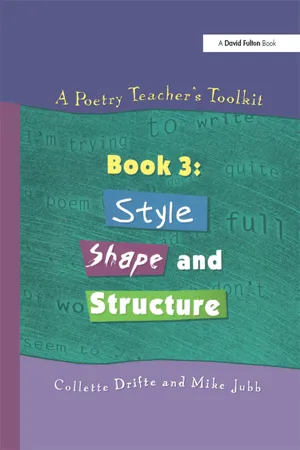
Key themes covered in BOOK 3: Style, Shape and Structure are style and structure, addressing regular and standard forms, the impact of layout, free form, 'found' poetry, and concrete poetry.
Other books in the series are: BOOK 1:Words and Wordplay; BOOK 2: Rhymes, Rhythms and Rattles;and BOOK 4: Language and Performance.
- 160 pages
- English
- ePUB (mobile friendly)
- Available on iOS & Android
eBook - ePub
About this book
Information
1 Good Form!
Featured poems
Today’s the Day by Celia Warren
Dreamer by Brian Moses
Haiku by Japanese Masters
Triad by Adelaide Crapsey
The Warning by Adelaide Crapsey
Daughter of the Sea by Philip Gross
After the Storm by William Wordsworth
There Was a Young Bard of Japan, Anon.
My Cat is Dead by Mike Jubb
Turn the Clock Back by Charlotte Jarvis
‘A poem is never finished, only abandoned.’ (Paul Valery, 1871–1945)
Putting pattern into poems
I suppose the word ‘form’ in poetry is usually thought to mean some kind of pattern. The essential point about pattern, of course, is that something is repeated. In a rhyming poem, it’s the sound at the end of some of the lines.
But for children, a simpler, yet effective, way of putting a pattern into a poem is to build in some repetition at the beginning of lines. Brian Moses does this in his poem Dreamer (p. 41). By creating a formula for himself (‘I dreamt I was … and …’), he ensures that the piece will have both rhythm and unity. OK, in this case the final sound of each couplet is ‘ee’, but the poem would work just as well if they were all different.

Using Dreamer as a model, get the children to write about some of the contents of a house. The poem could be called something like Neglected.
I dreamt I was a chair
but no-one sat on me.
I dreamt I was a cup
but no-one drank from me.
As with Brian’s poem, restrict them to six items plus a concluding stanza. And you may think it prudent to tell the little darlings that the toilet (but not the bath) is out of bounds! What other areas could be explored using the ‘I dreamt I was’ formula?
This is another formula that can be used many times – I call it a good/bad poem. First, you decide what you want to write about: maybe Mum or Dad, brother or sister, or someone else you know. Or it could be something like cats or snow. Next, you think up some good things, and some not-so-good things, about your subject, and fit some of them into the pattern below.
Compose one at the board with the whole class first, then let them loose.
Cats
Cats are soft and furry, but
they leave hairs on the sofa.
Cats are playful, but
they dig their claws into you.
Cats are elegant, but
they kill birds.
Cats are confusing. M.J.
The formula can be played around with:
My Mum is …, but
sometimes she …
Coming up with three ‘good’ and three ‘bad’ things isn’t too onerous, but more could get boring. I suggest to children that they come up with a ‘tidy-up’ or ‘summing-up’ line, which breaks the pattern, to end the poem, e.g. My cat, Rover, sleeps on the fridge.
Reading/collecting
Ask the children to search for, and copy out, non-rhyming poems that have repetition at the beginning of lines. The more they read and hear, the more they’ll get the idea. Here’s a little something dashed off by Amy Bulpitt of Peel Common Junior School, Gosport. It’s simple, but effective.
My Mum
My mum loves me, My mum loves my dad,
My mum loves my brother, The only thing she
Doesn’t like is
H A S S L E !
Here’s one from Nathan Bethell, also of Peel Common Junior School, Gosport:
I love | I HATE |
I love T.V. | I HATE T.V. |
I love sport | I HATE sport |
I HATE school | I love school |
I HATE work | I love work |
I love Pompey | I HATE Pompey |
I love Liverpool | I HATE Liverpool |
I love you and I love you
Make up your own formulae for poems, and encourage children to do the same.
Other ideas for creating pattern at the start of lines: time of the day, days of the week, months of the year, seasons, counting up, counting down.
Haiku
‘Haiku happen all the time, wherever there are people who are ‘in touch’ with the world of their senses, and with their own feeling response to it.’ (The Haiku Handbook by William J. Higginson)
‘Haiku is the poetry of meaningful touch, taste, sound, sight and smell.’ (R. H. Blyth)
Everyone knows that a haiku consists of three lines of five, seven and five syllables respectively. But, if you really want to find out about haiku, I thoroughly recommend The Haiku Handbook by William J. Higginson (ISBN 4–7700–1430–9). It’s a fascinating and comprehensive eye-opener about this, and related, forms of Japanese poetry.
Here are two facts that I’ve learnt:
• Haiku is an evolving form, with its origins as the opening stanza of a collaborative poem called renga (linked poem) or haikai-no-renga (humorous renga).
• Japanese poets do not count syllables. If they bother counting anything at all, they count different sound units called onji. A Japanese haiku translates into something nearer 12 English syllables, or even fewer.
Conclusions
• To insist that haiku is fixed in the form of a 17-syllable poem in three lines of five, seven and five syllables, is a simplistic trap.
• If the haiku of Japanese masters doesn’t translate into 17 English syllables, why should haiku written in English conform to that ‘rule’?
• As the form is still evolving, we’re free to add our tuppence worth.
• The ‘spirit’ of haiku is more important than specific rules.
Sorry if I’ve confused you. Like me, you were probably quite happy with the 5–7–5 pattern. Perhaps you’re thinking ‘So, what is a haiku if it doesn’t have rules?’ Well, it does have rules, but they are not written in stone. As a writer I have often chosen the 5–7–5 pattern because I like the discipline, the problem-solving quality. It gives me a frame and throws me back into words, forcing me to seek alternatives.
However, after reading William Higginson’s book, and doing a bit of Internet research, I now have a much broade...
Table of contents
- Cover
- Half Title
- Title Page
- Copyright Page
- Dedication
- Table of Contents
- The Authors
- Acknowledgements
- Introduction
- A ‘Must Read’ Chapter!
- 1 Good Form!
- 2 But is it Poetry?
- 3 You’d Better Shape Up!
- 4 More Ways Than One
- Further Reading
- Glossary
- Index
Trusted by 375,005 students
Access to over 1.5 million titles for a fair monthly price.
Study more efficiently using our study tools.
Frequently asked questions
Yes, you can cancel anytime from the Subscription tab in your account settings on the Perlego website. Your subscription will stay active until the end of your current billing period. Learn how to cancel your subscription
No, books cannot be downloaded as external files, such as PDFs, for use outside of Perlego. However, you can download books within the Perlego app for offline reading on mobile or tablet. Learn how to download books offline
Perlego offers two plans: Essential and Complete
- Essential is ideal for learners and professionals who enjoy exploring a wide range of subjects. Access the Essential Library with 800,000+ trusted titles and best-sellers across business, personal growth, and the humanities. Includes unlimited reading time and Standard Read Aloud voice.
- Complete: Perfect for advanced learners and researchers needing full, unrestricted access. Unlock 1.5M+ books across hundreds of subjects, including academic and specialized titles. The Complete Plan also includes advanced features like Premium Read Aloud and Research Assistant.
We are an online textbook subscription service, where you can get access to an entire online library for less than the price of a single book per month. With over 1.5 million books across 990+ topics, we’ve got you covered! Learn about our mission
Look out for the read-aloud symbol on your next book to see if you can listen to it. The read-aloud tool reads text aloud for you, highlighting the text as it is being read. You can pause it, speed it up and slow it down. Learn more about Read Aloud
Yes! You can use the Perlego app on both iOS and Android devices to read anytime, anywhere — even offline. Perfect for commutes or when you’re on the go.
Please note we cannot support devices running on iOS 13 and Android 7 or earlier. Learn more about using the app
Please note we cannot support devices running on iOS 13 and Android 7 or earlier. Learn more about using the app
Yes, you can access A Poetry Teacher's Toolkit by Collette Drifte,Mike Jubb in PDF and/or ePUB format, as well as other popular books in Education & Education General. We have over 1.5 million books available in our catalogue for you to explore.