- 144 pages
- English
- ePUB (mobile friendly)
- Available on iOS & Android
eBook - ePub
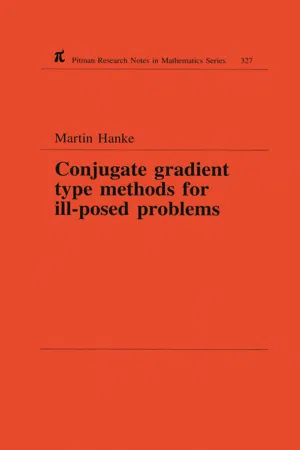
Conjugate Gradient Type Methods for Ill-Posed Problems
About this book
The conjugate gradient method is a powerful tool for the iterative solution of self-adjoint operator equations in Hilbert space.This volume summarizes and extends the developments of the past decade concerning the applicability of the conjugate gradient method (and some of its variants) to ill posed problems and their regularization. Such problems occur in applications from almost all natural and technical sciences, including astronomical and geophysical imaging, signal analysis, computerized tomography, inverse heat transfer problems, and many more
This Research Note presents a unifying analysis of an entire family of conjugate gradient type methods. Most of the results are as yet unpublished, or obscured in the Russian literature. Beginning with the original results by Nemirovskii and others for minimal residual type methods, equally sharp convergence results are then derived with a different technique for the classical Hestenes-Stiefel algorithm. In the final chapter some of these results are extended to selfadjoint indefinite operator equations.
The main tool for the analysis is the connection of conjugate gradient
type methods to real orthogonal polynomials, and elementary
properties of these polynomials. These prerequisites are provided in
a first chapter. Applications to image reconstruction and inverse
heat transfer problems are pointed out, and exemplarily numerical
results are shown for these applications.
Tools to learn more effectively

Saving Books

Keyword Search

Annotating Text

Listen to it instead
Information
Table of contents
- Cover Page
- Conjugate Gradient Type Methods for Ill-Posed Problems
- copy
- Table of Contents
- 1 Preface
- 2 Conjugate Gradient Type Methods
- 3 Regularizing Properties of MR and CGNE
- 4 Regularizing Properties of CG and CGME
- 5 On the Number of Iterations
- 6 A Minimal Residual Method for Indefinite Problems
- References
- Index
Frequently asked questions
Yes, you can cancel anytime from the Subscription tab in your account settings on the Perlego website. Your subscription will stay active until the end of your current billing period. Learn how to cancel your subscription
No, books cannot be downloaded as external files, such as PDFs, for use outside of Perlego. However, you can download books within the Perlego app for offline reading on mobile or tablet. Learn how to download books offline
Perlego offers two plans: Essential and Complete
- Essential is ideal for learners and professionals who enjoy exploring a wide range of subjects. Access the Essential Library with 800,000+ trusted titles and best-sellers across business, personal growth, and the humanities. Includes unlimited reading time and Standard Read Aloud voice.
- Complete: Perfect for advanced learners and researchers needing full, unrestricted access. Unlock 1.4M+ books across hundreds of subjects, including academic and specialized titles. The Complete Plan also includes advanced features like Premium Read Aloud and Research Assistant.
We are an online textbook subscription service, where you can get access to an entire online library for less than the price of a single book per month. With over 1 million books across 990+ topics, we’ve got you covered! Learn about our mission
Look out for the read-aloud symbol on your next book to see if you can listen to it. The read-aloud tool reads text aloud for you, highlighting the text as it is being read. You can pause it, speed it up and slow it down. Learn more about Read Aloud
Yes! You can use the Perlego app on both iOS and Android devices to read anytime, anywhere — even offline. Perfect for commutes or when you’re on the go.
Please note we cannot support devices running on iOS 13 and Android 7 or earlier. Learn more about using the app
Please note we cannot support devices running on iOS 13 and Android 7 or earlier. Learn more about using the app
Yes, you can access Conjugate Gradient Type Methods for Ill-Posed Problems by Martin Hanke in PDF and/or ePUB format, as well as other popular books in Mathematics & Applied Mathematics. We have over one million books available in our catalogue for you to explore.