- 280 pages
- English
- ePUB (mobile friendly)
- Available on iOS & Android
eBook - ePub
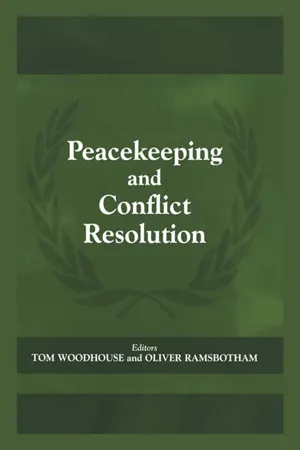
Peacekeeping and Conflict Resolution
About this book
Conflict resolution theory has become relevant to the various challenges faced by the United Nations peacekeeping forces as efforts are made to learn from the traumatic and devastating impact of the many civil wars that have erupted in the 1990s. This work analyzes the theory.
Information
Conflict Prevention: Options for Rapid Deployment and UN Standing Forces
The planning of peacekeeping operations is the ultimate challenge because you never know where you have to operate; you never know what they want you to do; you don't have the mandate in advance; you don't have forces; you don't have transport; and you don't have money… We always have to start from zero. Each and every operation that we start, we start with nothing.
Major-General Frank van Kappen,
Military Advisor to the UN DPKO, March 19971
Military Advisor to the UN DPKO, March 19971
Fifty-five years after the United Nations was formed, we continue to explore ways to empower the Organization. On balance, its record in preventing and resolving violent conflict is characterized by modest progress; not what it could or should be. Recent efforts to enhance a UN rapid deployment capability parallel that assessment. One defining moment and opportunity has already passed in the past decade, but in exposing our collective limitations, another arises. Finally, there is agreement that preventive action, through a combination of conflict resolution, diplomacy and even prompt deployments, is far more cost-effective than later, larger efforts. Similarly, many recognize that one essential mechanism for conflict prevention is a reliable and effective UN rapid deployment capability. Whether these will be lessons learned and institutionalized or lessons spurned may depend on the extent to which ‘we the people’ organize, inform and democratize further efforts. It is time to consider a more inclusive approach, one that draws on new partnerships to encourage the ideas and approaches essential for effective political, military and humanitarian responses to complex emergencies.
The rationale underlying recent initiatives to enhance UN rapid deployment capabilities was very compelling. Frequent delays, vast human suffering and death, diminished credibility, opportunities lost, escalating costs – these were just some of the tragic consequences of slow and inappropriate responses. Unprecedented demand for prompt UN assistance highlighted the deficiencies of existing arrangements, challenging the Organization, as well as member states. Most recognize the UN was denied sufficient resources, as well as appropriate mechanisms with which to respond. Fortunately, an array of complementary reforms have combined to expand the options. As expected, there are limitations and competing alternatives, but few easy or immediate remedies.
International efforts in this endeavour focused primarily on improving peacekeeping. The larger process involves measures to organize the contributions of member states, as well as the establishment of basic mechanisms within the UN's Department of Peacekeeping Operations (DPKO). Several initiatives are quite promising.
Approximately 27 member states, designated ‘Friends of Rapid Deployment’, cooperated with the DPKO to secure support for developing a rapidly deployable mission headquarters (RDMHQ). As well, since 1994 a DPKO team has organized the UN Standby Arrangement System (UNSAS) to expand the quality and quantity of resources that member states might provide. To complement this arrangement, the Danish government, in cooperation with 13 regular troop contributors, has organized a multinational Standby High Readiness brigade (SHIRBRIG).
SHIRBRIG is improving the tactical foundation by promoting further cooperation in multilateral planning, establishing training and readiness standards, and furthering the pursuit of inter-operability. By the end of the year 2000, the void at the operational level within the Secretariat may be partially filled by a permanent, albeit skeletal, UN rapid deployment mission headquarters. Once funded and staffed, it will simply enable the prompt coordination and control of diverse missions authorized by the Security Council. At the strategic level, the Security Council has agreed to provide further consultation with troop contributors.2
Thus, as the tactical, operational, and strategic foundation is strengthened, participants look for a corresponding response at the political level. Hopefully, these arrangements will combine to inspire a higher degree of confidence and commitment among member states. In short, these various ‘building blocks’ are gradually forming the institutional foundation for future peacekeeping. Initially, they are likely to circumscribe activity to Chapter VI, albeit within a flexible interpretation of peace support operations for complex political emergencies.3
The efforts of the UN Secretariat, the ‘Friends’ and member states such as Denmark, Canada, and the Netherlands were laudable and deserve support. There remain a number of issues, however, that warrant further effort and scrutiny. This study explores several initiatives to enhance a UN rapid deployment capability. It provides an overview of recent proposals, considers the progress within DPKO and the related efforts of Friends of Rapid Deployment, and it identifies the potential limitations of the new arrangements. To activate and revitalize support for further measures, it points to the need for a new ‘soft power’ approach. Finally, a vision-oriented, cumulative development process is proposed as a means to expand on this foundation.
How are we to assess such initiatives? Within the Secretariat, one focus is on reducing response times.4 Other considerations must address whether these measures, when combined, contribute to:
- Providing a widely-valued service;
- Increasing confidence in the UN's capacity to plan, deploy, manage, and support at short notice;
- Alleviating the primary worries of potential troop contributors and other member states;
- Generating wider political will and adequate financing;
- Encouraging broad participation;
- Ensuring sufficient multidimensional and multifunctional elements for modern conflict prevention and management;
- Enhancing the training, preparation, and overall competence of potential participants; and
- Instilling a unity of purpose and effort among the various participants.5
We must also ask whether the measures under way are sufficient to build an effective and reliable UN capability. Are these initial efforts likely to build a solid foundation with the capacity for modernization and expansion? Alternatively, is there a risk of being locked into another ad hoc, conditional system requiring last-minute political approval and improvisation prior to each mission? Can we identify national defence reforms that would complement UN rapid deployment and conflict prevention? The question also arises as to what additional measures will be necessary to institutionalize and consolidate a dedicated UN standing capability?
Background
Since the release in 1992 of former Secretary-General Boutros-Ghali's An Agenda for Peace, there has been a wide-ranging discussion of the UN's options for responding to violent conflict.6 Among the various catalysts for the debate were the Secretary-General's call for peace enforcement units and Article 43-type arrangements, as well as Sir Brian Urquhart's efforts to revive Trygvie Lie's proposal for a UN Legion.7 As these ideas began to attract a constituency, they also generated apprehension and a search for less ambitious options in many national capitals.
Opinion on the subject of any UN capability is always mixed. The debate here tended to follow two perspectives: the ‘practitioners’ who favoured strengthening current arrangements, and the ‘visionaries’ who desired a dedicated UN standing force or standing emergency capability.8 With notable exceptions, the official preference focused on pragmatic, incremental reform within the structure of the UN Secretariat and available resources.9 The latter was also assumed to entail fewer risks, fewer obligations and more control.
In the early years of the past decade, there were promising indications of support for some form of UN rapid reaction force.10 The need for a new instrument was widely recognized in the aftermath of Bosnia, Somalia and the failure to avert the Rwandan genocide. Regrettably, few governments were willing to back their rhetoric with meaningful reform. Prior commitments tended to be followed by carefully nuanced retractions.11 There were exceptions, notably among middle-power, regular UN troop contributors. Yet, even supportive governments were worried about moving ahead of public opinion, fellow member states, the international defence community and their own capacity to secure more ambitious reforms.
National Studies
Prior to the fiftieth anniversary of the United Nations, the Netherlands, Canada, and Denmark commenced studies and consultative processes to develop options for a UN rapid reaction capability. These studies were followed by concerted diplomatic efforts to organize a wider coalition of member states and secure the cooperation of the UN Secretariat. These initiatives were instrumental, first, in narrowing the range of short-term options – allaying official fears of a potentially large and expensive supranational intervention force – and second, in informing others as to how they might best contribute to the process.
The Netherlands Study
In 1994, the Netherlands began to explore the possibility of creating a permanent, rapidly deployable brigade at the service of the United Nations Security Council. A team of experts conducted the study, and an international conference was convened to review their initial report. They then released the Netherlands Non-Paper, ‘A UN Rapid Deployment Brigade: A Preliminary Study,’ which identified a critical void in the UN peacekeeping system. If a crisis were not to escalate into widespread violence, they argued it could only be met by dedicated units that were instantly deployable: ‘the sooner an international “fire brigade” can turn out, the better the chance that the situation can be contained.’12
The focus, the Dutch stressed, should not be on the further development of the UN Standby Arrangements System13 so much as a military force along the lines advocated by Robert Johansen14 and Brian Urquhart15 – a permanent, rapidly deployable brigade that would guarantee the immediate availability of troops when they were urgently needed. The brigade would complement existing components in the field of peacekeeping and crisis management. Its chief value would be as a ‘stop-gap’ measure when a crisis was imminent,16 and its deployments would be of strictly limited duration. The brigade's tasks would include preventive action, peacekeeping during the interval between a Security Council decision and the arrival of an international peacekeeping force, and deployment in emergency humanitarian situations. The annual cost of a 5,000-person brigade was projected at approximately US$300 million, the initial procurement of its equipment at $500–550 million. ‘Adoption’ of the brigade by one or more member states or by an existing organization such as NATO was recommended as a means of reducing the expenses of basing, transportation, and equipment acquisition.
The non-paper succeeded in stimulating an international exchange of views. It was clear, however, that only a less binding, less ambitious arrangement would be acceptable, at least for the immediate future. A few member states were supportive of the Dutch initiative, but the majority were opposed to any standing UN force, and even the modest expenditures outlined.
The Canadian Study
In September 1995, the Government of Canada presented the UN with a study entitled, Towards a Rapid Reaction Capability for the United Nations,17 with twenty-one recommendations to close the UN's capability gap in the short to mid term. The report also offered five recommendations to stimulate further research and development over the long term.
After establishing the need for a rapid reaction capability, the report...
Table of contents
- Cover
- Half Title
- The Cass Series on Peacekeeping
- Title Page
- Copyright Page
- Table of Contents
- Acronyms and Abbreviations
- Introduction
- Conflict Resolution and Peacekeeping: Critiques and Responses
- United Nations Peacekeeping: A Matter of Principles?
- Defining Warlords
- Sharpening the Weapons of Peace: Peace Support Operations and Complex Emergencies
- Organizing for Effective Peacebuilding
- Working with Ethno-political Conflict: Sean Byrne and A Multi-modal Approach
- NGOs, Conflict Management and Peacekeeping
- Cultural Issues in Contemporary Peacekeeping
- Reflections on UN Post-Settlement Peace building
- Peacekeeping, Conflict Resolution and Peacebuilding: A Reconsideration of Theoretical Frameworks
- Conflict Prevention: Options for Rapid Deployment and UN Standing Forces
- Select Bibliography
- Notes on Contributors
- Index
Trusted by 375,005 students
Access to over 1.5 million titles for a fair monthly price.
Study more efficiently using our study tools.
Frequently asked questions
Yes, you can cancel anytime from the Subscription tab in your account settings on the Perlego website. Your subscription will stay active until the end of your current billing period. Learn how to cancel your subscription
No, books cannot be downloaded as external files, such as PDFs, for use outside of Perlego. However, you can download books within the Perlego app for offline reading on mobile or tablet. Learn how to download books offline
Perlego offers two plans: Essential and Complete
- Essential is ideal for learners and professionals who enjoy exploring a wide range of subjects. Access the Essential Library with 800,000+ trusted titles and best-sellers across business, personal growth, and the humanities. Includes unlimited reading time and Standard Read Aloud voice.
- Complete: Perfect for advanced learners and researchers needing full, unrestricted access. Unlock 1.5M+ books across hundreds of subjects, including academic and specialized titles. The Complete Plan also includes advanced features like Premium Read Aloud and Research Assistant.
We are an online textbook subscription service, where you can get access to an entire online library for less than the price of a single book per month. With over 1.5 million books across 990+ topics, we’ve got you covered! Learn about our mission
Look out for the read-aloud symbol on your next book to see if you can listen to it. The read-aloud tool reads text aloud for you, highlighting the text as it is being read. You can pause it, speed it up and slow it down. Learn more about Read Aloud
Yes! You can use the Perlego app on both iOS and Android devices to read anytime, anywhere — even offline. Perfect for commutes or when you’re on the go.
Please note we cannot support devices running on iOS 13 and Android 7 or earlier. Learn more about using the app
Please note we cannot support devices running on iOS 13 and Android 7 or earlier. Learn more about using the app
Yes, you can access Peacekeeping and Conflict Resolution by Oliver Ramsbotham,Tom Woodhouse in PDF and/or ePUB format, as well as other popular books in Politics & International Relations & International Relations. We have over 1.5 million books available in our catalogue for you to explore.