- 303 pages
- English
- ePUB (mobile friendly)
- Available on iOS & Android
eBook - ePub
About this book
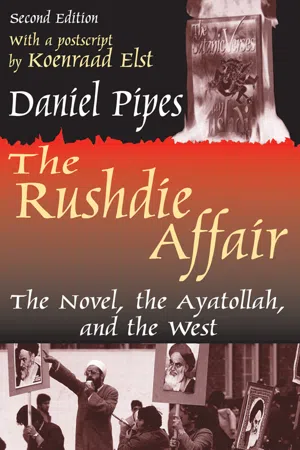
The publication in 1988 of Salman Rushdie's novel The Satanic Verses triggered a furor that pitted much of the Islamic world against the West over issues of blasphemy and freedom of expression. The controversy soon took on the aspect of a confrontation of civilizations, provoking powerful emotions on a global level. It involved censorship, protests, riots, a break in diplomatic relations, culminating in the notorious Iranian edict calling for the death of the novelist. In The Rushdie Affair, Daniel Pipes explains why the publication of The Satanic Verses became a cataclysmic event with far-reaching political and social consequences.Pipes looks at the Rushdie affair in both its political and cultural aspects and shows in considerable detail what the fundamentalists perceived as so offensive in The Satanic Verses as against what Rushdie's novel actually said. Pipes explains how the book created a new crisis between Iran and the West at the time--disrupting international diplomacy, billions of dollars in trade, and prospects for the release of Western hostages in Lebanon.Pipes maps out the long-term implications of the crisis. If the Ayatollah so easily intimidated the West, can others do the same? Can millions of fundamentalist Muslims now living in the United States and Europe possibly be assimilated into a culture so alien to them? Insightful and brilliantly written, this volume provides a full understanding of one of the most significant events in recent years. Koenraad Elst's postscript reviews the enduring impact of the Rushdie affair.
Information
1.
HALF A YEAR OF UPHEAVAL
Controversy over The Satanic Verses started in late September 1988 and built up to a crescendo by mid-February 1989. Then, a month later, the issue dropped from sight, though its effects continued to be felt long after.
Protests and Riots
Protests against The Satanic Verses began even before the book’s official British publication, on September 26, 1988. Surprisingly, the furor began not in Britain but in India, where Muslims learned about The Satanic Verses from two magazines, India Today and Sunday, which in their mid-September editions provided reviews of the book, excerpts, and interviews with the author. With prescience and understatement, Madhu Jain preicted in India Today that The Satanic Verses “is bound to trigger an avalanche of protests from the ramparts.”1
It did not take long. Syed Shahbuddin and Khurshid Alam Khan, Muslim members of the Indian parliament, did not like what they had read of the book, so they began a campaign to have the novel banned in India. Their efforts met with almost instant success; under a ruling of the Indian Customs Act, the Finance Ministry prohibited the book on October 5. Shahbuddin had the honor not only of starting the controversy, but of laying down two of its most enduring traits. Addressing Rushdie, he wrote shortly after the banning:
You are aggrieved that some of us have condemned you without a hearing and asked for the ban without reading your book. Yes, I have not read it, nor do I intend to. I do not have to wade through a filthy drain to know what filth is.2
His defiant assertion, “Yes, I have not read it, nor do I intend to,” foreshadowed the sentiments of almost all other Muslim leaders. Neither he nor they felt a need to read the book in its entirety, and precious few critics even bothered to read extracts. Second, Shahbuddin’s nastiness (“I do not have to wade through a filthy drain to know what filth is”) came to characterize the tone of the dispute to come. The debate would be an emotional one at the highest pitch, with no rhetorical prisoners taken.
Then the action moved to Great Britain. Word reached the Muslims there in a letter that arrived on the first day or two of October, from Aslam Ejaz of the Islamic Foundation in Madras to his friend Faiyazuddin Ahmad of the Islamic Foundation in Leicester, England. In the letter, Ejaz informed Ahmad about the impending ban in India on The Satanic Verses, and encouraged Ahmad to do God’s work in Great Britain. Ahmad bought the book, read it, and was appalled. He then photocopied the offending passages and on October 3 sent these around to other Islamic organizations in the United Kingdom.
On October 7, more copies went out to the London embassies of all Muslim states. The Saudi government, which sees itself as the standard-bearer of orthodox Islam, took up the cause with alacrity. The next day, the Saudi-sponsored newspaper published in London, Ash-Sharq al-Awsat, featured a story on The Satanic Verses denouncing the book. Soon thereafter, the Saudi-backed weekly, Impact International, published a selection of the book’s most controversial passages. Ahmad was invited to Jidda, Saudi Arabia, where he briefed officials about the novel and mobilized Saudi support for a campaign against it. Several Saudi-sponsored international organizations (including the Muslim World League and the U.K. Action Committee on Islamic Affairs) then took up the cause.
Overall, these efforts to bring international pressure to bear did not achieve much. Weeks passed and most Muslim states gave no response, not even bothering to ban the book. Indeed, as adverse publicity stimulated curiosity, importation of the novel to Muslim countries continued to be legal and, by all reports, to be done. The one gesture by the Muslim states was in late December, when they sent a delegation of three London-based ambassadors to meet the Home Office Minister, John Patten.
In the meantime, the effort within Britain picked up wide support among Muslims. Hesham El Essawy, chair of the Islamic Society for the Promotion of Religious Tolerance, wrote a letter to Viking Press on October 12: “I would like to invite you to take some kind of corrective stand, before the monster that you have so needlessly created grows, as it will do worldwide, into something uncontrollable.”3
The publishers did little more than snicker; a society claiming to promote tolerance was requesting censorship! Also on the 12th, Trevor Glover, the managing director of Penguin, received a like letter from ‘Ali Mughram al-Ghamdi, the Saudi who served as convenor of the U.K. Action Committee on Islamic Affairs, an umbrella group representing Saudi-backed Muslim organizations in Britain. A letter sent out by Ghamdi on October 28 to rouse British Muslims to action dubbed The Satanic Verses “the most offensive, filthy and abusive book ever written by any hostile enemy of Islam” and called for three measures: the retraction of all copies of the novel, an apology by the author, and a payment of damages by him to a Muslim charity in Britain.4
The Union of Muslim Organisations, another umbrella organization, hosted a crisis meeting on October 15 at which it was decided to get The Satanic Verses legally banned in Britain and Rushdie criminally prosecuted, both on the charge of blasphemy. The group pressed for such a ban in a letter of October 20 to Prime Minister Margaret Thatcher, but its efforts went nowhere, for British laws of blasphemy, as Muslims soon discovered, apply only to Christianity, and even then are hardly ever applied. The prime minister’s answer came on November 11, and it turned the Union down flat—’’there are no grounds on which the government could consider banning” the book, she wrote.5
Further efforts to pursue the matter (with the attorney-general, the lord chancellor, and the home secretary) proved equally unavailing. Muslims even pushed their cause at the Conservative party’s annual meeting in Brighton, without success.
By October, threats against Rushdie’s life had already begun to affect his daily routine; in that month he cancelled a planned trip to Cambridge, England, because of death threats. He took an unlisted telephone number. On leaving the house, he was sometimes accompanied by a bodyguard, especially when attending public functions. By all accounts, these threats came from the grassroots, and were not sanctioned by the Muslim leadership in Britain, much less by the states behind them. Writing in Impact International, M. H. Faruqi called for the application of pressure “through all civilised and legitimate means. But please leave Mr. Salman Rushdie all to himself and to his charmed circle of ‘literary critics.’”6
There had also been trouble during the fall in the United States and South Africa. An organized letter campaign in several cities (notably Houston, Detroit, Chicago, and the Queens borough of New York) inundated Viking Penguin in New York City with tens of thousands of menacing letters. Serious threats against the press began in December 1988, two months before the book was available locally, and were repeated at least seven times even before the ayatollah’s edict. One anonymous caller announced that $50,000 would be paid to anyone who assassinated the firm’s president. On two occasions in December, alone, bomb scares forced the Viking staff to evacuate its offices. Rumor had it that several Viking executives wore bulletproof vests to the office.
In South Africa, two anti-apartheid institutions, The Weekly Mail and the Congress of South African Writers (COSAW), invited Rushdie to deliver the keynote speech at a conference they were cosponsoring on censorship. The title of Rushdie’s talk came from a famous line of Heinrich Heine, “When you start by burning books you end by burning men too.” No one in South Africa having ever seen The Satanic Verses, the organizers did not realize what they were up against by inviting Rushdie. But it soon became clear, as the death threats against him proliferated, that the 500,000-strong Muslim community in South Africa had been alerted to Rushdie’s blasphemies and would not suffer his presence. The editors of The Weekly Mail were particularly impressed by the fact that almost all the threats against him were signed, and even included return addresses, suggesting powerful emotions of a sort they could barely comprehend. Protest demonstrations followed, as did more threats to Rushdie himself, his sponsors, and bookstores that might carry his novel (not a single copy of which had yet reached South Africa, it must be emphasized). Under Muslim pressure, the government banned the book. Finally, on November 1, one day before Rushdie was due to arrive, COSAW withdrew his invitation. Ironically, the speaker invited to indict censorship by the state was censored by his fellows-in-arms.
Frustrated by the British government’s lack of response, as well as by The Satanic Verses having been awarded the Whitbread monthly prize for fiction in November, the Muslim community in Bolton (near Manchester) decided to take action on their own, and they settled on a ritual burning of the book, which they did on December 2. Although the ceremony attracted a crowd of 7,000 Muslims, press coverage was virtually nil, so the event did not have the hoped-for impact.
Finally, the campaign took off when a second copy of The Satanic Verses was burned on January 14 in Bradford, northern England, a town whose large Muslim population won it the sobriquet of “capital of Islam in the United Kingdom.” Although only 1,000 demonstrators rallied in Bradford, a fraction of those in Bolton, this time the Muslims found non-Muslim supporters (such as local politicians and the bishop of Bradford) and the presence of these figures helped bring out the media in force. Television news showed an auto da fé—the novel attached to a stake and set on fire—in loving, if horrified, detail. Further, pictures of the scene were splashed in the media for days, commentators opined at length on the event, and it became a major topic of discussion throughout the country. Subsequently, 8,000 fundamentalist Muslims (that is, Muslims who seek application of the Islamic law in its every detail) marched in London on January 29 to protest the book.
In reply to these attacks, Rushdie published a statement asserting his credentials as a good Muslim. In it, he called the Prophet Muhammad “one of the great geniuses of world history,” but noted that Islamic doctrine holds Muhammad to be human, and in no way perfect. Rushdie also held that the novel is not “an antireligious novel. It is, however, an attempt to write about migration, its stresses and transformations.”7
But book burnings were merely a warm-up for the violence that began in Islamabad, Pakistan, on February 12 and then continued for over a month. Controversial selections of Rushdie’s book had been crudely translated into Urdu, then presented in public readings in the streets. Outrage spilled into violence when a crowd of some 10,000 persons took to the streets and marched to the American Cultural Center. Shouting “American dogs” and “God is great,”8 the protesters set fires to the building. As the crowd surged toward the Center, five demonstrators died at the hands of the police and about a hundred were injured. While the police held the bulk of the mob at bay, a group of some two to three hundred protesters slipped to the back of the American Center and began throwing large rocks at the windows which, made of Mylar, withstood the assault....
Table of contents
- Cover
- Half Title
- Title Page
- Copyright Page
- Dedication
- Epigraph
- Table of Contents
- Acknowledgments
- Introduction
- Chapter 1. Half a Year of Upheaval
- Part 1. The Author, the Novel, and the Edict
- Chapter 6. Why Fundamentalist Muslims Picked on Rushdie
- Part 2. Protests and Repercussions
- Appendix
- Glossary
- Postscript
- Index
Trusted by 375,005 students
Access to over 1.5 million titles for a fair monthly price.
Study more efficiently using our study tools.
Frequently asked questions
Yes, you can cancel anytime from the Subscription tab in your account settings on the Perlego website. Your subscription will stay active until the end of your current billing period. Learn how to cancel your subscription
No, books cannot be downloaded as external files, such as PDFs, for use outside of Perlego. However, you can download books within the Perlego app for offline reading on mobile or tablet. Learn how to download books offline
Perlego offers two plans: Essential and Complete
- Essential is ideal for learners and professionals who enjoy exploring a wide range of subjects. Access the Essential Library with 800,000+ trusted titles and best-sellers across business, personal growth, and the humanities. Includes unlimited reading time and Standard Read Aloud voice.
- Complete: Perfect for advanced learners and researchers needing full, unrestricted access. Unlock 1.5M+ books across hundreds of subjects, including academic and specialized titles. The Complete Plan also includes advanced features like Premium Read Aloud and Research Assistant.
We are an online textbook subscription service, where you can get access to an entire online library for less than the price of a single book per month. With over 1.5 million books across 990+ topics, we’ve got you covered! Learn about our mission
Look out for the read-aloud symbol on your next book to see if you can listen to it. The read-aloud tool reads text aloud for you, highlighting the text as it is being read. You can pause it, speed it up and slow it down. Learn more about Read Aloud
Yes! You can use the Perlego app on both iOS and Android devices to read anytime, anywhere — even offline. Perfect for commutes or when you’re on the go.
Please note we cannot support devices running on iOS 13 and Android 7 or earlier. Learn more about using the app
Please note we cannot support devices running on iOS 13 and Android 7 or earlier. Learn more about using the app
Yes, you can access The Rushdie Affair by Daniel Pipes in PDF and/or ePUB format, as well as other popular books in Philosophy & Literary Criticism. We have over 1.5 million books available in our catalogue for you to explore.