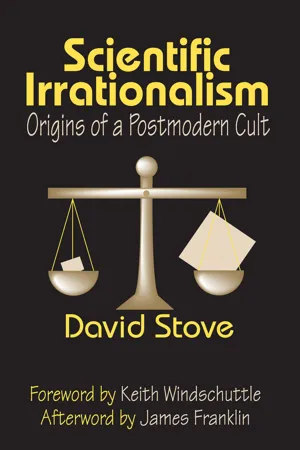
- 226 pages
- English
- ePUB (mobile friendly)
- Available on iOS & Android
eBook - ePub
About this book
Little known outside his native Australia, David Stove was one of the most illuminating and brilliant philosophical essayists of his era. A fearless attacker of intellectual and cultural orthodoxies, Stove left powerful critiques of scientific irrationalism, Darwinian theories of human behavior, and philosophical idealism.Since its inception in the 1940s, the field of science studies, originally intended to bridge the gap between science and the humanities, has been the center of controversy and debate. The most notable figures in this debate are Thomas Kuhn and Karl Popper. In Scientific Irrationalism, now available in paperback, David Stove demonstrates how extravagant has been the verbiage wasted on this issue and how irrational the combatants have been. He shows that Kuhn and Popper share considerable common ground. Stove argues that the problems all reside in the reasoning of the critics. He identifies the logical mistakes and conceptual allusions made by Kuhn and Popper and their supporters, as well as their collective dependency on a single argument made by the philosopher of the Scottish Enlightenment, David Hume. He then demonstrates how little potency that argument actually has for the claims of science.In his foreword, Keith Windschuttle explains the debate surrounding the field of science studies and explores David Stove's contribution as well as his lack of recognition. In an afterword, James Franklin discusses reactions to Stove's work.
Information
Part One
Philosophy and the English Language: How Irrationalism About Science is Made Credible
Chapter One
Neutralising Success Words
MUCH more is known now than was known fifty years ago, and much more was known then than in 1580. So there has been a great accumulation or growth of knowledge in the last four hundred years.
This is an extremely well-known fact, which I will refer to as (A). A philosopher, in particular, who did not know it, would be uncommonly ignorant. So a writer whose position inclined him to deny (A), or even made him at all reluctant to admit it, would almost inevitably seem, to the philosophers who read him, to be maintaining something extremely implausible. Such a writer must make that impression, in fact, unless the way he writes effectively disguises the implausibility of his suggestion that (A) is false.
Popper, Kuhn, Lakatos, and Feyerabend, are all writers whose position inclines them to deny (A), or at least makes them more or less reluctant to admit it. (That the history of science is not "cumulative", is a point they all agree on.) Yet with a partial exception in the case of Feyerabend, none of these writers is at all widely regarded by philosophers as maintaining an extremely implausible position. On the contrary, these are the very writers who are now regarded by most philosophers as giving an account of science more plausible than any other. So if what I have said is true, they must write in a way which effectively disguises the implausibility of their position. My object in Part One of this book is to show how they do it.
Of course I do not suppose that these authors, or even any two of them, agree on every point. Feyerabend argues persuasively, indeed, that in the end Lakatos's philosophy of science differed only in words, not in substance, from his own more openly irrationalist one.1 And Kuhn had no difficulty in showing the very great amount of agreement that exists between himself and Popper.2 Lakatos and Popper, on the other hand, are at pains to magnify any distance separating them from Kuhn3 and would be still less willing to acknowledge affinities with Feyerabend; and Popper is almost equally anxious to distinguish Lakatos's position from his own.4 To an outside philosopher, indeed, the differences of opinion among the four must appear trifling by comparison with the amount of agreement that unites them. But it is in any case sufficient for my purposes that they all agree so far as to share a certain reluctance to admit the truth of (A).
Everyone would admit that if there has ever been a growth of knowledge it has been in the last four hundred years. So anyone reluctant to admit (A) must, if he is consistent, be reluctant to admit that there has ever been a growth of knowledge at all. But if a philosopher of science takes a position which obliges him, on pain of inconsistency, to be reluctant to admit this, then his position can be rightly described as irrationalism or relativism. Lakatos and Popper were therefore right in applying these epithets to Kuhns position.5 They were further right, I believe, in the suggestion, which is a major theme running through their comments on Kuhn, that this irrationalism stems from the conflation, in Kuhns writings about science, of the descriptive with the prescriptive: from his steady refusal to distinguish the history or sociology of science from the logic or philosophy of science.6
Kuhn, of course, 'admits the soft impeachment' and defends his practice in this respect.7 (Feyerabend likewise rejects the distinction between description and prescription.8) But Kuhn also retorts that in any case Popper and Lakatos do exactly the same thing themselves.9 This was a very palpable hit, quite impossible to deny. That he confused the logic with the history of science was a common complaint against Popper, and one only too well-founded, long before Kuhn mentioned it in his tu quoque; and to try to defend Lakatos from the same reproach would be even more idle. But if it is true, as these critics of Kuhn alleged, and as indeed it is, that the source of irrationalism in his case is the conflation of the history with the logic of science, then the same cause cannot fail to have the same effect in their own case as well.
The question from which I began may therefore be replaced by a more general one. I asked in effect, "How do these writers manage to be plausible, while being reluctant to admit so well-known a truth as (A)?" But in view of what has just been said we are entitled to ask instead: "How do they manage to be plausible, while being in general so irrationalist as they are? For example, while being reluctant to admit (A)?"
It is easy enough to answer this question, I think, in general terms. The answer lies in what I have just referred to: the constant tendency in all these authors to conflate questions of fact with questions of logical value, or the history with the philosophy of science. That this tendency is present, indeed inveterate, in all these writers is, as I have just indicated, quite widely recognised, and is no more than one could gather, if he could not see it for himself in each of them, from the things they say about one another. And this tendency is a cause sufficient to explain the phenomenon of plausible irrationalism. For it is so powerful in us all, and so productive of confusion where criticism does not check it, that it is easily equal to the task of making irrationalism about science plausible, it has imposed on philosophers grosser absurdities than that before now: for example it enabled Mill to find plausible his 'proof' of the principle of utility. For my own part, at any rate, I have no doubt that this tendency is the main part of the answer, in general terms, to my question.
But it is a deficient answer just because it is in such general terms. What we want explained is a specific phenomenon of literary history: namely that some philosophy of science, which is irrationalist enough to generate reluctance to admit (A), is nevertheless made plausible to thousands of readers who would have no patience at all with an open assertion that no more is known now than in 1580, or that no one ever knows anything. Between such specific facts as this to be explained, and the very general tendency so far offered (and correctly offered, as I think), in explanation of them, there is too wide a gap.
To fill this gap what is required, clearly, is to show in detail how the general tendency to conflate the history with the philosophy of science is carried out in the writings of our authors, in such a way as to disguise their irrationalism and make it plausible. We need a catalogue of the actual literary devices by which this trick is turned. It is this which I attempt to supply.
2
IF you wish to recommend a philosophy of science to readers who are sure to find the irrationalism in it implausible, then your literary strategy must clearly be a mixed one. Irrationalism which was open and unrelieved would be found hopelessly implausible. So your irrationalist strokes must be softened, by being mixed with others of an opposite kind, or again by being disguised as themselves of an opposite kind. All our authors, accordingly, employ a strategy which is mixed in this sense; and in fact many forms of it.
An extreme form of mixed strategy is, simple inconsistency: that is, assert an irrationalist thesis, but also assert others which are inconsistent with it.
Popper furnishes many examples of this, of which the following is one. He staggers us by denying that positive instances confirm a universal generalisation, but reassures us by allowing that negative instances are, as we always thought they were, disconfirmatory (so that for example "(x) (Raven x ⊃ Black x)" is disconfirmed by "Raven a.-Black a", but not confirmed by its negation). For he adopts a criterion of confirmation10 (one which I have elsewhere called the 'relevance criterion' of confirmation11), which is well known to have the consequence that ρ confirms q if its negation disconfirms q.
A strategy which is mixed in the above sense while falling short of inconsistency, can take the form of stating as the aim of science something which common sense would agree to be at least one of its aims; while also saying other things which imply that it is impossible to achieve this aim.
Popper and Lakatos both do this. They say the aim of science is to discover true laws and theories. But they also say, concerning any law or theory, that because it is universal, its truth is exactly as improbable, even a priori, as the truth of a self contradiction12: in other words, impossible.
A further form that a mixed strategy can take is this: embrace a methodology which is common-sense as far as it goes, but also say other things which imply that (even if it is possible) it is pointless to comply with it.
Popper does this. He enjoins our utmost efforts to establish empirically the falsity of any proposed law or theory. Yet no labour could be more pointless, if he is right in telling us that (for the reason mentioned in the preceding paragraph) the falsity of any such proposition is already assured a priori.
Yet another form that a mixed strategy can take is, of course, equivocation: leave them guessing what it is you really believe, the irrationalist bits, or the other ones.
Kuhn, for example, says that the world is the same after "paradigm-shift' as it was before13; that scientists working within different paradigms are nevertheless all studying the same world14; etc, etc. Well, of course! He is not some kind of crazy Berkeleian, after all, and these things are just common knowledge, like the proposition (A) from which I began, only more so. But Kuhn also uses every literary means short of plain English to suggest that these things are not so: that on the contrary, the world is somehow plastic to our paradigms.
Οf course it is not always easy to tell equivocation from downright inconsistency Take Kuhn again. Some one may tell me that he is not reluctant, at all, to admit my historical truism (A). And certainly it would be easy to point to many passages in his writings which support this interpretation. All those passages, for example, in which he says that normal science, operating under the guidance of a paradigm, solves' problems. No doubt, in particular, Kuhn would admit that normal science has solved a great many problems since 1580. Well, if it has solved those problems, then those problems have been solved, haven't they? We know Kuhn says that a new paradigm "replaces", "destroys", an old one. But he never says that every solution of a particular problem, achieved under the old paradigm, somehow is "destroyed" or becomes an un-solution under the new. Indeed, how could that be? What would it even mean, to say so? If a problem has been solved then it really has been solved. But if this tautology is not denied, then solutions of problems (unless they were, for example, forgotten) would accumulate through successive paradigms. But what then becomes of Kuhns famous rejection of the cumulative view of the history of science?
This may be another example, then, of our authors' mixed strategy issuing in an actual inconsistency. But on the other hand it may only be another case of equivocation. When Kuhn speaks of science as having solved problems, he no doubt often uses this phrase in the sense in which people normally understand it: which, whatever it is, may certainly be called an absolute sense. But—the idea naturally suggests itself—perhaps he sometimes also uses it in another and weaker sense: one which is more consistent with his repeated assertion that what constitutes the solution of a problem is relative to the paradigm, the group, and the time.
This suggestion (although I will not pursue it in connection with the phrase "solving problems") seems to me to furnish the key to the two main literary devices by which our authors make irrationalism about science plausible.
3
THE first of these devices I call neutralising success-words. A homely example will explain what I mean.
Nowadays in Australia a journalist will often write such a sentence as, "The Minister today refuted allegations that he had misled Parliament", when all he means is that the Minister denied these allegations. "To refute" is a verb with 'success grammar' (in Ryle's phrase). To say the Minister refuted the allegations is to ascribe to him a certain cognitive achievement: that of showing the allegations to be false. "To deny", on the other hand, has no success-grammar. So a journalist who used "refuted" when all he meant was "denied" has used a success-word, but without intending to convey the idea of success, of cognitive achievement, which is part of the word's meaning. He has neutralised a success-word.
When journalists do this, no doubt they mostly do so inadvertently, from mere ignorance. But imagine the same thing done by a journalist who does know the meaning of the two words, and who believes that in fact the Minister only denied the allegations; but who feels for some reason obliged to use language which, in his own opinion, exaggerates the cognitive achievements of Ministers. (Perhaps the reason is that he thinks his readers will listen to nothing but good about Ministers.) Then we would have what I believe is a very close parallel indeed to the way our authors use language to write about science.
For they use the language of success about science—words importing more or less of cognitive achievement, such as "knowledge", "discovery", "facts", "verified", "understanding", "explanation", "solution (of a problem)", and a great many more besides—they use this language quite as freely as do any of those older historians of science whom they despise. They clearly must do so, at least to some extent, for they would forfeit all plausibility if they were to write about science without ever using any success-words at all. Their substantive philosophy, however, is not really consistent with applying, to science, such words in their ordinary success-implying sense. So while they use the language of success, they neutralise it. Not all the time, of course: sometimes they use these words in their ordinary sense, despite the inconsistency involved in doing so. But often enough for such neutralised success words to be a prominent and distinctive feature of the English that they write.
This device is clearly one which, if it were used, would help enormously towards making irrationalist philosophy of science plausible. For in this way you can have, as thick as you like on every page, all the optimistic words of the old historiography and philosophy of science, reassuring the reader (who needs, after all, to be weaned gradually from whiggish notions of science) while all the time, nothing inconsistent with irrationalism need be being said at all.
I now have to substantiate my suggestion that the device of neutralising success-words is characteristic of our authors.
Before coming to cases it will be worthwhile to notice a passage in which the truth of this suggestion of mine is indirectly admitted at once, by one of our authors himself. This is a remarkable paragraph, occurring early in Against Method, in which Feyerabend, who is of course more openly irrationalist than our other authors, tells us that (to put it in my language), whenever he applies success-words to science in that book, they are never to be taken in their ordinary sense, but are intended to be always understood as neutralised.
The context was this. Feyerabend has just been expounding his 'anarchist' maxim that anything goes: by which he means that any principle of theory preference (induction, counter-induction, Tarot-card, or whatever) may on a given occasion advance science more than any other would. Then he adds the following:
"Incidentally, it should be pointed out that my frequent use of such words as 'progress','advance','improvement', etc., does not mean that I claim to possess special knowledge about what is good and what is bad in the sciences and that I want to impose this knowledge upon my readers. Everyone can read the terms in his own way and in accordance with the tradition to which he belongs. Thus for an empiricist,'progress'will mean transition to a theory that provides direct empirical tests for most of its basic assumptions. Some people believe the quantum theory to be a theory of this kind. For others, 'progress' may mean unification and harmony, perhaps even at the expense of empirical adequacy. This is how...
Table of contents
- Cover
- Half Title
- Title
- Copyright
- Dedication
- Contents
- Foreword
- PART ONE PHILOSOPHY AND THE ENGLISH LANGUAGE: HOW IRRATIONALISM ABOUT SCIENCE IS MADE CREDIBLE
- PART TWO HOW IRRATIONALISM ABOUT SCIENCE BEGAN
- Afterword
- Notes
- Bibliography
- Index
Trusted by 375,005 students
Access to over 1.5 million titles for a fair monthly price.
Study more efficiently using our study tools.
Frequently asked questions
Yes, you can cancel anytime from the Subscription tab in your account settings on the Perlego website. Your subscription will stay active until the end of your current billing period. Learn how to cancel your subscription
No, books cannot be downloaded as external files, such as PDFs, for use outside of Perlego. However, you can download books within the Perlego app for offline reading on mobile or tablet. Learn how to download books offline
Perlego offers two plans: Essential and Complete
- Essential is ideal for learners and professionals who enjoy exploring a wide range of subjects. Access the Essential Library with 800,000+ trusted titles and best-sellers across business, personal growth, and the humanities. Includes unlimited reading time and Standard Read Aloud voice.
- Complete: Perfect for advanced learners and researchers needing full, unrestricted access. Unlock 1.5M+ books across hundreds of subjects, including academic and specialized titles. The Complete Plan also includes advanced features like Premium Read Aloud and Research Assistant.
We are an online textbook subscription service, where you can get access to an entire online library for less than the price of a single book per month. With over 1.5 million books across 990+ topics, we’ve got you covered! Learn about our mission
Look out for the read-aloud symbol on your next book to see if you can listen to it. The read-aloud tool reads text aloud for you, highlighting the text as it is being read. You can pause it, speed it up and slow it down. Learn more about Read Aloud
Yes! You can use the Perlego app on both iOS and Android devices to read anytime, anywhere — even offline. Perfect for commutes or when you’re on the go.
Please note we cannot support devices running on iOS 13 and Android 7 or earlier. Learn more about using the app
Please note we cannot support devices running on iOS 13 and Android 7 or earlier. Learn more about using the app
Yes, you can access Scientific Irrationalism by Keith Windschuttle,David Stove in PDF and/or ePUB format, as well as other popular books in Philosophy & Epistemology in Philosophy. We have over 1.5 million books available in our catalogue for you to explore.