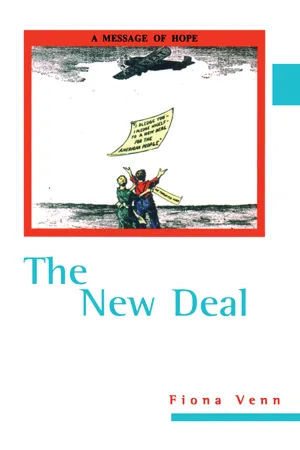
This book offers a chronological introduction to the New Deal, incorporating details of events and developments outside as well as within Washington, D.C., and examining American and foreign reaction to the policies. The main emphasis of the book is on policy formation and implementation and on the context in which the New Deal evolved. A detailed chronology of events is provided, and The New Deal ends with notes on further reading and an extensive index.
eBook - ePub
The New Deal
About this book
Information
Chapter 1
Introduction
On 2 July 1932, Governor Franklin Delano Roosevelt (FDR) of New York state flew from Albany to Chicago, where the Democratic Party was holding its national convention. In an unprecedented move, FDR chose to accept in person his Party’s nomination of him as its candidate for the 1932 Presidential election. Addressing the Convention delegates, he stated that ‘I pledge you, I pledge myself, to a new deal for the American people’.1 These words had been drafted by his close adviser and speechwriter, Samuel Rosenman, but the term ‘New Deal’ had not been used by Roosevelt before then. However, following the enthusiasm with which commentators and cartoonists seized upon the expression, it became the catch-phrase used then, and since, to describe the policies and programme adopted after FDR assumed the Presidency eight months later, on 4 March 1933.
President Roosevelt came to office at a time of national crisis. Over three years of economic depression had culminated in a series of banking panics which threatened the entire financial system. The New Deal order associated with his first two terms was a response to the severe worldwide depression which affected both industrial nations and primary producers in the early years of the 1930s. Debate continues as to the precise cause (or causes) of the Depression.2 It is, however, beyond question that the United States, as a country which combined industrial superiority with a strong primary sector, was particularly badly affected, and, indeed, did not recover fully from the effects of the Depression until the Second World War. The American experience is often compared with that of France, Great Britain, and Germany, providing some useful parallels and contrasts.3 The impact of the Depression was far greater in the United States than in Great Britain, where the south-east and the new industries enjoyed a boom during the later 1930s. Indeed, the United States experienced economic problems on a par with those facing the unstable government of Weimar Germany. However, there is a marked contrast between the political consequences for the two countries. While the United States retained a democratic system throughout the crisis, in Germany, economic depression was accompanied by radical political change. Thus, despite failing to solve its economic problems until the onset of war, the American government succeeded in diverting potential political difficulties. In seeking to understand this apparent paradox, an important factor is the New Deal, its achievements and the grass-root effects of its various programmes.
The New Deal lasted a comparatively short time. Commencing in March 1933, the major legislative measures comprising the programme were passed in the two ‘Hundred Days’ of 1933 and 1935, with a smaller group of measures in 1937–8. Thereafter, the New Deal effectively declined, although elements of the reform impulse may still be detected in the War years. The main shape of the New Deal legislation was fashioned by President Roosevelt, his cabinet colleagues (many of whom remained in office throughout the New Deal; for example, Secretary of Labor Frances Perkins and Secretary of the Interior Harold Ickes), more informal advisers, such as Rexford Tugwell, Raymond Moley, Benjamin Cohen and Thomas Corcoran, and the many lower-rank New Dealers who staffed the burgeoning departments in Washington. President Roosevelt resurrected the habit begun by his Democratic predecessor, Woodrow Wilson, of sending to Congress carefully drafted measures prepared by the executive, comprising a clear legislative programme. Thus, while some of the acts passed had their origins in private bills (notably the Wagner Act of 1935), for the most part the main legislative achievements of the New Deal were the work of the Administration. The consequence was a far-reaching programme of legislation which provided relief for millions of Americans, introduced a number of substantial reforms and sought, albeit with only limited success, to achieve economic recovery.
Commentators then, and historians since, have speculated and theorized about the genesis, intentions and ultimate consequences of this New Deal programme. Historical opinion has varied considerably. During the 1940s and 1950s, most historians were firmly within the liberal consensus and saw the New Deal as being part of the same liberalism.4 Debate centred around where exactly to locate the New Deal within the progressive continuum. Was it, for example, a revolution, or did it represent rather an evolution from a progressive heritage? If the latter, did it owe its genesis to the New Nationalism of Theodore Roosevelt or to the New Freedom of Woodrow Wilson? Should it be seen as the reawakening of policies and approaches articulated during the war effort of the First World War? Through their emphasis on the high politics of Washington DC, and a preoccupation with the antecedents of the New Deal, the liberal historians were less concerned with the consequences in the country. The New Left historians of the 1960s and 1970s soon remedied this partial omission. For writers such as Paul Conkin and Howard Zinn, the New Deal was remarkable, not so much for what it had achieved, as for the lost opportunities to attack the stranglehold of capitalism and address such fundamental social problems as civil rights and the appalling conditions faced by the sharecroppers of the South. Paul Conkin commented that ‘the story of the New Deal is a sad story, the ever recurring story of what might have been’.5 The very considerable political and constitutional limitations to such radical change, not to mention the lack of support for such a drastic programme among the American people, were rarely considered in detail.
Since the 1970s, studies of the New Deal have often moved beyond Washington DC to examine the consequences of the various programmes.6 If such studies have demonstrated the often limited nature of such achievements, they have also made plain the very real constraints faced by those seeking to implement the New Deal at local level. While the New Deal may not have succeeded in remaking the American socioeconomic structure, it did contain many administrators who were aware of the scope of the problem and who tried to the best of their ability to address it.
None the less, on the whole, recent historical interpretations of the New Deal have tended to emphasize its limitations as a reforming, radical force. Many of its achievements helped to institutionalize and consolidate the existing status quo in both economic and political spheres. Certainly, it saved capitalism, rejigged the existing socio-economic structure to remove some of the more glaring abuses and made concessions towards the most adversely affected groups of Americans. Conversely, it also reinforced the prevailing gender stereotypes, incorporated organized labour into a regulated contractual relationship with capital and failed to address critical issues such as the racial discrimination endemic in American society (particularly in the South). Many of its longest-lasting effects were virtually coincidental, most notably changes in the role of the federal government, the strengthening of the executive branch and the beginning of an ‘imperial presidency’. However, at the time, the New Deal succeeded in winning such strong support from ordinary Americans that it changed the nature of the Democratic Party permanently. This was partly due to the immense sense of achievement and change felt by many contemporaries, but it also reflects the significance of the intangible, subjective aspects of the New Deal, particularly its restoration of confidence among the public. It is in this vital area that one of Roosevelt’s major contributions lies.
The New Deal is inextricably linked to Franklin Delano Roosevelt.7 The 32nd President of the United States, he served for an unprecedented – and unequalled – twelve years in the Presidency. He was, in many ways, an untypical reformer and an unlikely presidential figure at a time of acute economic depression. Born in 1882, he came from the Hudson River gentry, had a privileged upbringing and never had to earn his own living, although at various times he pursued legal and business careers. His determined pursuit of a political career began in New York state politics before the First World War, led to the post of Assistant Secretary of the Navy in President Wilson’s administration, and culminated in his nomination as the Democratic Party’s vice-presidential candidate in 1920 (the Republican candidate, Warren Harding, won the election). However, his hopes of resuming his political activities were apparently dashed in 1921 when he suffered an attack of polio which left him effectively crippled. With determined effort, he could appear to walk, but only with callipers, crutches or the support of a strong arm. Given the contemporary attitude towards the disabled, it seemed likely that he would have to abandon any thought of a political career. However, his name remained prominent in Democratic politics throughout the 1920s, first because of his wife Eleanor, who played a major role in New York state Democratic party politics, then by his association with Al Smith, who urged him to run for State Governor in 1928. His record in the Governorship, and his astute lobbying and networking within the national Democratic Party, was sufficient to overcome his handicap, and in July 1932 he finally carried his party’s nomination. His election as President in November 1932 launched the New Deal on the national stage.
However, the New Deal was not simply, nor even mainly, about one single man. To understand the evolution and implementation of its policies it is important to look beyond the White House, and indeed, beyond the close-knit circle in Washington DC, to the thousands of administrators who between them shaped the New Deal. The proliferation of agencies during the 1930s demanded an influx of new staff who helped shape the many programmes through their enthusiasm and beliefs. The New Deal was a remarkably informed programme. While the political aspects of Roosevelt’s Presidency were entrusted to shrewd political operators with much experience of smoke-filled rooms – Louis Howe, James Farley and Edward Flynn, for example – the evolution of policies rested in different hands. For many of his cabinet appointees, Roosevelt drew upon social workers and progressive reformers. At the lower echelons, he looked to young, enthusiastic college graduates.
Moreover, outside the federal capital, the New Deal also relied upon a diverse group for its implementation. The 1930s revolutionized the role of federal government in American society, bringing every American into far more direct contact with the national government. This was clearly due to the legislation passed which impinged on the lives of so many, such as the recovery measures of the First Hundred Days, the numerous relief agencies, the Tennessee Valley Authority (TVA) and the Social Security Act. For many Americans, however, their experience of the New Deal was mediated, either by the complex network of federal-state arrangements created by a number of the New Deal acts, or by the day-to-day administration of the various programmes by the literally thousands of New Dealers. As individual administrators devised works projects, allocated relief, created Subsistence Homesteads, organized business codes, held National Labor Relations Board hearings and organized committees of farmers, they shaped the real New Deal experience for most Americans. The New Deal was not only about Roosevelt, Perkins, Ickes and Harry Hopkins devising schemes in Washington, it was the African American student put through college by the National Youth Administration’s scholarships and work programmes, the teenage hobo given a place at a Civilian Conservation Corps (CCC) camp, the impoverished artist painting murals on the local post office and the unemployed constructing playgrounds for deprived children.
Thus, the New Deal was made not simply in Washington, but in towns, cities and states throughout the United States. With programmes accepted by Congress in which a large area of discretion was given to the President, the room for creative administration was considerable. However, the frequent emphasis upon local implementation and administration also opened the way for widespread discrimination and prejudice, whether on grounds of race, gender or behaviour. To understand not only the successes, but also the failings, of the New Deal, we have to go beyond the legislation and political manoeuvring in Washington to appreciate how it functioned. This is, perforce, a complex picture to convey; every locality, every agency, every relief scheme, had its own particular strengths and weaknesses, its own successes and failures. All, however, had their origins in the Depression experience which created the political will to implement far-reaching programmes of change and the popular support for those advocating action.
Notes
1. Speech to the Democratic convention, 2 July 1932, in S. I. Rosenman (ed.), The Public Papers and Addresses of Franklin D. Roosevelt, 1928–1945 (13 vols, Random House: New York, 1938–50, hereafter Roosevelt Papers, plus volume), I, pp. 647–59.
2. Helpful discussions of the various explanations offered by historians may be found in Michael A. Bernstein, The Great Depression: Delayed Recovery and Economic Change in America, 1929–1939 (Cambridge University Press: Cambridge, 1987) and C. P. Kindleberger, The World in Depression 1929–1939 (Allen Lane: London, 1973).
3. Useful comparisons are made in Peter Temin, Lessons from the Great Depression (MIT Press: Cambridge, Mass., 1989) and John A. Garraty, ‘A Comparative Approach: The New Deal, National Socialism, and the Great Depression’, in Alonzo L. Hamby (ed.), The New Deal: Analysis and Interpretation (Longman: New York, 1981).
4. Two of the best-known liberal historians are William Leuchtenburg, Franklin D. Roosevelt and the New Deal 1932–1940 (Harper and Row: New York, 1963) and Arthur Meier Schlesinger Jr, The Age of Roosevelt (3 vol, Heinemann: London, 1957–61).
5. Paul Conkin, The New Deal (Routledge: London, 1968), p. 73. See also Howard Zinn (ed.), New Deal Thought (Bobbs-Merrill: New York, 1966).
6. It is more difficult to point to classic examples of this approach. One possibility is Anthony J. Badger, The New Deal: The Depression Years, 1933–1940 (Macmillan: London, 1989).
7. Biographies of FDR are listed in the Suggestions for Further Reading. My own views are expressed in a short study, Fiona Venn, Franklin D. Roosevelt (Cardinal: London, 1990).
Chapter 2
The Depression
Before exploring the initiation and implementation of the New Deal, it is important to understand something of the genesis and consequences of the massive slump which hit the American economy in the years between 1929 and 1933. The exact causes of the Depression are hotly debated, particularly between the monetarists and the Keynesians,1 but whatever they were, the impact they had on the American economy was devastating. During the four-year period, Gross National Product fell by 30 per cent, industrial production virtually halved and farm prices fell by about 60 per cent. The construction industry was badly hit and investment fell dramatically. Unemployment rose from 3 per cent to around a quarter of the work-force. Few in the United States were prepared for such a disaster, for the 1920s had ostensibly been a decade of unparalleled prosperity. Business expansion had been accompanied by extremely rapid increases in productivity and output. Particularly striking was the rise in consumer durables, as the vast expansion in electricity supply had triggered a growth in ownership of refrigerators, irons, washing machines and radios. By 1929, over 16 million homes, accounting for over 60 per cent of the population, had electricity. Car ownership had soared, with over five million cars produced in 1929 alone. In the same year, there were 26 million registered automobiles. The move towards a mass consumption society, accompanied by large gains in productivity, stimulated the new mass production industries and had a positive economic effect. The 1920s trained many Americans to expect a high standard of living. Meanwhile, American firms consolidated and merged, with large corporations in a number of fields, exercising monopolistic or oligopolistic power. There were indeed strong grounds for optimism about the American economy during the 1920s. In the 1928 Presidential election, Herbert Hoover, soon to be elected President of the United States, suggested that ‘We in America today are nearer to the final triumph over poverty than ever before in the history of any land. The poorhouse is vanishing from among us … we shall soon with the help of God be in sight of the day when poverty will be banished from the nation.’2
Along with the economic prosperity went political complacency and conservatism. The reform impulse which had characterized the late nineteenth and early twentieth centuries...
Table of contents
- Cover
- Half Title
- Title Page
- Dedication
- Copyright Page
- Table of Contents
- Abbreviations
- Chronology
- 1. Introduction
- 2. The Depression
- 3. The Early New Deal, Relief and the Pursuit of Recovery
- 4. The Later New Deal and Reform
- 5. The New Deal in Action
- 6. The New Deal in Decline
- 7. Conclusion
- Suggestions for Further Reading
- Index
Trusted by 375,005 students
Access to over 1.5 million titles for a fair monthly price.
Study more efficiently using our study tools.
Frequently asked questions
Yes, you can cancel anytime from the Subscription tab in your account settings on the Perlego website. Your subscription will stay active until the end of your current billing period. Learn how to cancel your subscription
No, books cannot be downloaded as external files, such as PDFs, for use outside of Perlego. However, you can download books within the Perlego app for offline reading on mobile or tablet. Learn how to download books offline
Perlego offers two plans: Essential and Complete
- Essential is ideal for learners and professionals who enjoy exploring a wide range of subjects. Access the Essential Library with 800,000+ trusted titles and best-sellers across business, personal growth, and the humanities. Includes unlimited reading time and Standard Read Aloud voice.
- Complete: Perfect for advanced learners and researchers needing full, unrestricted access. Unlock 1.5M+ books across hundreds of subjects, including academic and specialized titles. The Complete Plan also includes advanced features like Premium Read Aloud and Research Assistant.
We are an online textbook subscription service, where you can get access to an entire online library for less than the price of a single book per month. With over 1.5 million books across 990+ topics, we’ve got you covered! Learn about our mission
Look out for the read-aloud symbol on your next book to see if you can listen to it. The read-aloud tool reads text aloud for you, highlighting the text as it is being read. You can pause it, speed it up and slow it down. Learn more about Read Aloud
Yes! You can use the Perlego app on both iOS and Android devices to read anytime, anywhere — even offline. Perfect for commutes or when you’re on the go.
Please note we cannot support devices running on iOS 13 and Android 7 or earlier. Learn more about using the app
Please note we cannot support devices running on iOS 13 and Android 7 or earlier. Learn more about using the app
Yes, you can access The New Deal by Fiona Venn in PDF and/or ePUB format, as well as other popular books in History & World History. We have over 1.5 million books available in our catalogue for you to explore.