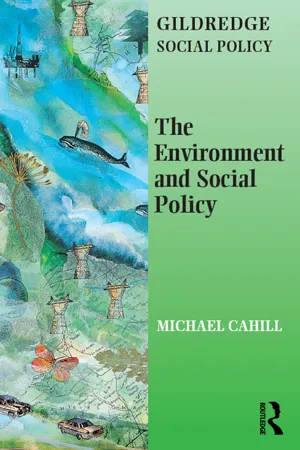
Focusing on human welfare and the environment from a social policy perspective, this text shows how environmental concerns are becoming increasingly central to policy-making and discusses the roles of central and local government in relation to environmental issues.
The Environment and Social Policy covers the following contemporary topics: sustainability, Local Agenda 21, green ideas, environmental health, housing and urban development, food, work, globalisation. Each chapter starts with an overview of the topics and ends with a list of key points and a guide to further reading. Core concepts are clearly explained and illustrated throughout this text which provides students with a concise and up-to-date summary of what they need to know.
- 192 pages
- English
- ePUB (mobile friendly)
- Available on iOS & Android
eBook - ePub
The Environment and Social Policy
About this book
Information
Chapter 1
Sustainability and social policy
Outline
Industrialisation brought untold wealth and transformed the way of life of the populations of the rich world in the nineteenth century, but it also produced social problems: poor housing, ill-health and poverty. Government intervention in the form of social policies was aimed at alleviating these social problems. Industrialisation and urbanisation, which by the late twentieth century had become a global phenomenon, resulted in serious environmental problems: resource depletion, climate change and widespread pollution. Consumer societies have exacerbated the environmental problems through their large-scale use of natural resources, their polluting processes and the transport infrastructures that they have created. The reaction to the developing environmental crisis has been widespread and has taken a variety of forms. This chapter focuses on the concept of sustainability because it has dominated environmental politics, and also considers the connections among consumer societies, the environmental agenda and social policy. It also examines the ways in which the environmental debate has linked with the debate on social inequality.
Sustainability
Sustainability is a ‘hurrah word’ in contemporary political debate – everyone is in favour of it just as we are all in favour of democracy or justice. The government has taken to spraying the word all over many of its policy papers and reports: sustainable transport policy, sustainable housing, sustainable health care. Sustainability and sustainable development are often used interchangeably, and they are at times used in this way in this book, but the two terms need to be distinguished: sustainability is the end-state, whereas sustainable development is the means to achieving that end. Sustainable development has been best defined as development which ‘meets the needs of the present, without compromising the ability of future generations to meet their own needs’ (Brundtland Report, 1987: 8). Sustainability and sustainable development are ambitious concepts for they integrate environmental, economic and social policy. This book is about the ‘how to’ policies which would enable a sustainable society to emerge, and so it is concerned with ‘sustainable development’ in social policy. Jacobs has identified six core themes in the contemporary debate on sustainability. These are:
• integration of environmental considerations in economic planning;
• futurity: concern about the impact of contemporary decisions on future generations;
• environmental protection: policies to reduce environmental damage;
• equity: commitment to meeting the basic needs of the poor today and in the future;
• quality of life: economic growth does not equate with human well-being;
• participation: sustainable development requires as much involvement as possible by individuals and groups if it is to work (Jacobs in Dobson, 1999: 26–7).
Social policy
Social policy is concerned with the satisfaction of human needs – for shelter, for food, etc. – for those people whose needs cannot be met by the working of the economic system because they are perhaps too poor, too old or too young or they are too disabled to work. The meeting of need has an environmental impact: how we produce food, organise housing and look after our health-care needs, for example, have environmental consequences and will affect future generations.
Social policy is central to discussions of sustainability because it is a major means by which governments provide a minimum level of support for the population. It has been a central feature of government policies in the rich world since 1945. Although the administrative and organisational arrangements differ widely, the ‘welfare state’ has been a component of government policy in most developed countries. The welfare state provides income maintenance, education, housing, health care and social services. Welfare states have been one of the achievements of most industrial societies, but these services are not immune from environmental considerations – they have an impact on the environment through their buildings, policies and the activities of their work force. Social policy can be used to reduce inequalities within society, and there is a variety of ways in which this can be done, e.g. by taxation which redistributes wealth or by spending programmes which benefit those living in poor areas. It could also involve the reduction of inequalities which result from the impact of environmental pollution. Social policy emerged in the nineteenth century as a response to the social problems produced by the impact of humanity on the environment. This is explored in the next section.
Industrialisation and the environment
The natural environment is the basis upon which human life and achievements are built – we cannot exist apart from it, and until the second half of the twentieth century nature was the dominant partner in the relationship between human beings and nature. Since the onset of industrialisation in the middle of the eighteenth century in Britain, humankind has been utilising natural resources – coal, water, minerals – at an accelerating rate. Social policy was a reaction to the social problems produced by the twin pressures of industrial processes and urbanisation. A great many of these social problems were related to the environmental damage produced by industrialisation and urbanisation: rivers were polluted by factories and became a health hazard and the dumping of industrial waste into streams had the result of contaminating clean water supplies. Atmospheric pollution was widespread in industrial areas from the coal used by furnaces, railway engines and gasworks. Coal was the major source of domestic heating and energy and thus added to the pollution.
After 1945 industrialisation and urbanisation steadily became global realities and the pressures on the environment increased substantially. We have now reached the point at which nature has been profoundly affected by the enterprise of human beings, and in our time nature is now responding to the stress and despoliation it has suffered. Nature is delicately balanced with complex interrelationships between species. The growing power of humanity and the way in which humans have regarded nature as seemingly an inexhaustible source of resources for human activity has changed the balance between humans and nature. Atomic weaponry meant that since the 1940s human beings have had the means to destroy nature over a wide area and indeed, if used, the present stock of nuclear devices could destroy the world many times over. The burning of fossil fuels and the clearing of forests which have contributed to global warming are the results of this indifference to the impact of human activity on nature. The result of industrialisation and the pressure of human population has been widespread environmental damage, and this has accelerated in recent years.
Brundtland Report
The contemporary usage of the concept of sustainability can be traced back to the report of the international commission headed by Gro Brundtland, a former Norwegian Prime Minister, which examined the relationship between development and environmental issues. The report defines sustainable development as ‘development that meets the needs of the present without compromising the ability of future generations to meet their own needs’ (Brundtland Report, 1987: 43) (Box 1.1). Pointing out that the essential needs of millions of people – for shelter, for food, for jobs – were not being met, the report proposed economic growth which did not endanger the planet’s life-support systems of water, soil and the atmosphere. The report was the first major document which combined the perspective of the problems facing the developing world – starvation, overpopulation, urbanisation, public health – and the environmentalist position which had begun to exercise the minds of so many in the developed world. In so doing, it attempted to bridge the divide between the green position that economic growth is harmful and the mainstream economic and political stance that growth is essential for the continuing harmony and prosperity of society. Brundtland’s formulation of ‘sustainable development’ was acceptable across the political spectrum. From the developing country perspective, the report emphasised the essential needs of the world’s poor, which the report stated should be accorded ‘overriding priority’. From the green position, Brundtland adopted the idea of limits that would be imposed by the state of technology and social organisation on the ability of the environment to meet needs today and in the future.
Box 1.1 The Brundtland Report
Sustainable development
Humanity has the ability to make development sustainable – to ensure that it meets the needs of the present without compromising the ability of future generations to meet their own needs. The concept of sustainable development does imply limits – not absolute limits but limitations imposed by the present state of technology and social organisation on environmental resources and by the ability of the biosphere to absorb the effects of human activities. But technology and social organisation can be both managed and improved to make way for a new era of economic growth. The Commission believes that widespread poverty is no longer inevitable. Poverty is not only an evil in itself, but sustainable development requires meeting the basic needs of all and the extending to all the opportunity to fulfil their aspirations for a better life. A world in which poverty is endemic will always be prone to ecological and other catastrophes.
Meeting essential needs requires not only a new era of economic growth for nations in which the majority are poor, but an assurance that those poor get their fair share of the resources required to sustain that growth. Such equity would be aided by political systems that secure effective citizen participation in decision making and by greater democracy in international decision making.
(Brundtland Report, 1987: 8)
Contained in the Brundtland definition is the idea of caring for future generations. Often described as environmental stewardship for future generations, this struck a new note in the environmental debate.
Given that a sustainable world is one where resources are used prudently, meaning that they will still be available for future generations, this can mean that a number of natural resources will be substituted by human-made products in order to conserve natural resources, although this too will necessitate the use of some other resources. Another way to restrict the use of resources of this kind – for example wood, coal, minerals – is to reduce the demand for them. For instance, consumers might be persuaded not to demand mahogany, with a consequent reduction in tree felling in the Brazilian rain forest. It is not only mineral resources that are threatened. It is also the animals and plants of the natural world that are endangered and need protection as they are hunted for meat, their fur or medicinal properties. Therefore, sustainability has to apply to humankind’s relationship with the animal and plant world as well. It might be said that we should preserve species for the sake of our descendants, who should be able to live in a world where, for example, tigers and elephants still exist. Apart from this, species have their own right to exist, a right which is independent of the pleasure they afford to human beings or the meat they supply.
Sustainability also has a strong social justice component. If we wish, according to the definition, ‘to meet the needs of the present’, then those needs will include, at least in most people’s understanding, the need to have adequate food, shelter and water. Many people in the world today do not have these necessities. The United Nations Food and Agriculture Organization estimates that there are 841 million people in the world – living in developing countries – who suffer from protein energy malnutrition, i.e. they do not receive sufficient protein calories. [But this is also a world where 600 million people are estimated to be overweight – 97 million of these are in the USA, where 55 per cent of the adult population is overweight, and the UK is not far behind with 51 per cent of its adult population being overweight (Brown in Brown and Flavin, 1999: 117]. There are more than fifty countries which are unable to provide safe water for domestic use, and 20 per cent of the world’s population has only limited access to clean water because of pollution of the supply (Instituto del Tercer Mundo, 1997: 70; Carley and Spapens, 1998: 102). Adequate shelter is denied to 600 million people world-wide. Over 75 per cent of the world’s population lives in developing countries, where urbanisation is proving to be a powerful magnet drawing people to the cities. Often, the only places they can find to live are illegal settlements on the outskirts, where they have to drink contaminated water and endure poor housing and health conditions (O’ Meara in Brown and Flavin, 1999: 134). These basic resources for a civilised life are absent from many people’s lives for numerous reasons: these include the working of an economic system which forces them to trade their crops on a world market for low prices or the fact that they live in a part of the world which is ill-favoured by nature, and they find it very hard to scratch a living because of drought and poor soil.
In the rich world, if we accept that we should restrain our use of natural resources for the sake of future generations, then we have to remember that, with the expected rise in world population from 6 billion to 9.4 billion by the year 2050, there will be many more people wanting those resources. If they were divided equally – which of course they will not be – then each person would receive less (L.R. Brown et al., 1998). Sustainability involves taking a global perspective which includes consideration of the millions of people living in the poor world. This should mean the countries of the northern hemisphere taking fewer resources and living with fewer consumer goods. In fact, what has happened over the last quarter of a century has been the complete reverse with industrial societies using their increased wealth to enjoy even higher levels of consumption.
The rise of the consumer society
Since 1945, the majority of the population of the rich industrial nations have enjoyed a higher living standard than has ever been achieved before in world history. During the post-war years, labour-saving domestic appliances such as washing machines, fridges and vacuum cleaners found their way into working-class homes. With rising real incomes by the late 1950s, the ‘affluent society’ had emerged, and the Prime Minister Harold Macmillan could tell the British people in a famous phrase that ‘you have never had it so good’. The affluent working class began to enjoy pleasures that were previously the exclusive preserve of the wealthy and the middle class. Cars and foreign holidays were now within the budget of many working people. In the 1950s and 1960s, the impact of a consumerist way of life on the natural environment was not discussed. But by the early 1970s, the mounting evidence of the damage that the industrial way of life was causing led a sizeable body of opinion to question the direction of advanced industrial societies.
The beginning of the contemporary concern with the environment dates from the early 1970s, when there was a real fear that the earth’s stock of minerals and natural resources was going to be exhausted within a finite period coupled with the realisation of the damage which had already occurred to the environment. This was a recognition that economic growth had environmental consequences, although they might be experienced more by future generations than by contemporaries. The Limits to Growth report (Meadows et al., 1972) was a landmark document warning industrial societies that time was running out for them as resources would only last for a finite period. The oil price rise by the Arab states in 1973 precipitated a crisis in the Western economic order which led to the first energy-saving measures – insulation, lower speed limits on the roads, reduction in the use of motor cars, some petrol rationing – during the period 1973–4. This coincided with the end of the long post-war boom in which employment levels had been high. This proved to be a temporary pause, however, as the growth of consumer societies and the era of cheap oil is still not at an end.
Over the past two decades, the growth of consumer societies has been unremitting, with newly industrialising countries aspiring to the range of goods and services which the people in the affluent First World enjoy. This consumption culture shows no signs of losing its fascination for the great majority of the population in First World countries. Shopping has become the principal leisure activity in the UK. The choice involved in consumption is at the heart of our society, and for many how we consume defines our identity just as much as the job that we do.
The emergence of a global communications network and a global market means consumer culture is now much more visible to the populations of the poor world, and rich world versions of the ‘good life’ appear to be increasingly influential. Consumerism has gone global. The growing popularity of long-distance air travel means that there are increasing encounters between rich and poor worlds, with the poor world chasing the dollars of the rich. Environmental consequences include the displacement of local people for the building of luxury hotels and golf courses, damage to the water table and the migration of people from the land to work in the tourist industries.
It is sobering to remember that one meaning of consume is ‘to destroy’. Consumer societies are particularly damaging to the environment as their benefits depend upon the use of non-renewable energy: gas, electricity and oil. They generate vast quantities of waste by cultivating dissatisfaction among the population via the medium of advertising, which can only be assuaged by buying more goods. Twenty per cent of the world’s population, mainly living in the West, consume 80 per cent of the world’s resources (McLaren et al., 1998: xiii). The vast quantities of goods to be found in the shops of the consumer societie...
Table of contents
- Cover
- Half Title
- Title Page
- Copyright Page
- Dedication
- Table of Contents
- Illustrations
- Acknowledgements
- 1 Sustainability and social policy
- 2 Sustainable development
- 3 Local Agenda 21
- 4 Green ideas
- 5 Environmental health
- 6 Housing and urban development
- 7 Food
- 8 Work
- 9 One world
- Bibliography
- Index
Trusted by 375,005 students
Access to over 1.5 million titles for a fair monthly price.
Study more efficiently using our study tools.
Frequently asked questions
Yes, you can cancel anytime from the Subscription tab in your account settings on the Perlego website. Your subscription will stay active until the end of your current billing period. Learn how to cancel your subscription
No, books cannot be downloaded as external files, such as PDFs, for use outside of Perlego. However, you can download books within the Perlego app for offline reading on mobile or tablet. Learn how to download books offline
Perlego offers two plans: Essential and Complete
- Essential is ideal for learners and professionals who enjoy exploring a wide range of subjects. Access the Essential Library with 800,000+ trusted titles and best-sellers across business, personal growth, and the humanities. Includes unlimited reading time and Standard Read Aloud voice.
- Complete: Perfect for advanced learners and researchers needing full, unrestricted access. Unlock 1.5M+ books across hundreds of subjects, including academic and specialized titles. The Complete Plan also includes advanced features like Premium Read Aloud and Research Assistant.
We are an online textbook subscription service, where you can get access to an entire online library for less than the price of a single book per month. With over 1.5 million books across 990+ topics, we’ve got you covered! Learn about our mission
Look out for the read-aloud symbol on your next book to see if you can listen to it. The read-aloud tool reads text aloud for you, highlighting the text as it is being read. You can pause it, speed it up and slow it down. Learn more about Read Aloud
Yes! You can use the Perlego app on both iOS and Android devices to read anytime, anywhere — even offline. Perfect for commutes or when you’re on the go.
Please note we cannot support devices running on iOS 13 and Android 7 or earlier. Learn more about using the app
Please note we cannot support devices running on iOS 13 and Android 7 or earlier. Learn more about using the app
Yes, you can access The Environment and Social Policy by Michael Cahill in PDF and/or ePUB format, as well as other popular books in Politics & International Relations & Health Care Delivery. We have over 1.5 million books available in our catalogue for you to explore.