
eBook - ePub
Managing Teaching and Learning in Further and Higher Education
- 224 pages
- English
- ePUB (mobile friendly)
- Available on iOS & Android
eBook - ePub
Managing Teaching and Learning in Further and Higher Education
About this book
The role of the teacher/lecturer is to manage and facilitate the process of teaching and learning in a two-way interaction between teacher self and taught other. This handbook covers ways of managing the teaching, learning and assessment process to improve students' learning. It guides readers through paths of enquiry and reflection to create a learning programme designed to meet students' specific needs. The focus includes student learning and tutors' teaching and how these are effected by institutional arrangements; the interpersonal skills of tutors; and course design and teaching methods.; The text includes enquiry tasks which invite the reader to explore issues introduced in each chapter in the context of their own institution. An annotated reading list at the end of each chapter enables the reader to take their particular interests further.
Information
Chapter 1
Teaching and Learning as a Management Process
This book is designed to appeal to open-minded and lively tutors who have a deep interest in developing their own teaching expertise within further or higher education, as well as in helping their students to become successful in their subject and able to make sense of the issues they will face in a diverse society.
Tutors new to teaching in colleges and universities are increasingly involved in new contracts requiring study and qualifications to develop basic and advanced teaching skills and an understanding of the learning process. More experienced tutors are facing a changing climate of quality control and academic standards. Some tutors recognize their need for professional updating. Many are interested in continuing professional development as part of their continuing quest for excellence in teaching. Yet others are leading professional development programmes for colleagues. You may fall into one of these categories; if so you will find this book useful.
We have tried to cover the management of teaching, and learning as it is related to any subject from the creative arts, through humanities to technical and vocational subjects. The book could be used in various ways. You might wish to explore new teaching, learning and assessment methods or consider models of the learning process itself and new ways of thinking about it. On the other hand you may decide to use the book for more specific purposes. You might work systematically through the book as a course or professional development text. Alternatively the book has been designed so you can dip into particular chapters to help you deal with a specific and immediate problem.
We have located the management of teaching and learning within the real, entrepreneurial climate of further and higher education in the 1990s. Thus the requirements many tutors face of having to meet the needs of new client groups and to build new kinds of educational programme are considered. The many interest groups who have some sort of relationship with or influence over the work of the tutor are recognized, including students, colleagues, institutional managers, employers, funding bodies and the community at large.
The book contains material about ways of managing the teaching, learning and assessment process to improve students' learning and benefit the learning process. This is seen as a process of management of self and others. It should help you to create an appropriate learning programme for your students and develop, through the process of enquiry and reflection, a range of teaching and learning strategies to meet your students' needs. We discuss the issues involved in the use of a wide range of assessment techniques to monitor student progress and enable self-assessment and a range of self, peer and student monitoring and evaluation techniques.
The book is written within a clear value framework, which includes the principles embedded within the reflective practitioner model (this is described later in this chapter) as they apply to further and higher education. We believe that part of the tutor's role is to help their students towards a reflexivity, also. This implies a valuing of student autonomy, collaboration and facilitation rather than an unqualified or simple didactic model of teaching or a transfer model of learning. Such a theory of teaching and learning emphasizes education as a holistic process, which recognizes feelings and relationships as well as ability as influences on learning. The real dilemmas that this model poses for a system of mass education are recognized, and some methods resolving some of the dilemmas discussed.
The Rationale for the Book
We wished to provide a handbook for teaching within the post-compulsory education and training sector with an emphasis on an entrepreneurial climate, but at the same time retaining a clear educational philosophy. We have aimed to provide an introduction to a model of informed action based on enquiry into teaching and learning as part of a management process. The main intention is to help you to reflect on your personal and professional practice and development in the light of evidence, assess your future development needs, and make plans for continuing professional development with the aim of improving practice through monitoring and evaluation.
Your practice and professional development is rooted in a personal and social context. The book should help you to understand what underlies your felt needs, satisfactions and dissatisfactions. At a time when external pressures seem to dictate educational decision making, this should help you to gain a sense of control over your own practice. The aim is to enable you to find out what sort of skills and values you need in order to do your job well. Although enquiry tasks are suggested, they should leave you scope to follow up your own concerns.
We wanted to develop material within the book which would address some of the difficult interpersonal and management issues often faced by tutors. These include the development of personal and professional coping strategies. In our view reflective practice involves developing key management skills and understandings, such as the management of people, resources and provision.
The Format of the Book
We do not intend to give a definitive guide to each issue. The chapters provide you with a starting point for development and enquiry or some starting points for dealing with immediate problems. In the second case you might refer to a synopsis of each chapter (and perhaps read the full chapter when you have more time). The style is practical, with concrete suggestions to try out and reflect upon. Research is quoted where appropriate, but it is not a research-based book.
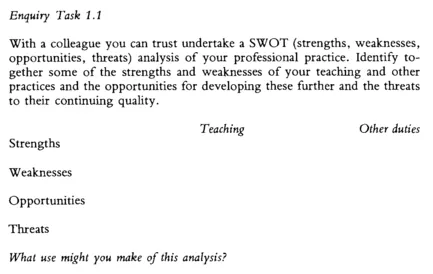
We hope you will contextualize the material through the suggested enquiry tasks interspersed within each chapter. These have been designed to enable you to collect data from within your institution and reflect upon the operation of ideas contained within the section. You will need a trusted colleague to help you with some of the tasks. The ongoing reflective diary at the end of each chapter is designed to form one model of interaction with the material.
Because we can only touch upon many issues in a book of this length, there is a short annotated reading list at the end of each chapter, designed to help you to target further reading and take forward those issues you find particularly relevant.
If you are working through the book systematically as a personal development text, you may find it useful to find a more experienced colleague, or perhaps a colleague who is interested also in developing their teaching, who can act as a mentor and give you regular feedback on the enquiry tasks and your reflective diary.
The Reflective Teacher Model
Reflective teaching is an active process of learning from experience and evaluating your ideas, feelings and behaviour in the light of supporting evidence and discussion. It involves asking questions about your assumptions, your tacit definitions of knowledge and the basis for these ideas. It involves discovering and critically examining your beliefs and values. There are various models of this process (Dewey, 1916; Zeichner, 1982). The basic premise however is that you start with actual experience, and from that experience frame your own problems. Since our experience is different from yours and we bring our own experience to the situations we describe, we have found it hard to define problems which we could be sure would be relevant to you. The aspects we found salient in a particular situation, you might not. Therefore your learning from our descriptions of experience depends on you actively making sense of it in your own terms.
The starting point for your development as a reflective practitioner is the problems you face in relation to the way you construe your role and the dilemmas inherent in it for you. The usual motivation for examining beliefs and practices is a felt concern, worry or disharmony. The enquiry tasks in this book are meant to help you to investigate your own 'felt concerns'. For example, if you felt that something is amiss with the assessments you set, the enquiry tasks in Chapter 4 might help you to name your problems and suggest ways of investigating them. The reflective diary might help you to look at the emotional baggage that you bring with you to teaching, learning and assessment, which might be obstructing your acknowledgment of certain salient features in the situation. The tasks should ideally be discussed with a colleague, since they will be able to provide you with other viewpoints.
The critical point about reflective practice is that it requires a commitment to learning from experience and from evidence, rather than to learning certain 'recipes' for action. Even if you start with recipes, they need to be explored and analysed for their underlying assumptions and effects as you gain in confidence. This process of critical enquiry should be reflexive, that is responsive to your own needs and the context in which you work, but also critical of the existing educational provision and ideology (including your own). The analysis involves not just your practice, but also the social, moral and political context for that practice.
Reflective practice does not require a perfect setting. Indeed it is the means of finding solutions which transform the dilemmas inherent in teaching and the institutional context. The development of technical skills such as voice control and questioning are a necessary but not sufficient condition for reflective practice. It is essential to develop other skills including the ability to work as part of a team; to observe using a variety of methods; to communicate and exchange ideas; to analyse and evaluate data collected; and to criticize the status quo from a moral and a political point of view. Some issues will raise dilemmas for which transformational solutions must be found. For instance, certain solutions may require you to transform your definition of the problem, your existing view of yourself, other people or of education. We have found that it is possible to develop transformational solutions if you develop key qualities, in particular, open-mindedness, responsibility and wholeheartedness (see Zeichner and Teitlebaum, 1982; Isaac and Ashcroft, 1986; Ashcroft, 1987; Ashcroft and Tann 1988; Ashcroft and Griffiths, 1989).
Open-mindedness implies that you wish to seek out alternative viewpoints. You do not automatically accept or reject the prevailing educational orthodoxy of your institution or the educational system, but you do examine it in the light of your experience and compare your ideas with those of students, colleagues, educationalists and others outside of education. Reflective practice is therefore an active process of questioning and data collection. It may challenge existing systems. Many of the enquiry tasks within this book are designed to involve you in the systematic investigation of alternative perspectives and interpretations of your own practice and educational values and those prevailing within your institution. This is the reason that they sometimes require you to discuss your findings with a colleague.
Responsibility involves you in the consideration of the long-term as well as the short-term consequences of the actions of all those involved in the teaching situation, including your own practice. It requires you to move beyond utilitarian consequences of 'what seems to work' in order to take an essentially moral stance. It requires a consideration of the worthwhileness of action at all levels. The enquiry tasks and reflective diary entries in this book are designed to help you to build up and continuously examine your model of teaching, investigate your actions in the light of this model and to direct your attention to the social, political and economic context of educational decisions.
Wholeheartedness implies that responsibility and open-mindedness become constant attributes which are not confined to particular situations, but permeate the whole of your professional life. In particular, they are not assumed in order to gain personal advantage. Taking an open-minded and responsible stance will not automatically be good for your career prospects. Questioning the dominant hegemony and prevailing practices may result in better practice, but will not always make you popular. This can be particularly problematic if you are experiencing job insecurity or work in an institution with an ethos inimical to change. (It is not unknown for 'whistle blowers' to lose their jobs.) In these circumstances, your sphere of reflective action may be restricted to a developing expertise with students and developing an understanding of the dilemmas you face and ways of making them more manageable.
Reflective practice is an ideal to work towards throughout a professional lifetime. It may be only fleetingly achievable, but the journey towards it is the point. Its value is as a vehicle for a continuous renewal and development of your professional practice and understanding.
Teaching and Learning as a Management Process
We have suggested above that the most appropriate process for fostering many of the skills necessary for reflective practice is through that of critical enquiry. We have found that certain conditions facilitate this. These include group work and a consideration of the wider context for action (Ashcroft and Griffiths, 1989).
In order for you to take alternative viewpoints seriously and to research the perspectives of others it is necessary that you seek to work as part of a team. You may need to look for creative ways to build the reality of team work into the teaching and assessment system. Where institutional systems have been built on teacher autonomy or are resistant to change, any team work may have to be informal, for instance, through discussion and advice with trusted colleagues, as well as through collaborative work with your students.
New tutors are often overwhelmingly concerned with immediate survival. As a reflective practitioner, you may have to struggle to rise above this in order to root your practice in the real dilemmas facing society, including issues of equal opportunities, at a time of scarce resources, competing definitions of quality and cost effectiveness and so on. We believe that more frustration results from ignoring these dilemmas.
The sort of enquiry that underpins reflective practice is not for people who want simple answers to simple questions. Unfortunately, simple solutions tend to produce their own problems since reality is complex and educational reality is also relative. For instance, it is easy to be popular w...
Table of contents
- Cover
- Dedication
- Title
- Copyright
- Contents
- Chapter 1 Teaching and Learning as a Management Process
- Chapter 2 Learning and the Reflective Practitioner
- Chapter 3 Personal Development and Interpersonal Skills
- Chapter 4 Assessment
- Chapter 5 Teaching
- Chapter 6 Open and Distance Learning
- Chapter 7 Aids to Learning
- Chapter 8 Counselling and Student Support
- Chapter 9 Equal Opportunities
- Chapter 10 The Evaluation of the Teaching and Learning Process
- Chapter 11 Action Research
- Chapter 12 Conclusion
- Index
Trusted by 375,005 students
Access to over 1.5 million titles for a fair monthly price.
Study more efficiently using our study tools.
Frequently asked questions
Yes, you can cancel anytime from the Subscription tab in your account settings on the Perlego website. Your subscription will stay active until the end of your current billing period. Learn how to cancel your subscription
No, books cannot be downloaded as external files, such as PDFs, for use outside of Perlego. However, you can download books within the Perlego app for offline reading on mobile or tablet. Learn how to download books offline
Perlego offers two plans: Essential and Complete
- Essential is ideal for learners and professionals who enjoy exploring a wide range of subjects. Access the Essential Library with 800,000+ trusted titles and best-sellers across business, personal growth, and the humanities. Includes unlimited reading time and Standard Read Aloud voice.
- Complete: Perfect for advanced learners and researchers needing full, unrestricted access. Unlock 1.5M+ books across hundreds of subjects, including academic and specialized titles. The Complete Plan also includes advanced features like Premium Read Aloud and Research Assistant.
We are an online textbook subscription service, where you can get access to an entire online library for less than the price of a single book per month. With over 1.5 million books across 990+ topics, we’ve got you covered! Learn about our mission
Look out for the read-aloud symbol on your next book to see if you can listen to it. The read-aloud tool reads text aloud for you, highlighting the text as it is being read. You can pause it, speed it up and slow it down. Learn more about Read Aloud
Yes! You can use the Perlego app on both iOS and Android devices to read anytime, anywhere — even offline. Perfect for commutes or when you’re on the go.
Please note we cannot support devices running on iOS 13 and Android 7 or earlier. Learn more about using the app
Please note we cannot support devices running on iOS 13 and Android 7 or earlier. Learn more about using the app
Yes, you can access Managing Teaching and Learning in Further and Higher Education by Kate Ashcroft,Lorraine Foreman-Peck in PDF and/or ePUB format, as well as other popular books in Education & Education General. We have over 1.5 million books available in our catalogue for you to explore.