
- 320 pages
- English
- ePUB (mobile friendly)
- Available on iOS & Android
eBook - ePub
Weak States in the International System
About this book
This work defines weak states and their strengths and weaknesses. It examines why they are weak and their position in different international systems as well as their economic positions.
Information
Chapter I
Definitions and Characteristics of Weak States
If the notion of war were unknown in international relations, the definition of “small power” would have no significance; just as in the domestic life of a nation it has no significance whether one man is less tall or has a weaker physique than his fellow citizen.
Laszlo Reczei1
The term “smaller country” seems to be reserved for large countries with small populations, small countries with large populations, small countries with small populations, and sometimes countries of any size that mostly mind their own business in world affairs.
Herbert Goldhamer2
Humpty Dumpty: “When I use a word, it means just what I choose it to mean—neither more nor less.”
Lewis Carroll3
The behavior of states in the international system is largely determined by the power relations and differentials among them. Order within the system is continually threatened by the possibility that some states will resort to force or war in order to improve their relative positions. Because states frequently do coerce one another—or threaten to do so—it is important to analyze their respective capacities to protect, maintain, or further their national interests.
The traditional theories of international relations take the unequal distribution of strength among states into account by recognizing the existence of a pecking order of states based upon five gradations: super powers, great powers, middle powers, small powers (states), and mini-states.
The term “small power” appears frequently in the literature,4 and it has a long tradition of usage. Yet it is a self-contradictory term, both semantically and logically. The main characteristic of weak states is, indeed, their lack of power or strength, and hence they are continuously preoccupied with the question of survival.
Raymond Aron refers to the semantic problem as follows:
We avoid here the common expression “small powers”, so as not to introduce a confusion in vocabulary. The use of the word power to designate the actors and not merely the capacity of the actors is self-explanatory. The rivalry of power being part and parcel of international life, we identify the actors and their capacity for action, and establish a hierarchy of actors as a function of their capacity.5
Aron, like the German scholars, employs the phrase “small state” (Kleinstaat) which, though more logical than “small power” (“Kleinmacht” would sound absurd!), is not entirely satisfactory. In the study of international relations, it is not the size of a state which matters, but rather its relative strength. Strictly speaking, a small state should be small in area. This term, however, has been applied to countries with enormous territories, such as Saudi Arabia, Chad, Mongolia, Libya, and Mauritania. To be exact, the expression “small state” should be used to describe only those states which both lack strength and are small in territory.
The term “weak states” has been adopted here because it can be applied not only to small, weak states but to countries of considerable area which are, nevertheless, weak and therefore vulnerable. When the term “small states” appears within quoted material, it should be understood to mean “weak states.”
The international power hierarchy—super powers, great powers, middle powers, weak states, and mini-states—might be illustrated by a pyramid in which the lowest layer, representing the weakest states, would include the greatest number of states. But it is more accurate to depict this hierarchy as a continuum:
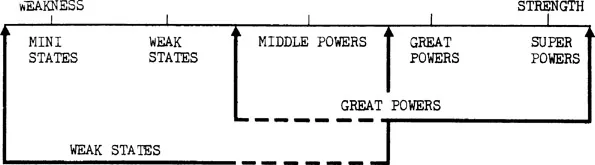
Fig. 1
This study will focus on weak states, those on the left side of the continuum (or the bottom layers of an imaginary pyramid).
The Great Powers
The simplest definitions of weak states are negative. For example: “A small state is any state in the international system that does not belong to the category of the powers….”7 An explanation similar to that lexicon definition has been given by Paul Herre:
… within the European historical development one should treat as Small States all those states which in the prevailing political system do not belong to the Great Powers.8
Other German scholars have simply referred to weak states as Nichtgrossmachten (non-great powers).9
Such definitions fail to characterize weak states positively; nor do they reveal enough about the great powers to make a derivative definition of weak states possible.10 It is necessary, therefore, to define the term “great power.” Historically, there has been general agreement on what states are in the great-power category, and since this class is limited in number, common denominators are more readily apparent.
In modern times, the possession of nuclear weapons distinguishes the great powers from the rest of the states.11 It is obvious, though, that prior to 1945 nuclear weapons could not have served as a criterion. Thus the standards used to define the great powers, as well as other states in the international system, are not static or permanent. Technological breakthroughs, changes in values, changes in perception by the states involved, and victories and defeats all lead to changes, often rapid and unexpected, in the power classification of states.12
The changing nature of such a definition becomes clear when one considers the growing number of states which may produce nuclear and conceivably even thermonuclear weapons, and thus join the hitherto exclusive atomic club of the great and super powers. The capability of additional countries to produce nuclear weapons also indicates the possibility of upward mobility in the international Hierarchy.13 Yet would the production of nuclear weapons by countries like Sweden, Israel, Switzerland, Brazil, and Egypt turn them instantly into great powers? The answer is obviously no. Under certain conditions, that achievement might add to their military power, bargaining leverage, and prestige; but under other conditions the development of nuclear weapons could lead to the imposition of pressures that might actually weaken rather than strengthen their position.14
The super powers at the extreme right of the continuum can be differentiated from the more numerous great powers by their nuclear development: the quantity of nuclear weapons available to them (abundance and overkill versus sufficiency);15 technological advancement in terms of miniaturization of nuclear devices; the sophistication of their delivery system; differences in their second strike capability; and their ABM and MIRV capabilities. In the future, however, different technological criteria may be suggested to differentiate between the super powers and the great powers, such as their space programs, which are out of the reach of any great power.
It is clear that more than one set of criteria is needed to define the position of a state in the international system. Nuclear weapons, the criterion used so far, will probably come to be only a necessary, not a sufficient, condition to determine whether a country can be classified as a militarily great or super power. The same thing is true of the other commonly used criteria.
Historically, the single most important yardstick for the measurement of military power has been the population size of a given state. This remained the basic standard for evaluating the military might of states well into the industrial-technological age. Indeed, until the outbreak of the First World War, despite all technological advances “the Balance of Power was directly affected by the population changes that took place during the period [among the major powers].”16 The larger the population, the larger the army a state could put into the field, and God usually favored the largest number of battalions.
Of course, organizational qualities and the tactical skill of great captains of war could, to a certain extent, help compensate for small populations. This accounts for the temporary rise of less populous states to the ranks of the great powers of their times—states like the Netherlands, Sweden under Gustav Adolf, and Prussia under Frederick the Great.17 Population size, then, is a necessary but not a sufficient condition for classifying a state as a great power.
Quite a few states whose populations are as great as or greater than those of Great Britain, France, West Germany, Japan—countries such as India, Indonesia, Brazil, Mexico, Nigeria, Italy—are not accepted as great powers. Indeed, a highly populated state cannot always utilize the manpower available to it. Although China’s population is at least three times greater than Russia’s, the Chinese army is smaller than that of the USSR and not so well equipped. It is much more difficult for a state that is less developed economically and socially to expand and equip a modern military force than it is for a modem industrialized society to do so.
In the 1970s, what counts is not the absolute size of a population but rather the so-called “effective population”,18 that is, the part of the population which can be armed and educated to operate modem sophisticated weapons. Additional criteria must therefore be introduced to correlate a nation’s population with its economic, industrial, and social capacity.19 Two major indicators are the Gross National Product (GNP) and the GNP per capita.
The overall GNP enables one to compare the absolute size of the economic output of a country with that of any other state. This index, however, is not completely satisfactory for the measurement of a state’s relative power. Canada with a population of 21.4 million produces a GNP o...
Table of contents
- Cover
- Half Title
- Title
- Copyright
- Dedication
- Contents
- List of Tables
- List of Figures
- List of Illustrations
- Acknowledgments
- Preface to this Edition
- Introduction
- Chapter I. Definitions and Characteristics of the Weak States
- Chapter II. Internal Sources of Weakness and Strength of the Weak States
- Chapter III. External Sources of Weakness and Strength of the Weak States
- Chapter IV. The Position of Weak States in Different International Systems
- Chapter V. The Economic Position of the Weak States in the International System
- Conclusions
- Appendix A A Note on the Domestic Sources of the Foreign Policy of Weak States
- Appendix B The ‘New’ International Norms of Conduct among States and the position of Weak States
- Appendix C The Potential Impact of Modern Military Weapons Technology on the Military Position of Weak States
- Bibliography
- Index
Trusted by 375,005 students
Access to over 1.5 million titles for a fair monthly price.
Study more efficiently using our study tools.
Frequently asked questions
Yes, you can cancel anytime from the Subscription tab in your account settings on the Perlego website. Your subscription will stay active until the end of your current billing period. Learn how to cancel your subscription
No, books cannot be downloaded as external files, such as PDFs, for use outside of Perlego. However, you can download books within the Perlego app for offline reading on mobile or tablet. Learn how to download books offline
Perlego offers two plans: Essential and Complete
- Essential is ideal for learners and professionals who enjoy exploring a wide range of subjects. Access the Essential Library with 800,000+ trusted titles and best-sellers across business, personal growth, and the humanities. Includes unlimited reading time and Standard Read Aloud voice.
- Complete: Perfect for advanced learners and researchers needing full, unrestricted access. Unlock 1.5M+ books across hundreds of subjects, including academic and specialized titles. The Complete Plan also includes advanced features like Premium Read Aloud and Research Assistant.
We are an online textbook subscription service, where you can get access to an entire online library for less than the price of a single book per month. With over 1.5 million books across 990+ topics, we’ve got you covered! Learn about our mission
Look out for the read-aloud symbol on your next book to see if you can listen to it. The read-aloud tool reads text aloud for you, highlighting the text as it is being read. You can pause it, speed it up and slow it down. Learn more about Read Aloud
Yes! You can use the Perlego app on both iOS and Android devices to read anytime, anywhere — even offline. Perfect for commutes or when you’re on the go.
Please note we cannot support devices running on iOS 13 and Android 7 or earlier. Learn more about using the app
Please note we cannot support devices running on iOS 13 and Android 7 or earlier. Learn more about using the app
Yes, you can access Weak States in the International System by Michael I. Handel in PDF and/or ePUB format, as well as other popular books in Politics & International Relations & Military & Maritime History. We have over 1.5 million books available in our catalogue for you to explore.