![]()
Chapter 1
Introduction to Management
Management, in the context of healthcare organizations, can be defined as the science and art of guiding the human and physical resources of an organization toward satisfying the health related needs and expectations 1 There is a subtle difference between “needs” and “expectations.” A client or community has certain “expectations” from the services providers. The “needs” of a client or community are those that are felt by them or assessed by healthcare professionals. Both are important from management’s perspective. of the clients.
A hospital manager’s foremost consideration is that the clients receive appropriate treatment, and that they are fully satisfied with the services they receive. To achieve this, the manager ensures that the staff deployed is friendly, courteous, and reassuring. They do not compromise on their safety at any cost. They are technically competent to provide quality clinical services and care. A manager also ensures that the work environment in the organization is pleasant, lively, and conducive for the staff to remain in high spirits.
In the process of providing services, resources are utilized, which in a hospital setting include manpower, medicine, sterile instruments, equipment, consultation chambers, inpatient beds, operating rooms, computer services, electricity, and water. An important consideration for a hospital manager is to ensure that these resources are utilized effectively and efficiently. The difference between effectiveness and efficiency should be understood. Effectiveness is the degree to which desired results are achieved. In other words, out of what was expected, how much could be achieved. If in a hospital, 80 beds are occupied out of a total of 100 beds, the hospital can be considered 80% effective in utilizing its beds. Efficiency refers to achieving something with minimum resources. Efficiency is measured as a ratio of output to input. The average length of stay of patients in a hospital indicates its efficiency in utilizing its beds. With a shorter length of stay and a faster turnover of patients, more patients can be treated on the same number of beds, resulting in a higher profit and, therefore, higher efficiency. However, if many beds are vacant and there are not many new clients who might require admission, the hospital does not gain financially by reducing the length of stay of patients. Only when bed occupancy is high, will reducing the length of stay be beneficial. Thus, effectiveness is a prerequisite of efficiency. In other words, efficiency is meaningless without effectiveness.
Another important consideration for a manager is increasing the organization’s profit. In this context, there are two broad possibilities. Firstly, efforts can be made to increase the utilization of services and secondly, the cost of providing the services needs to be kept under control. A hospital earns a major portion of its profit from operation rooms, laboratories, radiology, pharmacy, and intensive care units. These are known as the “profit centers” of a hospital. The number of operating rooms and intensive care beds are increasing in modern hospitals, with a view to increasing profits. It should be noted that outpatient clinics and inpatient beds do not yield considerable financial returns directly, but still they are important as they provide the clients for the profit centers. Most of the patients are admitted to wards through outpatient clinics. Most of the patients who need major surgeries are first admitted in wards. Thus, profit centers are dependent on outpatient clinics and inpatient beds.
Ensuring the quality of services is necessary to sustain the clientele. The manager needs to ensure that the outcomes of the treatment are comparable to national or international standards. Thus, for a hospital manager, effectiveness, efficiency, and quality of services in the hospital, and client satisfaction are important concerns.
Management Levels
Many old books on management refer to three levels of management:
■ First-line managers
■ Mid-level managers
■ Top-level managers
Nowadays, organizations do not strictly follow this classification; still an understanding of these levels can be helpful to understanding the human resource matrix of an organization:
First-Line Managers
First-line managers are also known as supervisors. They supervise frontline workers or technicians. They are generally promoted from frontline workers or technicians; accordingly, they possess the expertise of frontline work. They work in close association with their subordinates, they support and coach them to work with perfection. First-line managers are responsible for timely completion of the work.
In a hospital setting, supervisors are generally posted in support service departments, such as the central sterile supply department, linen and laundry department, kitchen, medical gases and pipeline unit. There can be more than one supervisor in a department. For example, in the central sterile supply department, one supervisor oversees autoclaving, and the other supervises the distribution of sterile supplies to user departments and the collection of used items. The first supervisor ensures that all autoclaves are functional, all posted technicians are available on duty, and that they all team up to complete the process of sterilization of the materials collected from the user departments in a timely manner. The second supervisor ensures the timely distribution of the sterile supplies to each user department and the collection of used materials. Similarly, in the hospital kitchen, one supervisor supervises cooking and the other supervises the distribution of meals to the admitted patients.
In healthcare organizations, first-line managers supervise outreach workers or village-level workers. Outreach workers are generally involved in promoting awareness among people in rural and remotes areas. Some of them also provide healthcare services, such as family planning services, presumptive treatment of malaria, or providing oral rehydration solution (ORS) for diarrhea in children. The first-line managers are generally positioned at the district level or below.
Mid-Level Managers
Middle-level managers are generally in charge of a support department. They are responsible for the proper functioning of the department, as well as the quality of services or products.
In a hospital setting, a middle-level manager is generally in charge of a support service department, such as the central sterile supply department, kitchen, medical records department, hospital pharmacy, linen and laundry unit, or medical gases and pipeline unit. The manager of the central sterile supply department is responsible for the effective functioning of the department, the quality of sterile supplies and their distribution. He would supervise the first-line managers of the department. He would coordinate with other related departments, such as the linen and laundry department, operating rooms, and other user departments, and he would ensure that their requirements for sterile supplies are fulfilled.
In the context of healthcare organizations, middle-level managers are generally positioned at the state or province level. A state program manager supervises several district-level managers.
Top-Level Managers
Top-level managers are in charge of major departments. They ensure the smooth functioning of the department, its effectiveness and efficiency. They are responsible for the profitability of the center, quality of services, and patient safety. They contribute to the formulation of rules, regulations, protocols and guidelines for their departments. They may also be involved in the strategic planning of the organization. In a hospital setting, the following departments are generally headed by top-level managers:
■ Clinical services
■ Support services
■ Human resources department
■ Accounts and finance
■ Marketing department
Organizational Structure of a Hospital
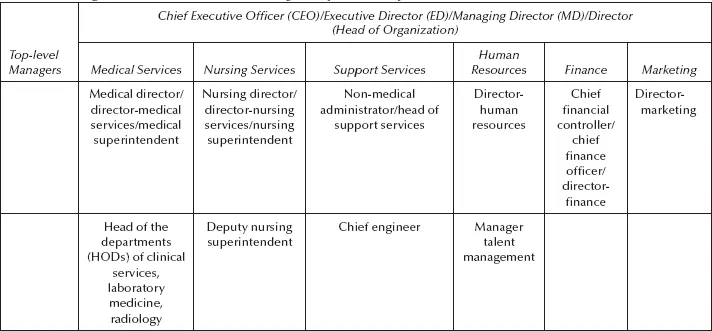
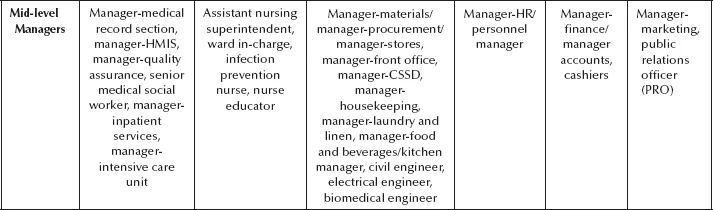
The head of hospital is generally known as the chief executive officer (CEO), executive director (ED), managing director (MD), or director. He supervises a number of top level managers, such as medical director, finance director, and HR director. Top level managers supervise mid-level managers; for example, the head of support services supervises those in charge of engineering services and of food and beverages services. Mid-level managers further supervise frontline supervisors; for example, the food and beverages manager supervises the pantry supervisors and kitchen supervisor. An example of the organizational structure of a typical corporate hospital is presented in Table 1.1.
Table 1.1 Organizational Structure of a Large Corporate Hospital
Note: HMIS, hospital management information system; CSSD, central sterile supply department; HR, human resources.
Organizational Structure of an NGO
In the case of nongovernmental organization (NGOs) and international NGOs, the head of a country program is generally known as the country director. These days, terms such as CEO, ED, o...