Learning to communicate with other people is perhaps the most important learning children do. Children with social communication problems may have trouble picking up the crucial skills of interacting and communicating with their peers, which can have more serious implications later on in life.
This resource will help teachers, teaching assistants and therapists to develop and improve the social skills of their younger pupils; provides sets of easily accessible, verbal and non-verbal games and activities to encourage social interaction; provides a clear rationale to the games to help the teacher or teaching assistant really get to grips with how and why these activities can help; provides a structured approach to pupils' social development for pupils in their early and primary years which has been tried, tested and proved to be effective; and includes assessment forms and monthly and daily planning sheets
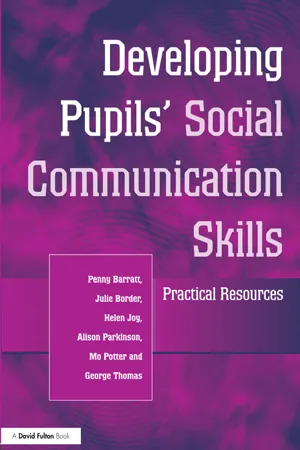
eBook - ePub
Developing Pupils Social Communication Skills
Practical Resources
- 112 pages
- English
- ePUB (mobile friendly)
- Available on iOS & Android
eBook - ePub
Developing Pupils Social Communication Skills
Practical Resources
About this book
Information
1 |
Introduction |
Learning to communicate with other people is arguably the most important learning that children do. The process starts early. Language emerges from looks and glances, hand waving, smiles, and noises exchanged between parent and child.
For most children, learning to relate to other people comes naturally. They will have different styles, with some learning more quickly than others, but, broadly speaking, they all learn in the same way. They learn where to look, and what to expect, how to copy and how to affect what another person does. They learn to share information, ideas and feelings, moving from the close circle of the family towards confident independence in the wider world.
In order to learn to communicate, young children need the means to do so. They also need opportunities and reasons. There are many means or ways of communicating, for example, speech, facial expressions, body language, signing and gesture. Opportunities to communicate are equally varied, but in every situation children will need an attentive listener who responds to them. Children develop many reasons to communicate. They make requests, they ask questions and give information; they express their feelings and generally enjoy talking to other people.
Children with social communication problems by definition often have trouble picking up ways of interacting and communicating with their peers. As teachers, we have to work on the development of children’s communication in order to help them bridge the gap between themselves and other people. So much of their future happiness and learning depends on being able to join in and to understand what others expect of them.
Children learn through playing with adults and other children. Play helps intellectual, emotional and physical development and provides a context for learning social skills. This book uses traditional children’s games to develop children’s communication. Many of the games outlined here have ‘been about for years’ and countless numbers of children have enjoyed playing them. As they play, they practise approaching, communicating and cooperating with others. The games here are being used to provide a structured approach to developing and enhancing children’s communication skills. They can also be a lot of fun.
This book is for all school staff. It may be used by class teachers to provide ideas for some whole class games that can promote the development of communication. It is, however, probably best used by classroom assistants or teachers who work with smaller groups of children.
You will need to complete the assessment on pages 7 and 8 for each child with social communication difficulties. Once this task has been undertaken you can plan your activities using the monthly and daily planning sheets. It is important to include activities that emphasise the strengths of the child with social communication difficulties in the sessions, as well as addressing their weaknesses.
A different game is described on each page. Many of these games will be familiar to you and the children for whom they are intended. The aim is to promote communication through familiar children’s games. Some of the games suggested are for playing outside, some in the school hall, some on a carpet area and others around a table. Different games may require a different number of players. A logo in the top right hand corner of each page will help you to see at a glance where the game is intended to be played and how many players are required (see table below).
| Logo – Explanatory table | |
 |
Indicates a game to be played with up to 10 players around a table. |
 |
Indicates a game to be played with up to 10 players in a small indoor space. |
 |
Indicates a game to be played inside or outside with 10+ players. |
The activities are organised throughout the book by the key skill that they address. This is shown in the top left hand corner. Below that is a cross reference to other skills that the activity may help to develop.
Important information is given at the bottom of the sheet about the role of the adult and the prompts he or she can use to promote the development of communication. This is the difference between simply teaching children how to play the games and using the games as a vehicle to develop communication skills.
Think carefully about the children who will make up the group. The authors would strongly suggest that as well as children with social communication difficulties ideally developing peers should be included as well. Try to use friendships as this will increase the likelihood of the games and skills being generalised and taken up at other times without adult intervention. This book contains a host of information about group organisation and how to steer the sessions toward tangible results.
We believe that communication should be natural and fun for all children and their helpers too!
2 | Assessment |
Communication is so much at the heart of everything that we do together that it can be very difficult to stand back and look at it objectively. We may be charmed, irritated or unmoved by another person’s behaviour towards us, but we seldom try to analyse how they have this effect upon us. We are too emotionally bound up in the whole process ourselves to look at the mechanism.
When we do start to look at how we communicate with one another we realise that there is no simple pattern. Instead, we are presented with a human process that is constantly changing, weaving and adapting to need, circumstance, situation and intention. The assessment sheets given here attempt to pick out some of the threads of this process so that we can begin to identify areas where we can support the development of children with social communication difficulties. We have called these threads key skills, which are directly addressed in the games, and other skills, which are referred to throughout the collection.
Fifteen key skills are identified in the assessment and the games that follow.
Eight are non-verbal
• I can share a focus of attention
• I can demonstrate listening and looking skills
• I can attract someone’s attention
• I can understand and use facial expression
• I can understand and use gesture and body posture
• I can play a role/pretend
• I can show awareness of others
• I can listen and do
Seven are verbal
• I can say what I want and don’t want
• I can start and finish talking to other people
• I can maintain a topic
• I can give and receive information
• I can say what I like and don’t like
• I can alter my style
• I can apologise
The next two pages contain descriptions and explanations of these key skills.
On pages seven and eight are two assessment grids to fill in for each child with social communication difficulties. This section finishes with a glossary of eight other skills referred to in the activities.
In order to determine the child’s strengths and weaknesses in each area, someone familiar with the child will need to carry out the assessment. This will involve:
1. Setting a time-frame over which the assessment will be completed, maybe as long as half a term.
2. Familiarising yourself with the key skills to establish a framework for observation.
3. Observing the child communicating in as wide a range of settings as possible. Watch him or her in the classroom, at playtime, on a school trip and with different people, such as teachers, school staff, peers and parents.
You may need to set up situations in order to give opportunities to elicit some of these skills, for example, giving the child a task without all the necessary equipment may lead to him or her attracting someone’s attention. This is essential if you do not see a particular skill in your general observations.
4. Discussing your findings with someone else who knows the child.
5. Making a judgement about the behaviours you observe, analysing them according to the grid and rating them using the scale. The rating scale takes into account frequency and appropriateness.
Typical behaviour in the context in which the observations have been carried out is represented by point three on the rating scale. If the focus child shows the same behaviours as other children he or she scores three for the relevant key skills. If you sometimes see the child using a key skill but not to the same extent as his or her peers, then score two. Points one and four on the scale represent ineffective use of the key skills. This may be because they are not used at all, score one, or occur excessively or inappropriately, score four. Only expressive skills can be overused. Receptive skills cannot be described in this way. If misunderstandings in any key skill do occur they should be scored four as being inappropriate.
6. Evaluating the child’s progress in acquiring the key skills will involve repeating the assessment after using the games for a designated period of time. Refer to the planning section for advice.
Once the assessment is completed you can use the guidance provided to plan your sessions. (See pages 12–16)
Key skills
The following paragraphs are intended to guide observations of the focus child by giving an outline of various aspects of communicative behaviour. Each skill relates directly to the assessment sheet.
Non-verbal Skills
I can share a focus of attention
People engage in the same moment, activity, or event, which involves looking and listening together, sharing looks, enjoyment and meaning.
I can demonstrate listening and looking skills
People share looks when they are speaking and listening. Speaking and listening without looking can appear rude. Looking helps people know that you are interested.
I can attract someone’s attention
All conversations begin with one person attracting another’s attention in a way which fit...
Table of contents
- Cover
- Title Page
- Copyright Page
- Table of Contents
- Acknowledgements and Author Details
- Chapter 1 Introduction
- Chapter 2 Assessment
- Chapter 3 Planning
- Chapter 4 Prompting
- Games Based on Non-Verbal Skills
- Games Based on Verbal Skills
- Appendix A: Ideas for ‘Hello and goodbye’
- Appendix B: ‘Sorry’
- Alphabetical Index of Games
Trusted by 375,005 students
Access to over 1.5 million titles for a fair monthly price.
Study more efficiently using our study tools.
Frequently asked questions
Yes, you can cancel anytime from the Subscription tab in your account settings on the Perlego website. Your subscription will stay active until the end of your current billing period. Learn how to cancel your subscription
No, books cannot be downloaded as external files, such as PDFs, for use outside of Perlego. However, you can download books within the Perlego app for offline reading on mobile or tablet. Learn how to download books offline
Perlego offers two plans: Essential and Complete
- Essential is ideal for learners and professionals who enjoy exploring a wide range of subjects. Access the Essential Library with 800,000+ trusted titles and best-sellers across business, personal growth, and the humanities. Includes unlimited reading time and Standard Read Aloud voice.
- Complete: Perfect for advanced learners and researchers needing full, unrestricted access. Unlock 1.5M+ books across hundreds of subjects, including academic and specialized titles. The Complete Plan also includes advanced features like Premium Read Aloud and Research Assistant.
We are an online textbook subscription service, where you can get access to an entire online library for less than the price of a single book per month. With over 1.5 million books across 990+ topics, we’ve got you covered! Learn about our mission
Look out for the read-aloud symbol on your next book to see if you can listen to it. The read-aloud tool reads text aloud for you, highlighting the text as it is being read. You can pause it, speed it up and slow it down. Learn more about Read Aloud
Yes! You can use the Perlego app on both iOS and Android devices to read anytime, anywhere — even offline. Perfect for commutes or when you’re on the go.
Please note we cannot support devices running on iOS 13 and Android 7 or earlier. Learn more about using the app
Please note we cannot support devices running on iOS 13 and Android 7 or earlier. Learn more about using the app
Yes, you can access Developing Pupils Social Communication Skills by Penny Barratt,Julie Border,Helen Joy,Alison Parkinson,Mo Potter,George Thomas in PDF and/or ePUB format, as well as other popular books in Education & Education General. We have over 1.5 million books available in our catalogue for you to explore.