eBook - ePub
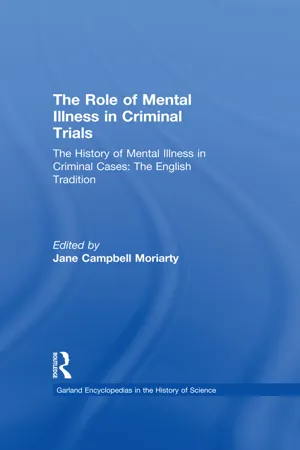
The History of Mental Illness in Criminal Cases: The English Tradition
The Role of Mental Illness in Criminal Trials
- 308 pages
- English
- ePUB (mobile friendly)
- Available on iOS & Android
eBook - ePub
The History of Mental Illness in Criminal Cases: The English Tradition
The Role of Mental Illness in Criminal Trials
About this book
Whether the accused is competent to stand trial, whether the plaintiff is competent to accuse, or whether a witness is competent to testify has had a long legal history. Such questions draw legal reasoning into areas of ethical reflection and scientific debate deeply rooted in the moral history of the United States. Mental competence has come to play a central and controversial role in proving guilt, and in evaluating the severity of a crime and its corresponding punishment. This compendium brings together the major legal precedents and legal commentaries that have defined the role of mental illness in criminal trials throughout U.S. history. The reprint collection considers, among other issues, the evolution of the Supreme Court's position on the insanity defense and mental retardation, how these affect one's competency to stand trial or be executed, and how these affect culpability and punishment. Each volume begins with an introductory essay, and includes both cases and commentary. Scholars as well as students will find these volumes a useful research tool.
Information
465. The Trial of EDWARD ARNOLD, for Felony (in maliciously and wilfully shooting at, and wounding, the Right Hon. the Lord Onslow), at the Assizes held at Kingston upon Thames, in Surrey, March 20, before the Hon. Robert Tracy, esq. one of his Majesty’s Justices of the Court of Common-Pleas; 10 GEORGE I. A. D. 1724.
REX ver. ARNOLD.
Edward Arnold brought to the bar.
Edward Arnold brought to the bar.
Sorry ss. JUR’ pro Domino Rege sup’ Sacrum suum presentant quod Edwanlns Arnold nup’ de Parocb’ Sci Nioholai Guildford aliis Guldeford in Com’ Surr’ predict’ post primum diem Junii Anno Dom’ Millimo septingentesi-mo vicesimo tertio scilt vicesimo octavo die Augusti anno Regni Domini nri Georgii Dei Gratia Magne Britannie Franc’ et Hibernie Regis fidei Defensoris, &c. decimo vi et armis, &c. apud Paroch’ Sci Nicholai Guildford aliis Guldford predict’ in Com’ Surr’ pred’ in et sup’ prehonorabil’ Thomam Dominum Onslow Baron’ Onslow de Onslow in Com’ Salop et de Clandon in Com’ Surrey in pace Dei et dicti Domini Regis adtunc et ibidem existen’ illice felonice voluntarie malitiose et ex malicia sua precogitat’ insult’ fecit et adtnnc et ibidem Idem Edrus Arnold quoddam Tormentum Augce ‘gun’ valent quinq’ solid’ cum pulvere Bom-bardino Angce ‘gunpowder’ et plumbeis Glo-bulis Angce ‘leaden shot,’ adtunc et ibm’ one-rat’ quod quidm’ Turmentum ipse idm’ Edrus in manibus suil adtunc et ibm’ habuit et tenuit in contra ad et versus prefat’ prahonorabil’ Thomam Dominum Onslow (eodem prehono-íabil’Thoma Domino Onslow in alta Regia via apud Paroch’ Sci Nicholai Guildford aliis Guldeford predict’ in Com’ Surr’ predict’ adtunc existen’) adtunc et ibm’ illice felonice volun-tarie malitiose et ex malitia sua precogitat’ displosit et exoneravit Angce ‘did sboot,’ pinde adtunc et ibm’ dans eidm’ Thome Domino On slow in et sup’ sinistrum humerum ipsiw Thome Domini Onslow unum grave vulow latitudinis Sex Pollicum et profunditat’ Dudrum Pollicum contra pacem dicti Domini Regis uunc Coron’ et Dignitat’ suas, &c. Dec nod contra formam Statut’ in homoi casu edit’ et provis’.
Clerk of Arraigns. How gayest thou, Edward Arnold, art thou Guilty of the felony whereof thou standest indicted, or Not Guilty?
Prisoner. Not Guilty.
Cl. of Arr: Culprit, How wilt thou be tried?
Prisoner. By God and my country.
Cl. of Arr. God send thee a good deliverance
Cl. of Arr. You Edward Arnold, the prisoner at the bar, hearken to what is said to you Those good men that are now called, and de here appear, are those that are to pass between our1 sovereign lord the king and you, upon year life and death; if therefore you will challenge them, or any of them, you must challenge them as they come to the book to be swotn before they are sworn.
Then the Jury were sworn.
Cl of Arr. Count these.
Cryer. Are you all sworn, gentlemen?
Jury. Yes.
Cl. of Arr. Make a proclamation.
Cryer. O Yes; if any of you can ínform
my lord the king’s justice, the king’s attorney, or solicitor general, of any treason, Harder, felony, or other misdemeanor, committed by the prisoner at the bar, come forth, and you shall he heard; for the prisoner at the bar now stands upon his deliverance : and all persons bound by recognizance to prosecute the prisoner, come forth and prosecute, or you will forfeit your recognizances.
Cl. of Arr. Edward Arnold, hold up thy hand. Gentlemen of the Jury, look upon the prisoner, and hearken to his cause; he stands indicted, &c.’ ut supra;’ upon which indictment he hath been arraigned, and pleaded Not Guilty; your charge is to enquire whether he be Guilty of the felony whereof he stands indicted, or Not Guilty.
Mr. Hungerford. I only beg leave to trouble your lordship with one word in this business. your lordship hath been applied to by petition, and an affidavit thereto annexed, in respect to the man’s circumstances, that he may have a solicitor by him to call his witnesses only. I fray they may be read.
Just. Tracy. Read the petition and affidavit.
Cryer. “To the honourable Robert Tracy, esq. &c. The humble Petition, &c.”
Mr. Hungerford. My lord, all that we desire is, that he may be by him, to tell and to assist him in calling for his witnesses.
Serj. Cheshirc. My lord, I am commanded to attend this service, as I have the honour to be of the king’s counsel; and I apprehend nothing is expected from me of a consent to a thing of this kind. Your lordship is of counsel for all the prisoners, who by law can have none, is this man can’t have any. This is a design to forestall the justice this man is coming under, and to anticipate it. My lord, if any thing appears in the nature of this man’s defence and his behaviour, your lordship will take care that the officer calls for what evidence is proper. Nothing hath appeared in this man’s conduct, as I am informed : he bath been celled to his trial; he hath pleaded in the common method as other people do; and the man, to my sight, seems as sensible as myself, or my person in court: therefore, when nothing the will do, they must have recourse to the method of this affidavit. What is this affidavit? An affidavit of two brothers, that he now is, and hath been, &c. which is more to Hacken the prosecution than any thing else. If they thought him so, why hath he not been restrained, and a commission of lunacy taken out? There is no pretence of that. As this person is charged with so horrid a fact, I cannot consent to this. I am sure your lordship will make no new precedent. And pardon me, my lord, if I say your lordship is of counsel for the prisoner; and till it doth appear that he is lunatic, your lordship will make no new precedent.
Serj. Whitaker. My lord, I am likewise of eoonsel for the king; and I must needs say, is the little experience I have had, I never saw ID; thing of this nature offered. I have been attending often on indictments at the Old Bailey, and elsewhere, and sometimes when mad people came on to trial, and have been really in that condition that the persons would fancy the prisoner to be; but such an attempt as this I never knew before. Your lordship and the Court will, when a man pleads Not Guilty, do right, and enquire after this matter: if there is any pretence for insanity, it is his defence; but that the counsel for the king should give it up, and yield that he is so, cannot be expected; for by agreeing to this petition we do.
It is very extraordinary to hear counsel speaking till they are assigned; but as they have taken that liberty, I don’t blame them : every one is to do the best for his client: but I hope, for precedent sake, and for justice sake, there shall not the least countenance be given to this matter; I take it we cannot consent to it. By law the prisoner cannot have counsel; therefore I hope this petition shall be rejected.
Serj. Comyns. I shall not trouble your lordship; it is a matter so new and surprising, that I need not add to what hath been already said, but shall submit it to your lordship.
Mr. Marsh. My lord, I beg your lordship will indulge me one word in this matter. The attempt they make is to have a lunatic assisted in his trial. With submission, I don’t know any assistance he is capable of: fur if really a lunatic, he is insensible, so as to receive no assistance, supposing he committed the fact.
As to calling his witnesses to prove this insanity, these very brothers, if they stand in any part of the Court, may equally call them, as well as if they had any assistance of an attorney or solicitor to stand by him. I would not fling any imputation on any person; but if the man bath a design to act a mad part, as the design will appear, if he be really sensible, then he is capable of receiving the instructions of the agent, if he happens to be out, how to behave himself mad; so that no good, but a very bad use may be made of it. As to the consent, we can’t do it. We think as to the subject-matter of the petition, your lordship can’t grant it, from the inconvenieucies that may attend it.
Mr. Hungerford. I ———
Serj. Whitaker. My lord, we oppose his speaking.
Mr. Hungerford. I was going ———
Just. Tracy. It must not be.
Mr. Hungerford. My lord, I know my duty so well, that I submit: but I see your lordship hath more temper and lenity. I believe it is indifferent what part of the court his biotliers are in, if his solicitor stand by him. I know no other use to be made of it than to call his witnesses.
Just. Tracy. I can’t do it with any consent. What my brother says, the law is clear in. It is my duty to give him all the assistance I can; and that I will do.
Mr. Hungerford. Let the names be handed to somebody to call the witnesses.
Serj. Cheshire. We that are counsel for the king will do nothing that is hard.
Serj. Whitaker. No, I never will, while a man’s life is at stake. None of us will do any thing that is hard.
Just. Tracy. I don’t believe you will.
Mr. Bollard. May it please your lordship, and you gentlemen of the jury, this is an indictment at the suit of the king, against Edward Arnold; and the indictment sets forth, that Edward Arnold, late of the parish of, &c.
To this indictment be hath pleaded Not Guilty; if we call our witnesses, and prove the indictment, you will find him Guilty.
Serj. Cheshire. May it please your lordship, and you gentlemen of the jury, I am in this case, counsel for the king. The prisoner at the bar, Edward Arnold, stands indicted upon an act of parliament of the last session of parliament; and, gentlemen, it is for maliciously and wilfully shooting the lord Onslow, and wounding him, as he apprehended, and as will appear from the evidence, mortally. It pleased God to preserve him; but notwithstanding that, the fact by him committed is felony, without benefit of clergy.*
And, gentlemen, though we need nothing to justify a law, made necessary from instances in your own neighbourhood, yet, give me leave to tell you, it is but reviving the old law of England; for by that, if a person did an act to another, whereby death might ensue, notwithstanding the party did not die in a year and a day, it was felony. We have instances of this so early as Edward the second, and Edward the third; but I own, of later years this hath been discontinued, and held an offence punishable at discretion, yet not punished with death, till this act I have mentioned, which is but only the old law of England revived. And if the barbarity of people made it necessary, it became the legislature to make it felony, without benefit of clergy.
Gentlemen, the fact this person hath been guilty of, was committed in this manner. On the 28th day of August last, within less than three months after passing the act, as if the fellow had studied, and been fond of being the first instance of cruelty t...
Table of contents
- Cover
- Title Page
- Copyright Page
- Table of Contents
- Series Introduction
- General Introduction
- Volume Introduction
- The Trial of Edward Arnold
- Wild Beasts & Idle Humours
- The Trial of James Hadfield
- From beasts to Bedlam: Hadfield, the regency crisis, M’Naghten and the “mad” business in Britain, 1788-1843
- The Queen Against Edward Oxford, 1840
- The Queen Against Daniel M’Naughton, 1843
- House of Lords Debate
- The McNaughton Case and Its Predecessors
- Origin and Development of the Legal Defense of Insanity in Anglo-American Law
- Acknowledgments
Trusted by 375,005 students
Access to over 1.5 million titles for a fair monthly price.
Study more efficiently using our study tools.
Frequently asked questions
Yes, you can cancel anytime from the Subscription tab in your account settings on the Perlego website. Your subscription will stay active until the end of your current billing period. Learn how to cancel your subscription
No, books cannot be downloaded as external files, such as PDFs, for use outside of Perlego. However, you can download books within the Perlego app for offline reading on mobile or tablet. Learn how to download books offline
Perlego offers two plans: Essential and Complete
- Essential is ideal for learners and professionals who enjoy exploring a wide range of subjects. Access the Essential Library with 800,000+ trusted titles and best-sellers across business, personal growth, and the humanities. Includes unlimited reading time and Standard Read Aloud voice.
- Complete: Perfect for advanced learners and researchers needing full, unrestricted access. Unlock 1.5M+ books across hundreds of subjects, including academic and specialized titles. The Complete Plan also includes advanced features like Premium Read Aloud and Research Assistant.
We are an online textbook subscription service, where you can get access to an entire online library for less than the price of a single book per month. With over 1.5 million books across 990+ topics, we’ve got you covered! Learn about our mission
Look out for the read-aloud symbol on your next book to see if you can listen to it. The read-aloud tool reads text aloud for you, highlighting the text as it is being read. You can pause it, speed it up and slow it down. Learn more about Read Aloud
Yes! You can use the Perlego app on both iOS and Android devices to read anytime, anywhere — even offline. Perfect for commutes or when you’re on the go.
Please note we cannot support devices running on iOS 13 and Android 7 or earlier. Learn more about using the app
Please note we cannot support devices running on iOS 13 and Android 7 or earlier. Learn more about using the app
Yes, you can access The History of Mental Illness in Criminal Cases: The English Tradition by Jane Moriarty in PDF and/or ePUB format, as well as other popular books in Diritto & Diritto penale. We have over 1.5 million books available in our catalogue for you to explore.