eBook - ePub
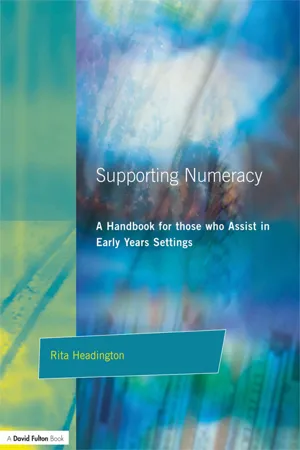
Supporting Numeracy
A Handbook for those who Assist in Early Years Settings
- 100 pages
- English
- ePUB (mobile friendly)
- Available on iOS & Android
eBook - ePub
About this book
First Published in 2001. Starting with references to the Cockcroft Report of 1982 and the National Strategy, this study defines numeracy as mathematics in action and outlines its importance in everyday life. Using and applying mathematics within the early learning setting means children are also taught to solve problems, to communicate their ideas and develop their reasoning skills. Teaching Assistants provide the most effective support in mathematics when working in partnership with the teacher, by sharing goals. To do this effectively it is important for assistants to understand how mathematics learning takes place within the early years setting and to know how and when to use mathematics language and equipment. The purpose of this book is to provide such understanding and knowledge.
Information
Chapter 1
What is numeracy?
Defining numeracy
We are frequently told by politicians and the media that numeracy is important. Few of us are likely to deny this. But what is numeracy? And what makes it so important?
The word ‘numeracy’ sounds similar to ‘number’, highlighting the central role which number plays. But the mathematical content of numeracy is much wider and embraces number, algebra, data handling, measures and even moves into shape and space. While these words may bring connotations of dull textbook mathematics, ‘numeracy’ is decidedly more active. An influential report into mathematics stated that numeracy has two essential attributes:
The first of these is an ‘at-homeness’ with numbers and an ability to make use of mathematical skills which enables an individual to cope with the practical mathematical demands of his everyday life. The second is an ability to have some appreciation and understanding of information which is presented in mathematical terms, for instance in graphs, charts or tables or by reference to percentage increase or decrease.
(Cockcroft 1982, paragraph 39)
This was confirmed in the National Numeracy Strategy which said:
Numeracy is a proficiency which involves confidence and competence with numbers and measures. It requires an understanding of the number system, a repertoire of computational skills and an inclination and ability to solve number problems in a variety of contexts. Numeracy also demands practical understanding of the ways in which information is gathered by counting and measuring, and is presented in graphs, diagrams, charts and tables.
(DfEE 1999a, Section 1 p. 4)
From these definitions we can say that numeracy is our ability to use mathematics in our lives with accuracy and confidence. Numeracy is mathematics in action.
The importance of mathematics to most people is in its relevance to everyday life. It is around us all the time and we all use it whether or not we label it as mathematics. Take a few events and items from an average day as examples:
Clock | Telling the time, using numbers to 60, using fractions, counting in fives |
Newspaper | Reading and using number, interpreting statistics, temperature, dates |
Driving | Reading scales, estimating time and distance, interpreting road sign shapes and symbols |
Shopping | Money, using a budget, exchange, receiving change, sorting purchases according to purpose and shape |
Cooking | Reading numbers, weight, volume and capacity, temperature, time, fractions, estimation |
At work many jobs require mathematics specific to the situation. Decorators develop a strong sense of area, length and angle; removal firms rely on skills of estimating volume; builders use triangles when erecting scaffolding; scientists and engineers measure with sophisticated instruments and analyse the data they have collected; architects use shape, angle and symmetry in their designs.
The importance of mathematics is not just due to its relevance in our daily or working lives. The patterns and relationships at the heart of mathematics make it a subject of intrinsic interest and fascination and while some simply enjoy puzzles and games, others delight in taking the subject to far greater abstraction.
If mathematics plays such an important part in our lives, why do so many suffer from the ‘fear factor’ of mathematics? Indeed, when research for the Cockcroft Report was undertaken interviewers found that half those approached simply refused to participate. Of those who did it was evident that ‘mathematics could induce feelings of anxiety, helplessness, fear and even guilt’ (Cockcroft 1982, paragraph 20) no matter what their occupation or qualifications.
Mathematics appears to be a subject where failure has been accepted as a norm, where those who excel are seen as different. This is quite unlike other subjects. In such a climate the statement ‘I’m hopeless at adding’ is more socially acceptable than the statement ‘I’m hopeless at reading’.
Unfortunately many adults developed a fear of mathematics at school and this was often due to two key influences – the presentation of the subject and the attitude of the presenter. Mathematics was often seen as a subject where answers were right or wrong within a tightly defined hierarchy, where speed and accuracy alone were paramount, where meaningless tricks needed to be learned and where strange, abstract symbols were commonplace. Mathematics also seemed to have had more than its fair share of teachers who lacked patience, who didn’t explain sufficiently and who used their understanding of the subject to belittle others (Buxton 1981).
To breed a positive attitude to mathematics learning in future generations these negatives need to be reversed. The subject needs to be presented in a positive light which builds upon previous experiences and understanding and instils confidence. It needs to be presented by those who are willing to work with individuals and not against them in ways which will help learning to take place.
Mathematics is made more relevant for children by linking it to their daily lives and by recognising and building upon their previous experiences from home and school. A study by Tizard and Hughes (1984) demonstrated the richness of early learning experiences in mathematics apparent in the home environment and enabled by a one-to-one situation. In the following extract a mother was playing with her four year old.
Child: ‘Two currant buns in a baker’s shop, round and fat with sugar on the top. Come a boy with a penny one day’ (stops singing). Put your hand up with two fingers. (Mother does so) ‘Along come a boy with a penny one day’ (folds one of the mother’s fingers down).
Mother: How many’s left now?
Child: (Sings) ‘One currant bun in the baker’ (stops singing). Put your finger out … (Mother holds up one finger) ‘Along come a boy … and took it away.’ None left.
Mother: None left now!
Mother: How many’s left now?
Child: (Sings) ‘One currant bun in the baker’ (stops singing). Put your finger out … (Mother holds up one finger) ‘Along come a boy … and took it away.’ None left.
Mother: None left now!
(Tizard and Hughes 1984, p. 95)
By playing with her mother, the child is developing an intrinsic interest in number and is learning about the mathematical concepts within counting and simple number operations through a practical and oral context. The initial learning experiences of the home are furthered within early years settings through rhymes, songs, stories, games, imaginative play and practical activities. Concepts are made more meaningful for children by encouraging them to make connections between practical or ‘concrete’ experiences (e.g. counting three cubes) and symbols (e.g. ‘3’) by using pictures and language (Haylock and Cockburn 1989). A firm understanding of early mathematical concepts provides children with a stronger basis upon which to build their future learning.
Changes of approach to mathematics learning have been taking place in many schools and early years settings during recent years. This is due greatly to the efforts of many teachers following the studies and reports of the 1980s which influenced the content and structure of the National Curriculum for Mathematics and, in the 1990s, the evolution of the Early Learning Goals and the development of the National Numeracy Strategy.
The Early Learning Goals focus upon children from three to five years, the Foundation Stage, in a range of early years settings. They ‘set out what is expected for most children by the end of the Foundation Stage’ (QCA/DfEE 1999 p. 3). The Early Learning Goals do not form a curriculum for this age group but provide early years practitioners with targets to work towards in ways which they determine are most appropriate for the children in their care and which reflect the common features of good practice at the Foundation Stage. The goals for mathematical development link clearly with the expectations of Reception children which are detailed in the National Numeracy Strategy.
The National Curriculum (DfEE/QCA 1999) gives a structure for mathematics teaching from 5–16 years which is the basis of the teaching which takes place in state schools. At Key Stage 1 of the National Curriculum (i.e. from 5–7 years) children are taught about Number and about Shape, Space and Measures. Mental methods are emphasised to help children to develop confidence and competence in their calculation skills and to form a basis for work at Key Stage 2, using written and calculator methods. It is important that children know how to count and recognise number patterns and relationships. They also need to be able to use number to calculate and to handle data.
The inclusion of Using and Applying mathematics within each section means children are also taught to solve problems, to communicate their ideas and develop their reasoning skills. They are not just taught mathematical facts but how and when to use them. For example, if children are given the problem of making party hats, they will need to make decisions about the most appropriate way to measure head sizes and choose the best equipment for the job. They will be taught to communicate their mathematics practically by using objects, drawing pictures, using words or mathematical symbols. They will be encouraged to predict answers and to explain their thinking processes, to ‘have a go’ without fear of failure.
The purpose of the National Numeracy Strategy is to provide a framework for teaching mathematics from Reception to Year Six. The Strategy gives teachers guidance on planning, teaching and assessing National Curriculum mathematics to develop key objectives. It presents examples of mathematics activities appropriate to different ages and abilities and provides structures for planning mathematics teaching across distinct periods of time – from a complete Key Stage to a single lesson. It emphasises the importance of a positive approach to mathematics with ‘direct teaching and questioning’ which is ‘oral, interactive and lively’ and recommends the use of whole class, group and individual pupil teaching (DfEE 1999a, section 1, p. 11).
The examples of children’s work in number, shape, space and measures and in problem solving given in Standards in Mathematics (QCA 1999a) demonstrate the quality of mathematics achieved when its relevance or its intrinsic value is explored and when adult guidance is given within a supportive yet challenging learning environment.
The result of changes of approach to mathematics learning has been gratifying, with children becoming engaged readily in lively practical, oral and interactive learning experiences, a far cry from the dull repetition of textbook mathematics. In stark contrast to previous generations it is now not unusual to hear children declare mathematics to be their favourite subject!
Supporting numeracy learning
Those who assist in early years settings are part of a team of adults who can give guidance to children learning mathematics. They can provide children with a positive role model for mathematics learning by projecting enthusiasm for the subject and by being patient and supportive.
Assistants work mainly with small groups of children or with individuals (HMI 1989, Moyles and Suschitzky 1997). These children often need help in particular aspects of mathematics. Some may have Individual Education Plans (IEPs). Such close contact with small numbers of children provides assistants with the opportunity to make mathematics learning more meaningful by linking it directly to the previous experience and understanding of individuals. Such close contact with a guiding adult provides children with the opportunity to demonstrate their capabilities through activity and discussion.
Assistants provide the most effective support in mathematics when working in partnership with the teacher, by sharing goals. This requires teachers to keep assistants well briefed (OFSTED 1995, DfEE 1998). It also means assistants should have the opportunity to tell the teacher about their work with the children. The quality of the assistants’ support for numeracy rests upon their own confidence in developing the mathematics learning of children within a given situation. To do this effectively it is important for assistants to understand how mathematics learning takes place within the early years setting and to know how and when to use mathematics language and equipment. The purpose of this book is to provide such understanding and knowledge.
Using this book
This book is written for assistants. Throughout, the word ‘assistant’ is used generically to refer to the diverse range of people who assist in early years settings on a paid or voluntary basis, be they classroom assistants, learning support assistants, parents, school governors, nursery nurses, National Vocational Qualification students or trainee teachers. Similarly, the word ‘teacher’ refers to the individual who manages the teaching and learning of the children within the setting while leading and coordinating other adults.
The book aims to reduce the ‘fear factor’ of mathematics and to increase confidence by providing assistants with knowledge of mathematics learning, language and equipment, and by considering the role of the assistant in the mathematics learning situation. It is a handbook for learning how to support numeracy which can also be used as a reference book for assistants in early years settings.
Mathematics learning, language and equipment are examined in Chapters 2, 3 and 4. Chap...
Table of contents
- Cover
- Title Page
- Copyright Page
- Contents
- Foreword by Professor Tricia David
- Acknowledgements
- 1. What is numeracy?
- 2. Building numeracy
- 3. Building bricks
- 4. Building tools
- 5. Supporting numeracy
- 6. ‘How can I help?’
- Activity sheets
- Answers to selected activities
- Bibliography
- Index
Trusted by 375,005 students
Access to over 1.5 million titles for a fair monthly price.
Study more efficiently using our study tools.
Frequently asked questions
Yes, you can cancel anytime from the Subscription tab in your account settings on the Perlego website. Your subscription will stay active until the end of your current billing period. Learn how to cancel your subscription
No, books cannot be downloaded as external files, such as PDFs, for use outside of Perlego. However, you can download books within the Perlego app for offline reading on mobile or tablet. Learn how to download books offline
Perlego offers two plans: Essential and Complete
- Essential is ideal for learners and professionals who enjoy exploring a wide range of subjects. Access the Essential Library with 800,000+ trusted titles and best-sellers across business, personal growth, and the humanities. Includes unlimited reading time and Standard Read Aloud voice.
- Complete: Perfect for advanced learners and researchers needing full, unrestricted access. Unlock 1.5M+ books across hundreds of subjects, including academic and specialized titles. The Complete Plan also includes advanced features like Premium Read Aloud and Research Assistant.
We are an online textbook subscription service, where you can get access to an entire online library for less than the price of a single book per month. With over 1.5 million books across 990+ topics, we’ve got you covered! Learn about our mission
Look out for the read-aloud symbol on your next book to see if you can listen to it. The read-aloud tool reads text aloud for you, highlighting the text as it is being read. You can pause it, speed it up and slow it down. Learn more about Read Aloud
Yes! You can use the Perlego app on both iOS and Android devices to read anytime, anywhere — even offline. Perfect for commutes or when you’re on the go.
Please note we cannot support devices running on iOS 13 and Android 7 or earlier. Learn more about using the app
Please note we cannot support devices running on iOS 13 and Android 7 or earlier. Learn more about using the app
Yes, you can access Supporting Numeracy by Rita Headington in PDF and/or ePUB format, as well as other popular books in Education & Early Childhood Education. We have over 1.5 million books available in our catalogue for you to explore.