Written to coincide with the introduction of Induction Standards for new entrants to the teaching profession, this text aims to help to smooth the transition from theory and supervised teaching to independent reflexive practice. It provides a combination of explanation, challenge, practical activities and authentic case studies. The author acknowledges the importance of professional development during the induction year and advocates the gradual implementation and reinforcement of effective strategies for good teaching. He also urges readers to develop the creative, intuitive and "natural-born" abilities that help to fashion their own individual teaching styles. Though informed by the Induction Standards, the aim of the book is to help teachers set ambitious personal and professional expectations through which they will realize their full potential.
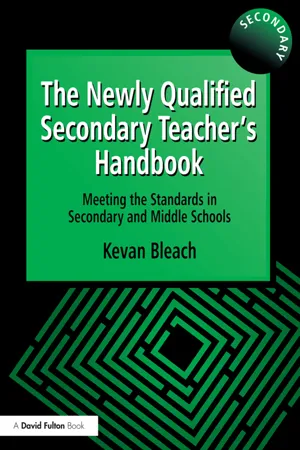
eBook - ePub
The Newly Qualified Secondary Teacher's Handbook
Meeting the Standards in Secondary and Middle Schools
- 162 pages
- English
- ePUB (mobile friendly)
- Available on iOS & Android
eBook - ePub
The Newly Qualified Secondary Teacher's Handbook
Meeting the Standards in Secondary and Middle Schools
About this book
Information
Part One
Chapter 1
Getting started in the classroom
For almost all of us at the start of our teaching careers, the first few weeks in front of our classes were challenging, to say the least! They tested our professionalism and our personal stamina. This is the time when we were learning to disentangle and get our heads round some of the initial complexities of the process of teaching. Research shows that for most new teachers, the first priority is establishing an orderly classroom atmosphere and a positive pupil relationship. Once that is under your belt, you can afford to let your management tactics become less visible and concentrate on your teaching and learning activities. There is more of an implicit understanding, between pupil and teacher, of what is expected. That is why learning to teach is a developmental process.
So this first section examines three issues that should enable new teachers, at the earliest stage of the induction year, to cope more effectively with classroom management:
1. What is involved in being an effective teacher?
2. How can new teachers get to know pupils?
3. How should the classroom be organised?
What is involved in being an effective teacher?
Current thinking recognises that quality of teaching is central to effective education. Schools will always be concerned about issues like curriculum design and structure, efficient systems of management, and ways of measuring attainment and progress. But teaching – and teachers – have rightly come into their own as the most vital components of effective schools. With the home, they are recognised as the decisive factors in pupils’ learning. That is why OFSTED places the main force of inspection on the observation of teaching and the extent to which it contributes to successful learning.
In Victorian times, Wragg (1974) informs us, teacher-training institutions were described as ‘normal’ schools. He says this presupposed agreement over one single, approved method that all novice teachers had to follow. It manifested itself in the ‘object lesson’ – a set piece that was deemed to have universal application. In Hard Times, Charles Dickens refers to ‘some 140 schoolmasters [who] had been turned at the same time at the same factory, on the same principles, like so many pianoforte legs’.
There is, perhaps, a hint of this approach today, albeit on a much more sophisticated level, if we bear in mind pointers towards a general prescription of favoured methods like:
• the Teacher Training Agency’s Standards for the Award of QTS;
• the DfEE’s Induction Standards;
• the OFSTED Chief Inspector’s views on ‘orthodox’ teaching methodology;
• Professor David Reynolds’ call (1998) for ‘an applied science of teaching’.
The research literature on effective teaching is vast and complex, which is why the tendency in initial teacher training in recent times has been to encourage a variety of approaches. Nevertheless, there is a degree of consensus about the generic features of effective teaching. Here are two typical summaries that explore effective teacher behaviour:
Pupils achieve more, when a teacher does the following:
• emphasises academic goals
• makes them explicit and expects pupils to be able to master the curriculum
• carefully organises and sequences the curriculum
• clearly explains and illustrates what pupils are to learn
• frequently asks direct and specific questions to monitor pupils’ progress and check their understanding
• provides pupils with ample opportunity to practise
• gives prompts and feedback to ensure success
• corrects mistakes and allows pupils to use a skill until it is over-learned or automatic
• reviews regularly and holds pupils accountable for work
(Doyle 1986, p. 95)
Effective teachers:
• are clear about their instructional goals
• are knowledgeable about their content and the strategies for teaching it
• communicate to their pupils what is expected of them – and why
• make expert use of existing teaching materials in order to devote more time to practices that enrich and clarify the content
• are knowledgeable about their pupils, adapting teaching to their needs and anticipating misconceptions in their existing knowledge
• address higher as well as lower level cognitive objectives
• monitor pupils’ understanding by offering regular, appropriate feedback
• integrate their teaching with that in other subject areas
• accept responsibility for pupil outcomes
• are thoughtful and reflective about their practice
(Porter and Brophy 1988, pp. 74–85)
A lot has been produced about effective teaching skills, too, as part of the Government’s standards-raising agenda. The ability to conceptualise and articulate practice in precise, technical language is relatively new – the best teachers have always tended simply to do these things and take them for granted. However, the list on the following page is typical of various research studies and reflects skills consistently noted as being important.
The question of how best to teach has tended to focus on two contrasting teaching styles – the ‘traditional’ didactic and ‘progressive’ discovery approaches. Researchers have found difficulty in relating particular teaching styles to effective learning outcomes and results. The sheer diversity of teaching situations and contexts probably makes a direct link impossible to establish. They also comprise a false and over-simplified dichotomy. If the truth were known, effective teaching is a sophisticated and multilayered activity, which is too complex for recipe solutions. Most teachers use a judicious repertoire of approaches and styles suited to the different learning situations they encounter. Twelve years ago, the National Evaluation of TVEI concluded that ‘a teacher who mixes his/her methods as appropriate to the topic is doing much as we would commonly ask’.
Effective teaching skills:
• Organisational – to sort out materials and sources of information
• Analytical – to break down complex sources of information
• Synthesising – to build ideas into arguments
• Presentational – to clarify complex information without harming its integrity
• Assessing – to judge the work of pupils so that appropriate feedback can be given
• Managerial – to coordinate the dynamics of individuals, groups and classes
• Evaluative – to improve teaching continually
(Mortimore 1994: pp.290–310)

This is designed to help you clarify your view of what constitutes effective teaching. It is a form of ‘personal construct’ theory. It allows you to examine your own emerging thinking and constructions by comparing and contrasting them with other individuals.
STEP 1
Think of two teachers who taught you – one in whose lessons you think pupils learned a lot and enjoyed being present, the other the opposite. Then jot down a brief descriptive paragraph about each teacher, with a couple of examples, e.g.
• patience to explain things, even if you didn’t understand first time – I was really frustrated with a Maths problem, so he just sat and did it with me till I understood
• unfair in her use of punishments – once kept whole class in because one boy hid someone’s PE kit
STEP 2
Now list some dimensions of teaching that have emerged from Step 1. Try to use phrases that are opposites, e.g.
• friendly but firm/martinet
• keeps pupils on task/loses pupils’ attention
• enthusiastic and lively/dull and boring
• provides lots of learning activities/lessons are chalk-and-talk
• provides routines and strategies/disorganised and vague
STEP 3
Finally, looking at the positive characteristics, identify some specific and practical ways you think you could embody them in your own teaching, e.g.
• correcting pupil misbehaviour in a calmly assertive manner
• regular checks during a written exercise on progress made with questions
• inject pace and vitality into reading a passage of prose
• provide choice of variety of means of recording a piece of work
• ground rules established for classroom entry and handing out books
(adapted from Wragg 1993, pp. 5–8)
How can new teachers get to know pupils?
More often than ...
Table of contents
- Cover
- Title Page
- Copyright Page
- Table of Contents
- Acknowledgements
- Introduction
- Part One
- Part Two
- Index
Trusted by 375,005 students
Access to over 1.5 million titles for a fair monthly price.
Study more efficiently using our study tools.
Frequently asked questions
Yes, you can cancel anytime from the Subscription tab in your account settings on the Perlego website. Your subscription will stay active until the end of your current billing period. Learn how to cancel your subscription
No, books cannot be downloaded as external files, such as PDFs, for use outside of Perlego. However, you can download books within the Perlego app for offline reading on mobile or tablet. Learn how to download books offline
Perlego offers two plans: Essential and Complete
- Essential is ideal for learners and professionals who enjoy exploring a wide range of subjects. Access the Essential Library with 800,000+ trusted titles and best-sellers across business, personal growth, and the humanities. Includes unlimited reading time and Standard Read Aloud voice.
- Complete: Perfect for advanced learners and researchers needing full, unrestricted access. Unlock 1.5M+ books across hundreds of subjects, including academic and specialized titles. The Complete Plan also includes advanced features like Premium Read Aloud and Research Assistant.
We are an online textbook subscription service, where you can get access to an entire online library for less than the price of a single book per month. With over 1.5 million books across 990+ topics, we’ve got you covered! Learn about our mission
Look out for the read-aloud symbol on your next book to see if you can listen to it. The read-aloud tool reads text aloud for you, highlighting the text as it is being read. You can pause it, speed it up and slow it down. Learn more about Read Aloud
Yes! You can use the Perlego app on both iOS and Android devices to read anytime, anywhere — even offline. Perfect for commutes or when you’re on the go.
Please note we cannot support devices running on iOS 13 and Android 7 or earlier. Learn more about using the app
Please note we cannot support devices running on iOS 13 and Android 7 or earlier. Learn more about using the app
Yes, you can access The Newly Qualified Secondary Teacher's Handbook by Kevan Bleach in PDF and/or ePUB format, as well as other popular books in Education & Classroom Management. We have over 1.5 million books available in our catalogue for you to explore.