
Structural Design from First Principles
eBook - ePub

Structural Design from First Principles

  1. 315 pages
  2. English
  3. ePUB (mobile friendly)
  4. Available on iOS & Android
eBook - ePub

Structural Design from First Principles

About this book

This enlightening textbook for undergraduates on civil engineering degree courses explains structural design from its mechanical principles, showing the speed and simplicity of effective design from first principles.

This text presents good approximate solutions to complex design problems, such as "Wembley-Arch" type structures, the design of thin-walled structures, and long-span box girder bridges. Other more code-based textbooks concentrate on relatively simple member design, and avoid some of the most interesting design problems because code compliant solutions are complex. Yet these problems can be addressed by relatively manageable techniques. The methods outlined here enable quick, early stage, "ball-park" design solutions to be considered, and are also useful for checking finite element analysis solutions to complex problems.

The conventions used in the book are in accordance with the Eurocodes, especially where they provide convenient solutions that can be easily understood by students. Many of the topics, such as composite beam design, are straight applications of Eurocodes, but with the underlying theory fully explained.

The techniques are illustrated through a series of worked examples which develop in complexity, with the more advanced questions forming extended exam type questions. A comprehensive range of fully worked tutorial questions are provided at the end of each section for students to practice in preparation for closed book exams.

Frequently asked questions

Yes, you can cancel anytime from the Subscription tab in your account settings on the Perlego website. Your subscription will stay active until the end of your current billing period. Learn how to cancel your subscription.
No, books cannot be downloaded as external files, such as PDFs, for use outside of Perlego. However, you can download books within the Perlego app for offline reading on mobile or tablet. Learn more here.
Perlego offers two plans: Essential and Complete
  • Essential is ideal for learners and professionals who enjoy exploring a wide range of subjects. Access the Essential Library with 800,000+ trusted titles and best-sellers across business, personal growth, and the humanities. Includes unlimited reading time and Standard Read Aloud voice.
  • Complete: Perfect for advanced learners and researchers needing full, unrestricted access. Unlock 1.4M+ books across hundreds of subjects, including academic and specialized titles. The Complete Plan also includes advanced features like Premium Read Aloud and Research Assistant.
Both plans are available with monthly, semester, or annual billing cycles.
We are an online textbook subscription service, where you can get access to an entire online library for less than the price of a single book per month. With over 1 million books across 1000+ topics, we’ve got you covered! Learn more here.
Look out for the read-aloud symbol on your next book to see if you can listen to it. The read-aloud tool reads text aloud for you, highlighting the text as it is being read. You can pause it, speed it up and slow it down. Learn more here.
Yes! You can use the Perlego app on both iOS or Android devices to read anytime, anywhere — even offline. Perfect for commutes or when you’re on the go.
Please note we cannot support devices running on iOS 13 and Android 7 or earlier. Learn more about using the app.
Yes, you can access Structural Design from First Principles by Michael Byfield in PDF and/or ePUB format, as well as other popular books in Technology & Engineering & Civil Engineering. We have over one million books available in our catalogue for you to explore.
Chapter 1
Limit state design
image
This chapter outlines the philosophy behind what Europeans call limit state design and Americans call load and resistance (safety) factor design. This is the method used by regulators to write modern structural design codes and it involves the application of partial safety factors to load and resistance. The ‘limit state’ is a condition beyond which a structure no longer fulfils the design intent, and there are two types:
  1. Serviceability limit state (SLS) design: The structure must be fit for purpose under working loads. For most situations, this means the structure must remain elastic and not deflect excessively when supporting unfactored loads.
  2. Ultimate limit state (ULS) design: The structure must be strong enough to support loads increased using (partial) safety factors. Unlike SLS design, the engineer can utilise the full plastic design strength if a material is ductile. For example, plastic design is allowed for some steel members, whereas brittle materials, such as wood, must be designed using elastic principles.
1.1 PARTIAL SAFETY FACTORS
The objective of ULS design is to ensure that
Design strengthDesign load
which is expressed as
RγMS×γF(1.1)
where
R is the resistance (strength).
γM is the material partial safety factor.
S is the estimate for load.
γF is the load partial safety factor.
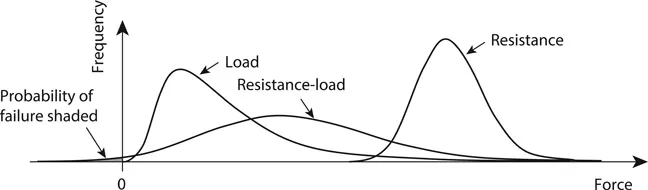
The partial safety factors are normally based on proven work over many years. When new design equations are added to codes, they are tested for accuracy in the laboratory. It is important to remember that design resistances and loads are only approximations. The statistical uncertainty is modelled using the log-normal probability distribution function for both load and resistance, a process that is illustrated in Figure 1.1. The partial safety factors are selected to ensure that probability of failure is very small.
image
Figure 1.1 Probability distributions of resistance, load and resistance-load.
Lists of partial safety factors (γ-factors) are shown in Tables 1.1 and 1.2. It can be seen that different factors are applied to different types of load and ...

Table of contents

  1. Cover
  2. Half Title
  3. Title
  4. Copyright
  5. Contents
  6. Symbols and abbreviations
  7. Foreword
  8. Preface
  9. Author
  10. 1 Limit state design
  11. 2 Steel members in flexure
  12. 3 Buckling of steel columns and trusses
  13. 4 Buckling of arches
  14. 5 Buckling of thin-walled structures
  15. 6 Composite structures
  16. 7 Reinforced concrete beams and columns
  17. 8 Prestressed structures
  18. 9 Strut and tie modelling of reinforced concrete
  19. 10 Control of cracking in reinforced concrete
  20. 11 Timber beams, columns and trusses
  21. Index