- 282 pages
- English
- ePUB (mobile friendly)
- Available on iOS & Android
eBook - ePub
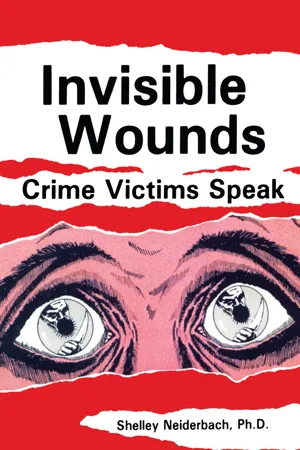
Invisible Wounds: Crime Victims Speak
About this book
Feel the terror and anger experienced by crime victims as you read accounts of the highly charged therapy sessions at New York City's Crime Victims'Counseling Services, the first group therapy services for crime victims of its kind. This emotionally charged book contains actual transcripts of interviews with crime victims as they explain the violations against them--their recollections of the assault itself and their feelings afterward. Their stories provide insights into the acute and profound trauma that crime victimization evokes. The helping and healing processes are a catharsis for the victim--and powerful reading for the rest of us.
Information
Print ISBN
9780918393302
Subtopic
Health Care DeliveryHow to Read this Book
Writings appearing, widely spaced in the typeface you are reading, are always and only edited transcripts of audiotaped interviews with crime victims who availed themselves of the group sessions offered by Crime Victims’ Counseling Services.
Writings appearing, in the typeface you are reading, are always and only from books, newspapers, magazines, journals, reports, brochures, and similar sources.
Writings appearing, in the typeface you are reading, are always and only the author’s responses.
Writings appearing, in the typeface you are reading, are always and only from group exercises and evaluations by members of Crime Victims’ Counseling Services group sessions.
One: LYNN
… I was coming home at night. I had been with some friends from out of town, and we had gone to a movie. In fact, someone had come with me on the subway, but he got off the stop before I did and so it was near midnight on a Saturday night. The way I’m situated, my house is about two and a half blocks away from the subway exit, and so I got out of the subway and I had about two and a half blocks to go home. I was about halfway between the subway exit and home, when I was aware that there were three men on the opposite side of the street walking toward me. I right away had some feeling that something was happening here. I remember kind of going through my mind, “You know what to do,” not real rationally but just kind of the alternatives were really there, and I thought about going back to the subway but it’s one of those that doesn’t have an attendant. It’s just a turnstyle thing. … I might have been trapped there, and also the train had just left. It was like no one would probably be there. There wasn’t anyone that I had passed on the street and it’s a commercial couple of blocks, there. It was deserted, all closed up. And I thought, “Okay, you can go on home, it’s about the same distance,” and I thought, “At least if you’re home you’re in the house and you’re locked in there, if you can get in there, but at least it’s not like being trapped in the subway,” so I decided to go ahead. They were on the other side of the street—so I thought, you know, I can kind of gauge how this goes by continuing to mark it. So I did, and they came across the street to my side of the street and one of them was on the sidewalk and the other two were still crossing the street. They weren’t really that close to me, at this point—maybe several car lengths away, I would say, and the one that was on the sidewalk pulled a gun. He told me not to move, not to run, not to scream, or he’d kill me. So I went from the sidewalk to the street, between the cars, and the [other] two (meanwhile) came to the sidewalk. They were kind of going that way and they kept coming toward me, and at this point I just kind of waited … but they were still on the sidewalk and at this point I was in the middle of the street. I don’t know. I can’t remember even thinking what to do. Then—I just remembered—next they—here I was in the middle of the street and they again said not to move, not to run, or they would shoot me. So they came to the street then and at that point (it was a oneway street we were on) I could see down the street a car coming. I could see the lights of a car coming, and at that point they hadn’t touched me or weren’t really that close to me. … They had threatened to kill me but they hadn’t been physically very close to me yet. When I saw the car coming down the street (they were probably on one of the streets, by the cars, and I was on the other, but we were all in the street, at this point, all four of us) … I just ran toward the car as fast as I could, and they were running behind me and yelling at me not to run. The car came and slowed down, and I was on the passenger side and they were on the driver’s side, and I had one hand on the door handle of the passenger side and the car slowed down and then, when I got there, the car just speeded away and left. So they then ran right over to me, the three of them, and said, “Why did you think you could get away with that? Never do that again.” [I was afraid because] I’d never have that chance again. They were going to teach me a lesson and they started pushing me around. They sort of circled me and pushed me, like from one to the other, just playing with me. Slapping me, not forceful, but just pushing my head around and pulling on my hair, [my] so … long hair, and they were pulling on that, so I don’t really remember them ever asking me for anything, like for money or anything like that. … My thought was that they wanted my money and that they were either going to rape me or kill me, or both. That’s what I thought was going to happen and it seemed like, at the first part of it, they were really enjoying this pushing around kind of thing. Anyway, they got me down on the ground through this pushing. Finally, I kind of backed away and pushed off of one of them, and they got me down on the ground. I remember one of them pulling at me and one of my shoes was pulled off, and again they were not really like, beating me, but, like pulling on my clothes, taunting me, and pulling on my pants. I remember getting up, one time, and pulling away from them and kind of running down to the next car. Then they got me down again and this time I remember being next to the car, and seeing underneath the car, and I saw the lights of another car coming down the street. So, at that point, I just … the whole time, inside of me, I was like … had this thing in my chest that just knotted up. I was so determined that this was just not going to happen to me. It was that I was going to do whatever I could to get out of here, whatever I had to do, I was going to do it. So when I saw the car lights [of the second car] down the street, and I remember, too, seeing under the car and seeing those car lights. I don’t know at all how I got up, but I remember running toward that car, and I had one shoe on, but how much the foot with my shoe on it hurt! It was just like a stinging. I remember just pounding on that foot and just running to the car, and again they ran right behind me and again they were screaming at me. Not screaming, yelling at me, not to run and they were going to kill me. I got to the car and there were two people in it, this time; last time there had only been one person, that I remember. I was on the passenger side again. This time one of them had gone on to the driver’s side and two of them had come behind me, on the passenger side. The one on the driver’s side is the one with the gun. I don’t know if the other ones had guns or not. He told the driver that he would kill him … [the car] never totally stopped, but I got to the passenger side and the car door opened and the woman inside helped me open the door. She was kind of pulling me in and I got in, and the car was kind of going away with the door not shut, and [the assailants] were pulling on the door … and we on the inside were pulling on the door. We kind of drove away. … It was a man and a woman. They were pretty young and out on the town … they had drinks in their hands and they were all dressed up. They were really very kind people. She put her arm around me and he asked me how I was, and he was going to kill the mother-fuckers, that was his thing. We got a little further away and he stopped the car. He wanted to go back and get them, and I said I didn’t really want him to do that. I knew they had a gun and I just didn’t see what we had to gain by going to search them out. … [The driver] had seen the gun, so what he did was, he drove backwards on this one-way street, about a block, a block and a half. [He] knew where they had run down. We all had seen in which direction they had gone and there were some people down there on the street, and so he got out and went down and talked to one or two guys down the street, but they didn’t seem to be the same guys, so he went down and they said some kids went that way, or whatever … he just sort of stood around for a while, stood outside his car for a while, and we were sitting inside and then finally he said, well, they wanted to take me to the hospital. I felt that I didn’t need any hospital attention that, well, I had done some stuff before with people, battered women, and had gone with them to the hospital and realized some of the things they went through in some serious cases, and felt that I didn’t have anything that looked like I needed anything. I didn’t want to go to the hospital, and so I was real calm, at that point, and I hadn’t started to cry or anything. I told them that it was okay, and that they could drop me off at the comer, I could walk home. And they said, “Don’t be crazy, we’re taking you home,” and they did. They took me right to the door and waited and made sure I got in, and when we went back I got my shoe. (Also, by the way, it was sort of tom up, but we got it and I remember later taking it to the shoe repair, thinking, well, maybe I should just throw these shoes out. I don’t know what I did with it.) Anyway, I got home and they dropped me off and left, and I thought later, “I never got their name,” or “I don’t know anything about these people that stopped there that night.” … I went up, and it wasn’t until I was in the house and shut the door—it was kind of like the incident was over; that is, when I started to collapse and cry and was just real upset. I didn’t really sleep all night. I called a lot of people. … That night I called the police and then it wasn’t until the next Thursday that I actually went in and reported it. (I was out of town. I left town that Sunday.) [The police] didn’t send a car over. … They told me to come in and report it in person, and I said, well, I was going to be out of town and wouldn’t be back until Thursday. They said to come in on Thursday, and that’s what I did. … I called my friends. I called three friends and I would call one and talk a while and kind of calm down a little bit, and then hang up the phone, and just as soon as I’d hang up the phone I realized that I was still just as upset, and then I would call someone else. … It really went through the whole night. I mean, the first person I called was maybe about twelve-thirty a.m., or something like that, … into three and four in the morning. One friend wanted me to come over, and I thought no way was I going to go over to anyone’s house, no matter if I called a car service or anything. There just was no way that I was going to do that. Then another friend set an alarm and kept calling back to make sure, just to check on me and see how things were going. So there was a lot of support. I mean, I was on the phone most of the night, really, and sometimes I would be off for a half hour or so and kind of sit there or pace around or take a shower. … I packed and I really just did did little things around the apartment I didn’t really need to do, necessarily. … I ironed things and I never iron! The next morning I had to go to Washington, so I had my stuff all ready. I hadn’t slept really at all, and I was taking the train down, and I had my bag and I had to walk that same street to go back to get the subway, and it didn’t seem that bad doing that. It was daylight and all the stores were open again and it seemed all right and I got on the subway. I remember walking down the street and there were three men that could have fit the description of the three men, because I really couldn’t describe them very well, other than to say that they were not a few things—that they were not over two hundred pounds. There are a few things I could eliminate, but anyway there were these three men there and I kind of thought, you know, these people know me and I don’t have any idea who they are. That was the only time I felt upset again, going in the morning. … I felt vulnerable at that point, but then I went, got the train, and went down to Washington. I was there until Wednesday night, three and a half days. It was a meeting with other people from other programs in education, not people I know particularly well. People I meet every year but I don’t really know them that well and so, at that point, I didn’t really have anyone to talk to about it, and I didn’t even think about it all that much. It was there, but I was just kind of numb at that point and I got into my work. I’d come in at night from the sessions and do all of the reading and was very efficient about doing all those things. … I think [at that point] I was just numb and I was functioning, but I wasn’t real alert to anything around me, particularly. It seemed like a very protective environment. I never went out of the hotel—was in the hotel the whole time: The meals were in the hotel, the conferences were in the hotel. … It was a very safe environment, plus it wasn’t even in New York. And one night I had set up to call a friend from high school who was living in Washington and go over to their house and h...
Table of contents
- Cover
- Half Title
- Title Page
- Copyright Page
- Dedication
- Table of Contents
- Acknowledgments
- Foreword
- “Phobiphobia”
- Introduction: “A Blow of Redirection”
- Genesis
- Crime Victims Speak
- Afterword
- Bibliography
- About the Author
Trusted by 375,005 students
Access to over 1.5 million titles for a fair monthly price.
Study more efficiently using our study tools.
Frequently asked questions
Yes, you can cancel anytime from the Subscription tab in your account settings on the Perlego website. Your subscription will stay active until the end of your current billing period. Learn how to cancel your subscription
No, books cannot be downloaded as external files, such as PDFs, for use outside of Perlego. However, you can download books within the Perlego app for offline reading on mobile or tablet. Learn how to download books offline
Perlego offers two plans: Essential and Complete
- Essential is ideal for learners and professionals who enjoy exploring a wide range of subjects. Access the Essential Library with 800,000+ trusted titles and best-sellers across business, personal growth, and the humanities. Includes unlimited reading time and Standard Read Aloud voice.
- Complete: Perfect for advanced learners and researchers needing full, unrestricted access. Unlock 1.5M+ books across hundreds of subjects, including academic and specialized titles. The Complete Plan also includes advanced features like Premium Read Aloud and Research Assistant.
We are an online textbook subscription service, where you can get access to an entire online library for less than the price of a single book per month. With over 1.5 million books across 990+ topics, we’ve got you covered! Learn about our mission
Look out for the read-aloud symbol on your next book to see if you can listen to it. The read-aloud tool reads text aloud for you, highlighting the text as it is being read. You can pause it, speed it up and slow it down. Learn more about Read Aloud
Yes! You can use the Perlego app on both iOS and Android devices to read anytime, anywhere — even offline. Perfect for commutes or when you’re on the go.
Please note we cannot support devices running on iOS 13 and Android 7 or earlier. Learn more about using the app
Please note we cannot support devices running on iOS 13 and Android 7 or earlier. Learn more about using the app
Yes, you can access Invisible Wounds: Crime Victims Speak by Shelley Neiderbach,Susan Iwansowski in PDF and/or ePUB format. We have over 1.5 million books available in our catalogue for you to explore.