- 341 pages
- English
- ePUB (mobile friendly)
- Available on iOS & Android
eBook - ePub
About this book
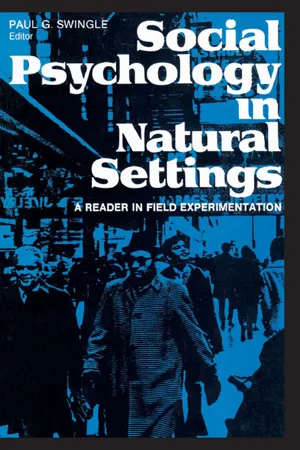
The study of human behavior in actual social settings is an extraordinarily complex area of research. Social behavior, unlike the controlled conditions of the laboratory, is affected by an enormous number of variables and environments. Researchers, therefore, are faced with the task of designing adequate experiments that have the sophisticated controls necessary to increase the experimenter's confidence that a relationship between a particular stimulus in a social environment and a particular social response actually exists. This distinctive supplementary text for social psychology courses gives students a real feeling for the possibilities of experimentation outside the laboratory. The reprinted and abstracted articles in this book are reports of experimental studies conducted in natural settings, and the orientation is scientific--focusing on consistencies between laboratory and field research, rather than their inconsistencies. The book discusses research on discrimination, status, prosocial behavior, dissonance, attitude change, interpersonal and group influence, compliance performance, change and rumors, honesty, and participation. The chapters were selected on the basis of both content and methodology and demonstrate particularly ingenious applications of experimental methodology to the study of natural settings. Throughout the book, the editor stresses the ethical and moral issues associated with field research, demonstrating that scientific work must be humane as well as rigorous. Social Psychology in Natural Settings is appropriate for course use at introductory as well as more advanced levels. It is instructive and useful as a reference volume for graduate students and researchers as well.
Information
1 | INTRODUCTION |
The study of human social behavior is an extraordinarily complex area of research. Among the many reasons, two are dominant. First, human social behavior obviously is affected by an enormous number of variables. To determine the relationship between a particular environmental or social variable and an individual’s or a group’s response, other influences on the behavior must be either eliminated or controlled. A most challenging task, therefore, is the design of adequate experiments that have the sophisticated controls necessary to increase the experimenter’s confidence that a relationship between a particular stimulus in a social environment and a particular social response actually exists.
Second, human social behavior tends to be affected by the research process itself. That is, if an individual knows he is involved in an experiment he is likely to behave in a manner somewhat different from the way he would were he not apprehensive about being evaluated. The extent of this contamination is hard to assess. It may vary from the subject’s simply being somewhat less active or more inhibited than usual in his behavior (the behavior in question being essentially the same) to a situation in which he acts in exact contradiction of his own personal beliefs in an attempt to behave in a manner he thinks is appropriate. Thus, an individual may act in a way he thinks the experimenter wants him to act, or in a way he feels normal people should act, but not the way he would behave were he unaware that his behavior was being observed.
A related problem is that the results of social research may have an effect on the behavior of the population in question. Let us assume that a researcher concerned with determining good indicators of conformity found that individuals who part their hair on the left side within two inches of the tops of their ears have a much higher probability of complying with requests than does the population at large. Should this information become public we might assume that individuals who did, in fact, part their hair in that fashion but also felt that being overly compliant was a negative personal characteristic might simply change their hairstyle. In short, the research process may have a reactive effect on the subjects in the research situation, be they individuals or groups of individuals.
Laboratory versus Field Experimentation
People have become overly concerned with the distinction between laboratory and field experimentation, and students frequently are expected to wade through the boring details of the essential differences between the two types of research. Much of the skepticism about laboratory-based studies of social behavior is the result of early self-report studies in which subjects were asked what they would do in various circumstances. Whenever data are limited to self-report, the researcher can never be quite sure that the reporter’s statements are an accurate estimate of what he did or what he would do in various situations. Much data now available demonstrate quite conclusively that data derived from self-report frequently are at variance with the subject’s actual behavior. Behavior is very much determined by the situation a person finds himself in. The prejudiced person may find it expedient to act as though he were extremely tolerant; the person who believes he is honest may feel compelled to be dishonest at certain times. It is important, therefore, to concentrate whenever possible on the actual behavior of subjects rather than on the subjects’ self-reports, whether in the laboratory or in the field. However, when the experimenter is concerned with a person’s aspirations or his confidence or his values, he generally must rely on what the subject tells him.
Advantages and disadvantages are, of course, associated with both laboratory and field research settings, and the advantages of one setting tend largely to reflect the weaknesses of the other. The laboratory might be thought of as the social psychologist’s microscope. Artificial social cultures may be established and precisely controlled, and the independent variable can be manipulated with great precision and the dependent variable(s)—the subject’s behavior—measured as frequently and as meticulously as the researcher deems appropriate. In the laboratory, however, subjects know they are being observed and evaluated. Their behavior may also be an artifact of the experimental setting such that the behaviors being studied may not be within the subject’s normal range of behaviors.
In field settings the subject’s behavior is natural, but the experimenter loses experimental precision and control. It is also difficult to find suitable field situations that can be experimentally manipulated for the purpose of studying a specific problem. Basically, one must consider only three things in evaluating a research project.
First, what is the likelihood that the subject was aware that his behavior was being observed and recorded? For instance, an experiment could easily be done on subjects walking through a building on the way to psychological experiments. In this situation it is very likely that the subjects would not be aware that their behavior was being observed. A long, detailed discussion about whether such an experiment would constitute a field or lab experiment seems to be a profound waste of time, but it is important to know whether a subject is aware of being observed, because his behavior may be affected by his awareness. Also to be considered is whether one is ethically and morally justified in interfering with a person’s right to privacy in his normal day-to-day activities.
Second, if the subject is aware that his behavior is being systematically observed and recorded does he know what aspects of his behavior are being observed? In other words, is the experiment so transparent that the subject is not naïve? Subject’s awareness of the behavior under investigation may be a serious contamination and may result in invalid data. In laboratory studies some sort of deception procedure usually is used to keep subjects unaware of the true purpose of the experiment, but in natural setting experiments transparency and subject naïveté usually are not serious problems.
Experimental Research
The third point to be considered in evaluating experiments is whether the data were collected in an experimental or in a non-experimental situation. Experimental social psychology refers to the deliberate manipulation of the independent variable and, concomitantly, controlled observation of the dependent variable. A few examples should clarify the distinction between experimental social psychology and other approaches to the study of social behavior.
One might be concerned, say, with the effects of heterosexual groups on the time required to solve a logical problem. The experimenter might ask four-person groups to solve a series of logical problems, taking measurements every 10 minutes to determine the number of problems correctly solved during that time unit. Three experimental conditions might be included: groups of four males, groups of four females, and groups of two males and two females. In this particular situation the experimenter has deliberately manipulated the independent variable—the sexual composition of the group—and is measuring the dependent variable—the number of logical problems solved during every 10-minute time block.
Another example is an episode staged by Allan Funt for the television show “Candid Camera,” modified to study the effects of group size on conformity behavior in a field situation. When people enter an elevator they usually turn to face the door and almost never stand facing the back wall. People feel uncomfortable, however, when their behavior is at variance with that of other people in a situation. Thus, if experimental confederates enter the elevator just after the naïve subject enters and, rather than facing the door, face the back wall, a measure of yielding can be obtained. The experiment might involve groups of one, two, three, four, or five confederates who enter the elevator singly. Group size then would be the independent variable. The dependent measure of the naïve subject’s conforming behavior might be whether or not he turned and faced the back wall within 30 seconds.
Endless examples, of course, could be offered. Most of the studies reported in this book involve manipulation of the independent variable and so can be referred to as experimental research. Again, the principal distinction between experimental and non experimental research is that in experimental research one deliberately manipulates the independent variable and determines the effect of this manipulation on the subject’s (or group’s) behavior—the dependent variable. Experimental studies of social behavior are our most powerful tool for developing an understanding of human social behavior, since this procedure facilitates the development of cause-and-effect hypotheses. If an experimenter has deliberately manipulated the independent variable and has observed a change in the subject’s behavior, he can be more confident that there is a causal relationship between the independent and the dependent variables.
The many nonexperimental approaches to the study of social behavior include attitude surveys, content analyses, correlation procedures, and other techniques designed to examine behavior in highly controlled situations and to relate that behavior to correlated conditions. Any time one does not directly manipulate the independent variable, however, one must exercise extreme caution in making causal statements.
For example, suppose that all people who regularly attend church score very highly on scales of ethnic prejudice; that is, a high correlation exists between church attendance and prejudicial attitudes. Should one find such a relationship, it is not justified to state that church attendance leads to prejudicial attitudes, nor is it legitimate to say that ethnocentric attitudes lead to an affinity for organized religion, which reflects itself in high church attendance. Given the circumstances, one can say only that these two variables vary together. When a person tends to be high in one, he tends to be high in the other. It is entirely possible, for example, that both of these factors are related to a third variable, which results in both high prejudice and high church attendance. Possibly both correlate very highly with conformity, and compliant individuals comply with the community’s social norms, which happen to be ethnocentrism and church attendance.
Ethical Considerations in the Conduct of Human Research
Man has the right to be left alone. He has the right to privacy. He has the right to protest individual surveillance of his behavior without his explicit permission. He has the right to know if his behavior is being manipulated, and if it is, why.
All of the above seems self-evident in any civilized free society. However, scientists with appalling frequency act in an unacceptably callous manner regarding physical and psychological hazards to their subjects. Beecher (1969) cites several disquieting experiments, such as the injection of live cancer cells into patients who were unaware of the type of cell being injected. Pappworth (1969) cites distressing examples of research conducted on human subjects; many violate ethical cannons of acceptability if not the law itself. Children have been exposed to harmful doses of chemicals without their parents’ awareness and have been subjected to physically painful procedures unrelated to treatment for any existing malady.
In known cases subjects were exposed to unacceptable risks of pain or physiological injury in psychological experiments that involved electric shock and loud noise. In the noise cases the dangers resulted from the researchers’ lack of knowledge about the stimuli they were using. Carrying out an experiment without being fully aware of the potential dangers to the subject is, of course, unethical as well as stupid.
Although the physical dangers to subjects are extremely important, they are more obvious than the psychological dangers, and regulating bodies therefore tend to notice them more rapidly. The psychological dangers to subjects are more insidious, less subject to regulation and control, but in general at least as dangerous to the subject as are the physical dangers. Subjects have been exposed to deceptive manipulations that have led them to believe that they had exposed a helpless person to extremely painful shock or loud noise, were homosexually aroused, had cheated, lied, or yielded. Persons have been observed to cheat, to open and keep lost mail, and to lie. Experimenters have joined groups and pretended to share the groups’ norms and beliefs in order to observe the behavior of gangs, religious extremists, and work crews. Washrooms have been bugged, private conversations have been recorded, audiences in darkened theaters have been observed with infrared systems, and researchers have hidden under beds in students’ dormitory rooms to record conversations during tea parties (Webb et al., 1966).
Scientists interested in the study of social behavior must therefore confront the serious conflict of concern for individual subjects in research situations against the scientist’s obligation to develop an understanding of meaningful human social behavior and important social problems. Social psychologists are being encouraged to study the behavior of people in natural environments and to directly study urgent social problems. To accomplish this research, subjects may be exposed to deception, invasion of privacy, stress, embarrassment, restriction of personal freedom, and other indignities.
Professional associations have wrestled long with the problem of ethical standards for research. Codes of ethics have been developed for researchers who use human subjects, but the dilemmas scientists must face are extremely complex (APA, 1971). Some issues seem straightforward—for example, the right of any subject to refuse to participate in an experiment that involves risk of physical or psychological harm. However, this assumes that the experimenter can evaluate the risk, which may imply previous experimentation, and that prospective subjects are fully informed before they consent to participate. Children, mental patients, and persons highly dependent on the experimenter cannot give consent or may not be able to feel free to refuse participation. Consent of guardians is sometimes considered adequate if restricted to situations that have no risk to the subject or, if risks or discomfort are involved, to procedures that may benefit the subject. Further, in some situations informing the subject prior to the experiment would seriously contaminate the data, either because subjects would not act naturally or because many people would refuse to participate, which might leave a population of subjects who are unique, thereby limiting the extent to which the results could be generalized to the larger population.
One might argue that subjects could be informed after they had participated in an experiment and could be allowed to withdraw their data if they choose not to be included in the experiment. Once again the experimenter might be left with a unique population, perhaps limiting the usefulness of the findings. However, more serious issues are involved in the procedure of informing subjects after they have participated. It may be practically impossible to inform all participants, or, since psychologists frequently are interested in such important human behaviors as aggression, cheating, love, influenceability, and the like, informing the subject may create considerable stress, guilt, or embarrassment.
One could argue that protecting the subject’s anonymity and not informing him of his participation would be the most ethically desirable procedure. The counterargument is that the indignities and invasions of privacy that unaware subjects are exposed to in experimental manipulation and scrutiny are legitimate because the scientists are well intentioned.
For man to learn something about himself, social research must be conducted. When risks are involved, the potential benefits from the results of the experiment must be weighed against the risks and costs to the participants. The question, of course, is: Who does the weighing? Researchers may be too concerned with continuing the project to deal objectively with the ethical issues; the agency or group that pays for the research may be too committed to deal effectively with them. One suggestion (APA, 1971) is that all research proposals dealing with human subjects be reviewed by a group of persons who represent different sensitivities and could advise the experimenter and assist him in developing the most ethically desirable procedures. A review board might include fellow social scientists, clergymen, lawyers, and representatives from the potential research population. Such review procedures are far from perfect, of course, and the responsibility for the research must remain solely with the experimenter.
It is obvious, then, that the problems of ethical standards in behavioral research are not at all simple. Even the seemingly straightforward issue of informed consent opens up into a myriad of complex and perhaps irreconcilable conflicts of values. Other problems of an ethical nature, including the selection of research topics and experimental populations and the final application of research findings, are likewise extremely complex and subject to marked differences of opinion. The interested student may want to read some of the many thorough treatments of these issues by such social scientists as Erikson (1967), Kelman (1968), Mead (1969), and Parsons (1969)
The following articles are reports of experimental manipulations of social behavior in nonlaboratory situations. Persons moving about in their day-to-day activities were the unknowing subjects observed by unobtrusive hardware or researchers. In some situations the subjects remained anonymously buried in larger groups of people. In others the person’s manipulated behavior was individually recorded. Some of the experiments made use of naturally occurring manipulations of the independent variables; however, in most of the reported studies the experimenters deliberately manipulated the independent variable.
In a few of the studies the subjects were aware that their behavior was being recorded (e.g., when an experimenter asked questions) but were...
Table of contents
- Cover
- Half Title
- Title Page
- Copyright Page
- Table of Contents
- 1 INTRODUCTION
- 2 PERFORMANCE AND PARTICIPATION
- 3 DISCRIMINATION AND STIGMATIZATION
- 4 STATUS EFFECTS
- 5 HELPING AND HONESTY
- 6 DECISIONS AND DISSONANCE
- 7 INTERPERSONAL INFLUENCE
- 8 GROUP INFLUENCE
- 9 COMPLIANCE
- 10 ATTITUDE CHANGE
- 11 RUMORS
Trusted by 375,005 students
Access to over 1.5 million titles for a fair monthly price.
Study more efficiently using our study tools.
Frequently asked questions
Yes, you can cancel anytime from the Subscription tab in your account settings on the Perlego website. Your subscription will stay active until the end of your current billing period. Learn how to cancel your subscription
No, books cannot be downloaded as external files, such as PDFs, for use outside of Perlego. However, you can download books within the Perlego app for offline reading on mobile or tablet. Learn how to download books offline
Perlego offers two plans: Essential and Complete
- Essential is ideal for learners and professionals who enjoy exploring a wide range of subjects. Access the Essential Library with 800,000+ trusted titles and best-sellers across business, personal growth, and the humanities. Includes unlimited reading time and Standard Read Aloud voice.
- Complete: Perfect for advanced learners and researchers needing full, unrestricted access. Unlock 1.5M+ books across hundreds of subjects, including academic and specialized titles. The Complete Plan also includes advanced features like Premium Read Aloud and Research Assistant.
We are an online textbook subscription service, where you can get access to an entire online library for less than the price of a single book per month. With over 1.5 million books across 990+ topics, we’ve got you covered! Learn about our mission
Look out for the read-aloud symbol on your next book to see if you can listen to it. The read-aloud tool reads text aloud for you, highlighting the text as it is being read. You can pause it, speed it up and slow it down. Learn more about Read Aloud
Yes! You can use the Perlego app on both iOS and Android devices to read anytime, anywhere — even offline. Perfect for commutes or when you’re on the go.
Please note we cannot support devices running on iOS 13 and Android 7 or earlier. Learn more about using the app
Please note we cannot support devices running on iOS 13 and Android 7 or earlier. Learn more about using the app
Yes, you can access Social Psychology in Natural Settings by Paul G. Swingle in PDF and/or ePUB format, as well as other popular books in Psychology & History & Theory in Psychology. We have over 1.5 million books available in our catalogue for you to explore.