- 226 pages
- English
- ePUB (mobile friendly)
- Available on iOS & Android
eBook - ePub
About this book
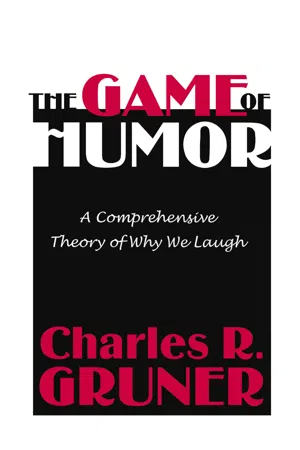
Humor, wit, and laughter surround each person. From everyday quips to the carefully contrived comedy of literature, newspapers, and television we experience humor in many forms, yet the impetus for our laughter is far from innocuous. Misfortune, stupidity, and moral or cultural defects, however faintly revealed in others and ourselves, seem to make us laugh. Although discomforting, such negative terms as superiority, aggression, hostility, ridicule, or degradation can be applied to instances of humor. According to scholars, Thomas Hobbes's "superiority theory" that humor arises from mischances, infirmities, and indecencies, where there is no wit at all applies to most humor. With the exception of good-natured play, Charles R. Gruner claims that humor is rarely as innocent as it first appears.Gruner's proposed superiority theory of humor is all-encompassing. In The Game of Humor, he expands the scope of Hobbes's theory to include and explore the contest aspect of "good-natured" play. As such, the author believes all instances of humor can be examined as games, in terms of competition and keeping score winners and losers. Gruner draws on a broad spectrum of thought-provoking examples. Holocaust jokes, sexual humor, the racialist dialogue of such comic characters as Stepin Fetchit and Archie Bunker, simple puns, and many of the author's own encounters with everyday humor. Gruner challenges the reader to offer a single example of humor that cannot be "de-humorized" by its agonistic nature.The Game of Humor makes intriguing and enjoyable reading for people interested in humor and the aspects of human motivation. This book will also be valuable to professionals in communication and information studies, sociologists, literary critics and linguists, and psychologists concerned with the conflicts and tensions of everyday life.
Information
1
Win Or Lose: The Games We Play
Sign outside a church:
Next Sunday: “Do You Know What Hell Is?”
Come in and hear our organist.
The time: 12 March 1996; the place: Terrell Hall 214, University of Georgia. Event: my lecture to the members of SPC 490, “Wit and Humor as Communication.”
I wanted to quickly communicate to the students the central theme of this book. I told this story:
George Ostermeyer went into the operating room with a critical illness and for a surgical procedure that he knew in advance he very well might not survive. When he awoke, he found himself lying in a large sumptuous bed in a huge bedroom. On the walls hung priceless old masters paintings, and gorgeous antique tapestries; exotic oriental rugs covered the floor; beautifully haunting music cascaded softly from all sides. A manservant stood attentively at the side of George’s bed. “Could I get you anything, Sir? Anything at all?” he asked.
“I must have died,” replied George.
“Yes, Sir, you certainly did,” answered the manservant. “Can I get you anything to make you comfortable?”
“Why, yes,” said George. “How about a large, very dry, very cold martini?”
“Done,” said the servant, and George instantly held in his hand the biggest, coldest, driest martini he had ever sipped.
As George finished his martini the servant again asked if he wanted anything. George replied, “Well, I am famished. How about a big, thick steak, medium rare, with baked potato and Caesar salad, and a bottle of your very best champagne.”
“Certainly, Sir,” said the servant, and the bountiful repast was suddenly spread before the amazed gentleman.
After George finished his dinner, the servant once again asked if he could bring his master anything. George thought for a moment, then brightened: “I’d really like a woman. A blonde. Say—how about a young Marilyn Monroe.”
“Of course, Sir.” And suddenly a nubile Marilyn Monroe was under the sheet next to George, wearing nothing but perfect makeup and a smile, throatily saying through her smile, “Dear George—I am totally yours!”
“Wow,” interjected our hero. “I always dreamed of going to Heaven, but I had no idea I would find it this great!”
“Oh, but Sir,” interrupted the servant, “I fear you have the wrong impression. You did not go to Heaven.”
As the story ended, there was a long, puzzled silence in the classroom.
I continued. Let’s suppose that I am the servant and you are the “Georges” and I could grant each of you any and everything that any of you could possibly desire: suppose I could provide it instantly and completely, without reservation or condition. Would you really enjoy that?
After another pause, one student opined that such instant gratification could get pretty old pretty fast.
I asked if anyone present played golf. Three young men held up their hands. I turned to Craig, the golfer in the front row: “Suppose I could grant that you would play perfect golf each time you hit the links. How (and what) would you do at ‘perfect golf’?”
“Eighteen straight holes-in-one,” was the reply.
“OK, Craig. I grant you perfect golf for life. You now will score a perfect eighteen each round you play. Will you now enjoy the game more?”
Without even thinking about it he said, “Heck no. I’d quit the game.”
I knew that Omari played on the UGA Bulldog football team. I turned to him. “Omari, what would be perfect football for the ‘Dawgs?’”
“Well,” he said, “Each offensive play is drawn on the board to go for a touchdown on each play.”
“What about defense?” I queried.
“Each defensive play gets drawn on the board as stopping the other team for no gain or else intercepting a pass.”
“OK, then,” I said. “I decree that the Bulldogs will now play nothing but perfect football. Each offensive play they run will result in a touch-down; every defensive play will either throw the opposition for a loss, or recover the ball for us. So Georgia ought to win all their games by several hundred points to none. Wouldn’t you like that, Omari?”
“Shoot, I can’t see any fun in that!”
Scanning the entire class, I continued: “How about you fans? Wouldn’t you enjoy the game better if Georgia played perfectly?”
They all literally or figuratively held their noses.
“But don’t you always want to win?” I asked.
Of course, they did. But it had to be a contest. The synonym for a truly boring game came out: “No contest.”
So I asked for examples of truly interesting, exciting, fun games to win. One student recalled the football game over at Georgia Tech in the 1980s. Georgia was down by four points with just over two minutes to play when they got the ball on their own twenty-yard line. Quarterback Andy Johnson brought the team down the field with short down-and-out passes to stop the clock since the Bulldogs had no more timeouts left. Finally, with seconds left on the clock, Johnson crashed over the goal line in a quarterback draw play. The Georgia fans went ballistic in their gleeful celebration.
Another recalled the great comeback by Duke’s basketball team in the 1992 NCAA tournament. Duke was trying for its second consecutive national championship, but found themselves behind by one point with only 2.7 seconds left in the game. After a timeout, Duke’s Grant Hill threw a baseball-type pass the length of the floor where stood center Christian Laettner at his foul line, his back to the basket. Laettner faked left, dribbled once right, and lofted a perfect shot through the net as the buzzer sounded. The entire Duke half of the Coliseum erupted in a hurricane of cheers, laughter, screams, back-pounding, and high-fives.
Other students gave accounts of close games of chess, bridge, Parcheesi, poker, Monopoly, even solitaire in which they had joyously pulled out victories.
I presented somewhat contrasting examples from my hometown experience. It had been a tremendous thrill for tiny Pinckneyville to win the Illinois state basketball championship in 1948, although the championship game became so lopsided that the seniors watched the last two minutes from the bench while the second-stringers (including myself) got onto the floor to take a small part in the 65–39 score, a record differential for a championship game.
On the other hand, when Pinckneyville once again became an Illinois state basketball champion (1994), this time as a Class A school, it was with a last second heartstopping drive by all-stater Shane Hawkins, ending in a leaping pass-off to forward Ryan Bruns, who dropped through a six-foot jumper to break the tie as the buzzer sounded. The result was crowd pandemonium!
Other dull, boring victories came up in the discussion. Perhaps the biggest yawner must have been the most uneven score in football history, according to the Guinness Book of World Records:
Georgia Tech’s thrashing of hapless Cumberland University. That scoreboard read 222–0 at the game’s merciful end.
So: in order to be fun, in order to provoke a big emotional high at it’s conclusion, a game must (1) be close-must involve a conflict that keeps tension high until (2) a sudden conclusion, resulting in a victory for the winner and a defeat for the loser. (One is tempted to remember ABC’s “The thrill of victory, the agony of defeat.”)
But, of course, there are “laffers,” where you or the home team is assured of victory long before the game’s end. But at the conclusion of those “no-contests,” the squeals, the shouts, the celebration of victory becomes much subdued. Oh, you enjoy those wins, but not as ecstatic, blood-pounding highs; instead, more as warm, pleasant, satisfying inward glows. We call it “gloating.”
This same formula that operates in sports and games (tension built up, then suddenly released) also accounts for humor. Let us consider one of my favorite jokes:
Old Zeke was in poor health, but he liked to play the lottery, and had done so for years. One day Zeke’s family learned by way of TV that Zeke had won $100,000 in the lottery. They were concerned about how to convey this information to dear ole Zeke because of his bad ticker. They feared that the sudden good news would trigger a heart attack and kill Zeke.
They conferred with their minister, who was naturally good with words, and asked him if he would break the news to Zeke in a gentle and life-preserving fashion. The minister agreed.
The minister began his conversation with Zeke:
“Zeke, I understand you like to play the lottery.”
“Yep, shore do,” Zeke replied.
“Well, tell me, Zeke, did you ever win any money?” the minister asked.
“Nope, never won a dime,” said the gambler.
“Well, Zeke,” replied the preacher, “Tell me. Have you ever considered what you would do if you did win some money? For instance, let’s just suppose that you won, say, $100,000. That’s a lot of money. What would you do with that much money, Zeke?”
Zeke replied immediately. “Well, first, I’d give half of it to the church.”
Whereupon the minister dropped dead of a heart attack.
In the story of Zeke and the minister we have a subdued microcosm of a close, hard-fought, suddenly won game. Zeke’s good fortune, as well as his poor health and thus his family’s concern, first engage our interest (read: “develops tension”); then the enlisting of the wordsmith minister to help solve this touchy, dangerous problem heightens our concern. We notice that the minister starts out doing a good job of approaching the subject matter in an emotionless manner. He gradually leads up to a nonthreatening hypothetical illustration of what Zeke might do if he had won a large sum. Zeke’s quick reply suddenly “turns the tables,” as the minister immediately suffers a fatal heart attack. Let’s retell the “joke” without the tension-building.
Old Zeke ran into his minister on the street one morning, says to him, “Hey Parson, I just heard on TV that I won $100,000 in the lottery. I’ll be giving the church half of it when I git it.” The minister drops dead of a heart attack.
Not as funny, right? Let’s tell it again and take out the sudden turning of the tables: The minister has just asked his hypothetical question of Zeke, and Zeke replies,
“Well, first I’d give half of it to the church.” At this news the minister falls silent. After a moment: “Please excuse me, Zeke, but I don’t feel well. I think I had best get home.” At home, the minister complains to his wife of chest pains. Despite his protestations that it’s probably only “heartburn,” his wife calls an ambulance and insists that he go to the hospital. There, in the emergency room, the minister is diagnosed as having had cardiac arrest. He is put on artificial life support; the city’s leading heart surgeon is called in, and she performs a triple bypass operation on the minister. But to no avail. After a coma lasting four days, the minister “Graduates to Glory.”
Again, not very funny, eh what? Slow, agonizing deaths are funny only to one’s meanest, most spiteful enemies.
What I have just illustrated here is the major thesis of this book: laughing at something that is “funny” is basically the same thing as our reactions to winning in sports and games, even the “games of life” (and I emphasize the plural in “games” because we play so many such in this existence).
In sports or games, the amount and duration of our outward expression of joy and happiness is, at least in gross measure, proportional to the amount of tension built up by the closeness of the contest, and then to the suddenness of perception of winning. With humor, our behavior indicating pleasure (usually laughing, smiling, grinning, sometimes screaming with joy or applause) varies with the amount of emotional involvement with the subject of the humor and the abruptness or suddenness of the surprising outcome. The desired resolution of the game, as well as that of the joke, must pleasantly surprise us to evoke the strong “thrill of victory.” (More on “the agony of defeat” later.)
To put that thesis more succinctly: laughing equals winning.
Now, lest you prematurely reject that thesis, let me define what I mean by “winning.” I do not mean the mere “beating” of someone else, as in a formal or informal game in which a score is kept, although “beating someone” comes into play (again, later, with the “agony of defeat”). Of course, I do include “winning” to mean coming out first in a contest between individuals. But I mean far more, too. The dictionary helps us.
Winning also means succeeding at “reaching a specified condition or place,” such as to “win freedom from bias and prejudice” or “win free from a pressing crowd.” It also means having success in a dispute or argument; perhaps being proved “right” or “correct.” To win also can mean to prevail upon, to persuade, as in “to win over a convert” or “to win sympathy” from another; you might “win” someone as your own, to marry. Or you might “win” from nature some treasure, such as minable ore, or gold, or oil.
In short, I use “winning” here in its broadest sense: Getting what you want. For it is “getting what we want” that makes us happy, isn’t it? We say that we enjoy getting what we want. And it is not getting what we want that makes us unhappy.
We experience, not joy, but frustration or sadness when we do not get what we want.
And getting what we want suddenly, as a surprise, exhilarates us far more than receiving the same as a simple matter of course. Being born into and growing up with great wealth would please but not excite us; but hearing from Ed McMahon that we just won ten million dollars for answering his letter sends our emotions soaring to the stratosphere. Helping to plan your own birthday party will hardly thrill you; but the lights suddenly coming on, and everyone jumping up from behind furniture and shouting “Happy Birthday” and “Surprise!” provides an emotional jolt long to be remembered.
The rest of t...
Table of contents
- Cover Page
- Title Page
- Copyright Page
- Contents
- Introduction
- 1. Win Or Lose: The Games We Play
- 2. Conflict in Daily Life
- 3. Drollery in Death, Destruction, and Disaster
- 4. Comic Scripts: Laughing at People, Groups, and Concepts
- 5. Sexual, Sexist, and Scatological Humor
- 6. The Special Case of Puns: Word is a Game to be Won, Too.
- 7. The Mirage of “Innocent” Humor
- References
- Index
Trusted by 375,005 students
Access to over 1.5 million titles for a fair monthly price.
Study more efficiently using our study tools.
Frequently asked questions
Yes, you can cancel anytime from the Subscription tab in your account settings on the Perlego website. Your subscription will stay active until the end of your current billing period. Learn how to cancel your subscription
No, books cannot be downloaded as external files, such as PDFs, for use outside of Perlego. However, you can download books within the Perlego app for offline reading on mobile or tablet. Learn how to download books offline
Perlego offers two plans: Essential and Complete
- Essential is ideal for learners and professionals who enjoy exploring a wide range of subjects. Access the Essential Library with 800,000+ trusted titles and best-sellers across business, personal growth, and the humanities. Includes unlimited reading time and Standard Read Aloud voice.
- Complete: Perfect for advanced learners and researchers needing full, unrestricted access. Unlock 1.5M+ books across hundreds of subjects, including academic and specialized titles. The Complete Plan also includes advanced features like Premium Read Aloud and Research Assistant.
We are an online textbook subscription service, where you can get access to an entire online library for less than the price of a single book per month. With over 1.5 million books across 990+ topics, we’ve got you covered! Learn about our mission
Look out for the read-aloud symbol on your next book to see if you can listen to it. The read-aloud tool reads text aloud for you, highlighting the text as it is being read. You can pause it, speed it up and slow it down. Learn more about Read Aloud
Yes! You can use the Perlego app on both iOS and Android devices to read anytime, anywhere — even offline. Perfect for commutes or when you’re on the go.
Please note we cannot support devices running on iOS 13 and Android 7 or earlier. Learn more about using the app
Please note we cannot support devices running on iOS 13 and Android 7 or earlier. Learn more about using the app
Yes, you can access The Game of Humor by Charles R. Gruner in PDF and/or ePUB format, as well as other popular books in Psychology & Communication Studies. We have over 1.5 million books available in our catalogue for you to explore.