- 224 pages
- English
- ePUB (mobile friendly)
- Available on iOS & Android
eBook - ePub
Children and the Media
About this book
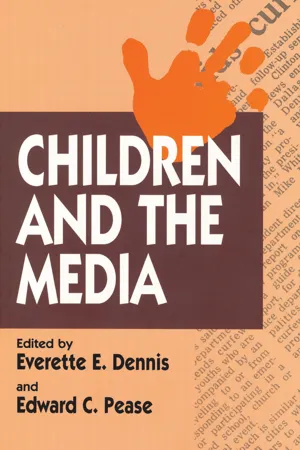
Throughout history the media has primarily been produced by adults, for adults, about adults. Increasingly, children have become a matter of high priority in the modern media society, and as they have, they have also become the subject of much concern. From debates in Congress about the detrimental effects of movies, comic books, and video games over the last century to efforts to court children as media consumers, there is a clear recognition that the media are not now and probably never were purely adult fare. Their impact on children is at issue.
Information
I
Overview
1
Symposium I
Jana Eisenberg
Issues raised in scrutinizing the interaction between children and the mass media in the 1990s are so far-reaching—touching homes, schools, government, society and culture, both here and abroad, indeed, our very future—that the editors of Children and the Media decided to spread a somewhat wider net than usual in soliciting the thoughts of people who influence both policy and practice in this crucial arena. Author Jana Eisenberg contacted dozens of social and political leaders, media professionals, scholars, researchers and kids themselves for their sense of the core issues and concerns surrounding media and young people in this latest epoch of the brave new media world. A representative selection of these responses, in short takes, appears in each of the four sections of Children and the Media.
Contributors to the four "symposium" roundtables include a U.S. Cabinet secretary, two 13-year-old sister writers from Duluth, Minn., a congresswoman from Colorado, Mr. Rogers, distinguished scholars and researchers, a 19-year-old New Yorker, a U.S. senator from Illinois, legendary entertainers and authors, journalists, educators and many others. They had much to say when we asked them for their thoughts on the most crucial issues facing the coverage of children, media content for a child audience, and the question of kids' own participation in the media process.
Many of the concerns raised by our final 23 sources are familiar ones—enduring problems of violence, commercialization, trivialization and the "abdication" of social and family responsibility to the "electronic babysitter." But other perhaps less obvious topics also are broached by this panel of experts—questions of young people's own unfiltered voices in the mass media, their frustration with how the media represent them, and issues of society's interest in a media literacy in the burgeoning information age.
In this first of four "symposium" discussions, "Before the Show Starts," six of our expert sources help define the issues explored in the rest of this book.
Secretary Richard W. Riley, U.S. Department of Education:
It's no secret that the print and broadcast media have a dramatic impact on children's ability to learn and their interest in learning. Yet the media have a mixed record when it comes to using their power to promote the social, emotional and intellectual growth of children.
Above all else, it is essential that children read. Reading is the starting point of learning, and reading with young children is both educationally valuable and great fun for the adults who care for them. There are many examples of creative and stimulating magazines designed for specific age groups.
In the broadcast media, while there have been wonderful successes, including high quality cable and network shows, there have also been too many blatantly commercial, inferior efforts—programming that fails to challenge young minds and engage children, and offers little positive reinforcement for learning. Children deserve the opportunity to see and hear messages that will teach, encourage and inspire.
American children watch an average of three hours of television per day, even more than a decade ago, and some watch six hours per day. Even two hours a day has been shown to have a negative impact on academic achievement. I urge American parents to limit their children to a maximum of two hours a day, even if that means that the remote control may have to disappear on occasion.
In a world with such extraordinary techno logical opportunities as ours, the media can and must do more to serve our children. I encourage media professionals to link education with entertainment more effectively, and to help parents and schools at every turn to challenge our young people to begin a lifetime of learning.
Vivian Horner, creator of Nickelodeon, director, children's and educational services, Bell Atlantic Video Services:
My impression is that, across the board, children have gotten the short end of the stick.
Most commercial television for children is inadequate at best and damaging at worst. Broadcasters program to children only when there is no more commercially attractive audience. Children's fare is designed to engage kids' eyeballs, not their minds. Since kids generally don't have disposable incomes, TV makes them surrogate salesmen. They want something and pester their parents for it. Young children have great difficulty distinguishing between reality and fantasy, yet we advertise directly to them. While the FCC periodically sounds an alarm about the quantity and quality of children's television and its intense commercialization, interest and enforcement tend to wax and wane.
At first, cable provided more programming for kids, and mostly it didn't carry commercials. But as their audiences increased, cable networks grew to resemble broadcast networks, unable to resist the lure of advertising dollars. Almost all cable offerings for kids today are highly commercialized.
Children learn from all media. The question is what do they learn? Do they learn that all problems can be resolved in 28 minutes? Do they learn that disagreements are settled with fists or a gun? Do they learn what to buy? Children deserve entertainment and experiences from electronic media that result in more than "incidental" learning.
Ernest Boyer, president, Carnegie Foundation for the Advancement of Teaching:
No one can deny television's great potential. But over the past 30 years, commercial television's great promise for the education of children has faded. And while we acknowledge that "fantasy" has a rightful place in enriching children's perspective, the fantasy world of commercial television is often an irresponsible approach to entertaining them, let alone to nurturing their capacity to learn and grow.
The multibillion-dollar television industry has decreed that the airwaves are overwhelmingly for adults, not children. Edward Palmer, author of Television and America's Children, has said, "It is economically irresponsible that we fail to use television fully and well to help meet nationwide... educational deficiencies."
Television sparks curiosity and opens up distant worlds to children. Through its magic, youngsters can travel to the moon, the bottom of the ocean or inside a cell. They can visit medieval castles and climb mountains. They are exposed to science, technology, history and art—all with a flick of the wrist. Let's use the exciting, almost unlimited potential of the electronic teacher to uplift rather than degrade. By so doing, we will improve the quality of education and, ultimately, help secure the future of the nation.
The 1990s could be the decade when television's promise to children is finally fulfilled. What is needed is a more coherent policy established not just by government but by concerned citizens and committed leaders in the industry itself. The promise is to enrich the lives of all children, to give them an exciting new window to the world.
Newton Minow recently said, "A new generation now has the chance to put the vision back into television, to travel from the wasteland to the promised land, and to make television a saving radiance in the sky." I could not agree more.
Sen. Paul Simon, D-IIL:
Adults and children watch too much television. In the inner cities—high crime areas—kids watch more television than they do nationally. Because we have let education deteriorate and tolerated a high level of adult illiteracy, many parents are not able to enrich their kids much. Alternatives to television are limited.
The glorification of violence has a real impact. It is a factor in the crime problem. And when the former president of the United States, George Bush, as well as kids, say, "Make my day," what they are saying is violence is fun as well as a way of solving a problem.
We are gradually—not dramatically—moving away from the glorification of violence. The phenomenon is similar to what has happened with cigarettes and alcohol. If you look at some old films, you'll see heroes and heroines smoking a great deal and drinking very heavily. That has gradually changed, and in the process we have modified the habits of the people. It's a cultural thing. And I think the same thing will happen in terms of violence.
I got interested ill this subject when I turned on a television set and saw someone being sawed in half with a chainsaw, in living color. It bothered me. And I thought, "What does this do to a 10-year old?" There is an overwhelming amount of research that says that the glamorization of violence on television does harm to our society, just as cigarettes do harm to our health.
Shari Lewis, family entertainer, ventriloquist and author:
I come from a very large family, and the examples that were set provided the context for how to live. Today, the media are the storytellers and provide the examples.
Media cannot be trusted to do well when kids are available to the highest bidder, even though commercials are a fact of life—the way that things get paid for in America. All of the studies say that children who watch hostile and aggressive shows are more hostile and aggressive in the schoolyard and in the classroom. I know the network children's departments are run by very nice, intelligent, humane, family women. But they all must compete at the level of the lowest common denominator.
Another sad fact is that in spite of the many hours that children spend listening to TV and radio, their vocabularies are shrinking. Their frame of reference is broader (for example, when you were a kid, did you know where Iraq was?), but cultural references are going by the boards. Whenever I refer to "sour grapes" or "don't cry wolf," kids don't know what I am talking about. In response to that trend, I am doing a series of books based on Aesop.
America provides the media for the entire world. My daily PBS show, "Lamb Chop's Play-Along," is on the air in every English-speaking country. No matter where you go, you see American children's shows. We are influencing the conscience, behavior and standards of the entire planet. It behooves us to do a better job.
Art Linkletter, family entertainer and author:
I have always been an optimist, but now I'm becoming discouraged. In the last 20 years, children's media—except recorded music—have gotten better. But unfortunately, the worst has become worse. And there's more of it. Electronic media have replaced books. TV is used as a babysitter.
Ever since 1960, kids have listened to a stream of sex and violence in popular music. When I lectured against drug abuse, music was one of my greatest opponents: It was telling kids drugs were great.
TV and other media were not designed for education, information or even entertainment. They are billboards. My biggest complaint about TV is the state of the talk show, which I originated. The people who run these shows, particularly in the daytime, are social street sweepers, depositing mental misfits in our parlors. Children see grown-ups endorsing previously taboo behavior.
Humans have always been fascinated by sex and grotesque things. For example, when Spielberg's "ET" was released, it was also rushed into a video-game version by Atari. That product was the biggest flop in video-game history, because kids who buy those games want violence. They will go and see a sweet movie, as they do Disney's The Lion King, but when it comes to buying video games, they want smashing, burning and killing people.
I do not believe that kids, as a result of seeing make-believe violence in movies and on TV, go out and kill people. But it callouses them. So when they see the real thing on the daily news, it's just another murder.
Jan a Eisenberg is a New York-based free-lance writer, formerly with New York Newsday.
2
The Moment of Truth
Reed Hundt
There is tremendous concern in this country about TV violence. The concern is justified: Violence on television is one of many causes of violence in our society, and violence is totally unacceptable in any "well-ordered society."
It should not be necessary for government to step in to deal with violence on broadcasting, but because congressional leaders such as Sens. Ernest Hollings, Daniel Inouye, Byron Dorgan and Paul Simon, and Rep. Edward Markey helped identify this issue, both the cable and television industries have announced comprehensive, industrywide antiviolence initiatives.
This fall, ABC will introduce a new on-air logo to designate certain programs as "particularly enjoyable for family viewing." Television set manufacturers have approved a standard for blocking technology that will rely on the programmers' sending their ratings electronically. A number of companies already have begun to sell devices that will enable parents to block programs.
One task we can and should assign to government, however, is to guarantee that the communications revolution reach all Americans, to ensure that we do not divide into a society of information haves and have-nots. How could we develop the consensus ethic of a well-ordered society if we were divided into groups of those who could read and write and those who could not? How could we truly compare beliefs, share aspirations, agree on facts, or reason civilly together?
Such may be the future distinction between those who have the opportunity to take advantage of modem communications and those who do not.
Now, some argue that by virtue of the inexorable logic of market economics, the information highway will naturally reach to all Americans who need it. Is this true? Let's look at how we are doing with regard to the oldest lane on the information highway: the wire telephone network.
In 13 states, more than one in 12 households don't have telephones. In the African American and Hispanic households representing the lowest one-quarter of income groups, 10 percent to 36 percent lack active phone service. Overall, 15 million Americans are without phones. Nearly 10 percent of children under age 6 live in homes without phones, 20 percent to 36 percent among African American and Native American children.
Is it important for these people to be connected? You bet.
And the capabilities of the humble telephone line are multiplying. The common telephone line could bring every classroom in the country—all 45 million students—onto the information highway. That line could connect the computers that are in half the classrooms in the country to a world of information. But only one out of 24 classrooms even has telephone lines.
Why focus on connecting our children to the potential of the communications revolution? Because any concept of a well-ordered society depends on raising our children to participate in public discourse, and that discourse will increasingly be through electronic means.
We can't afford to deny anyone the opportunity to enjoy the communications revolution. When we read that our children are falling behind, we are all responsible. When we learn from the Department of Education that 90 million adults—47 percent of the U.S. adult population—demonstrate low levels of literacy, we accept that as a challenge for us all.
The communications revolution could bring all these adults and all our children into the great public reasoning process that ultimately will sort out the chaos of values in this country.
I believe this from personal experience. In 1969, when all telephones were black and all dials were rotary, I spent a short time as a middle-school teacher. Only half the kids who started the seventh grade would graduate from ninth. On average, in three years at my school, a child would fall two years behind in reading skills.
The best way out—the only way out—was physically to get out. And the way to get out was to be permitted to enroll in one of the city's magnet schools, the only ticket out of an ever-deepening cycle of poverty and hopelessness.
Three students out of my 150 who started seventh grade could read well enough to qualify for a chance for admission to the magnet school. We met every Saturday for special study sessions on how to pass the entrance exam. After months, the day of the exam came.
Maybe you've seen the movie "Lean on Me," about the New Jersey principal Joe Clark, or the movie "Stand and Deliver," about East Los Angeles math teacher Jaime Escalante, Both were true stories in which the efforts of dedicated teachers vastly improved the test scores of their students. Both movies included the key to all successful movies: a happy ending.
But no movie was made about my three special students. No movies will be made. All my students failed the test. And I had failed them.
But I did make a promise to myself: I wouldn't settle for that ending. None of us should ever settle for that ending. Today's schoolchildren must have better ways to escape poverty, despair and hopelessness. We must make sure that the teachers of today are better teachers than I was, have better tools than I did, and don't bring too little too late to their mission, as I did.
The communications revolution won't guarantee happy endings for all; it is not a cure for all society's ills. But I know it presents an opportunity for our children that is far more important than simply getting more cable channels or movies on demand. The communications revolution should not be a highway—it should be a bridge between the world of opportunity and the world of despair.
I'd like to express the urgency I feel as we take on the many issues of the communications revolution. This moment in time reminds me of a hymn I used to sing in high school as part of our daily service. It said, "Once to every man and nation comes the moment to decide, in the strife of truth with falsehood, for the good or evil side."
We are now at such a moment. This is a moment to decide if we want the communications revolution to be a dawn of opportunity for everyone, for kids in all schools, for adults with low literacy levels, for those who don't even hav...
Table of contents
- Cover
- Half Title
- Title
- Copyright
- Contents
- Preface
- Introduction
- Part I Overview
- Part II Covering Children
- Part III The Child Audience
- Part IV Kids Making Media
- Part V Books and Organizations
- For Further Reading
- Index
Trusted by 375,005 students
Access to over 1.5 million titles for a fair monthly price.
Study more efficiently using our study tools.
Frequently asked questions
Yes, you can cancel anytime from the Subscription tab in your account settings on the Perlego website. Your subscription will stay active until the end of your current billing period. Learn how to cancel your subscription
No, books cannot be downloaded as external files, such as PDFs, for use outside of Perlego. However, you can download books within the Perlego app for offline reading on mobile or tablet. Learn how to download books offline
Perlego offers two plans: Essential and Complete
- Essential is ideal for learners and professionals who enjoy exploring a wide range of subjects. Access the Essential Library with 800,000+ trusted titles and best-sellers across business, personal growth, and the humanities. Includes unlimited reading time and Standard Read Aloud voice.
- Complete: Perfect for advanced learners and researchers needing full, unrestricted access. Unlock 1.5M+ books across hundreds of subjects, including academic and specialized titles. The Complete Plan also includes advanced features like Premium Read Aloud and Research Assistant.
We are an online textbook subscription service, where you can get access to an entire online library for less than the price of a single book per month. With over 1.5 million books across 990+ topics, we’ve got you covered! Learn about our mission
Look out for the read-aloud symbol on your next book to see if you can listen to it. The read-aloud tool reads text aloud for you, highlighting the text as it is being read. You can pause it, speed it up and slow it down. Learn more about Read Aloud
Yes! You can use the Perlego app on both iOS and Android devices to read anytime, anywhere — even offline. Perfect for commutes or when you’re on the go.
Please note we cannot support devices running on iOS 13 and Android 7 or earlier. Learn more about using the app
Please note we cannot support devices running on iOS 13 and Android 7 or earlier. Learn more about using the app
Yes, you can access Children and the Media by Everette E. Dennis in PDF and/or ePUB format, as well as other popular books in Social Sciences & Media Studies. We have over 1.5 million books available in our catalogue for you to explore.