- 383 pages
- English
- ePUB (mobile friendly)
- Available on iOS & Android
eBook - ePub
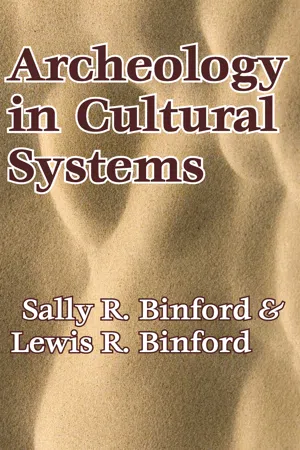
Archeology in Cultural Systems
About this book
Archeology shares with other anthropological sciences the goal of explaining differences and similarities among cultural systems. Sally R. Binford and Lewis R. Binford, therefore are concerned with theory and arguments which treat problems of the interrelationship of cultural variables with explanatory value. Archeology in Cultural Systems is devoted to four different aspects of archeology.This book progresses from theoretical-methodological discussions to specific consideration of archeological materials. It focuses on the analysis of archeological remains from a single site. Its concern is primarily with recognizing, measuring and explaining variability in the form and distribution of a site's cultural remains. The authors argue that internal variability derives from the composition and distribution of societal segments represented at the site. The work then shifts to study of archeological components (or their attributes) and seeks explanations for observed differences and similarities. A final section of the volume comments and discusses materials in the volume.Archeology in Cultural Systems is not a monolithic presentation of any particular school of archeological thought. There are common interests and many points of agreement among the authors, but there is also diversity of opinion on several points. These points are the focus of research here.
Information
PART I
Archeological
Theory and Method
Archeology is neither history nor anthropology. As an autonomous discipline, it consists of a method and a set of specialized techniques for the gathering or “production” of cultural information (Taylor, 1948, p. 44).
It has been said that archaeology, while providing data and generalizations in such fields as history and general anthropology, lacks a systematic body of concepts and premises constituting archaeological theory. According to this view, the archaeologist must borrow his theoretical underpinning from the field of study his work happens to serve, or do without. Whether the latter alternative be an admissible one does not seem to be an arguable point. Acceptable field work can perhaps be done in a theoretical vacuum, but integration and interpretation without theory is inconceivable. ... It seems to us that American archaeology stands in a particularly close and, so far as theory is concerned, dependent relationship to anthropology (Willey and Phillips, 1958, p. 1).
These quotations voice a common opinion regarding the degree to which archeology can be said to make use of a body of theory which is unique or even specific to itself. Taylor defines archeology as a method and set of specialized techniques; Willey and Phillips accept this view, at least in part, in stating that it is possible to do field work in a vacuum, but they add that interpretation is dependent upon theory, in this case anthropological theory. In the papers that follow it will be argued that scientific methods and techniques can be developed only when they are relevant to certain aims and only with regard to the properties of the empirical data utilized. A. C. Spaulding has stated:
Archaeology can be defined minimally as the study of the interrelationships of form, temporal locus, and spatial locus exhibited by artifacts. In other words, archaeologists are always concerned with these interrelationships, whatever broader interests they may have, and these interrelationships are the special business of archaeology (1960, p. 439).
Accepting Spaulding’s minimal definition of what archeology is, we can go a step further and specify its aim as the explanation of the observed interrelationships; in other words, as an explanation of the order we observe in the archeological record. Archeological theory consists of propositions and assumptions regarding the archeological record itself—its origins, its sources of variability, the determinants of differences and similarities in the formal, spatial, and temporal characteristics of artifacts and features and their interrelationships. It is in the context of this theory that archeological methods and techniques are developed.
Since artifacts are cultural data and since they once functioned as elements of a cultural system, many of the explanations we might offer for observations made on the archeological record will refer to organizational features of past cultural systems. On the other hand, the archeologist might explain an observed pattern in his data by citing sampling error. The former situation is no more justification for saying the archeologist is a technician in the service of anthropology than is the latter for calling him a technician in the service of probability statistics. The archeologist is an anthropological scientist, but this does not imply that there is no body of theory specific to his specialty. On the contrary, advances in archeological theory are prerequisite to the achievement of broader anthropological goals. It is through theoretical advances and sound arguments of relevance that we can link our observations on the archeological record to particular questions on the operation of past cultural systems.
Archeology shares with other anthropological sciences the aim of explaining differences and similarities among cultural systems. We are, therefore, concerned with cultural theory and processual arguments which treat problems of the interrelationship of cultural (and any other relevant class of) variables which have explanatory value.
If archeological theory attempts to develop arguments of relevance for archeological data to past conditions, then it should develop arguments on the explanatory relevance of cultural and ecological variables to differences and similarities among cultural systems. Archeological anthropologists must try to advance both of these complementary areas. We might be able to demonstrate the relevance of our observations to certain past conditions, but if these conditions are irrelevant for measuring either cultural change or variability, then our accomplishments would be (as Deetz cautions) “sterile methodological virtuosity.” On the other hand, advances in cultural theory which place crucial explanatory value on variables not previously considered challenge the archeologist to develop arguments of relevance so that he may make use of these advances. In such a case the hope would be that archeological data could be used in testing hypotheses drawn from theories of general anthropological interest. The ability of archeologists to maximize advances in culture theory depends on the existence of a viable and progressive body of archeological theory and method.
There are five papers in the first portion of this book, and they are arranged in a progression from more exclusively theoretical-methodological discussions to specific consideration of archeological materials. In the final paper of this first part, a particular cultural-historical period is discussed in terms of many of the points treated theoretically in the preceding papers. It should be pointed out that there are disagreements and incompatibilities in some of the archeological theory and method discussed in these papers. This volume is not a monolithic presentation of any particular school of archeological thought; there are common interests and many points of agreement among the authors, but there is also diversity of opinion on several points. It is these points which we can expect to be the focus of research interest in the coming years.
References
SPAULDING, ALBERT C. 1960. The dimensions of archaeology. In Gertrude E. Dole and Robert L. Carneiro (Eds.), Essays in the science of culture: in honor of Leslie A. White. New York: Thomas Y. Crowell.
TAYLOR, WALTER W. 1948. A study of archeology. Memoir no. 69, American Anthropologist, 50(3), Part 2.
WILLEY, GORDON R., and PHILLIP PHILLIPS. 1958. Method and theory in American archaeology. Chicago: University of Chicago Press.
ONE
LEWIS R. BINFORD
Archeological
Perspectives
A book whose title proclaims something new immediately challenges the reader to verify the claim to novelty or innovation. The purpose of this paper is to justify this book’s title by making explicit what is new and, also, how familiar ideas and arguments gain a new significance when viewed in the perspective being developed.
This paper does not attempt an exhaustive historical analysis of the field of archeology but is rather the selective treatment of several general areas of archeological concern put into historical perspective. It is hoped that this background will offer the reader a greater depth of field against which to view the substantive papers which follow.
The Aims of Archeology
The most profitable inquiry [of archeology] is the search for the origin of epoch-making ideas in order to comprehend the history of civilization (Mason, 1893; p. 403).
Archaeology, by etymology the study of beginnings, has historical reconstruction for its objective (Kroeber, 1937, p. 163).
These early statements summarize the generally accepted view on the aims of archeology. Taylor (1948, pp. 26, 207) has thoroughly documented the fact that reconstruction of culture history was widely accepted as the end of archeological research. Since Taylors publication, this aim has been reiterated frequently and continues to be stated in very recent publications (Rouse, 1965, p. 2; Meggers, Evans, and Estrada, 1965, p. 5; Willey, 1966, pp. 2–3; Deetz, 1967a, p. 3).
If seeking origins and tracing the history of culture was one task of archeology, some researchers considered a further aim to be the reconstruction of the lifeways of the peoples responsible for the archeological remains. Such an aim appears early in the literature—for example, in H. I. Smith (1910) and Sollas (1924). Concern with the reconstruction of lifeways of extinct peoples has been expressed by many, but probably the most influential advocate for more attention toward this end has been Taylor:
The conjunctive approach . . . has as its primary goal the elucidation of cultural conjunctives, the associations and relationships, the “affinities,” within the manifestation under investigation. It aims at drawing the completest possible picture of past human life in terms of its human and geographic environment (1948, pp. 95–96).
Most archeologists would agree that we should not lose sight of “the Indian behind the artifact” (Braidwood, 1959, p. 79) and would accept as a major aim of archeology the reconstruction of lifeways.
While these aims of reconstructing culture history and lifeways cannot be said to have been satisfactorily achieved, a few archeologists during the 1930’s began to suggest aims reaching far beyond these:
Some day world culture history will be known as far as archaeological materials and human intelligence permit. Every possible element of culture will have been placed in time and space. The invention, diffusion, mutation and association of elements will have been determined. When taxonomy and history are thus complete, shall we cease our labors and hope that the future Darwin of Anthropology will interpret the great historical scheme that will have been erected? . . . Candor would seem to compel the admission that archaeology could be made much more pertinent to general cultural studies if we paused to take stock of its possibilities. Surely we can shed some light not only on the chronological and spatial arrangements and associations of elements, but on conditions underlying their origin, development, diffusion, acceptance and interaction with one another. These are problems of cultural process . . . (Seward and Setzler, 1938, pp. 5–7).
And one year earlier a Scandanavian archeologist also urged that his colleagues take stock of where they have been and where they were going:
It appears that archaeology, in spite of its remarkable achievements, has got into a cul-de-sac. . . . The whole subject consists merely of a comparison of forms and systematization. . . . Brilliant systematization, regarded as exact, has not led to and does not lead to an elucidation of the organic structure of the whole life of the period studied, to an understanding of social systems, of economic and social history. . . . Forms and types . . . have been regarded as much more real and alive than the society which created them and whole needs determined these manifestations of life. . . . Have we reached a crisis where the procedure and aim of our science must be revised? (Tallgren, 1937, pp. 154–55).
Statements urging archeologists to concern themselves with problems of process appeared with increasing frequency in the literature of the next twenty years (Steward, 1942, p. 139; Bennett, 1943, p. 208; Childe, 1946, p. 248; Clark, 1953a, 1953b; Barth, 1950; and especially Caldwell, 1959). As recently as 1958 this concern with process was still being defined and distinguished from other aims of archeology:
So little work has been done in American archaeology on the explanatory level that it is difficult to find a name for it. . . . In the context of archaeology, processual interpretation is the study of the nature of what is vaguely referred to as the culture-historical process. Practically speaking, it implies an attempt to discover regularities in the relationships given by the methods of culture-historical integration. . . . On this explanatory level of organization . . . we are no longer asking merely what but also how and even why (Willey and Phillips, 1958, pp. 5–6).
Willey and Phillips’ statement about so little work having been done on the explanatory level was made despite such efforts as Steward’s (1937) investigation of settlement patterns which were later elaborated on in the Viru Valley project. Willey himself had expressed great optimism about the possibilities for “processual interpretation” as well as for the reconstruction of cultural institutions (Willey, 1953, p. 1). Some of the other efforts made between the late 1930’s and the late 1950’s toward gaining an understanding of cultural process were White’s arguments on the role of energy in the evolution of culture (White, 1943, pp. 335–56), Steward’s “Cultural Causality and Law ...” (1949), and Steward and Wittfogel’s study of irrigation (Steward et al., 1955).
In his 1962 Presidential Address to the American Anthropological Association, Willey again commented on the lack of progress in gaining a processual understanding of culture history:
Certainly the answers to the . . . causal questions as to why the ancient American civilizations began and flourished as they did and when they did still elude us, and what I can offer . . . will do little more . . . than describe and compare certain situations and series of events (Willey, 1962, p. 1).
There began to appear in the literature a general dampening of enthusiasm of those who some twenty years earlier had called for the archeologist to turn his attention to processual investigations. There was a similar pessimism expressed in the writing of British scholars despite the work of such authors as Childe (1936), Crawford (1953), and Clark (1951, 1953):
We have lost the confidence of the nineteenth century, and are children of an age of doubt. . . . We must recognize that in archaeology . . . there are no facts other than those which are. . . “observational data.” . . . What we have at our disposal, as prehistorians, is the accidentally surviving durable remnants of material culture, which we interpret as best we may and inevitably the peculiar quality of this evidence dictates the sort of information we can obtain from it (Piggott, 1965b, pp. 4–5).
The linking together of the limits of archeological interpretation with the fragmentary nature of the archeological record is a phenomenon we examine in some detail later (see pp. 18–23), but the points to be made here are: (1) there was general acceptance of the three aims of archeology-reconstruction of culture history, reconstruction of lifeways, and the delineation of cultural process; and (2) there has been increasing despair over the feasibility of achieving the third aim.
The Methods of Archeology—Traditional Approaches
This section examines the methods traditionally used in attempts to achieve the aims of archeology. We shall deal with each of the aims separately, attempt to describe the methods employed, and analyze some of the problems underlying the application of method to problem.
Reconstructing Culture History
Reconstructing culture history consists of arranging cultural units in a way which accurately reveals their generic affinities. Archeologists have generally operated on the basis of the following two assumptions:
1. The degree of...
Table of contents
- Cover Page
- Title Page
- Copyright Page
- Dedication
- Preface
- Contents
- Part I Archeological Theory and Method
- Part II Investigating Variability in the Archeological Record: A Single Occupation Unit
- Part III Investigating Variability in the Archeological Record: Variability among Occupational Units
- Part IV Discussion
- Contributors
- Index
Trusted by 375,005 students
Access to over 1.5 million titles for a fair monthly price.
Study more efficiently using our study tools.
Frequently asked questions
Yes, you can cancel anytime from the Subscription tab in your account settings on the Perlego website. Your subscription will stay active until the end of your current billing period. Learn how to cancel your subscription
No, books cannot be downloaded as external files, such as PDFs, for use outside of Perlego. However, you can download books within the Perlego app for offline reading on mobile or tablet. Learn how to download books offline
Perlego offers two plans: Essential and Complete
- Essential is ideal for learners and professionals who enjoy exploring a wide range of subjects. Access the Essential Library with 800,000+ trusted titles and best-sellers across business, personal growth, and the humanities. Includes unlimited reading time and Standard Read Aloud voice.
- Complete: Perfect for advanced learners and researchers needing full, unrestricted access. Unlock 1.5M+ books across hundreds of subjects, including academic and specialized titles. The Complete Plan also includes advanced features like Premium Read Aloud and Research Assistant.
We are an online textbook subscription service, where you can get access to an entire online library for less than the price of a single book per month. With over 1.5 million books across 990+ topics, we’ve got you covered! Learn about our mission
Look out for the read-aloud symbol on your next book to see if you can listen to it. The read-aloud tool reads text aloud for you, highlighting the text as it is being read. You can pause it, speed it up and slow it down. Learn more about Read Aloud
Yes! You can use the Perlego app on both iOS and Android devices to read anytime, anywhere — even offline. Perfect for commutes or when you’re on the go.
Please note we cannot support devices running on iOS 13 and Android 7 or earlier. Learn more about using the app
Please note we cannot support devices running on iOS 13 and Android 7 or earlier. Learn more about using the app
Yes, you can access Archeology in Cultural Systems by Lewis R. Binford in PDF and/or ePUB format, as well as other popular books in Social Sciences & Anthropology. We have over 1.5 million books available in our catalogue for you to explore.