- 172 pages
- English
- ePUB (mobile friendly)
- Available on iOS & Android
eBook - ePub
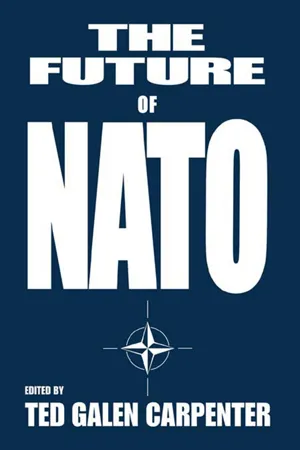
The Future of NATO
About this book
The end of the Cold War has raised questions about the future of NATO. Now that the threat from the Warsaw Pact has disappeared, there seems little need for a Western military alliance of such magnitude. The contributions here offer various views on NATO's future.
Information
Beckoning Quagmires: NATO in Eastern Europe
For nearly half a century NATO kept the peace in Europe without firing a shot in anger. With the defeat and disappearance of its erstwhile Soviet adversary, one might have expected this fortunate state of affairs to continue. Suddenly, however, within the space of three months at the beginning of 1994 the following events took place: NATO heads of government issued a declaration that linked NATO's security directly with the conflicts in post-communist Eastern Europe; NATO ambassadors agreed on an ultimatum to parties in the Bosnian conflict that fairly bristled with warlike rhetoric; NATO fighter planes shot down four ‘enemy’ aircraft over Bosnia; a NATO plane was itself shot down on an intended bombing mission; and NATO ground troops killed an ‘enemy’ soldier.
What is the explanation for such developments? Were they an aberration or did they presage far-reaching changes in NATO's posture and doctrine? In short, where is NATO headed in the post-Cold War era? These are important and troubling questions. To search for answers, it is necessary to look beyond the short-term impulses afforded by the Bosnian crisis into NATO's post-Cold War search for identity.
Finding something for NATO to do has become a cottage industry in its own right. Numerous reasons have been offered:1 NATO retains the transatlantic link against the possibility of a resurgent Russia; it represents a focus of trans-European stability at a time of flagging European political integration; it inhibits the re-emergence of Germany as the dominant, potentially nuclearized European military power;2 it permits the United States to share its security burden with trusted, militarily effective partners and prolongs American influence in Europe;3 it represents years of investment in combined training and force interoperability, factors that will be important if, as many assert, future European and American security requirements will increasingly be met through multinational cooperation.4
Transcending these ideas, a widespread concern that the demise of the Warsaw Treaty Organization (WTO) might trigger instability in Eastern Europe fuelled a lively debate about a possible role for NATO. In mid-1991, both President George Bush and Secretary of State James A. Baker III made speeches emphasizing the preeminent priority they attached to stability in the emergent noncommunist Eastern Europe.5 Those concerns were matched in Eastern Europe where Polish President Lech Walesa and Czech President Vaclav Havel took the lead in seeking membership in NATO on behalf of the Czech Republic, Poland, Hungary, and Slovakia.6 These themes soon made their way into academic arguments to the effect that ‘NATO is not an organization whose mission is over.’7
Those functions and concerns are not to be lightly dismissed. Is NATO, however, the right agency to address them? Do they in sum continue to pro-vide a convincing justification for NATO's survival as a military organization beyond the demise of the Warsaw Pact? And if they do, what are the implications for US national security policy? What new commitments do they presage for the western democracies? In short, for what purpose are all the generals, admirals, tanks, ships and planes?
To the European members of NATO, such questions may seem overly theoretical or old fashioned. For them, the problems are close at hand and the consequences of miscalculation immediately tangible. Looking for assets with which to tackle the various security problems on the Continent, the West Europeans view NATO as the only readily available instrument. They regard the reshaping of the Alliance as a strictly practical problem.
For the United States, however, NATO's inexorable metamorphosis from an antihegemonic defensive force into a rapid-reaction unit to quell brushfire conflicts raises more principled and fundamental questions. Does the ‘new’ NATO portend American involvement in the type of fratricidal European quarrels from which the United States throughout its history tried to stand clear? If that is the import, what is the nature of American interests?
The New Rationale
NATO's advocates recognize the force of these questions. They know that defense alliances cannot live by good intentions alone; alliances need to have something specific to do – a military mission. As Senator Richard Lugar (Republican-Indiana) put it in a speech to the Atlantic Council in December 1993:
A credible American commitment to an alliance focused on territorial defense against a non-existent threat… cannot long be politically sustained on Capitol Hill. If only for domestic political reasons, a new rationale … revolving around new missions … may be essential to halting the erosion in support for NATO in the Congress.8
More recently, that ‘new rationale’ has come to be expressed less in terms of concrete missions than in a more abstract form. In an indiscreet but revealing remark in March 1994, a senior British Army officer explained the rationale for his activities in Yugoslavia: ‘Frankly, I don't care much what happens to Yugoslavia. But I care a hell of a lot what happens to NATO.’ As far as that officer was concerned, the prime purpose of NATO's intervention in Bosnia is to prevent the organization from becoming what he described as ‘an international laughing stock’.9
In the United States, the view that NATO's foremost task is to assert its own ‘viability’ commands support across the political spectrum. Jeane Kirkpatrick, a senior scholar at the conservative American Enterprise Institute, and Morton Abramowitz, president of the liberal-inclined Carnegie Endowment for International Peace, have jointly promoted this proposition in the New York Times.10 National Security Advisor Anthony Lake spoke in the same vein in a speech about Bosnia to the School of Advanced International Studies at Johns Hopkins University, ‘We have an interest in showing that NATO – history's greatest military alliance – remains a credible force for peace.’11
Years before Lake's speech, NATO's leaders and bureaucrats had, in fact, already initiated what proved to be a long and agonizing debate about what that mission might be. Beginning with the 1990 NATO summit in London and reaching a doctrinal high watermark at the 1991 summit in Rome, they traversed a path strewn with ambitious new notions such as the ‘new strategic concept’, ‘out-of-area capability’, and ‘North Atlantic Co-operation Council’.12
Those proposals always seemed somewhat paperbound exercises, however. They failed to grip the public imagination as a sufficient justification for a military alliance marshalling enormous firepower and consuming huge resources. The erosion of NATO's credibility continued: the number of American troops in Europe continued to fall; budgetary constraints impelled the Canadians to announce a withdrawal of their NATO forces to Canada; in the United States, congressional support could no longer be taken for granted.13 Even when NATO naval forces began to patrol the Adriatic in July 1992 to monitor observance of sanctions against Serbia and NATO deployed AW ACS aircraft in November 1992 to enforce the UN-mandated ‘no-fly-zone’ over Bosnia, it did not seem to be enough. Lugar's graphic forecast that NATO must ‘get out-of-area’ or else it would go ‘out-of-business’ typifies the impatience with pious statements and ineffectual action.14 As the Bosnia crisis intensified and reform prospects in Russia became more clouded, the fear of NATO's total irrelevance finally concentrated minds. At their summit meeting in January 1994, NATO's leaders issued a declaration designed once and for all to guarantee the Alliance's ‘indispensability’.15
The strategy they adopted had two main components: first, an expansion of the Alliance toward the east through the ‘Partnership for Peace’ program under which any member of the former Warsaw Pact or European neutral nation could, after meeting certain conditions, form a partnership with NATO; and second, an agreement that NATO could offer itself as a military executor to support the peacekeeping or peacemaking activities of the United Nations, the West European Union (WEU), or the Conference on Security and Cooperation in Europe (CSCE).
A Ticking Time Bomb
NATO's leaders could be well satisfied with those ‘battle plans for survival’.16 Their focus had been on keeping the Alliance afloat, with the means being less important than the ends. In that task they were eminently successful,17 but they have left behind a ticking time bomb. Within the text of the communique lie two phrases that, if they represent statements of serious intent, dramatically expand the potential for NATO involvement in crisis management far beyond the Alliance's traditional boundaries.
The first is: ‘NATO will consult with any active participant in the Partnership [for Peace] if that partner perceives a direct threat to its territorial integrity, political independence or security.’ The underlying philosophy for that statement may be found earlier in the declaration: ‘Our own security is inseparably linked to that of all other states in Europe.’ For these purposes the declaration defines ‘Europe’ as comprising the whole CSCE membership and, therefore, as including the former Soviet central Asian and trans-caucasian republics.18
The practical implications of this doctrine are already under debate. Sophisticates point out that the word ‘consult’ means no more than that. The Alliance agreed to talk but did not enter into any new Western defense guarantees, and in particular stopped short of offering NATO membership to any of the East European countries. In setting out the initial case for the Partnership for Peace (PFP), Secretary of State Warren Christopher was careful to stress the evolutionary nature of the changes.19
Perhaps the sophisticates are right, but it is already clear that others harbor more expansive interpretations of the text. Many East Eu...
Table of contents
- Cover
- Half title
- Title Page
- Copyright Page
- Table of Contents
- Introduction: The Post-Cold War NATO Debate
- The Next Step Toward a More Secure Europe
- Why an Expanded NATO Must Include Russia
- Beckoning Quagmires: NATO in Eastern Europe
- Romancing NATO: Partnership for Peace and East European Stability
- ‘Cold War’ Continuities: US Economic and Security Strategy Towards Europe
- America and Collective Security in Europe
- Ending Europe's Security Dependence
- Conflicting Agendas and the Future of NATO
- Notes on Contributors
Trusted by 375,005 students
Access to over 1.5 million titles for a fair monthly price.
Study more efficiently using our study tools.
Frequently asked questions
Yes, you can cancel anytime from the Subscription tab in your account settings on the Perlego website. Your subscription will stay active until the end of your current billing period. Learn how to cancel your subscription
No, books cannot be downloaded as external files, such as PDFs, for use outside of Perlego. However, you can download books within the Perlego app for offline reading on mobile or tablet. Learn how to download books offline
Perlego offers two plans: Essential and Complete
- Essential is ideal for learners and professionals who enjoy exploring a wide range of subjects. Access the Essential Library with 800,000+ trusted titles and best-sellers across business, personal growth, and the humanities. Includes unlimited reading time and Standard Read Aloud voice.
- Complete: Perfect for advanced learners and researchers needing full, unrestricted access. Unlock 1.5M+ books across hundreds of subjects, including academic and specialized titles. The Complete Plan also includes advanced features like Premium Read Aloud and Research Assistant.
We are an online textbook subscription service, where you can get access to an entire online library for less than the price of a single book per month. With over 1.5 million books across 990+ topics, we’ve got you covered! Learn about our mission
Look out for the read-aloud symbol on your next book to see if you can listen to it. The read-aloud tool reads text aloud for you, highlighting the text as it is being read. You can pause it, speed it up and slow it down. Learn more about Read Aloud
Yes! You can use the Perlego app on both iOS and Android devices to read anytime, anywhere — even offline. Perfect for commutes or when you’re on the go.
Please note we cannot support devices running on iOS 13 and Android 7 or earlier. Learn more about using the app
Please note we cannot support devices running on iOS 13 and Android 7 or earlier. Learn more about using the app
Yes, you can access The Future of NATO by Ted Galen Carpenter in PDF and/or ePUB format, as well as other popular books in Politics & International Relations & Military & Maritime History. We have over 1.5 million books available in our catalogue for you to explore.