- 256 pages
- English
- ePUB (mobile friendly)
- Available on iOS & Android
eBook - ePub
About this book
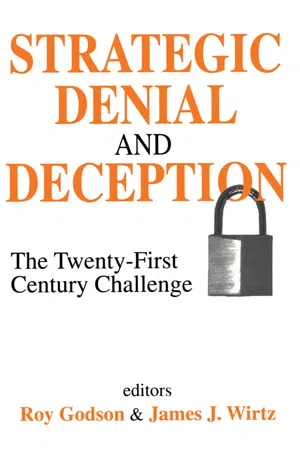
Does foreign denial and deception threaten the interests of contemporary democracies? Strategic denial and deception (D&D) has emerged as a little understood challenge to security in general, and the intelligence community in particular. To gain advantages, adversaries seek to deny critical information about their own activities and capabilities, and to decieve foreign governments. In recent years, Iraq, India, Somalia, Colombian criminal groups, and terrorists, for example, have all used D&D successfully against the United States. Denial and deception is a low cost, potentially high impact to level political, military, and economic playing fields, particularly against strong opponents.Concerns about the threat of denial and deception have waxed and waned since the end of World War II. Sometimes it shaped assessments about the former Soviet Union, for example. At other times, such as the end of the Cold War, such threats appear to fade into insignificance. This volume considers whether globalization, proliferating communication technologies, and the dissemination of vast amounts of information make effective foreign denial and deception more or less likely. Contributors also examine whether more information and data sources make policymakers better informed or simply create confusion.Drawing on lessons learned from historical experiences, the authors propose ways to minimize future challenges. Chapters include ""Elements of Strategic Denial and Deception,"" by Abram Shulsky; ""Conditions Making for Success and Failure of D&D,"" by Barton Whaley; ""Conditions Making for Success and Failure of D&D,"" by M.R.D. Foot; ""Conditions Making for Success and Failure of D&D,"" by J. Bowyer Bell; ""Arms Control,"" by Lynn M. Hansen; and ""Prescription: Detecting Deception-Practice, Practitioners, and Theory,"" by Barton Whaley and Jeffrey Busby.While there are previous books about celebrated D&D cases, from Troy to Pearl Harbor and D-Day, no work attempts to assess how these instruments o
Information
1
Strategic Denial and Deception
Strategic Denial and Deception
Roy Godson and James J. Wirtz
A concern about the threat of high-level denial and deception has waxed and waned among Americans since the end of World War II. Sometimes they fear that denial and deception has shaped threat assessments: witness the 1976 “A Team/B Team experiment” in a competitive intelligence analysis undertaken by the Gerald R. Ford White House.1 At other times, the threat of denial and deception—here the euphoria accompanying the end of the Cold War comes to mind—seems to fade into insignificance. As the United States reigns as the only superpower and the world experiences a communication revolution, how much of a threat does denial and deception pose to American interests today? Do globalization, proliferating communication technologies, and the dissemination of vast amounts of information make effective foreign denial and deception more or less likely? Will more information and data sources make policymakers better informed or will the proliferation of information simply create confusion?2
Strategic Denial and Deception Defined
Denial and deception (D&D) is a term often used to describe a combination of information operations that a nation undertakes to achieve its objectives. Denial refers to the attempt to block information that could be used by an opponent to learn some truth. Deception, by contrast, refers to a nation’s effort to cause an adversary to believe something that is not true.
Although they are distinct activities, denial and deception are intertwined in practice and are used as a single concept here. To deceive an opponent about the true intentions or goals of the deceiver, accurate information (e.g., about a military development program, a policy, a course of action, etc.) must be concealed or “denied” to the target. Deception, the effort to cause an adversary to believe something that is not true, can be undertaken together with denial operations. This involves using “leaks,” planted information, or decoys to create the impression that the truth is other than it actually is, thereby creating an “alternative reality” for the target. When denial and deception works, the deceiver leads the target to believe a “cover story” rather than the truth. The target will then react in a way that serves the deceiver’s interests.
The term “strategic,” more difficult to define, is used here to denote a high level of importance. D & D is strategic if it directly affects the national fortune and interests. Strategic denial and deception is related to the “big picture.” It concerns the major policies of a government, rather than the details of policy implementation. Strategic deception is thus aimed at the highest levels of a government or of the military chain of command (e.g., chiefs of state, cabinet members, or senior military commanders). The subject of the deception effort must be something that a high-level official would deal with personally. Similarly, strategic denial would be the effort to withhold information of the sort that is handled primarily by senior officials.
Foreign denial and deception occurs when state or nonstate actors (e.g., terrorist groups, criminal organizations, or separatist movements) use denial and deception to achieve their objectives against U.S. targets, interests, or policies. D&D also can be used by foreign adversaries as a strategic instrument in the sense that it becomes a primary means for disadvantaging the United States—politically or militarily. For terrorist or criminal organizations, D&D is a strategic instrument, much in the same way as the navy or nuclear weapons are strategic instruments for the United States. Criminals and terrorists use D&D as a strategic instrument to shape the environment so that they can better achieve their objects.
Various “channels” of communication are used by D&D practitioners. Sometimes intelligence sources and methods channel “corrupt” information to policymakers. Often, however, less clandestine methods of communication are used: media (television, radio, Internet) outlets, diplomatic interactions, academic exchanges and international travel and tourism. D&D does not require “dedicated” communication channels to be effective. In fact, D&D is often facilitated when the transfer of information appears to be incidental to the ostensible purpose of an event or contact. Diplomats, academics, and business travelers offer convincing conduits for the information they discover by “accident” during the regular course of their professional activities.
Successful Denial and Deception
Based on historical experience and deductive logic, a successful denial and deception campaign3 requires several components. First, the campaign benefits from strategic coherence. The deceiver nation must have an overall plan in mind for the achievement of its objectives; it must determine in advance how the target should behave and how deception will contribute to that outcome. The deceiver also must predict how the target will react in the wake of both successful and unsuccessful deception. This is no small task. Those contemplating deception may engage in wishful thinking when predicting the consequences of their deception campaign.4 Additionally, the deceiver must integrate its actions with (a) efforts to deny an opponent accurate information and (b) deceptive cover stories. Again, this is no small task. D&D campaigns require coherent, if not coordinated, action from many departments, agencies, or ministries. Public statements, press articles, and Internet communications must be shaped to support the goals of the nation intent on deception. As this corrupt information is disseminated, steps must be taken to prevent accurate information from reaching the target.
Second, deception is enhanced when the strategic culture of the adversary is understood. To be successful, the deceiver must recognize the target’s perceptual context5 to know what (false) pictures of the world will appear plausible. History, culture, bureaucratic preferences, and the general economic and political milieu all influence the target’s perceptions.6 False information should conform to the idiosyncrasies of strategic and even popular culture. Mistakes are easily detected and often appear comical to the target audience.7 Thus, deception requires creative planning: experience shows that successful deception planners manage to escape the routine and culture of large bureaucracies. In sum, deception planners “need to know a great deal about the worldview of those they are trying to manipulate, and recognize the human proclivity for self-deception.”8
Third, deception requires information channels to reach the adversary. Supplying the target with corrupt information in creative ways can also increase its credibility in the eyes of the target. Deception planners thus require the authority and imagination to exploit traditional channels and develop new ones on an ad hoc basis.
Fourth, a successful D&D campaign benefits from feedback mechanisms to collect data about the target’s behavior. Discovering the way the target has interpreted received data is especially important. A deception campaign is a dynamic enterprise: cover stories, communication channels, and specific initiatives require fine-tuning to take advantage of unforeseen opportunities or problems. Knowing that a deception campaign is succeeding also can be crucial to the achievement of grand strategic objectives. To pursue a course of action that relied on deception if the target failed to “take the bait” would be foolhardy. Alternatively, if an initial deception plan failed, the feedback mechanism could activate backup D&D campaigns.9
Practitioners of Denial and Deception
Deceivers can be divided into four categories: democracies; authoritarian regimes; regimes in transition (changing from authoritarian to democratic or vice versa); and nonstate actors (criminal organizations, terrorist groups, separatist organizations). At one time or another all types of actors launch (and suffer from) successful deception campaigns.
Democracies
Democracies employ D&D mostly in wartime. But democracies are quite capable of deceiving even in peacetime. From the Revolutionary War campaign at Yorktown, to the D-day landings in World War II, to the “feint” of a Marine amphibious assault during the Gulf War, United States history is replete with instances in which deception was used to U.S. military advantage. Throughout the twentieth century, Great Britain and other democracies also occasionally showed themselves to be effective at D&D in war and peace. For example, Israel’s and, more recently, India’s programs to develop nuclear weapons benefited from sophisticated D&D campaigns. But Americans are often unaware of the successful D&D campaigns of other democracies, especially in peacetime.
Authoritarian Regimes
In contrast to democracies, authoritarian and especially totalitarian regimes use denial and deception as a regular instrument of governance.10 This increases their reliance on similar tactics in foreign policy and defense matters. Especially disturbing is the tendency of authoritarian and totalitarian regimes to use D&D to support the initiation of hostilities. For example, Operation BARBAROSSA (the 1941 Nazi invasion of the Soviet Union) and Japan’s attack on the United States and Great Britain in December 1941 were accompanied by sophisticated D&D campaigns. Authoritarian regimes also are adept at other uses of D&D: witness Iraq’s continuing efforts to elude international inspection and destruction of its weapons of mass destruction.11
Nonstate Actors
The way nonstate actors employ D&D poses a rising threat to U.S. interests and those of other democracies. Transnational businesses, criminal syndicates, revolutionary organizations, terrorists, and religious groups pursuing illicit objectives, all must seek cover to operate effectively. For criminals, rebels, and terrorists, denial becomes their raison d’être. The shadowy world of the terrorist or the criminal is an alternative reality, not a temporary expedient to achieve limited objectives. The criminal flourishes in the hidden world created by denial while the gunman uses denial and deception to enter the world of legitimate power. The clandestine underground is a way of life and a strategic instrument for highly illicit organizations.
For clandestine groups, denial creates a parallel world that exhilarates, offers a safe haven, and enhances the life of the committed. Evidence of this type of behavior can be observed both in the Sicilian Mafia, which seeks respect, power, and money, and in terrorist organizations that seek to change the direction of history through violent action. A cult may be perceived as benign by outsiders—witness how a group of Islamic extremists were generally ignored prior to their 1993 attack on New York’s World Trade Center or how the Aum Shinrikiyo operated in Japan, Russia, and the United States with little interference from the authorities—until it uses violence to fulfill objectives that are hidden from even its own rank and file.
By contrast, sustained and coordinated deception campaigns often exceed the resources of nonstate actors.12 These clandestine groups rarely can afford the time and resources needed for an effective deception campaign. But as the activities of Columbia’s Cali Cartel, the Irish Republican Army, and the Sicilian and U.S. Cosa Nostra demonstrate, they have on occasion deliberately deceived as well as denied.
When used by nonstate actors, D&D poses an immediate threat. Scarce foreign aid and intelligence resources are often squandered against fake or insignificant issues. When criminals use D&D, police time is spent “chasing after shadows.” Investigative efforts are diluted to the point where they no longer yield significant results. Criminals and political terrorists often use D&D to eliminate their competition or to misdirect law enforcement investigators. For example, U.S. analysts and policymakers are alarmed about “starving sentries” at Soviet-built weapons plants and storage facilities. But once out of the spotlight, are senior Russian officials also conspiring to sell the inventories and infrastructures to the highest bidder?
Regimes in Transition
Some regimes are in transition from an authoritarian to democratic form of government. Some seek to reverse the process, while others may seek to increase their foreign capabilities to alter the international status quo. When increasing their military capabilities some powers are attracted to denial and deception as a means of protecting developing weapons and military infrastructures from outside interference or treaty commitments.
The history of how transitional powers have exploited D&D offers insights into such contemporary problems as the 1998 collapse of the monitoring efforts of the United Nations Special Commission for the Disarmament of Iraq (UNSCOM).
Decades earlier, during the interwar arms control and disarmament regime directed at the Weimar Republic, Germans had obfuscated, if not actually hidden, their rearmament efforts from international inspectors. Sometimes individuals, most interested in their own pecuniary interests, hid existing stocks of weapons or manufacturing equipment on their own initiative. At other times, officials engaged in coordinated actions to hide activity forbidden by treaty. “Advertising Squadrons,” whose ostensible purpose was to provide skywriting and advertising services, actually served in the late 1920s as the first operational units of the reborn German air force.
The Inter-Allied Control Commission (1920–26), charged with verifying German compliance with the Treaty of Versailles, became aware of these German violations. But because the inspectors failed to uncover convincing evidence of systematic German violation of the treaty, the Allies accepted the mundane explanation...
Table of contents
- Cover
- Half Title
- Title Page
- Copyright Page
- Table of Contents
- Chapter 1. Strategic Denial and Deception
- Chapter 2. Elements of Strategic Denial and Deception
- Chapter 3. Conditions Making for Success and Failure of Denial and Deception: Authoritarian and Transition Regimes
- Chapter 4. Conditions Making for Success and Failure of Denial and Deception: Democratic Regimes
- Chapter 5. Conditions Making for Success and Failure of Denial and Deception: Nonstate and Illicit Actors
- Chapter 6. Arms Control: Focus on Denial and Deception
- Chapter 7. Detecting Deception: Practice, Practitioners, and Theory
- Chapter 8. The Denial and Deception Challenge to Intelligence
- Chapter 9. The Impact on Foreign Denial and Deception of Increased Availability of Public Information about U.S. Intelligence
- About the Contributors
- Index
Trusted by 375,005 students
Access to over 1.5 million titles for a fair monthly price.
Study more efficiently using our study tools.
Frequently asked questions
Yes, you can cancel anytime from the Subscription tab in your account settings on the Perlego website. Your subscription will stay active until the end of your current billing period. Learn how to cancel your subscription
No, books cannot be downloaded as external files, such as PDFs, for use outside of Perlego. However, you can download books within the Perlego app for offline reading on mobile or tablet. Learn how to download books offline
Perlego offers two plans: Essential and Complete
- Essential is ideal for learners and professionals who enjoy exploring a wide range of subjects. Access the Essential Library with 800,000+ trusted titles and best-sellers across business, personal growth, and the humanities. Includes unlimited reading time and Standard Read Aloud voice.
- Complete: Perfect for advanced learners and researchers needing full, unrestricted access. Unlock 1.5M+ books across hundreds of subjects, including academic and specialized titles. The Complete Plan also includes advanced features like Premium Read Aloud and Research Assistant.
We are an online textbook subscription service, where you can get access to an entire online library for less than the price of a single book per month. With over 1.5 million books across 990+ topics, we’ve got you covered! Learn about our mission
Look out for the read-aloud symbol on your next book to see if you can listen to it. The read-aloud tool reads text aloud for you, highlighting the text as it is being read. You can pause it, speed it up and slow it down. Learn more about Read Aloud
Yes! You can use the Perlego app on both iOS and Android devices to read anytime, anywhere — even offline. Perfect for commutes or when you’re on the go.
Please note we cannot support devices running on iOS 13 and Android 7 or earlier. Learn more about using the app
Please note we cannot support devices running on iOS 13 and Android 7 or earlier. Learn more about using the app
Yes, you can access Strategic Denial and Deception by James Wirtz in PDF and/or ePUB format, as well as other popular books in Politics & International Relations & Arms Control. We have over 1.5 million books available in our catalogue for you to explore.