eBook - ePub
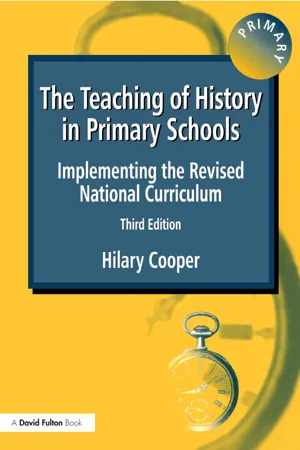
The Teaching of History in Primary Schools
Implementing the Revised National Curriculum
- 208 pages
- English
- ePUB (mobile friendly)
- Available on iOS & Android
eBook - ePub
The Teaching of History in Primary Schools
Implementing the Revised National Curriculum
About this book
Updated in response to the 2000 revision of the National Curriculum, this text explores ways in which curriculum balance and coherence can be achieved and a rich and exciting primary history curriculum retained, while not underestimating the demands of literacy, numeracy and ICT.
Information
Chapter 1
Historical Thinking
Before history became a required part of the primary curriculum, history books for children did not take into account that, from the very beginning children are able, in a simple but genuinely historical way, to grapple with the problems that lie at the heart of the discipline and that they should so do in increasingly complex ways (Bruner 1963; Lawton 1975; Pring 1976). Often books made generalised and stereotypical statements and gave no indication of the sources on which these were based or of the areas of uncertainty in interpreting sources which influence any description, account or explanation of the past. Children were usually given a single perspective of the past and not helped to see why different people, at different times, create different interpretations which may be more or less valid. The concepts of time and change, motive, cause and consequence, similarity and difference were rarely developed.
After they had been there for four hundred years, the Romans went away. Their homes in Italy were being attacked by fierce tribes and every soldier was needed. The Britons were sad when they went, for they had no soldiers of their own to protect them from the sea-raiders who were growing bolder in their attacks upon the coast.
(Unstead 1964: 42)
Illustrations of artefacts were often presented as curious remnants rather than as rich sources from which a range of possible deductions may be made about the people who used them, and how their lives may have been influenced by them. ‘Main events’ and ‘famous people’ were listed at the back of a book simply because they happened, without apparent significance, and without conveying the idea that historians weave them together into accounts of the past, that they select and interpret them, and that this is why accounts may differ. (For current research on causation, and children’s understanding of the reasons why the Romans conquered Britain see Lee (1998) and Lee et al. (1996a–d) referred to in Chapter 2.)
Children’s active learning was often assumed to occur through ‘Things to Do’ at the end of a chapter, but this rarely involved a reconstruction based on real historical evidence, a real building or an archaeological site, and the inevitable questions this would raise. It is more likely to suggest that you ‘Make a model Viking ship from stiff card or paper as shown below…’ (Mitchell and Middleton 1967: 88). Alternatively, children were asked to ‘Pretend you are a merchant living in Saxon times and tell of your adventure’, which presupposes an understanding of attitudes, values and a social structure quite different from our own, or else invites anachronism and identification and so inhibits the development of true historical understanding. (Dickinson and Lee (1994) are also investigating young children’s understanding of motive in the context of Anglo-Saxon oath-taking. This research is referred to in Chapter 2.)
Secondary sources for children were often written in unnecessarily obscure language.
Drake is the most famous mariner in English history. He is renowned for his adventurous exploits as well as his enterprising skill in establishing the English navy as the country’s main national weapon.
(Famous Sailors 1970)
Yet history is not only concerned with great events or famous men. It encompasses all aspects of the lives of the men, women and children in a society. Historians attempt to find out about them through asking particular kinds of questions of whatever traces of the past remain.
The content of history
As David Thomson (1969) explained, history has developed over the last 200 years from chronicles of unrelated events into a discipline which aims to interpret different kinds of evidence in order to understand societies in the past. Its content is diverse: social, economic, constitutional, aesthetic. It may be concerned with individuals, institutions or groups. Philip Phenix (1964) saw history, with religion and philosophy, as forming a ‘Realm of Meaning’ which unites all other kinds of thinking. The National Curriculum takes account of this breadth of content.
It is the questions historians ask, however, and the ways in which they answer them, that distinguish history as a discipline. History is concerned with the causes and effects of change over time; with the ways in which, and the reasons why, societies in the past were different from ours, and what caused them to change. Historians investigate the past by interpreting traces of the past, the evidence. They interpret evidence through a process of deductive reasoning, but evidence is often incomplete, and for this and other reasons, more than one interpretation may be defensible. Producing a range of valid interpretations involves thinking which we may call ‘historical imagination’. A wide and perceptive range of valid interpretations may eventually lead to an understanding of why people in the past may have thought, felt and behaved differently from us. Historical enquiry also depends on concepts which are, in varying degrees, peculiar to history. In this chapter, each of these aspects of historical thinking will be considered in turn. It is important to remember that they interact with each other in the process of finding out about the past.
The processes of historical enquiry
Making inferences about the past from evidence
There are many kinds of historical evidence: oral history, artefacts, pictures and photographs, maps, statistics, writing. Written evidence is wide-ranging: documents, laws, tombstone inscriptions, diaries, newspaper accounts, contemporary literature. Making historical inferences involves forming arguments about the significance of a piece of evidence: what does it tell us about the society that produced it? How was it made? Why? What was it used for? By whom? Where was it found? Are there others?… and so on.
Superior examples of Roman shoes found at Vindolanda, the equivalent of shoes made by Gucci or Lobbe today, tell us something about the social and economic structure of the fort. A letter from a first generation ‘Dutch’ Roman at the fort, written in Latin, asking for underpants and socks from Rome, may tell us about the economic and transport systems of the empire, and the attitudes of Dutch tribes to the cold, clothes and culture.
Since there is a limit to what can be known for certain, a historian must also make inferences which are probabilistic – reasonable guesses about the evidence. The four post-holes in the centre of an Iron Age house plan may be to support the roof (Bersu 1940), they may surround an open courtyard where animals could be kept (Clarke 1960), or they may be a free-standing tower for repairing the roof (Harding 1974).
If the evidence is incomplete, the historian must also be able to tolerate that which can never be known; for example, we do not know how much of a new style of agriculture the Romans introduced to Britain, or how it was related to the old, and so how British communities related to Roman villas, since no examples of Roman field patterns have been identified (Richmond 1955).
This process of enquiry in interpreting historical evidence was clarified by Collingwood in his autobiography (1939). He proceeded from specific questions about the significance and purpose of objects (whether they were buttons, dwellings or settlements), to their meaning for the people who made them. For instance, he knew that a Roman wall from the Tyne to Solway existed. He guessed its purpose was to form a sentry wall with parapets as a protection against snipers. He wanted to know if there were towers as a defence against trying to land at Bowness or St Bees, in order to support his guess. A search revealed that towers had been found, but their existence forgotten (because their purpose was not questioned).
Interpreting historical evidence involves not only internal argument, but also debate with others, testing inferences against evidence from other sources and considering other points of view. It means then supporting opinions with arguments, accepting that there is not always a ‘right’ answer, that there may be equally valid but different interpretations, and that some questions cannot be answered. This kind of thinking is as important to the social, emotional and intellectual growth of young children, as it is necessary in adult society.
Developing historical understanding
Interpreting historical evidence may involve suggesting how something was made, or used, or what it may have meant to people at the time. It may involve explaining a sequence of events or the behaviour of an individual or a group. Evidence is always incomplete. It is a reflection of the feelings and thoughts of the people who created it. Historical evidence is, therefore, often open to a variety of equally valid interpretations. In order to interpret evidence, it is necessary to understand that people in the past may have thought, felt and behaved differently from us, because they lived in societies with different knowledge-bases, belief-systems, views of the world, and different social, political and economic constraints. The disposition to make a variety of suggestions about incomplete evidence, which take into account that people in the past may have thought and felt differently from us, is therefore an integral part of making historical inferences. It has been called ‘historical imagination’ or ‘historical empathy’. However, these terms have led to a great deal of confusion because they have often been regarded as the product of free-floating imagination discrete from interpreting evidence. They have also been confused with projecting oneself into the past, or with identifying or sympathising with people in the past. The historian cannot share the thoughts and feelings of people in the past but can attempt to understand and explain what these may have been. There has been confusion too, because the terms ‘historical imagination’ or ‘empathy’ involve a number of subordinate concepts: understanding different points of view in a conflict, the motives of an individual or a group, the values, attitudes and beliefs of another society.
Historians have an implicit understanding of historical imagination, which is usually not adequately articulated. Kitson Clarke (1967) pointed out that ‘men’s actions can be the subject of detailed research, but what went on in their minds can only be known by inference’. Elton (1970) saw historical imagination as ‘a tool for filling in the gaps when facts are not available’. Ryle (1979) saw it as a means of cashing in on the facts and using them: ammunition shortage and heavy rain before a battle cause the historian to wonder about the hungry rifleman and delayed mule trains. Thomas (1983) said that what interests him about the past is what ordinary people thought, felt and believed. Collingwood (1939: 7) attempted to clarify the relationship between interpreting evidence and interpreting the thoughts and feelings of the people who made it. He says, for example, that we know that Julius Caesar invaded Britain in successive years; we can suppose that his thoughts may have been about trade, or grain supply, or a range of other possibilities. and that his underlying feelings may have included ambition or career advancement. (Mink (1968) rigorously analysed Collingwood’s thinking on this subject in his article ‘Collingwood’s Dialectic of History’.)
Historians, then, do not question that making deductions about historical evidence involves probabilistic interpretations, and conjectures about thoughts, feelings and beliefs. Their job is not to reproduce the lost world of the past, but to ask questions and to try to answer them.
Nevertheless, it is important to recognise that suppositions about the feelings and thoughts of people who made and used historical evidence have to conform to criteria of validity. There must be no contradictory evidence. It must be assumed that people in the past acted rationally. Inferences must be supported by argument and conform to what else is known of the period. Historians must also attempt to understand what the evidence may have meant to people at the time. What, for example, was the status of a torc, dating from 1000 BC, discovered in a Wiltshire field? ‘This may have been a votive offering to a God, or buried as part of a funeral ceremony, or it might have been stored’ (Merriman, 1990).
Children can take part in the process of making suggestions about how things were made and used and how the people who used them may have thought and felt. They can be helped to imagine, for example, how it may have felt to do the washing using a copper, a dolly, a scrubber and a flat iron, to go to bed by candlelight, or to wear the clothes of children depicted in an old portrait. They can use parish registers, census records, street directories, old maps and information about daily life from secondary sources to reconstruct the life of a particular family living in a particular house at a given time in the past. They can suggest what life may have been like in seventeenth-century London after reading extracts from Pepys’ diary, or how a Roman villa they have visited may have looked when it was first built. But the imaginative conjecture must be rooted in the evidence.
Children must be encouraged to ‘go beyond the evidence’ because this is central to developing historical understanding. Therefore they must gradually learn through discussion with each other and with their teacher how to make interpretations which are historically valid.
Using historical concepts
Historical evidence can only be interpreted through language. In order to ask questions of evidence, we need to use concepts which are in varying degrees peculiar to history. As Blyth (1990) pointed out, however, lists of historical concepts are drawn up almost arbitrarily. Some concepts are concerned with space and time, some are methodological: similarity and difference, cause and effect, continuity and change. Other concepts are organising ideas which run through human society: communication, power, beliefs, conflict. Concepts are created by historians to encapsulate historical periods: Renaissance, Reformation, Victorian. There are ‘closed’ concepts which refer to a particular time (villa, elderman, Roundhead, Cavalier), and concepts which are not exclusively historical (trade, law, agriculture).
Children need to be given the opportunity explicitly to discuss historical concepts, and to use them in a variety of contexts in interactive situations because these concepts form the framework which makes historical enquiry possible.
Why is it necessary for children in the primary school to learn the processes of historical thinking?
It is impossible to learn history without learning the processes by which historians find out about the past. There is no one view of the past, and historians’ accounts of the past differ. To understand history, it is necessary to understand why these differences occur. It is necessary to understand that evidence from which accounts are constructed is incomplete and so more than one interpretation is usually possible. Therefore, historians write accounts of the past which involve both selecting and interpreting evidence, in order to explain what happened and why. The areas they choose to investigate, the evidence they select, their interpretations of the feelings and thoughts which lie behind actions, and the patterns of events they construct often differ. They may vary as a result of the historian’s interests, the concerns and philosophies of the times in which s/he lives, or the discovery of new evidence. A Marxist historian like Christopher Hill, for example, will write a different account of the English Civil War from that of C. V. Wedgewood. Recent historians (Fryer 1984, 1989; Vishram 1988; Rodney 1972) have challenged an Anglocentric view of history. Others have taken a woman’s perspective (Boulding 1981; Beddoe 1983; Rowbotham 1973).
History is dynamic. In learning about the past through secondary sources, children will discover that accounts differ, and in asking their own questions about primary sources, they will begin to discover why. It is important to social and intellectual development, not solely to historical understanding, to realise that arguments must be supported and that there is often no one ‘right’ answer.
The National Curriculum created a focus and structure for the development of a rich variety of materials to support genuine historical enquiry at Key Stages 1 and 2. These all remain valid, although with experience the ways in which they are used has been modified. A major new series published since 1995 is the Cambridge Primary History (McAleavy 1997) in which activities are clearly rooted in reserach into the development of children’s understanding in history, and allow for differentiation and progression. Other publishers have produced new additions to history topics. Ancient African Town-Benin (MacDonald and Wood 1999) is a good example. This is part of the expanding Metropolis series from Franklin Watts. History in Evidence has continued to produced replica sources of all kinds. New books on the teaching of history have been published. Often authors have worked in partnership with teachers to find ways of applying theory and research to develop practice in teaching the National Curriculum: Wood and Holden 1995; Fines and Nichol 1997; Nichol and Dean 1997; Davidson 1997. Claire (1996) has shown how an inclusive history curriculum can be developed for the primary school; this is one of the stated key objectives of the 2000 curriculum. Others have debated lively issues concerning the content and implementation of the National History Curriculum in 2000 and beyond (Jenkins 1995; Arthur and Phillips 2000; Husbands 1996; Phillips 1998).
The Historical Association magazines, Primary History and Teaching History continue to flourish. The major new resource for teaching the 2000 curriculum however, is multimedia. The BBC Video Plus series has been produced in boxed sets with supporting materials: Within Living Memory (0 563 46230), Tudor Life (0 563 462175), Time-Lines: Teaching Chronology (0 563 462132). CD Roms such as Houses and Householders (Anglia Multimedia) are accompanied by glossy books. The Interfact Series (Two-Can Publishing) covers disks on The Romans, Aztecs, Egyptians and Vikings, which involve geography and science as well as history. The opportunities offered by the proliferation of history web sites are discussed in Chapter 5.
Official guidance since 1995 has been concerned with showing teachers how to link history to other subjects (SCAA 1997) and to teach and a...
Table of contents
- Cover
- Title Page
- Copyright Page
- Table of Contents
- Acknowledgements
- Introduction
- 1 Historical Thinking
- 2 Historical Thinking and Cognitive Development
- 3 The Implementation of the Revised National Curriculum for History 2000: A Whole-School Approach
- 4 Case Studies: Medium-Term Plans and Examples of Work
- 5 Collaboration in Professional Development
- 6 The National Curriculum and Action Research
- Appendix: History Internet Sites Referred to in the Text
- References
- Resources Referred to in the Text
- Index
Trusted by 375,005 students
Access to over 1.5 million titles for a fair monthly price.
Study more efficiently using our study tools.
Frequently asked questions
Yes, you can cancel anytime from the Subscription tab in your account settings on the Perlego website. Your subscription will stay active until the end of your current billing period. Learn how to cancel your subscription
No, books cannot be downloaded as external files, such as PDFs, for use outside of Perlego. However, you can download books within the Perlego app for offline reading on mobile or tablet. Learn how to download books offline
Perlego offers two plans: Essential and Complete
- Essential is ideal for learners and professionals who enjoy exploring a wide range of subjects. Access the Essential Library with 800,000+ trusted titles and best-sellers across business, personal growth, and the humanities. Includes unlimited reading time and Standard Read Aloud voice.
- Complete: Perfect for advanced learners and researchers needing full, unrestricted access. Unlock 1.5M+ books across hundreds of subjects, including academic and specialized titles. The Complete Plan also includes advanced features like Premium Read Aloud and Research Assistant.
We are an online textbook subscription service, where you can get access to an entire online library for less than the price of a single book per month. With over 1.5 million books across 990+ topics, we’ve got you covered! Learn about our mission
Look out for the read-aloud symbol on your next book to see if you can listen to it. The read-aloud tool reads text aloud for you, highlighting the text as it is being read. You can pause it, speed it up and slow it down. Learn more about Read Aloud
Yes! You can use the Perlego app on both iOS and Android devices to read anytime, anywhere — even offline. Perfect for commutes or when you’re on the go.
Please note we cannot support devices running on iOS 13 and Android 7 or earlier. Learn more about using the app
Please note we cannot support devices running on iOS 13 and Android 7 or earlier. Learn more about using the app
Yes, you can access The Teaching of History in Primary Schools by Hilary Cooper in PDF and/or ePUB format, as well as other popular books in Education & Education General. We have over 1.5 million books available in our catalogue for you to explore.