eBook - ePub
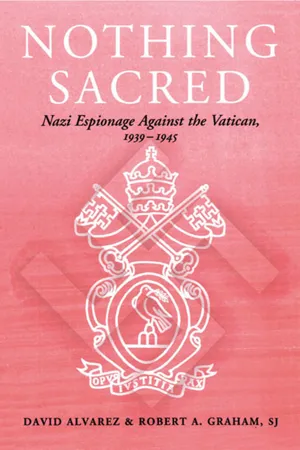
Nothing Sacred
Nazi Espionage Against the Vatican, 1939-1945
- 208 pages
- English
- ePUB (mobile friendly)
- Available on iOS & Android
eBook - ePub
About this book
Nazi Germany considered the Catholic Church to be a serious threat to its domestic security and its international ambitions. In Germany, informants provided intelligence, but in Rome, German attempts to penetrate the Papacy were less successful - except for the codebreaking work.
Information
1
Traditional Channels
Germany fought the Second World War with a large and disparate collection of intelligence organizations. At the height of the conflict more than 20 agencies, civilian and military, were collecting information for the German war effort. Some, like the ‘Research Institute’ of the Reich post office which untangled the electronically scrambled voice messages on the London-Washington radio-telephone link, were small and unknown to the public, while others, such as the massive Reich Security Administration (RSHA), were prominent institutions of the state. A few, like the Cipher Branch of the Armed Forces High Command, which broke the secret codes and ciphers of foreign governments, hunted the most jealously guarded secrets of both friend and foe, while yet others, such as the Press Bureau of the Foreign Ministry, harvested intelligence from the popular newspapers and magazines which were fixtures of any news-stand in Paris, Madrid, Stockholm, or Buenos Aires.
Among the members of the German intelligence community (many of which were created during or shortly before the war), two institutions had seniority. Traditionally, the foreign ministry claimed responsibility for foreign political and economic intelligence. Reports on political developments, diplomatic policies, and economic affairs in various countries flowed into the ministry’s offices on the Wilhelmstrasse from German embassies, legations, and consulates around the world. The Abwehr, the espionage service of the Armed Forces High Command (OKW), concentrated on military intelligence. From offices in the various military districts inside Germany and, during the war, from stations in the capitals of neutral and friendly states the Abwehr collected information on the military capabilities and plans of foreign powers. During the war competing intelligence agencies would successfully challenge the primacy of the foreign ministry and the Abwehr, but in the early days these two agencies were the main elements of Germany’s intelligence offensive against all governments, including the Vatican.
FOREIGN MINISTRY
At the outbreak of the war in September 1939, Germany’s principal source of information on the Vatican was the Reich embassy to the Holy See.1 Berlin had every reason to expect much of its diplomatic mission to the Pope. With a staff of four, the embassy was not among the largest of the 34 diplomatic missions then accredited to the Holy See, but it was certainly among the most distinguished. Many governments considered the Vatican a minor diplomatic post and were content to treat their missions as sinecures for politically or socially deserving individuals who were pleased to enjoy the attractions of Italy without the distractions of a demanding post. As a result, the diplomatic corps accredited to the Pope partook of a certain rakish eccentricity. Many ambassadors could only rarely be found in Rome. Some, like those of Argentina and Peru, preferred the social attractions of other European capitals, while others, like the representatives of Estonia, Liberia and El Salvador, were simultaneously their country’s ambassador to other countries and could more reasonably justify their residence in Paris or Brussels. Latvia’s ambassador was detained in Riga by his responsibilities as his country’s foreign minister and had not appeared in Rome for years. The Panamanian ambassador had simply disappeared one day in 1929 and was never seen again; his foreign ministry failed to notice or care about his absence. The Belgian ambassador quietly passed the time until he could claim his pension, while his colleague from Nicaragua drifted into senility. At papal ceremonies the staff of the legation of the ancient but tiny republic of San Marino outnumbered the delegations representing such great powers as Britain and Italy.2 Of course, with more at stake, the embassies of the major powers were more conscientious in asserting their governments’ interests at the Vatican but, even among these missions, the German embassy was distinguished by the professionalism of its staff and the stature of its ambassador.
Ambassador Diego von Bergen was an accomplished professional who found his posting to the Vatican to so complement his aptitudes and temperament that during the Weimar Republic he twice refused the office of foreign secretary and also declined the prestigious Paris embassy in order to remain in Rome. Ambassador since 1920, Bergen had a knowledge of the Vatican and its personalities unmatched by any of his colleagues in the diplomatic corps. His education in papal affairs began in 1906 when he was posted as a junior officer to his country’s legation to the Holy See. His friendship with Pope Pius XII (Eugenio Pacelli) extended back to the First World War when he had been responsible for Vatican affairs in the foreign ministry and the then Monsignor Pacelli had been the papal nuncio (ambassador) in Germany. The friendship was further nurtured during the 1930s when the future Pope, then Cardinal Secretary of State, collaborated with the ambassador on various issues of church-state relations including the landmark Concordat (Treaty) of 1933 which was intended to regularize relations between the Nazi regime and the Catholic Church. The Vatican’s frustration over Hitler’s refusal to honour this concordat and its alarm over anti-Catholic measures in the ‘new’ Germany did nothing to lessen its respect for the German envoy. In the papal Secretariat of State (the Vatican’s foreign ministry), Bergen’s reputation for probity and good sense was so strong that his eventual retirement in 1943 was considered a calamity for German-Vatican relations.
Privileged by the special status of its chief and by the Germanophile inclinations of a Pontiff who admired German culture, spoke its language fluently, and surrounded himself with German staff, the Reich embassy was potentially a rich source of information on the papacy. For various reasons it never fully realized that potential during the war. In part, the embassy was constrained by factors beyond its control. With the onset of war, the secrecy which normally characterized the internal affairs of the papal Secretariat of State became even stricter. Concerned to avoid any questions about its neutrality, the Vatican adopted an attitude of correct but reserved relations with the belligerents. It became more difficult for Allied as well as Axis representatives to tease information from their contacts inside the Vatican. At one point the German embassy frankly informed Berlin that ‘It is impossible to drag any information out of responsible sources’, while the Japanese ambassador admitted to his superiors in Tokyo that ‘Vatican officials do not tell me much’.3 In Germany’s case this reserve took on a particular chill as a result of policies in the Reich and in German-occupied territories which the Vatican considered either anti-Catholic or contrary to divine and natural law. The arrest and deportation of priests, the suppression or harassment of Catholic newspapers, and the dissemination of anti-Catholic propaganda were not policies conducive to warm relations. The German embassy also suffered from the effective loss of its leader. Socially and professionally Diego von Bergen was a product of the conservative milieu of the old imperial Germany. He had little enthusiasm for the new Germany of National Socialism whose personalities and policies he found increasingly distasteful. Disenchanted with the regime he was sworn to serve, plagued by ill-health, and increasingly weary of a mission whose principal task had become the defence of his government’s anti-religious policies, the ambassador withdrew from the day-to-day operations of his embassy. Cables still went out over his signature and his presence was occasionally required at important ceremonial events in St Peter’s Basilica or the Apostolic Palace, but increasingly Bergen left affairs to his deputy, embassy counsellor Fritz Menshausen, a competent career officer, but one whose experience and contacts fell far short of his superior’s. By the second year of the war, the 68-year-old ambassador rarely appeared at the Vatican and seldom ventured beyond the walls of the Villa Bonaparte, the ambassadorial residence overlooking the Porta Pia.4
The German mission collected political intelligence from a variety of sources. The Vatican’s daily newspaper, L’Osservatore Romano, was required reading for embassy officers who scrutinized its columns for signs of shifts in papal attitudes. Ambassador Bergen or Counsellor Menshausen regularly visited the papal Secretariat of State for conversations with the Cardinal Secretary of State, Luigi Maglione, and his deputies, Monsignors Domenico Tardini and Giovanni Montini. During these conversations the Germans would seek to discover the Vatican’s attitude towards various developments and, through careful questioning, uncover some hint of what the Secretariat was learning from its nuncios in foreign capitals and from the other missions accredited to the Holy See. These contacts were potentially important sources of information, but all too frequently they were limited to presenting or receiving protests concerning the dismal state of church-state relations in the Reich. Additional information was gleaned from contacts with colleagues in other diplomatic missions to the Vatican, although the growth of the Allied coalition reduced the circle of accessible colleagues to the representatives of states associated with the Axis (Italy, Hungary, Japan, Rumania, Slovakia) and the neutrals which maintained relations with the Holy See (Ireland, Portugal, Spain). Occasional items of political interest would come from the German-speaking community in Rome, especially from priests like Bishop Alois Hudal, the Austrian rector of one of the German ecclesiastical colleges in Rome, who was a regular source of information for the embassy. Finally, there was the small army of informants, professional tipsters, journalists and purveyors of informal news services which served as a fertile field of information for any diplomat foolish or desperate enough to trust its reliability. Bergen usually viewed this group with a sceptical eye, but the embassy developed a particular relationship with one of their number, the shadowy Monsignor Enrico Pucci. This priest and sometime journalist held no official position in the Vatican, but prowled the corridors and reception rooms of the palace, noting the arrival of visitors and gossiping with the guards, ushers, messengers and chamberlains who were the natural denizens of these spaces. Whatever items of news or scandal he picked up from these contacts he sold in the always bustling market of real or spurious Vatican intelligence.5
The reports of the German embassy to the Vatican were generally rather pedestrian, but no more so than those from any diplomatic mission in any capital. Despite a tendency to exaggerate the papacy’s sympathy for the Axis cause, the embassy, in the early years of the war, reported affairs at the Vatican as it saw them, although it did not always see them correctly. Under Ambassador Bergen it was not afraid to contest the fantasies or prejudices of officials in distant Berlin. In February 1941, for example, the embassy politely threw cold water on foreign minister Joachim von Ribbentrop’s excitement over reports circulating in the Reich capital that the Pope had expressed optimism about an eventual German victory in the war. The embassy noted that it had attempted to check such reports and that in every case had discovered that they had been taken out of context or had been considerably and imaginatively modified in the telling. It was also prepared to acknowledge the limits of its information, as when in September 1941 it admitted that it was only partially informed about the mission to the Vatican of a Special Representative of President Franklin Roosevelt and could outline only its general purpose. Often, however, the embassy’s reporting merely skimmed the surface of Vatican affairs and failed to notice what was hidden below. This was evident in its appreciation of the events surrounding the Pope’s decision to send letters of sympathy to the King of Belgium, the Queen of the Netherlands, and the Grand Duchess of Luxembourg after the German invasion of their countries in May 1940. The embassy advised Berlin that the letters were intended neither as a political intervention nor as a protest against Germany’s attack. Despite pressure from the Allies to pronounce a condemnation of German aggression, Pius had settled for polite expressions of sympathy for the heads of state as their countries faced the hardships of war.6 The embassy, however, misperceived the nature of the Vatican’s reaction to the attack. It was unaware that the German aggression against the three small neutrals had deeply offended the Holy Father and aroused much ill feeling in the Secretariat of State, which had drafted for Pius two versions of a public response which it urged the Pontiff to release. Both versions explicitly condemned the German action as unjust and illegal. Always cautious, Pius ultimately preferred the low-key response of a personal letter of condolence to the heads of state not, as the embassy implied, from any friendship for Germany or complacency in the face of international lawlessness, but from a fear of provoking political attacks, or worse, against the Vatican which was already subject to vilification by the Fascists for its allegedly pro-Allied sympathies. By simply accepting the letters at face value the embassy seriously underestimated the German invasion’s negative impact at the Vatican.7
Occasionally there were outright intelligence failures. Some were merely embarrassing, as when the embassy was taken by surprise when the Vatican and Japan announced that they were establishing diplomatic relations. Others, however, were more serious. After the Japanese attack on Pearl Harbor brought the United States into the war, the embassy erroneously reported that the Vatican was now disillusioned with President Franklin D. Roosevelt, having decided that the President, insincere in his professed desire to avoid war, had deliberately manoeuvred his country into the conflict. In March 1942 Bergen informed Berlin that the Vatican had urged the South American Republics at the Rio de Janeiro Conference (January 1942) to resist American efforts to turn them against the Axis Powers and to align their diplomatic and military policies with those of Washington. In this case Bergen was a victim of ‘blowback’ from Axis propaganda which fabricated the story of papal opposition to American policy in order to torpedo the Conference. In fact, the Vatican had adopted an attitude towards the Conference of strict non-involvement, turning aside Italian and Ecuadorian suggestions that it should exert its influence on behalf of neutrality, and actually reprimanding the nuncio in La Paz for private comments to the Bolivian president which had been construed as endorsing neutrality.8 The most serious lapse, however, was the embassy’s failure to pick up any hint of the so-called ‘Roman Conversations’ of October 1939-January 1940 and April-May 1940, when Pope Pius served as a channel of communication between the British and opposition circles in Germany who were exploring possible conditions for peace between the Allies and a Germany freed from Hitler and Nazism. These contacts culminated in the ‘May warnings’ when Pius, informed by the German opposition of the imminent offensive in the west, warned Brussels and The Hague as well as the British, French and Belgian diplomatic missions at the Vatican. The conspirators went to great lengths to protect the secrecy of these conversations, but a surprising number of individuals in the German ecclesiastical community in Rome were aware of the conversations, if not their content, and two agents of German counterintelligence who visited Rome, one in the summer of 1940 and the other in the spring of 1941, rather quickly exposed the traces of the conspiratorial talks.
In July 1943, Diego von Bergen was recalled into retirement and Ernst von Weizsäcker, the state secretary in the foreign ministry, was appointed the Reich’s new ambassador to the Holy See. For some time it had been apparent to Berlin that, physically and emotionally, the failing Bergen was no longer up to the job. His replacement by the number two man in the ministry was not, however, a sign of the Vatican’s importance to Nazi foreign policy. Ribbentrop saw a chance to remove an able and independent deputy who had become an irritating contrast to the servile mediocrities with whom the arrogant foreign minister preferred to surround himself. For his part, Weizsäcker was disillusioned with the fatuous diplomacy of his superior, and eagerly sought the appointment in Rome. The assignment was attractive also because it offered a platform from which to launch a scheme which the state secretary had long been nurturing. Convinced that the continuation of the war would result in Germany’s defeat and dismemberment, Weizsäcker saw a negotiated settlement as the only salvation for his country. He believed that the Vatican might serve as the mediator in such a settlement, but he knew that the leadership in Berlin would accept papal mediation only if it was convinced of the Pope’s sympathy with Germany.9
Weizsäcker’s dream of ending the war had a significant impact on the political reporting of the embassy. In order to enhance Berlin’s confidence in the Vatican, the new ambassador deliberately distorted papal attitudes towards Germany, the war on the eastern front, and the prospects for a negotiated peace. His reports seriously exaggerated papal sympathy for Germany. They portrayed the Vatican as obsessed with the fear that Germany’s defeat would result in the Bolshevization of Europe, convinced that only a strong and unified Germany could serve as a necessary bulwark against the Bolsheviks, and committed to inducing the Western Allies to negotiate a separate peace with Berlin as a preliminary to a common front against the threat from the east.10 This was a caricature of Vatican attitudes. To be sure, the Pope and his advisers were under no illusions concerning the Soviet Union. They dismissed the glib assurances from Washington that Stalin was really a social democrat and that the anti-religious policies of his regime had been abandoned in favour of religious toleration. From the perspective of the papal palace, the Soviet Union was an implacable foe of the church and all that the church held dear, and there was every reason to worry about the westward extension of Soviet influence. Furthermore, papal officials considered the Allies’ commitment to unconditional surrender a misguided policy which (since Germany would fight to the end rather than surrender unconditionally) would prolong the war, increase human misery, and leave a dangerous vacuum in central Europe by destroying Germany.11 Nevertheless, the Vatican did not allow its anti-communism to influence its policy towards Berlin. Weizsäcker’s reports that the Vatican desired a coalition of the Western Allies and Germany against the Soviet Union were complete fabrications. At no time did the Secretariat of State propose such a course to American or British representatives. When the ambassador suggested at the Vatican that London and Washington under-estimated the importance of Germany as a bulwark against Bol...
Table of contents
- Cover
- Title page
- Copyright page
- Dedication
- Contents
- Preface
- 1 Traditional Channels
- 2 Secret Police
- 3 A Convent for Cover
- 4 We are from the North
- 5 Eavesdroppers
- 6 Conclusion
- Bibliography
- Index
Trusted by 375,005 students
Access to over 1.5 million titles for a fair monthly price.
Study more efficiently using our study tools.
Frequently asked questions
Yes, you can cancel anytime from the Subscription tab in your account settings on the Perlego website. Your subscription will stay active until the end of your current billing period. Learn how to cancel your subscription
No, books cannot be downloaded as external files, such as PDFs, for use outside of Perlego. However, you can download books within the Perlego app for offline reading on mobile or tablet. Learn how to download books offline
Perlego offers two plans: Essential and Complete
- Essential is ideal for learners and professionals who enjoy exploring a wide range of subjects. Access the Essential Library with 800,000+ trusted titles and best-sellers across business, personal growth, and the humanities. Includes unlimited reading time and Standard Read Aloud voice.
- Complete: Perfect for advanced learners and researchers needing full, unrestricted access. Unlock 1.5M+ books across hundreds of subjects, including academic and specialized titles. The Complete Plan also includes advanced features like Premium Read Aloud and Research Assistant.
We are an online textbook subscription service, where you can get access to an entire online library for less than the price of a single book per month. With over 1.5 million books across 990+ topics, we’ve got you covered! Learn about our mission
Look out for the read-aloud symbol on your next book to see if you can listen to it. The read-aloud tool reads text aloud for you, highlighting the text as it is being read. You can pause it, speed it up and slow it down. Learn more about Read Aloud
Yes! You can use the Perlego app on both iOS and Android devices to read anytime, anywhere — even offline. Perfect for commutes or when you’re on the go.
Please note we cannot support devices running on iOS 13 and Android 7 or earlier. Learn more about using the app
Please note we cannot support devices running on iOS 13 and Android 7 or earlier. Learn more about using the app
Yes, you can access Nothing Sacred by David Alvarez,Revd Robert A., SJ Graham in PDF and/or ePUB format, as well as other popular books in Politics & International Relations & Military & Maritime History. We have over 1.5 million books available in our catalogue for you to explore.