Problem-based learning (PBL) is becoming widely used in higher education. Popular in the medical sciences, PBL is now finding applications beyond - in engineering, sciences and architecture - and is widely applicable in many fields. It is a powerful teaching technique that appeals to students and educators alike. This book will be of great value to those who want to improve their use of PBL and for those who want to learn more and implement it. It provides compelling accounts of experiences with PBL from eight countries including the UK, US, Canada, Australia and New Zealand, and gives readers the opportunity to understand PBL and to develop strategies for their own curriculum, in any subject and at many levels.
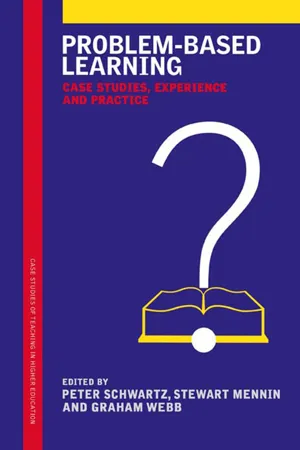
- 182 pages
- English
- ePUB (mobile friendly)
- Available on iOS & Android
eBook - ePub
Problem-based Learning
About this book
Information
Topic
EducationSubtopic
Education GeneralSECTION 1
POLITICAL, ADMINISTRATIVE AND RESOURCE ISSUES
CHAPTER 1
COME AND SEE THE REAL THING
Case reporters: David Prideaux, Bren Gannon, Elizabeth Farmer, Sue Runciman and Isobel Rolfe
Issues raised
This case study focuses on some of the methods that can be used to try to convince faculty members to accept a proposal to adopt PBL within a medical curriculum.
Background
The School of Medicine at Flinders University in Adelaide is, by Australian standards, relatively small and recent. The first class was admitted in 1974. The current intake comprises 58 domestic students and a further 25 full fee paying overseas students. In 1996, the School was the first in Australia to move from the traditional six-year, undergraduate-entry medical course to a four-year, graduate-entry course.
PART 1
The Faculty at Flinders decided in 1991 to move to a four-year, graduate-entry medical course. At the time, a small but enthusiastic group of staff, including some who had worked in similar programmes in other medical schools, advocated the adoption of PBL as the main teaching/learning method for the new course. Similar proposals had been considered but rejected in the 1974 six-year curriculum and its subsequent revisions. During 1992, four staff members attended a five-day Medical Curriculum Workshop at Harvard University and they returned to become key advocates for PBL. One of the four subsequently travelled extensively at his own expense to gain information on and experience in PBL in medical education. The end result was that the PBL Working Party was one of the first groups to be established in the decision-making structures for the new programme. One of its main tasks was to convince the majority of the staff in the School to embrace the PBL approach.
There was a history of curriculum reform in the School, with three major revisions of the six-year course having been undertaken prior to the decision to adopt graduate entry. A high level of collegial decision making had characterized earlier curricular establishment and revision. A fundamental component of that process was the Annual Curriculum Conference, during which staff moved off campus for a day and a half to discuss significant educational issues. An additional Curriculum Conference had been called in 1991 to consider and decide upon the adoption of a graduate-entry course.
The Conference Organizing Committee and the PBL Working Party developed a plan to devote the 1993 Curriculum Conference to an introduction to PBL for School of Medicine staff. We hoped that this would lead to a decision by the whole School to adopt the approach in the new course. We knew that there would be other opportunities to promote our message, but the Curriculum Conference was the big chance. The stakes were high. What could we do at the Conference that would have the best chance of convincing faculty members to accept PBL?
If you had the task of organizing the Faculty Conference and wanted to promote PBL, what would you do?
What do you think was actually done?
PART 2
For better or worse, we decided to adapt the old adage: ‘experience is the best teacher’ and we developed a three-part plan. The first two parts consisted of two staff participation exercises that we organized for the Conference. The first, on the tutorial process, was brought back from the University of New Mexico by the key staff member who had studied PBL extensively at other institutions and who was now co-chair of the PBL Working Party. The second was used with the kind permission of the Faculty of Architecture at the University of Newcastle and centred on a PBL exercise involving the design of a bird hide (a concealed place for watching birds). We deliberately chose a non-medical ‘case’ because we feared that some clinical staff might move quickly to a rapid diagnosis with a medical case and not engage fully in the processes of PBL.
The third part of our plan for the Curriculum Conference was to provide a live demonstration of PBL. The newly appointed Dean of the School of Medicine had come from Newcastle University which, at the time, was the only Australian medical school to use PBL. He offered to use his contacts to bring a group of students and their tutor from Newcastle to participate in a tutorial in front of the Flinders staff. Significantly, he also undertook to fund the transport and accommodation costs for this demonstration. Those of us who were planning the Curriculum Conference placed two conditions on the exercise. First, the tutorial group was to be a regular one engaged in its normal case of the week. Second, the tutor was to be the group’s regular one, albeit one of the acknowledged ‘better’ tutors at Newcastle. A tutor was subsequently invited to make the trip with her normal group.
The Conference was set for a day and a half in October 1993. There was a large attendance, in excess of the 100–120 who usually attended such events, and expectations were high. The first morning began with the two staff participation exercises. If the aim of these exercises was to achieve staff consensus in support of introducing PBL, then we had a feeling that they had not fared well. This was especially true for the ‘bird hide’ exercise. Staff were allocated to groups to respond to a scenario that asked them to design a bird hide for the university lake using recycled materials. The exercise encouraged some frivolity, lightheartedness and competition between the various staff tutorial groups. Underneath this veneer of conviviality, however, the exercise exposed some substantive concerns about PBL. These were raised in plenary feedback sessions at the end of the small group activity. There were four major issues:
1. PBL appeared to be ‘time wasting and inefficient’. Basic points were subject to prolonged discussion rather than being resolved quickly. It was questioned whether Flinders could afford the luxury of extended time being spent in discussion, given that the course was being reduced from six to four years.
2. There was a strong view that the exercise had resulted in the pooling of ‘collective ignorance’. Who was going to provide the correct explanations and how would these be recognized as correct?
3. Allied to the point above was an expressed concern about the lack of an ‘expert’ tutor. In the absence of such a person, who would rule on ‘incorrect’ or ‘irrelevant’ ideas?
4. The final issue concerned assessment. It was claimed that PBL would be constrained by assessment and the need to prepare for examinations. We had unwittingly brought this issue to the fore because we had added, for fun, an assessment of the bird hide design by a selected panel consisting of the Newcastle students and their tutor. This drove much of the staff group work. In light of what we all now know about how assessment drives learning, we should, perhaps, have avoided introducing this part of the exercise.
By lunchtime, some of us judged that, had a motion to adopt PBL been put at that time, it would have gone down. A couple of us chose to take our lunch outside in the October sun for some relief from what we saw as impending doom. Perhaps we would have been better off engaging in some reflection on what we could (and perhaps should) have done to manage the morning sessions better. We should have asked ourselves some of the following questions:
• What was the effect of the decision to use the bird hide example? Did it trivialize the exercise? Would a medical example have been better?• How well were we prepared to handle important and predictable questions of ‘time wasting’, ‘collective ignorance’ and ‘expert tutors’? These were common issues in the literature. Had we thought through how they might be handled?• Why did we put the assessment exercise in? What purpose was it supposed to serve? Again, did this act to trivialize the whole exercise?
After lunch, the demonstration of PBL began. The tutor and eight Newcastle students sat in a ‘fishbowl’ at the front of a tiered lecture theatre with 100 or so Flinders staff looking on. The students were wired up so that all could hear their voices and they were under the glare of strong lighting. One roving and one fixed studio TV camera recorded the demonstration on video for posterity. This was hardly the stuff of a routine tutorial!
Conference planning committee members took their seats in the front row of the lecture theatre. Given the way the morning’s session had unfolded, some of us were slumped low in our seats. We continued to sink lower as the demonstration began and audio-visual staff tried to sort out technical problems with the sound and recording system that had caused the students to be inaudible to the gathered staff observers. We wondered, ‘Could the Conference reach any lower point than this?’
The case under discussion began with a video vignette of a female patient with abdominal pain. It began slowly as sound problems were corrected and the students got used to the glaring lights. But the momentum picked up as the students went through the classic steps of PBL and soon they seemed to forget or ignore their unfamiliar surroundings and the presence of their audience. The problem was discussed, key information lists generated, hypotheses constructed, further information was sought, learning issues were identified, learning goals were set and group processes were observed. Most importantly, in all of this the tutor said very little. We began to sit up straighter in our seats. Was the tide beginning to turn?
What came next sealed the fate of PBL at Flinders. At the conclusion of the PBL tutorial, a decision was made to cancel an ‘expert panel’ session that was to provide a commentary on the exercise in favour of an ‘all in’ plenary where the students and tutor were challenged by questions from the Flinders staff and responded accordingly. The students provided answers to many of the issues raised by Flinders staff earlier in the day. The charge of time wasting in PBL was dealt with quickly. One of the students responded: ‘The question is, how much more time would I waste if I went away and tried to learn all this on my own?’
Similarly, they outlined mechanisms for dealing with ‘incorrect’ information and discussed the role of the tutor in guiding and facilitating learning. The students were able to demonstrate that they were well advanced in the process of making the tutor redundant as they moved to the end of their block of time with her. The climax came towards the end of question time. One of the senior Flinders staff members asked the students to indicate who had come straight from high school and who had other experiences before beginning the five-year undergraduate course at Newcastle. The challenge was thrown back to the staff member by one of the students: ‘Would you like to try to identify which of us entered straight from high school?’ No one in the audience could or was willing to do it. The intent of the question had obviously been to establish whether the sophisticated thinking displayed by the group was a result of PBL or prior experience. The returned challenge provided most of the answer; the rest came when the challenging student, who had clearly been one of the most active students during the tutorial, revealed herself as being straight from high school.
The discussion continued both formally and informally throughout the Conference, but the Organizing Committee had a newfound confidence. What emerged was that the Flinders staff were particularly impressed with at least three things:
1. the high level of motivation displayed by the Newcastle students;
2. the high level of critical thinking and problem solving displayed; and
3. the impressive knowledge base demonstrated by the students.
The Newcastle students were judged to be far superior to our own students in the existing six-year course at Flinders on these attributes. PBL was on its way to being adopted at Flinders. No more slumping in seats!
Why did observation of students engaged in an actual PBL session have such a profound effect? Why did participation exercises for faculty fail to work?
What other methods might be used to convince faculty to accept PBL?
What are the implications of this case for other schools wishing to introduce PBL?
CASE REPORTERS’ DISCUSSION
For us this case raises two major issues in curriculum change. The first is the importance of building upon existing patterns of decision making in planning the change. There was a need to move the advocacy of PBL from the small group of supporters to what Fullan (1992) and others have described as ‘ownership’ of the methodology by a much wider group of staff in the School. Clearly, the Curriculum Conference provided a well-tried option to do this, but there were risks. The Curriculum Conference could have offered the opportunity for power blocs opposing PBL to form. These can sometimes be quite influential in preventing significant change. The outcome of the Conference could have gone either way: support for or rejection of PBL as the main teaching methodology in the new course. Prior to the live tutorial demonstration it had appeared to be headed for the latter.
The second issue was the use of the live demonstration of PBL. We describe PBL as ‘its own best advocate’. Up to that point, we had recommended readings about PBL, held discussions about PBL and even got staff participating in exercises that were contrived, designed or borrowed, but all of them were of little avail. In the end, there was no substitute for coming to see the ‘real thing’. We would claim that the demonstration was the real thing, albeit with a degree of artificiality introduced by the cameras, lights and sound system, and by the audience of interested and critical onlookers. In the final analysis, however, the Newcastle students were a normal student group, with their regular, although specially selected tutor, and they were working with their prescribed case for the week. It was not a demonstration exercise. Thus the stakes were high for the students as well as for the Conference planning group. The students had to achieve their learning goals for the case while at the same time demonstrating the worth of the PBL process. This is in marked contrast to the ‘bird hide’ case undertaken by the staff. It was not a ‘real’ problem and was probably of little interest to most staff. Nor was there any pressure on them to learn something. In retrospect, we wonder whether the staff could ever have been expected to work in the same way as the students on such an exercise.
The discussion following the demonstration was every bit as important as the demonstration itself. It showed that the PBL students had sophisticated thinking skills, could reflect upon and articulate their learning processes and were not necessarily intimidated by an audience of academics of all levels of s...
Table of contents
- Cover
- Title Page
- Copyright Page
- Table of Contents
- Contributors
- Introduction
- Section 1: Political, Administrative and Resource Issues
- Section 2: Issues Relating to Teachers
- Section 3: Issues Relating to Students
- Conclusion
- Further Reading
- Index
Trusted by 375,005 students
Access to over 1.5 million titles for a fair monthly price.
Study more efficiently using our study tools.
Frequently asked questions
Yes, you can cancel anytime from the Subscription tab in your account settings on the Perlego website. Your subscription will stay active until the end of your current billing period. Learn how to cancel your subscription
No, books cannot be downloaded as external files, such as PDFs, for use outside of Perlego. However, you can download books within the Perlego app for offline reading on mobile or tablet. Learn how to download books offline
Perlego offers two plans: Essential and Complete
- Essential is ideal for learners and professionals who enjoy exploring a wide range of subjects. Access the Essential Library with 800,000+ trusted titles and best-sellers across business, personal growth, and the humanities. Includes unlimited reading time and Standard Read Aloud voice.
- Complete: Perfect for advanced learners and researchers needing full, unrestricted access. Unlock 1.5M+ books across hundreds of subjects, including academic and specialized titles. The Complete Plan also includes advanced features like Premium Read Aloud and Research Assistant.
We are an online textbook subscription service, where you can get access to an entire online library for less than the price of a single book per month. With over 1.5 million books across 990+ topics, we’ve got you covered! Learn about our mission
Look out for the read-aloud symbol on your next book to see if you can listen to it. The read-aloud tool reads text aloud for you, highlighting the text as it is being read. You can pause it, speed it up and slow it down. Learn more about Read Aloud
Yes! You can use the Perlego app on both iOS and Android devices to read anytime, anywhere — even offline. Perfect for commutes or when you’re on the go.
Please note we cannot support devices running on iOS 13 and Android 7 or earlier. Learn more about using the app
Please note we cannot support devices running on iOS 13 and Android 7 or earlier. Learn more about using the app
Yes, you can access Problem-based Learning by Peter Schwartz in PDF and/or ePUB format, as well as other popular books in Education & Education General. We have over 1.5 million books available in our catalogue for you to explore.