eBook - ePub
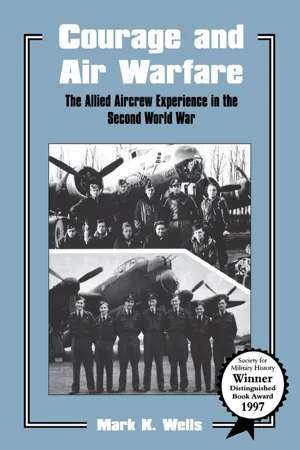
Courage and Air Warfare
The Allied Aircrew Experience in the Second World War
- 256 pages
- English
- ePUB (mobile friendly)
- Available on iOS & Android
eBook - ePub
About this book
Colonel Wells investigates the nature of aerial warfare and the men who took part. The book analyzes aircrew selection, reaction to combat, adaptability to stress, morale, leadership and combat effectiveness, and compares the efforts of the US Eighth Air Force and RAF Bomber Command.
Information
1
Choosing the Best: Selection and Classification of Aircrew
FROM THE earliest days of aviation, airmen have been regarded as members of an élite group, largely as a result of the dangers associated with flying. In the early part of the twentieth century, flimsy machines, unreliable engines, and inadequate preparation caused scores of accidents.1 Aircraft and flying were considered novelties and pilots were often seen as daredevils. In the view of many, it took a special type of man to brave the obvious perils.2
This image became even more exaggerated during the First World War, especially in the popular perception. Circumstances combined to generate the favoured notion that aviators were somehow ‘supermen’, who not only had nerves of steel, but were also physically and mentally superior. The air combat arena appeared far more antiseptic, and certainly more captivating, than the daily grind of trench warfare. Heroes were easier to identify as individuals and, with their youthful, mostly handsome faces, less difficult to glamorize.3
The reality was very different, of course, but elements of this attitude were common even inside military services. Long before the war most countries began laying down minimum physical standards for airmen. Good eyesight was an obvious requirement, as was a modicum of muscular co-ordination.4 Often these standards were related to characteristics associated with sportsmen, hunters or cavalrymen. Naïve notions relating to the social and cultural background of flyers were similarly popular, especially in Britain,5 but it was the war itself which served to give the biggest impetus to more rigorous and realistic selection criteria.
During the First World War, many military commanders and aviation medical authorities settled on the necessary prerequisites for successful flyers. The intensity of combat operations and rapidly advancing aircraft technology made it clear that, at an absolute minimum, a robust emotional constitution was necessary for an aviator’s success and survival. Fixed physical standards were therefore supplemented with detailed personal characteristics which gave clues to a flyer’s temperament.6 Eagerness to fly counted for much, as did youth, resolution, tenacity and a willingness to take risks. Each of the war’s belligerents adopted this formula in some form to help select suitable candidates.
In America, the desire to identify good men – and eliminate the unsuitable – received special impetusreceived special impetusthe words from US War Department figures. The conflict brought 50,000 battle deaths but more than double that number of soldiers were admitted to hospital on psychiatric grounds.7 There was considerable surprise at the rate at which ground soldiers broke under the strain of combat; so much so, that in the summer of 1918 General John J. Pershing demanded a screening examination to reduce the intake of those who might succumb to what was then termed ‘shell shock’.8 By war’s end no fewer than 48,888 individuals had been rejected for service for reasons based on indications of mental disorder.9 Despite this, more than 125,000 mentally afflicted veterans would eventually apply for monetary compensation under the War Risk Insurance Act.10 In an attempt to control alarming statistics like these, army psychiatrists joined the staffs at all induction centres, and would remain a permanent fixture of the American military selection process.
In Britain, due largely to cultural and economic factors, there was more reluctance to rely on psychiatric explanations for breakdown. This was also partly explained by the great faith the British maintained in traditional methods of classification and selection of recruits. Even after the events of 1914–18 there was no great inclination to add any kind of psychological or psychiatric examination to the process. It was not until early in the Second World War that the system was modified to include psychiatrists and a psychiatric examination. Even so, under ordinary circumstances psychiatric specialists would only be called in to examine especially suspicious or obvious cases of disorder.11 In the case of the RAF, as we shall see, this step was taken for aircrew candidates only reluctantly.12 Most often, British selection boards relied on their own internal and essentially non-professional expertise. For the British, the underlying notion was that airmen with no aptitude for flying could be ‘weeded out’ without too much difficulty by general observation and practical appraisal.
Thus, as will become apparent, at the beginning of the Second World War, both the Royal Air Force and the US Army Air Corps (in 1941 renamed the US Army Air Forces) had functional systems for finding qualified aircrew members for training. At a fundamental level the goal was essentially the same: to find the best candidates for flying duty. But the approaches taken by the two air forces would reflect quite different techniques and, especially for the Americans, were aimed not only at singling out the men best suited to withstand the rigours of training, but also at identifying those who would succeed in combat.
AIRCREW IDENTIFICATION AND TESTING IN THE USAAF
The American approach to aircrew selection and classification reflected a strong faith in the scientific method of evaluating human capabilities. During the first year of US involvement in the Second World War, the US Army Air Forces (USAAF) had relied on a system which emphasized the traditionally high educational and physical standards set for aircrew during the interwar years.13 Reception centres subjected new recruits destined for aircrew enlisted duties to a series of tests designed to measure general intelligence, mechanical aptitude and probable speed of learning. Despite the best intentions, the psychiatric examination at the time was best characterized as ‘intuitive and haphazard’.14 Men were ostensibly interviewed to reveal civilian skills or experiences which might be easily related to military specialities. Scores were assigned and candidates divided into five categories according to the result. For most of the period, Air Corps training programmes received a larger percentage of the top rated men for enlisted duty than did the other branches of the army.15
Potential officers were similarly culled. From 1927 to 1942 there was an educational requirement which called for a minimum of two years of college. Physical standards for pilots, navigators and bombardiers were already high.16 Moreover, it was intended that every aspiring officer would have a comprehensive interview with an experienced flight surgeon or an aviation medical examiner.17 The US Army School of Aviation had developed a guide to be used in the evaluation of the personality of potential pilots.18 Unfortunately, many examiners, a high proportion of whom were old flying instructors, smugly believed themselves particularly adept at picking prospective candidates,
I can observe a boy as he drives a car, plays tennis, or even as he walks across the street, and tell you whether or not he will make a flier!19
As the need for qualified candidates grew exponentially, it became clear that the AAF would need a better way to screen volunteers. The scientific community was prepared to provide help.20 Various schemes were investigated, some quite novel, but some with questionable scientific validity.
One of the more dubious approaches was based on an examination of a candidate’s facial features. The theory was that a man’s face could be used as an indicator of his mental, physical and emotional capability and stamina. The size and shape of particular parts of a face were carefully measured and charted. These areas were thought to correspond to particular skills. By comparing the results with a composite picture drawn from 20 outstanding aviators, a man’s potential was measured. Not surprisingly, practical experimentation proved that this ‘test’ was of no value in determining success in flying training.21
After January 1942, under wartime manpower pressures, the AAF dropped the college requirement in favour of an aviation cadet qualifying examination for all volunteers.22 This written qualifying examination, lasting three hours, was frequently altered in the hope of improving its predictive quality. Likewise, its pass marks were occasionally changed to meet varying manpower requirements.23
A 1943 experiment directed solely to test the efficacy of this AAF qualifying examination allowed a group of 1,000 applicants to enter training regardless of their marks. Of those admitted who would have nominally failed the exam, fully 88.9 per cent were subsequently eliminated from flying training. Moreover, two-thirds of those who passed were also eliminated. So while the experiment validated the qualifying examination as a tool to screen those with almost no potential for flying service, it also showed that further testing was necessary to find men who could fly. In short, although generally effective at preventing blatantly unqualified men entry into the technical environment of the air forces, the aircrew qualifying examination was an inadequate tool for identifying actual aircrew aptitudes.24
As a result, it was supplemented by a series of 20 tests, both written and physical, known as ‘the classification battery’, or ‘stanine tests’. The latter term arose as a result of the words ‘standard nine’, and referred to the scores assigned to men ranging from one (low) to nine (high). Individual scores were weighted and cited as composites which measured potential for the three major aircrew positions of pilot, bombardier and navigator. The higher the score in a particular category the man earned, the better his chances of success in training in that speciality.25
For these tests to work properly it was obviously necessary for military and medical authorities to predict what kind of skills would be necessary for successful pilots, navigators and bombardiers. Psychologists worked closely with training officials and instructor pilots to create such a list. Among the most important predictors of success for pilots were the ability to perceive and react to stimuli, adequate muscular co-ordination, the skill to visualize mechanical movements and adeptness at discriminating between visual objects. Some of these characteristics could be measured by ‘psychomotor’ equipment. Typically simple wooden devices of various configurations with pulleys, lights and rudimentary controls, these apparatuses were designed to be centrally produced. Delays in production and the large number of men to be tested often forced the reception centres to use locally devised tests of questionable value.
I do remember trying to hold a stylus in a small round hole while they were trying to distract me with marbles falling on a tin pan over my head and yelling at me ‘You are going to crash!’26
Physical stanines were complemented by written examination and a similarly scored interview designed to investigate a candidate’s background and interests. There was much publicity at the time about the value of ‘ink-blot’ tests and word association quizzes. It was obviously intended that every man be adequately examined, but, largely as a result of the huge number of men to be screened, most veterans apparently received only a very cursory interview with a psychiatrist.27 For aircrew candidates the results became part of the ‘Adaptability Rating for Military Aeronautics’ or ARMA. The interview’s purpose was to review their family histories and screen them for blatant clues of emotional disorder. Accordingly, much weight was assigned to traits which might be easily spotted or casually admitted: loudness, timidity, excessive nervousness, bed-wetting, nail-biting, and sexual preference.28 Men who appeared effeminate, ‘unmanly’, or were suspected of outright homosexuality were quickly rejected. Generals Arnold and Eaker opined that ‘the frank, open-faced, pleasant-mannered, serious-minded, and co-operatively-inclined boy’ was the one wanted and selected in nine out of ten cases.29
As a result of feedback coming from various theatres of combat, by late 1944 the School of Aviation Medicine began developing a programme which emphasized a longer and more intensive psychiatric evaluation. By that time aircrew manpower requirements had eased somewhat, and more psychiatric specialists were available to do the screening. However, the objections of some local commanders – many of whom always regarded psychiatrists with scepticism and suspicion – and the end of the war led to the programme’s abandonment.30
For much of the war an overall ten or 15 per cent rejection rate on the original psychiatric interview was about the average. Altogether about 40 per cent of all rejections at the induction centres were made on neuropsychiatry grounds.31 Moreover, depending on manpower requirements, air force authorities could use the expedient of lowering or raising the overall stanine scores required for flying specialities to decrease or increase the flow of men to training units. Usually pilot can...
Table of contents
- Cover
- Half Title
- Title Page
- Copyright Page
- Contents
- List of Illustrations
- Editor’s Foreword
- Foreword by Bernard C. Glueck
- Acknowledgements
- Abbreviations
- Introduction
- 1 Choosing the Best: Selection and Classification of Aircrew
- 2 The Nature of Air Combat during the Combined Bomber Offensive
- 3 Combat Stress, Emotional Breakdown and their Treatment in the Allied Air Forces
- 4 Attitudes and Morale in the Eighth Air Force
- 5 Aircrew Morale in Bomber Command
- 6 Sustaining Morale: The Impact of Leadership
- 7 Moral Fibre and the American Experience
- 8 Bomber Command and Lack of Moral Fibre
- 9 Conclusion
- Bibliography
- Index
Trusted by 375,005 students
Access to over 1.5 million titles for a fair monthly price.
Study more efficiently using our study tools.
Frequently asked questions
Yes, you can cancel anytime from the Subscription tab in your account settings on the Perlego website. Your subscription will stay active until the end of your current billing period. Learn how to cancel your subscription
No, books cannot be downloaded as external files, such as PDFs, for use outside of Perlego. However, you can download books within the Perlego app for offline reading on mobile or tablet. Learn how to download books offline
Perlego offers two plans: Essential and Complete
- Essential is ideal for learners and professionals who enjoy exploring a wide range of subjects. Access the Essential Library with 800,000+ trusted titles and best-sellers across business, personal growth, and the humanities. Includes unlimited reading time and Standard Read Aloud voice.
- Complete: Perfect for advanced learners and researchers needing full, unrestricted access. Unlock 1.5M+ books across hundreds of subjects, including academic and specialized titles. The Complete Plan also includes advanced features like Premium Read Aloud and Research Assistant.
We are an online textbook subscription service, where you can get access to an entire online library for less than the price of a single book per month. With over 1.5 million books across 990+ topics, we’ve got you covered! Learn about our mission
Look out for the read-aloud symbol on your next book to see if you can listen to it. The read-aloud tool reads text aloud for you, highlighting the text as it is being read. You can pause it, speed it up and slow it down. Learn more about Read Aloud
Yes! You can use the Perlego app on both iOS and Android devices to read anytime, anywhere — even offline. Perfect for commutes or when you’re on the go.
Please note we cannot support devices running on iOS 13 and Android 7 or earlier. Learn more about using the app
Please note we cannot support devices running on iOS 13 and Android 7 or earlier. Learn more about using the app
Yes, you can access Courage and Air Warfare by Mark K. Wells in PDF and/or ePUB format, as well as other popular books in Storia & Storia militare e marittima. We have over 1.5 million books available in our catalogue for you to explore.