- 388 pages
- English
- ePUB (mobile friendly)
- Available on iOS & Android
eBook - ePub
About this book
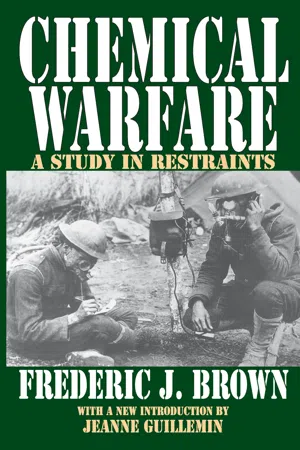
In the aftermath of 9/11, the potential terror of weapons of mass destruction--from nuclear, biological, and chemical to dirty bombs--preoccupies national security experts. In Chemical Warfare, Frederic J. Brown, presents a cogent, innovative framework for understanding the historical forces that have restrained the use of WMD and how they continue to have relevance today. Analyzing both world wars, he argues that the restraints on use were complex and often unpredictable and ranged from the political to the technological. The author offers a detailed examination of American chemical warfare policy as it was shaped by industry and public sentiment, as well as national and military leaders. The organization of the book into three parts reflects the importance of battlefield experiences during the First World War and of international political restraints as they evolved during the interwar years and culminated in ""no first use"" policies by major powers in World War II. Part I examines the use of chemical weapons in World War I as it influenced subsequent national policy decisions. Part II focuses on the evolution of political, military, economic, and psychological restraints from 1919 to 1939. Part III discusses World War II during two critical periods: 1939 to early 1942, when the environment of the war was being established largely without American influence; and during 1945, when the United States faced no credible threat of retaliation to deter its strategic and battlefield use of chemical weapons. Written at the height of controversy about the U.S. use of chemicals in Vietnam, Chemical Warfare offers a valuable historical perspective, as relevant now in its analysis of chemical and also nuclear policy as it was when first published.
Part I World War I
INTRODUCTION
World War I occupies a crucial position in the evaluation of American chemical warfare policy. The record of employment, as it was and as it would be perceived by later decision-makers, was the precedent which influenced the actions of each of the major powers in preparing for and fighting the Second World War.
The one chapter that treats World War I (Chapter I) focuses upon evolving incentives and restraints to subsequent employment of toxic agents rather than upon the chronology of immediate use. Therefore, emphasis is placed upon perceptions of critical elite groups and the evolution of popular sentiment with respect to chemical warfare. In essence, this chapter develops the range of national and group reactions to a brutal and unexpected opening of a veritable “Pandora’s Box” of war.
Chapter 1 The Heritage of War
A. Record of Use
“Ypres, April 22, 1915: Try to imagine the feelings and the condition of the [French] colonial troops as they saw the vast cloud of greenish-yellow gas spring out of the ground and slowly move down wind toward them, the vapour clinging to the earth, seeking out every hole and hollow and filling the trenches and shell holes as it came. First wonder, then fear; then, as the first fringes of the cloud enveloped them and left them choking and agonized in the fight for breath—panic. Those who could move broke and ran, trying, generally in vain, to outstrip the cloud which followed inexorably after them.”1
The casualties of this attack were the first of approximately one million gas casualties of World War I.2
Ypres was a place of horror on that spring afternoon in 1915. The Allied troops facing the German attack, which had been achieved with complete strategic and tactical surprise, were totally unprepared and therefore utterly helpless. Having neither the training nor the protective equipment essential to survival in a toxic environment, they retreated in panic and disorder, and by nightfall were facing a major disaster. The line of trenches had been ruptured, communications were disrupted, and, most important, the enemy had developed a weapon for which there seemed to be no defense. Yet the Germans did not capitalize on their technological advantage. The Allies reinforced and eventually sealed the breach. The lengthy battle precipitated by the first gas attack, the Second Battle of Ypres, ground on until the last week of May, 1915. The Germans were unable to exploit the Ypres salient after more than a month of fighting and a cost of over 100,000 Allied and German casualties.3
Considering the nature of the breakthrough, the Germans could have secured a decisive success in Flanders. It is apparent, however, that they were not prepared to exploit, on other than a limited tactical scale, any success that the use of gas might bring. The attack, which had to be postponed several times due to unfavorable wind conditions, was not launched until late afternoon. Inadequate reserves prevented the Germans from capitalizing on the breach in the Allied lines. Although the gas employed, chlorine released from cylinders, could be neutralized through reasonably simple protective means, the German troops had not been furnished with defensive equipment.
In short, the Germans demonstrated an astonishing lack of thoroughness in initiating the use of gas. Having accepted gas as sufficiently promising to justify experimentation on the battlefield, they used it on a scale adequate to alert the Allies to the reality of toxic weapons, but inadequate to ensure success. Their error was threefold. The General Staff apparently had not evaluated either the importance of surprise, or the certainty that the Allies could in time develop defensive measures, or the possibility that the Allies could retaliate in kind. They were to pay dearly for these errors later in the war. As they had done in the employment of the submarine, the Germans had provoked an unrestricted land war that would, on balance, accrue to their disadvantage.
Although the results of the Second Battle of Ypres were indecisive at best and at least represented a significant opportunity lost for the Germans, the implications of April 22, 1915, were major. The experience of Ypres demonstrated in most acute form both the impact of science and technology on the battlefield and the unlimited nature of Word War I. Each, by the horror it aroused, was to contribute to military and civilian rejection of the use of poison gas after World War I.
The very nature of chemical warfare inhibited its acceptance by the German military in 1915. The chlorine gas employed at Ypres was a product of the civilian laboratory, developed through the initiative of the brilliant German chemist, Fritz Haber, manufactured by a complex industrial process, and employed on the battlefield by specialists under the supervision of a civilian chemist.4 It was not a weapon in which the army could claim a proprietary interest. On the contrary, it was a weapon promoted by civilians and the reservists to rescue the German military professionals, who were handicapped by a shortage of conventional artillery units and ammunition and by an inability to devise any more satisfactory means of overcoming the protracted position warfare that Germany had to avoid.5
Thus from the first, the German military themselves regarded gas with suspicion and distrust. A characteristic problem in the use of gas—assimilation by the military—was in evidence at Ypres as it would be in subsequent battles.
The decision to initiate gas warfare enabled Germany to make maximum use of one of her most significant advantages over the Allied powers—a highly developed chemical industry. Ypres represented a logical extreme in the employment of the chemical industry: the use of chemicals as an end product rather than as a by-product of conventional armaments. After Ypres, the military establishment had little alternative to acceptance of scientific expertise. The war had now become a “chemical war” and the German army had not benefited from its initial advantage.
While the Germans do not appear to have weighed the importance of the use of gas as a deliberate and wanton violation of conventional law regarding land warfare, the British realized the importance of this aspect immediately.6 Article 23 of the Hague Convention of 1899 bound the signatories “to abstain from the use of projectiles the sole object of which is the diffusion of asphyxiating or deleterious gases.” The same article forbade the use of weapons causing “unnecessary suffering.”7
British lack of preparedness for gas warfare in 1915 was due partially to the absence of a developed chemical industry resulting from the German monopoly of dye stuff manufacture; but it was also a result of British compliance with the Hague Convention and fear of the implications of unlimited war. The British government had considered using incapacitating noxious gases (sulphur fumes) as early as the siege of Sebastapol in the Crimean War.8 But, although the government approved the projects, gases were not employed.
In 1913, foreign press reports of research in gases caused the British government to study the wording of the Hague Conventions. It was determined that a double-purpose shell, that is, “one which contained a small portion of lachrymatory substance without asphyxiating or deleterious effect,” was permissible by the wording of the conventions, “although contrary to its spirit.” The shell was not adopted by either the Army or Navy.9
The subject was raised again in September 1914, when Lord Dundonald revived the Crimean project that had originally been sponsored by his ancestor. Rejected for the Army by Lord Kitchener as ill-suited for land warfare, it was considered by Churchill in the Admiralty. The subject was studied during the winter of 1914-1915 and was finally referred to Colonel Hankey, Secretary of the Committee of Imperial Defense, for further development. By March 31, 1915, experiments were being conducted with a view to the possible use of nonlethal gases in the Dardanelles campaign. But these plans were curtailed by Churchill, who realized “that it would not be expedient to introduce into the War, elements which might justify the enemy in having recourse to inhuman reprisals.”10
Thus the British were not unmindful of the military possibilities of noxious gases when the Germans initiated their use. The employment of such gases had been seriously studied and then rejected out of respect for the Hague Conventions, out of fear of the implications of unlimited war, and out of an appreciation of the weakness of the British chemical industry. The British decision to retaliate was of equal or greater importance than the German decision to initiate. The Germans initiated in the hope of finding a palliative to a tactical military weapons problem. The English retaliated with the full realization that the land war had become unlimited.
The British appreciated these implications of Ypres, even if the Germans did not. There was no question of the necessity for providing protective devices to the Allied Armies. Crude gauze bandages were immediately dispatched to the front and a crash program was instituted to develop a protective mask.11 The decision to retaliate was made on May 18, 1915. General Thuillier, a British gas warfare expert, indicates that some of the factors considered beforehand were the ethical question posed by the Hague Conventions, the capability of British chemical science and industry to respond to the challenge, and the morale problem among the troops if the Allies did not respond in kind.12 The first English gas attack was launched at the battle of Loos on September 25, 1915. Unpreparedness had cost the British six months, but this was to be fully compensated for in the rising scale of gas attacks in 1918.
General reaction to Ypres was exemplified by General Pershing’s response to the German attack: “the impression was that the Germans had now thrown every consideration of humanity to the winds.”13 Gas was never to lose the twin stigmas acquired at Ypres. To the military it represented the encroachment of science which was corrupting the expertise and honor of their profession; to the civilian, it symbolized the ruthlessness and inhumanity of modern war.
The period from April 1915 to July 1917 saw the gradual expansion of the use of gas. However, once the Allied and German troops acquired protective equipment, albeit primitive, gas lost its critical role. By December 1916, the situation had become stabilized to the point where Sir Douglas Haig, the British Commander-in-Chief, was able to note rather smugly in his year-end dispatch: “it is satisfactory to be able to record … that the enemy has suffered heavy casualties from our gas attacks, while the means of protection adopted by us have proved thoroughly effective.”14 There was a continuing qualitative arms race between belligerents to find new, more deadly agents and more effective protective measures, but the characteristics of the gases employed relegated chemical warfare to a secondary supporting role. The gases of this period were all non- persistent and had to be breathed into the lungs to gain their effect. The practical result of this was to place a premium upon the ability to surprise the enemy by delivering large amounts of gas to a selected location before the enemy could react and mask. Research and development was oriented to producing more effective delivery means. Once the enemy was masked, he was safe.
Under these circumstances, gas could not compete with conventional explosives. The enormous logistic burden required to surprise an enemy position with a momentarily lethal concentration of gas could be more profitably used for conventional explosives that were not affected by the weather and that could continue to destroy enemy equipment after the soldier had taken passive defense measures.15
This situation changed drastically on July 12, 1917, when the Germans achieved their second major technological breakthrough in chemical warfare. Again, Ypres was the target. This time the Germans achieved complete surprise by introducing mustard gas—a persistent agent that could disable by...
Table of contents
- Cover Page
- Half Title Page
- Title Page
- Copyright
- Dedication
- Table of COntents
- Introduction to the Transaction Edition
- Acknowledgements
- Introduction
- Part I World War I
- Part II The Interwar Years
- Part III The Test of World War II
- Glossary of Abbreviations
- Bibliography
- Index
Trusted by 375,005 students
Access to over 1.5 million titles for a fair monthly price.
Study more efficiently using our study tools.
Frequently asked questions
Yes, you can cancel anytime from the Subscription tab in your account settings on the Perlego website. Your subscription will stay active until the end of your current billing period. Learn how to cancel your subscription
No, books cannot be downloaded as external files, such as PDFs, for use outside of Perlego. However, you can download books within the Perlego app for offline reading on mobile or tablet. Learn how to download books offline
Perlego offers two plans: Essential and Complete
- Essential is ideal for learners and professionals who enjoy exploring a wide range of subjects. Access the Essential Library with 800,000+ trusted titles and best-sellers across business, personal growth, and the humanities. Includes unlimited reading time and Standard Read Aloud voice.
- Complete: Perfect for advanced learners and researchers needing full, unrestricted access. Unlock 1.5M+ books across hundreds of subjects, including academic and specialized titles. The Complete Plan also includes advanced features like Premium Read Aloud and Research Assistant.
We are an online textbook subscription service, where you can get access to an entire online library for less than the price of a single book per month. With over 1.5 million books across 990+ topics, we’ve got you covered! Learn about our mission
Look out for the read-aloud symbol on your next book to see if you can listen to it. The read-aloud tool reads text aloud for you, highlighting the text as it is being read. You can pause it, speed it up and slow it down. Learn more about Read Aloud
Yes! You can use the Perlego app on both iOS and Android devices to read anytime, anywhere — even offline. Perfect for commutes or when you’re on the go.
Please note we cannot support devices running on iOS 13 and Android 7 or earlier. Learn more about using the app
Please note we cannot support devices running on iOS 13 and Android 7 or earlier. Learn more about using the app
Yes, you can access Chemical Warfare by Fredric Brown in PDF and/or ePUB format, as well as other popular books in History & Military & Maritime History. We have over 1.5 million books available in our catalogue for you to explore.