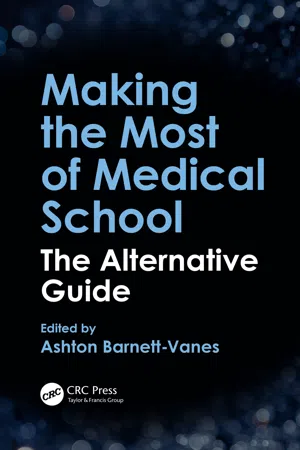
This concise guide to medical school offers an alternative path to developing a diverse set of academic and professional skills for a successful career in medicine. Written for current and prospective medical students, chapters are structured around eight key themes relevant to the active 'all-rounder' medic, including learning and leading high-quality research, opportunities in global health, further academic degrees and the complementary career options available to today's medical graduate. This book serves as essential reading for anyone considering and embarked upon an exciting career in medicine.
- 231 pages
- English
- ePUB (mobile friendly)
- Available on iOS & Android
eBook - ePub
About this book
Information
1Introduction
Ashton Barnett-Vanes
Without doubt, a 4- to 6-year period of study in medical school is challenging, burdensome and costly. Your raison d’etre during this time is the learning, understanding and application of clinical medicine – for which there are countless books already. Yet medical school can serve as a platform for more than the achievement of this, albeit essential, goal. This book is intended to serve as an alternative guide for medical students seeking to develop a wider set of skills, qualifications or experience in areas relevant to today’s and tomorrow’s clinical world. While it is intended to be read primarily by medical students, it is likely that junior doctors and other healthcare professionals in training or early practice will find this book of use.
Today, training programmes in medicine and surgery are placing increasing expectations on the non-clinical attributes medical students and junior doctors must possess and demonstrate for job competitiveness. They include – inter alia – academic publications and presentations, leadership skills, teaching experience, policy and management training – to name just a few. Medical students and those in the early stages of training can feel under pressure to acquire as many of these attributes as possible. But like most things in life that are worthwhile, rushing is ill advised. Accordingly, this book seeks to go beyond the tick box-style nature of today’s ‘curriculum vitae (CV) building’, to offer thoughtful guidance and advice from writers with real-life experience as, or teaching, students.
For instance, scrambling around a poorly conceived research idea is unlikely to even bring good data, never mind an academic publication. If your eyes are fixated on the output, you risk overlooking arguably the most important part of the endeavour at this stage: understanding the process. Becoming a successful researcher does not depend on how many papers or letters you have on PubMed, but whether you can see problems, hypothesise a cause and construct a methodical approach to solving them – or at least proving they exist, as covered in Chapter 2.
Alongside research and academic skills, medical school offers a unique opportunity to both observe and demonstrate leadership and organisational acumen. In Chapter 3, two common examples are outlined – establishing a group or campaign and organising an event, told through the experience of running a conference. These chapters cover a wealth of insight and lessons learned but, importantly, impart advice that the reader can mould and apply to a diverse range of activities outside of the remit of this book – a feature central to its wider function. Communication is central to the advancement of medicine, and Chapter 4 focusses on core topics in this area such as writing and publishing books, blogging and authoring for the general public and public speaking and presentations – the latter covering a range of scenarios that are featured in chapters elsewhere.
Chapter 5 focusses on the opportunities medical school offers for international health exchange and learning told through medical electives, global health research and internships. Importantly, this chapter includes a diverse collection of perspectives and insights from both high- and low-resource settings. Although the elective sections are written with the view of going abroad, much of their contents are readily transferrable to a domestic adventure. Chapter 6 explores the breadth of further degrees one can consider during and after medical school, and while not exhaustive, it is certainly comprehensive. Elsewhere, chapters cover opportunities in medical education, law and ethics and innovation and management. Chapter 9 covers an area of increasing interest – international mobility in medical training and practice. Finally, Chapter 10 features career perspectives from eminent clinicians who have combined the demands of clinical practice with exemplary leadership in their field.
In closing, this book is to be used and not just read. Annotate it, make notes, even cross out things you do not agree with: if it is not falling apart at the seam by the time you are finished with it, something is not right. Finally, while it is important to develop and lead a rich and fulfilling life as a student and beyond, keep your eyes on the prize. The completion of medical school and your graduating as a doctor is the number one aim. Striking a balance between curricular and extracurricular activities is vital – don’t overdo it!
So without further ado, welcome to the first Alternative Guide to Medical School.
Box 1.1Undergraduate’s perspective
Being exposed to the health challenges in Jamaica was a catalyst in deciding to find a career where I could help people. This, coupled with my interest in medical science and exposure to global health whilst interning on Medical Research Council projects in The Gambia, led me to pursue Medicine as a career. Whilst the course is intense, there are already a number of medical students – myself included – starting to get involved with other activities such as research and entrepreneurship. The undergraduate medical course does have time and allocated project space to explore other interests. I plan to do an intercalated BSc in order to enhance my research understanding; ultimately, I aspire undertake a PhD. Though some years away, for my elective I would love to go back to The Gambia. There I hope to apply the skills acquired during my time at medical school and be exposed to situations I may never have come across before (or again!). I believe new challenges and situations are key to furthering personal and professional growth; I hope to discover and maximise these whilst at medical school in order to become a successful and multi-skilled future doctor.
James Frater
Second-year medical student, King’s College London
Box 1.2Postgraduate’s perspective
Being a graduate student does offer you greater perspective on the wider professional world that can be put to use during the course. Painfully aware that who you know can be just as important as what you know, I will be keeping an ear out for worthy conferences to attend and look to make contacts wherever possible. I had intended to do some research whilst studying, but due to the intensity of the graduate course it’s hard to find an additional 20 hours a month to contribute meaningfully at this stage. I still hope that this may become possible in the later years of the course. I also plan to try and use my elective working at the headquarters of an international research or health body; and at some point beyond qualification, I would like to complete a Diploma in Topical Medicine. I aim to specialise within the NHS but I hope to take the opportunity to live and practice abroad. I have a strong interest in infectious disease and would be keen on a career balancing research with public health interventions. Though, if I am aware of one thing, it is my own ignorance. There will undoubtedly be topics as yet unknown to me that will pique my interest!
Chris Bodimeade
Second-year medical student, Leicester Medical School
2Research
Scientific and clinical research
Ashton Barnett-Vanes and Henry D. I. De’Ath
Audit
Henry D. I. De’Ath
Writing and publishing academic work
Ashton Barnett-Vanes with Chris McMurran and Jonathan C. M. W...
Table of contents
- Cover
- Half Title Page
- Title Page
- Copyright Page
- Contents
- Preface
- Acknowledgements
- Editor
- Author
- Chapter 1 Introduction
- Chapter 2 Research
- Chapter 3 Organising and leading
- Chapter 4 Writing and speaking
- Chapter 5 Global health
- Chapter 6 Further degrees
- Chapter 7 Design, innovation and management
- Chapter 8 Medical law, ethics and teaching
- Chapter 9 Trading placesMedicine abroad
- Chapter 10 Career perspectives
- Chapter 11 Afterword
- Index
Trusted by 375,005 students
Access to over 1.5 million titles for a fair monthly price.
Study more efficiently using our study tools.
Frequently asked questions
Yes, you can cancel anytime from the Subscription tab in your account settings on the Perlego website. Your subscription will stay active until the end of your current billing period. Learn how to cancel your subscription
No, books cannot be downloaded as external files, such as PDFs, for use outside of Perlego. However, you can download books within the Perlego app for offline reading on mobile or tablet. Learn how to download books offline
Perlego offers two plans: Essential and Complete
- Essential is ideal for learners and professionals who enjoy exploring a wide range of subjects. Access the Essential Library with 800,000+ trusted titles and best-sellers across business, personal growth, and the humanities. Includes unlimited reading time and Standard Read Aloud voice.
- Complete: Perfect for advanced learners and researchers needing full, unrestricted access. Unlock 1.5M+ books across hundreds of subjects, including academic and specialized titles. The Complete Plan also includes advanced features like Premium Read Aloud and Research Assistant.
We are an online textbook subscription service, where you can get access to an entire online library for less than the price of a single book per month. With over 1.5 million books across 990+ topics, we’ve got you covered! Learn about our mission
Look out for the read-aloud symbol on your next book to see if you can listen to it. The read-aloud tool reads text aloud for you, highlighting the text as it is being read. You can pause it, speed it up and slow it down. Learn more about Read Aloud
Yes! You can use the Perlego app on both iOS and Android devices to read anytime, anywhere — even offline. Perfect for commutes or when you’re on the go.
Please note we cannot support devices running on iOS 13 and Android 7 or earlier. Learn more about using the app
Please note we cannot support devices running on iOS 13 and Android 7 or earlier. Learn more about using the app
Yes, you can access Making the Most of Medical School by Ashton Barnett-Vanes in PDF and/or ePUB format, as well as other popular books in Médecine & Déontologie en médecine. We have over 1.5 million books available in our catalogue for you to explore.