- 304 pages
- English
- ePUB (mobile friendly)
- Available on iOS & Android
eBook - ePub
About this book
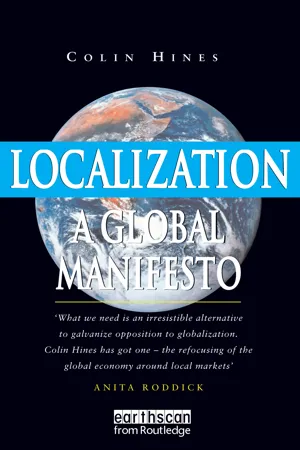
Localization is a manifesto to unite all those who recognize the importance of cultural, social and ecological diversity for our future - and who do not aspire to a monolithic global consumer culture. It is a passionate and persuasive polemic, challenging the claims that we have to be 'internationally competitive' to survive and describing the destructive consequences of globalization. This book is unique in going beyond simply criticizing free trade and globalization trends. It details self-reinforcing policies to create local self-sufficiency and shows clearly that there is an alternative to globalization - to protect the local, globally.
Information
Part One
The Problem — Globalization

Chapter 1
Globalization — What it is and the Damage it Does
THE OFFICIAL VIEW
‘The government remains firmly behind a comprehensive newround of negotiations in the WTO as the best way forward forthe UK, for developing countries in particular, and for theworld economy as a whole. We are working for a more transparent WTO which promotes sustainable development andfosters the rule of law in international trade.’Richard Caborn MP, UK Minister for Trade1
Trade liberalization is not the cause of the world economies problems, but the answer to them:
‘By securing better access to overseas markets for producers,by reducing trade barriers, and maintaining and improving thesupply of competitively priced goods and services toconsumers, trade liberalization brings widespread welfarebenefits and helps to improve the efficiency with which theworld’s resources are used. That is why the Governmentsupports the EU’s call for a comprehensive new Round of tradeliberalization, which has already met with support from anumber of developed and developing countries.’
Trade and environment:
‘Our overall aim is to work towards sustainable developmentin accordance with the principles set out in the Rio Declarationadopted in 1992. The Government will work to ensure thattrade liberalization contributes to this aim, including action tosafeguard the environment and the interests of developingcountries. By enabling developing countries to derive morebenefits from increased access to overseas markets and to inward investment, we can help them to increased prosperitywhich in turn has the potential to enable them to raise theirstandards of environmental and social protection.The Government believes that the evidence shows stronglythat trade liberalization is in the best interests of developingcountries as well as developed countries. The OECD has foundthat in the last decade countries which have been more open totrade and investment have achieved twice the average annualgrowth of more closed economies. This is of particular importance to those countries which need to grow faster to deal withtheir greater infrastructure and capacity weaknesses.’Brian Wilson MP, former Minister for Trade2
THE CRITICS’ VIEW
Globalization — the ever-increasing integration of national economies into the global economy through trade and investment rules and privatization, aided by technological advances. These reduce barriers to trade and investment and in the process reduce democratic controls by nation states and their communities over their economic affairs. The process is driven by the theory of comparative advantage, the goal of international competitiveness and the growth model. it is occurring increasingly at the expense of social, environmental and labour improvements and rising inequality for most of the world.
Or more bluntly:
Globalization n.1. the process by which governments signaway the rights of their citizens in favour of speculativeinvestors and transnational corporations. 2. The erosion ofwages, social welfare standards and environmental regulationsfor the sake of international trade. 3. the imposition world-wide of a consumer monoculture. Widely but falsely believedto be irreversible. — See also financial meltdown, casinoeconomy, Third World debt and race to the bottom (16th century: from colonialism, via development).3
AN ALTERNATIVE
Localization — a process which reverses the trend of globalization by discriminating in favour of the local. Depending on the context, the ‘local’ is predominantly defined as part of the nation state, although it can on occasions be the nation state itself or even occasionally a regional grouping of nation states. The policies bringing about localization are ones which increase control of the economy by communities and nation states. The result should be an increase in community cohesion, a reduction in poverty and inequality and an improvement in livelihoods, social infrastructure and environmental protection, and hence an increase in the all-important sense of security.
Localization is not about restricting the flow of information, technology, trade and investment, management and legal structures which further localization, indeed these are encouraged by the new localist emphasis in global aid and trade rules. Such transfers also play a crucial role in the successful transition from globalization to localization. it is not a return to overpowering state control, merely governments’ provision of a policy and economic framework which allows people, community groups and businesses to rediversify their own local economies.
GLOBALIZATION VERSUS INTERNATIONALISM
It is crucial to make a clear distinction between, for example, a global flow of technology, ideas and information to rebuild sustainable local communities, ie a supportive ‘internationalism’, and the process of globalization. in essence, the latter is the systematic reduction of protective barriers to the flow of goods and money by international trade rules shaped by and for big business. it pits country against country, community against community and workers against workers. That is the point of it, because such a structure and process is the route to maximizing profits. internationalism can be thought of as the flow of ideas, technologies, information, culture, money and goods with the end goal of protecting and rebuilding local economies worldwide. its emphasis is not on competition for the cheapest, but on cooperation for the best.
Linguistic clarity is vital since the advocates and beneficiaries of globalization misuse the indisputable benefits that can accrue from such constructive international flows to justify the destructive process of globalization. in tandem with this misleading approach is invariably a promise that someday the growth resulting from globalization will somehow trickle down to benefit the majority.
DOWNSIDES OF GLOBALIZATION
There are a vast number of books and other publications which authoritatively detail the adverse effects of globalization, and how it is directly guided by the priorities of transnational companies (TNCs) (see Suggested Reading). It is not the intention of this book to go over that ground again other than in the briefest of summaries. The main purpose of this chapter is to summarize the faulty theoretical underpinnings of what has now become an international theology. This then clears the way to consider its diametric opposite localization — along with the policies that can bring it about.
Up until the Asian crisis that began in July 1997, supporters of a global economy built on trade liberalization, usually described it as a win-win game. The theory is that the economies of all participants grow as countries specialize in what they are good at providing. They then import what they are less proficient in, what economists term ‘comparative advantage’.
Although it is conceded that this process has increased income disparities in most countries, the theory is that the resulting growth will eventually result in benefits for the majority. All countries are supposed to benefit by providing the cheapest exports, and for the resulting growth to trickle down to the general populace. This rarely happens in practice. What does occur is that hand in hand with rising gross national product (GNP) statistics and — until recently — booming world-wide stockmarkets has come a global rise in inequality, declining social and environmental conditions and a loss of power by sovereign states, local governments and citizens. The major beneficiaries have been the TNCs and international capital, the major losers have been the poor and the rising numbers who have lost their jobs, or are underemployed and underpaid.
In its reports in the latter half of the 1990s, the International Labour Office (ILO) catalogued that one third of the world’s willing-to-work population was either unemployed or underemployed, the worst situation since the 1930s.4 The income inequalities that have come in globalization’s wake are illustrated by the fact that in 1960 the combined incomes of the richest fifth of the world’s population were 30 times greater than the poorest fifth. By 1991 it was over 60 times and in 1998 the UN’s latest figures put this as 78 times as high.5 The stock of wealth of the 447 (mainly American) dollar billionaires listed by Forbes magazine in 1996 has been estimated by the Institute of Policy Research (IPR) in Washington DC to exceed the annual income of the poorest half of the world’s people.6 The richest three have assets that exceed the combined GDP of the least developed countries with a total population of more than 600 million.7
To sustain this ‘success’, ever less trade barriers, minimal constraints on capital flows, privatization, deregulation, flexible working and strict curbs on public expenditure goals are demanded. Virtually all the world’s economies are geared to maximum inward investment and cheaper exports. It is constantly asserted that these measures are really succeeding in delivering prosperity. Until the Asian crisis this tended to be defined in terms of rising GNPs, stockmarket valuations and trade statistics. Globalization’s supporters also claimed that one day the process will provide the surplus necessary to tackle environmental and social problems. in any case there is, most establishment commentators still agree, no alternative.
Until the Asian crisis it was of course possible to list from a conventional economic perspective a number of gains from trade liberalization. Between 1975 and 1995, the proportion of East Asians living in absolute poverty declined from 60 per cent to 20 per cent. In Latin America in particular, inflation was sharply reduced from a regional mean of 196 per cent in 1991 to 19 per cent in 1996.8 Unfortunately the July 1997 Asian economic crash and the cuts in Latin America’s public expenditure have resulted in an increase in the number in absolute poverty.
GLOBALIZATION IS DE-LOCALIZATION
‘Behind all these “meanings” of Globalization is a singleunderlying idea which can be called “de-localization”: theuprooting of activities and relationships from local origins andcultures. It means the displacement of activities that untilrecently were local into networks of relationships whose reachis distant or world-wide. Domestic prices of consumer goods,financial assets such as stocks and bonds, even labour — areless and less governed by local and national conditions; theyall fluctuate along with the global market prices. Globalizationmeans lifting social activities out of local knowledge andplacing them in networks in which they are conditioned by,and condition, world-wide events.’9
Of course however far globalization proceeds it is not omnipotent. it will always be true that some dimensions of a society’s economic life are not affected by world markets, though these may change over time. Modern information and communication technologies have meant though that people’s traditional cultures are far more deeply influenced than ever before.
Globalization also doesn’t bring total homogeneity. Business when it invests abroad adapts to some extent to local conditions in order to maximize local demand for their products or services and to minimize the chance of their being discriminated against by trade or investment barriers. This process is known as glocalization, and has been defined as: ‘ֵ ֵ a company’s attempt to become accepted as a “local citizen” in a different trade bloc, while transferring as little control as possible over its areas of strategic concern.’10
Despite these minor caveats, the gap between rich and poor in this overall process of de-localization is widening, in large part, according to the United Nations Committee on Trade and Development (UNCTAD), due to the uneven impacts of globalization, inequalities which UNCTAD believes could cause major social upheavals.11 Taken as a whole the pressure for trade liberalization, pushed by TNCs, economists, commentators and more recently by politicians has been to the detriment of the majority globally, to social cohesion and to the environment (see Part Three).
Chapter 2
History and WTO Enforcing of Comparative Advantage
A VERY BRIEF HISTORY OF TRADE
There have been four major phases of development in trade.1 The first wa...
Table of contents
- Cover Page
- Title Page
- Copyright Page
- Table of Contents
- Preface and Acknowledgements
- An Intemperate Introduction
- Acronyms and Abbreviations
- Part One The Problem — Globalization
- Part Two The Solution — Localization
- Part Three How Localization Might Come About
- A Controversial Conclusion — Localization will Bale Out the Market
- Appendix I: Answers to Some Criticisms of the Protect the Local, Globally Form of Localization
- Appendix II: ‘Making' Money to Fund Employment, a Citizen's Income, and the Shift to Localization
- A Global Manifesto
- Notes and References
- Notes and References
- Index
Trusted by 375,005 students
Access to over 1.5 million titles for a fair monthly price.
Study more efficiently using our study tools.
Frequently asked questions
Yes, you can cancel anytime from the Subscription tab in your account settings on the Perlego website. Your subscription will stay active until the end of your current billing period. Learn how to cancel your subscription
No, books cannot be downloaded as external files, such as PDFs, for use outside of Perlego. However, you can download books within the Perlego app for offline reading on mobile or tablet. Learn how to download books offline
We are an online textbook subscription service, where you can get access to an entire online library for less than the price of a single book per month. With over 1.5 million books across 990+ topics, we’ve got you covered! Learn about our mission
Look out for the read-aloud symbol on your next book to see if you can listen to it. The read-aloud tool reads text aloud for you, highlighting the text as it is being read. You can pause it, speed it up and slow it down. Learn more about Read Aloud
Yes! You can use the Perlego app on both iOS and Android devices to read anytime, anywhere — even offline. Perfect for commutes or when you’re on the go.
Please note we cannot support devices running on iOS 13 and Android 7 or earlier. Learn more about using the app
Please note we cannot support devices running on iOS 13 and Android 7 or earlier. Learn more about using the app
Yes, you can access Localization by Colin Hines in PDF and/or ePUB format, as well as other popular books in Politics & International Relations & Ecology. We have over 1.5 million books available in our catalogue for you to explore.