- 337 pages
- English
- ePUB (mobile friendly)
- Available on iOS & Android
eBook - ePub
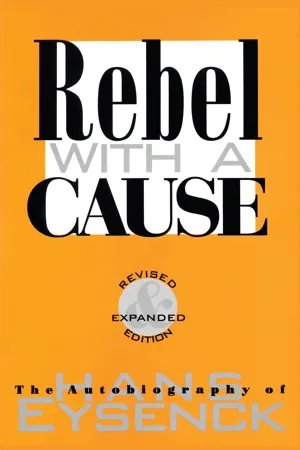
Rebel with a Cause
About this book
Hans Eysenck is one of the world's leading psychologists and undoubtedly the most controversial. Throughout a long and illustrious career his work on personality and intelligence has aroused impassioned debate and attacks, both verbal and physical, on Eysenck himself. In his compelling and absorbing autobiography, Eysenck recounts in some detail the battles he had to fight in order to establish his major conclusions, as well as the reasons why he investigated these subjects. He also discusses his work on such topics as the health hazards of smoking, the prophylactic effects of behavior therapy on cancer and coronary heart disease, parapsychology, astrology, and other matters. In a new foreword, written for this edition, Eysenck expresses his pleasure regarding the fact that his autobiography is now being published in the United States. He discusses how much of his scientific life has been bound up with American psychology. Also new to this American edition is a chapter titled "Genius, Creativity, and Vitamins," in which Eysenck talks about the research he has worked on since his retirement in 1983. Rebel with a Cause is an intriguing autobiography and will be of paramount interest to psychologists, sociologists, and genetic scientists.
Information
CHAPTER 1
I was Born in Interesting Times
Youth, what man’s age is like to be doth show.
We may our ends by our beginnings know.
Sir John Denham
The Chinese are reputed to have a saying: ‘Let me be born in uninteresting times.’ I was not that lucky. I was born on 4 March 1916, in Berlin, in the middle of the First World War, lived through defeat in that war, inflation, unemployment, the Hitler regime, exile, the Second World War, and a variety of other events which no one could call ‘uninteresting’. I was certainly lucky to survive all this; most of my class-mates at school died, or were severely injured, in Hitler’s War.
I almost didn’t make it. In his speech at the Drill Hall in Cambridge, on 9 December 1918, Sir Eric Geddes vowed: ‘We will get everything out of her [Germany] that you can squeeze out of a lemon and a little bit more … I will squeeze her until you can hear the pips squeak.’ I was one of the pips mentioned in this most Christian diatribe. In the armistice that followed the war, when the Allies continued to blockade Germany, I almost died of starvation. Having been blessed with a sound constitution, and a strong body, I managed to survive, but it was touch and go.
For reasons that will become obvious, I did not know my parents very well, but before they died they let me have official documents and brief written histories of their lives. I shall supplement them, where necessary, by my own experiences and memories.
My mother was born towards the end of the nineteenth century in Konigshütte, a small town in Silesia; this is now Polish territory, and has been renamed Chorzew. Silesia had been made part of Prussia by Frederick the Great in the Seven Years War, and like the rest of Prussia was fervently Protestant in its religion. Ruth Werner, my mother, although not very religious, was brought up in that faith. Her father was a doctor who was called to work in a hospital in Berlin when she was still a little girl; he died of tuberculosis in his early thirties.
My mother was determined to study law, and I am sure she would have done exceptionally well as a lawyer because of her high intelligence, and her tremendous efficiency in all things practical. However, at that time it was almost impossible for women to study law, and the early death of her father left the family with very little income. She had always been exceptionally good-looking, and when she was fifteen years old a photographer took some excellent pictures of her which he thought might help her to get into films. My grandmother decided that she should obtain some serious training, and she went to the Rheinhardtschule, at the time probably the best training institution for actors and actresses in the country. My mother’s first engagement was in Göttingen, where she fell in love with my father, also an actor, and married him. I was born a short time afterwards.
The marriage was not destined to last long. Working in different towns, my parents were hardly ever together, and after my birth my mother spent two years in Berlin looking after me while my father toured Germany, finally taking part in the war effort, leaving her destitute. My mother had no choice but to go back to the stage, and she, my grandmother and myself travelled all over Germany, going from one theatre to another. Finally my mother was offered roles in films, becoming a starlet and then a proper star with ‘Bavaria’ in Munich, and then with Terra Films’ in Berlin in the twenties. My grandmother and I lived for five years in an old castle in Lichterfelde, a suburb of Berlin; it had a wonderful old park, and my first memories are of playing there, and living the life of Riley. In the holidays mother, grandmother and I would travel to the Baltic in the summer and to the Harz Mountains in the winter. It was at this time, too, that I became an actor – Germany’s answer to Shirley Temple! I played my mother’s son in a film in which she was divorcing her husband, and I brought them together again, although how I managed this I don’t know – I was not allowed to see the film, which was for adults only. I do remember trundling my hoop through the Tiergarten, with the cameras turning and bypassers staring. My father was later on to press for me to enter the acting profession, but my mother firmly opposed it. But I never had any desire to act so the point did not really arise.
As my mother became more successful she assumed the name of Helga Molander for her screen roles and made some forty films. Most of these were of course silent, but I saw her in one or two speaking parts at the end of her career.
When the time came for me to enter school, my grandmother and I moved to a flat in West Berlin, not far from the Kurfürstendamm, in the Kaiserallee (now the Bundesallee). My mother says that I was ‘Ein ausgezeichneter Schüler’, i.e., an outstanding pupil, but I have no memory of this. She also says, ‘Er war ein bildhübsches Kind gewesen, mit langen blonden Locken.’ Whether I really was a beautiful child, with long blond locks, I cannot say; she also says that I was good-looking even in later years. She adds, rather unkindly: ‘He seemed to know that, too. Uncalled-for modesty was never a fault of his.’
What can I say about my mother? She was exceptionally beautiful, highly intelligent, and fascinating to every male who came near her. I don’t think she was a natural actress, but her combination of beauty and intelligence made up for what nature had failed to give her in talent. She certainly became well enough known to be called a star, although not an international one – at that time no German actor or actress managed to become known outside the confines of the homeland.
I don’t think nature intended her to be a mother. I saw very little of her, except occasionally on holidays, and she never managed to treat me as a child, or show much interest in what I was doing. Conversation with her was always on strictly adult lines. She would talk to me about the theatre, plays, literature and poetry, and cultural topics of that kind; in self-defence I started reading through all the assorted German classics she kept in her library in our flat, and being a fast reader with a retentive memory, I was soon at home in this cultured atmosphere, and could hold my own in conversations. Indeed, I became genuinely interested in German literature, so perhaps her method of upbringing was not entirely mistaken.
My mother thought it important to be socially competent, and encouraged me to take up tennis, dancing and bridge. She herself taught me tennis, being quite good at it herself, and bridge; and for a while I earned some pocket-money going to the Kaufhaus des Westens, a large department store, which had set aside part of its coffee room for customers who wanted to play bridge. These, in the main, were old ladies who followed the then predominant bidding system of Culbertson, which is very precise in telling you exactly what to bid for each hand. I went along with a good friend and tennis partner, and we devised a system of anti-Culbertson, making our bids in such a way as to confuse the opposition completely. This paid off, and we nearly always won, which, in monetary terms, was quite important considering the paltry pocket-money I received!
For dancing lessons I went to the renowned Salon run by a former world championship pair of dancers, and while I enjoyed it and was quite good at it, I could never get rid of the idea that dancing was somewhat effeminate. I recognized this notion as absurd even then, but could not get it out of my mind. I fell in love with a beautiful assistant who danced with us, but when I found out that she supplemented her income by standing around the Kurfürstendamm at night trying to attract customers, I was deeply shocked and depressed – no prig like a young prig! (I was told later that her father had run away with a younger woman and her mother was dying of cancer; she was the only source of income for the family. I was beginning to learn not to judge other people and their actions in terms of a cosseted middle-class youngster born, if not with a golden, at least with a silver spoon in his mouth.)
My mother did one other good deed when she enrolled me in a kind of sports academy run by Hans Dietrich, a well-proportioned and sportingly outstanding man, who promised to take pounds of fat off his customers and turn it all into muscle. I went there twice a week, at the age of twelve or thirteen, to tone up my system and benefited a great deal in health and stamina. Dietrich was particularly keen on work with medicine balls, those large, very heavy leather balls with which many athletes work out. We were always working in twos; in one exercise one of the partners would lie prone on his back, the other holding his ankles. The one on his back would have his arms outstretched behind his head, holding the medicine ball; he would then convulsively engage the muscles of his stomach to raise himself up and throw the medicine ball as hard as he could at his partner who would release his ankles and catch the ball. This is hell on one’s stomach muscles, and I remember slinking home on many an evening hardly able to walk. However, the next time somebody hits you in the stomach you are much better able to ride the blow!
Another favourite exercise was having two people standing a few feet away on either side of a line drawn on the floor with chalk. One would throw the ball as hard as he could, and the other would have to catch it and throw it back. Gradually the stronger would drive the other one away from the line, and against the wall; by the time he touched the wall, he had lost. There is a great deal more to throwing a medicine ball very hard than having strong muscles; just as a blow in boxing starts from the soles of the feet, and is really produced like a screwlike turning motion of the whole body, so is throwing of the medicine ball powered by the whole body. I eventually became quite good at this, and finally competed with Dietrich himself in demonstrations of how this should be done, although I must admit I never beat him. I mention these rather unimportant points because later in life I was quite unexpectedly to be involved again in a much more serious duel involving medicine balls – but of that more anon.
When my mother became a star for the Terra Film Company she soon became attracted by the best-known producer and director there, Dr Max Glass. They fell in love and lived together while his Catholic first wife refused him a divorce. When she died they married and lived happily together until his death some fifteen years before hers (she died at the age of ninety-four). While my grandmother and I lived in the flat in the Kaiserallee, Dr Glass and my mother lived in a large and opulent flat in the Uhlandstrasse also quite close to the Kurfürstendamm. He was a fascinating man, ugly but brilliant. He was short, fat and bald, but extremely vital. In his presence it was difficult to get a word in edgeways; he was constantly talking, but his conversation was so interesting, full of wit, humour, and novel ideas, that one could only listen in fascination. He was a typical middle-European Jew, or at least he was the way one imagines such a person to be. Bom in Hungary, he had been a Professor of Aesthetics at the Sorbonne in Paris, had become rich as a director and then producer of films, had acquired a large estate near Linz, in Austria (on the banks of the Danube), had written novels, plays and books on politics, and seemed to know everybody who was anybody in the cultural life of Berlin. He could almost have served as a prototype of the extra vert, and I liked him very much indeed.
Fortunately he returned that liking, for having been disappointed in his own two sons, he found in my somewhat introverted personality something that appealed to him, and we always got along famously. This of course made my mother happy. The fact that he was Jewish did not matter to me in the slightest, but when Hitler came to power it was necessary, inevitably, for him, and my mother, to emigrate to Paris.
But this is to anticipate events. I have said enough about my mother; how about my father? I have learned far more about the ancestry of Anton Eduard Eysenck, born on 28 March 1889 in Bergisch-Gladebach, and his ancestors, including his great-grandparents, than either I or the reader would ever wish to know. The reason of course is that when Hitler came to power my father, like most other Germans, had to prove his ‘Aryan’ ancestry, and accordingly he had this traced by some expert genealogist.
My father told me that in the course of the inquiries concerning his ancestry, it had been discovered that the family originated on the younger branch of a feudal baron who lived in a castle on the Rhine, hence Eisen-eck, or iron corner; the ending -eck also denotes a castle. The family then migrated down the Rhine, to Holland and Belgium, where the ‘i’ was turned into a ‘y’.
My father also used to misquote the famous German revolutionary song:
Der Gott der Eisen wachsen liess,
Der wollte keine Knechte!
(God, who let iron sprout from the soil,
Never wanted slaves to be!)
Only he changed ‘Eisen’ to ‘Eysenck’, to let the song say, in effect, that God who let Eysenck grow wanted no slaves. In view of the fact that he later on joined the Nazi Party, I took the assertion with a good deal of salt!
My father’s family was Catholic. They all lived in the Rhineland, and had solidly bourgeois occupations. One of my grandfathers was the owner of a restaurant, another a Customs Officer, and most of my other relatives were in business. Where my mother was the only child, my father was the youngest of three, having one brother (Ernst) and one sister (Elly). Like my mother, my father did not take religion very seriously, and I inherited this attitude. I could do nothing about having been christened in the Protestant faith, but when it came to being confirmed I had to be bribed by the gift of a bicycle to take part in the ceremony.
At my christening, I was given the name ‘Hans Jürgen’. Does one’s given name have any significance? In Plato’s Cratylus Socrates argues that a man’s name determines his nature – a rather odd notion that was later to inspire Sterne’s Tristram Shandy. Hans Jürgen had the connotation of a simple, honest, none-too-bright youngster, reliable and trustworthy. Except for the bit about being none-too-bright, that was roughly how I saw myself – a large good-natured dog, always ready to be friendly, but possibly dangerous when kicked in the teeth. I was to receive many such kicks in the course of my life – but then I suppose most people do. Rebels are particularly exposed to such extremities, of course, and a rebel I was to become, more through force of circumstances than predilection.
I never had the slightest interest in religion, other than as a social and literary phenomenon. My grandmother, who brought me up, embraced the Catholic faith, and I know that it meant a great deal to her; it was to help her very much when, during the war, she was dragged off as a cripple to one of Hitler’s Concentration Camps, where she died.
My disenchantment with the Christian religion began early on, when I found it impossible to reconcile the existence of evil with the omnipotence and essential goodness of God. St Augustine might get over this difficulty by saying: ‘Credo quia impossibile!’ but I could see no sense in believing it because it was impossible. The Saint endeared himself to me when he said: ‘Da mihi castitatem et continentiam, sed noli modo’, asking God to give him chastity and continency, but not quite yet. That seems a more reasonable and rational utterance than the one about belief.
The teacher who took us in religion tried to convince me that there was a common belief system underlying all the great religions, so I read the Koran, the Talmud, and some of the Buddhist and Hindi religious writings. I could see very little similarity between the Christian heaven, full of harp-playing angels, and the Mohammedan one, full of delicious Houris, out to fulfil the sexual needs of warriors fallen in the Jehad. Similarly, the proselytizing fervour of Catholics and Moslems alike contrasted strangely with its absence among Jews, and the Nirvana concept of the Buddhists seemed to me to be quite different from the ideals favoured by the other religions. My teacher was quite cross when I presented these arguments to him; typically he had not read any religious writings outside the Christian tradition!
My father began his working life in the German Navy, but then became an actor; he used to play the juvenile lead, being tall and very good-looking. (Several years later he was chosen as ‘The best looking man on the Baltic’ in a competition, though perhaps not a very serious one. He was inordinately proud of this title.) He was a great womanizer, and carried on with this habit through two marriages, right into old age. (His second wife stayed with him to the end.) He also appeared in operetta, playing Ruritanian princes in beautiful uniforms, although his singing left much to be desired. Indeed, my mother too played in operetta; I recall seeing a picture of her as one of the three young maids from school in The Mikado. Her voice, too, was tolerable but nothing to be remembered. Mine, unfortunately, was unbelievably bad, something I always regretted but could do nothing about.
As he became older, my father switched over to being a Conferencier, a kind of profession that does not really exist in England or the United States. A Conferencier is the anchor man in the large cabarets that used to be so popular in all the bigger towns in Germany. He introduces the acts, holds the show together, and has his own act, in which he tells jokes and stories, comments on politics and cultural affairs, and generally endeavours to be witty, clever and amusing. Nearly all the successful Conferenciers in Germany, at the time of the Weimar Republic, were Jewish. My father attributed this to the fact that most of the owners of cabarets were Jewish too, and favoured their own; he did not consider the alternative hypothesis that Jews are cleverer and wittier than non-Jews, an alternative for which there is much to be said. Perhaps both hypotheses are true, and may serve to complement each other.
In spite of the competition, my father was very successful, travelling from one month’s engagement to another in his little Freia, the first car he ever owned, and later on in a larger but still pretty primitive Chevrolet. Finally he graduated to a Horch, an opulent and gigantic car which carried him around Germany in great style. As befits a Conferencier, he was a wonderful raconteur; he could tell stories, describe a play or a film, or the contents of a book so vividly that when you came across the real thing you were disappointed – his stories were so much better!
When Hitler came to power all the Jewish Conferenciers, who had been a thorn in the side of the Nazis because of their political comments, were dismissed, while my father, who had been pretty non-political in his talks, became even more firmly established. Goering apparently liked his act, and often invited my father to join his table. My own hatred of the Nazis had led me by this time to leave Germany, and my father’s hobnobbing with these people did nothing to increase my love for him.
Typical perhaps of my father’s method of upbringing is the occasion when he bought me a bicycle, and promised to teach me how to ride it. He took me to the top of a hill, told me that I had to sit on the saddle and pump the pedals and make the wheels go round. He then went off to release some balloons and shoot them down with the rifle he still had from the war, leaving me to learn how to ride all by myself. I got on it, started to pedal, and promptly fell off. But after an hour, and many similar discomfitures, I managed to wobble along. A good training in independence, but not perhaps the behaviour of a loving father.
Like my mother, he too did not know how to communicate with children, and when he talked to me it was about politics, which he was interested in, but did not take part in. As in the case of my mother, I had to fortify myself for these discussions, and I took to reading magazines such as the Weltbühne in its famous red cover and the Tagebuch in its equally famous green. These were similar to the New Statesman in its heyday under Kingsley Martin in England, or the New Masses in the United States; half political, half literary ...
Table of contents
- Cover Page
- Title Page
- Copyright Page
- Contents
- Foreword
- Introduction
- 1 I was Born in Interesting Times
- 2 Student Life in Exile
- 3 Becoming a Professional
- 4 The Battle for Behaviour Therapy
- 5 The Battle of the Cigarettes
- 6 Intelligence and Personality: the fight for a new paradigm
- 7 The Battle for the Stars
- 8 Genius, Creativity, and Vitamins
- 9 Does Age Bring Wisdom?
- Glossary of Technical Terms
- Titles in the International Series of Monographs in Experimental Psychology
- Author’s Bibliography
- Additional Biographical and Autobiographical Sources
- Index
Trusted by 375,005 students
Access to over 1.5 million titles for a fair monthly price.
Study more efficiently using our study tools.
Frequently asked questions
Yes, you can cancel anytime from the Subscription tab in your account settings on the Perlego website. Your subscription will stay active until the end of your current billing period. Learn how to cancel your subscription
No, books cannot be downloaded as external files, such as PDFs, for use outside of Perlego. However, you can download books within the Perlego app for offline reading on mobile or tablet. Learn how to download books offline
Perlego offers two plans: Essential and Complete
- Essential is ideal for learners and professionals who enjoy exploring a wide range of subjects. Access the Essential Library with 800,000+ trusted titles and best-sellers across business, personal growth, and the humanities. Includes unlimited reading time and Standard Read Aloud voice.
- Complete: Perfect for advanced learners and researchers needing full, unrestricted access. Unlock 1.5M+ books across hundreds of subjects, including academic and specialized titles. The Complete Plan also includes advanced features like Premium Read Aloud and Research Assistant.
We are an online textbook subscription service, where you can get access to an entire online library for less than the price of a single book per month. With over 1.5 million books across 990+ topics, we’ve got you covered! Learn about our mission
Look out for the read-aloud symbol on your next book to see if you can listen to it. The read-aloud tool reads text aloud for you, highlighting the text as it is being read. You can pause it, speed it up and slow it down. Learn more about Read Aloud
Yes! You can use the Perlego app on both iOS and Android devices to read anytime, anywhere — even offline. Perfect for commutes or when you’re on the go.
Please note we cannot support devices running on iOS 13 and Android 7 or earlier. Learn more about using the app
Please note we cannot support devices running on iOS 13 and Android 7 or earlier. Learn more about using the app
Yes, you can access Rebel with a Cause by Hans J. Eysenck,Hans Eysenck in PDF and/or ePUB format, as well as other popular books in Social Sciences & Social Science Biographies. We have over 1.5 million books available in our catalogue for you to explore.