- 446 pages
- English
- ePUB (mobile friendly)
- Available on iOS & Android
eBook - ePub
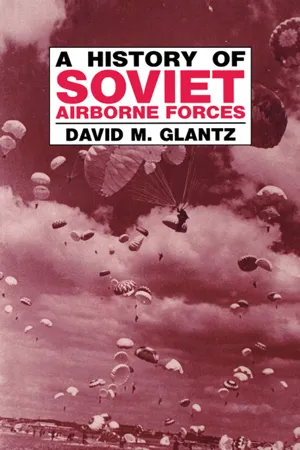
A History of Soviet Airborne Forces
About this book
For almost 70 years Soviet and Russian military theorists have been fascinated with the concept of airborne operations. Now Russian theorists tackle the problems posed to such operations by high-precision weaponry. This work, using newly released and formerly classified Soviet and East German archives, provides a detailed record of the performance of Soviet airborne forces during peace and war.
Information
CHAPTER 1
The Interwar Years (1919–1941)
THE GENESIS OF AIRBORNE CONCEPTS
The concept of committing forces into combat from the air or, as it came to be known, vertical envelopment, originated during the early post-World War years, which was a period characterized by intense intellectual ferment in Soviet as well as Western military affairs. In the early 1930s, rampant industrialization and the adoption of modern technology intensified to produce a renaissance in military thought within the Soviet Union. A generation of military leaders and thinkers, conditioned by a revolutionary philosophy and participation in the Russian Civil War and Allied intervention and eager to elevate the Soviet Union into a competitive military position with the rest of Europe, gave shape and focus to that renaissance. They were imaginative men, infused with ideological zeal, encouraged by their political leaders to experiment, and willing to learn from the experiences of military leaders abroad. Their efforts produced a sophisticated military doctrine, advanced for its time, and an elaborate, if not unique, military force structure to implement that doctrine.
It is one of the major ironies of history that the work of these men – the Tukhachevskys, the Triandafilovs, the Issersons, and a host of others – would be eclipsed and almost forgotten. Their efforts for the Soviet Union earned for them only sudden death in the brutal purges of the late 1930s. The formidable armed force they had built and the sophisticated thought that had governed use of that force decayed. The brain of the army dulled, and imagination and initiative failed. The military embarrassments of 1939–40 and the debacle of 1941 blinded the world to the true accomplishments of Soviet military science in the 1930s, and an appreciation of those accomplishments never really returned. The military leaders of 1943–45 resurrected the concepts of their illustrious predecessors and competently employed them to achieve victory over Europe’s most vaunted military machine. Yet the memories of the Soviets’ poor performance in 1941 never faded and have since colored Western attitudes toward Soviet military art. Thus, it is appropriate to recall the realities of Soviet military development unblemished by the images of 1941. One of those realities was Soviet experimentation with airborne forces in the 1930s.
Soviet receptivity to the idea of air assault was but a part of greater Soviet interest in experimentation with new military ideas to restore offensive dominance to the battlefield. The World War had seen the offensive fall victim to static defensive war. In positional warfare, the firepower of modern weaponry stymied the offense and exacted an excruciating toll in human lives. Those wedded to the idea of the dominance of the infantry – the ultimate elevation of men to preeminence on the battlefield – saw the infantry slaughtered in the ultimate humiliation of man’s power to influence battle. Infantry, the collective personification of man, dug antlike into the ground, overpowered by impersonal firepower and the crushing weight of explosives and steel.
New weapons – the tank, the airplane – emerged during wartime, but most military theorists saw these weapons as demeaning to the infantry and as an adjunct to the existing technological dominance of fire. Yet there were those who experienced war in a different context. For three years after 1918 in the vast expanse of Russia, regiments, brigades, divisions, and armies engaged in a seesaw civil war – a chaotic confrontation over vast territories, a war in which the zeal of man and his ability to act counted more than human numbers on the battlefield. Shorn of advanced weaponry, separate armies joined a struggle in which imaginative maneuver paid dividends, in which rudimentary operational and tactical techniques could once again be tested without prohibitive loss of life. It was a different sort of struggle, one that conditioned many of its participants to be receptive to new concepts of warfare. The credibility of the offense emerged supreme, and to that new faith in the offense was added the imperative of an ideology that inherently embraced the offensive.
The Red Army (Raboche-Krest’ianskaia Krasnaia Armiia [Workers and Peasants Red Army – RKKA]) as it emerged from the civil war was crude by Western standards. Large, ill-equipped, and relatively unschooled in military art, the Red Army was simultaneously the shield of the Soviet state and the sword of revolutionary socialism. Although Soviet ardor for international revolution waned in the face of harsh economic and political realities, and the army shrank in the immediate postwar years as it provided manpower for factories and fields, the revolutionary foundation of the army remained. The writings of Mikhail Frunze enunciated the uniqueness of the Red Army. The attitudes and actions of the leading commanders and theorists better characterized the reality of the army. Theoretical debates within the army over the nature of war and the role of man and modern weaponry began in the 1920s. At first, these debates expressed mere hopes, kept so by the reality of Soviet industrial and technological backwardness. But as that industrial development began to accelerate, goaded by Stalin’s ruthless ‘Socialism in One Country,’ and as technological proficiency rose, either generated from within or imported from abroad, abstract hopes turned into concrete policies and programs. These new doctrines sought to combine the offensive potential of new weapons with the ideological zeal and faith in the offensive which was born of revolution and civil war experience. Thus, while the victors of the World War sought to make new weapons the slave of the defense and guarantor of the status quo, those defeated – Germany and the U.S.S.R. – turned to the new weaponry as a means of overturning the status quo. In this sense, it is not surprising that German and Soviet military thought evolved in so similar a manner during the interwar years.
The shape of future Soviet military thought began to take form in the late 1920s. Frunze’s postulation of a proletarian military doctrine reflecting the classless nature of the Socialist state gave focus to that thought. Soviet officers began to ponder the implications of Frunze’s ‘Unified Military Doctrine,’ a doctrine that dictated dedication to maneuver, activnost [activity], and the offensive in the real world of battle. These new principles rejected the concepts of defensive, static, positional warfare so dominant in Western European and American military thought.1
Although Frunze died in 1925, other thinkers expanded his theories, deriving first an intellectual basis in doctrine and then specific methods and techniques to translate that doctrine into practice. The Field Regulation [USTAV – Ustavlenie (regulation), Russians routinely refer to regulations as USTAVs] of 1929 reflected this mixture of theory and experiment. It established the objective of conducting deep battle [glubokyi boi] to secure victory at the tactical depth of the enemy defense by using combined arms forces, specifically infantry, armor, artillery, and aviation, acting in concert.2 Deep battle, however, remained an abstract objective that could be realized only when technology and industry had provided the modern armaments necessary for its execution. The 1929 regulation was a declaration of intent, an intent that would begin to be realized in the early 1930s as the first Five Year Plan ground out the heavy implements of war.
Among those implements of war were tanks and aircraft, each symbolizing an aspect of potential deep battle. The tank offered prospects for decisive penetration, envelopment, and the exploitation of offensive tactical success to effect greater operational success, the latter dimension conspicuously absent in the positional warfare of the World War. Aircraft also added a new dimension to the battlefield. Besides the potentially devastating effects of aerial firepower, aircraft offered prospects for vertical envelopment, a third dimension of offensive maneuver. Vertical envelopment, of potential value even in isolation, would supplement the offensive action of mechanized forces and further guarantee the success of deep battle. Thus, the emerging doctrinal fixation on deep battle gave impetus to experimentation with airborne forces, experimentation that began in earnest in the late 1920s.
EXPERIMENTATION WITH AIRBORNE FORCES, 1929–1932
The first recorded Soviet use of air-landed forces occurred in 1929, when the Red Army landed a small detachment to relieve a small force besieged by a larger Basmach band in the Tadzhik town of Garm. The landing was made by 15 men transported by three trimotor aircraft, and the operation led to the defeat of the Basmach force and relief of the encircled garrison.3
Subsequent experimentation with airborne forces went hand in glove with doctrinal research. Although many theorists examined the uses of airborne forces, in particular the problems and their potential missions, M. N. Tukhachevsky played the leading role. In 1928, as commander of the Leningrad Military District, he conducted trial exercises and prepared a study on the ‘Operations of an Air Assault Force in an Offensive Operation.’ The following year Tukhachevsky conducted an exercise employing a reinforced rifle company as an air-landed assault force. As a result of his critiques of exercises conducted in 1929 and 1930, he proposed to the Revoensovet [Revolutionary Military Soviet – RVS] a sample air-motorized division TOE (table of organization and equipment) for use as an operational-strategic air-landing force.4
Supplementing Tukhachevsky’s work, A. N. Lapchinsky, chief of staff of the Red Army’s air force [VVS (voenno-vozdushnyi sil’)], and N. P. Ivanov wrote an article in the journal War and Revolution [Voina i revoliutsiia], for the first time discussing combat use of air assault forces. Reflecting on experiences of the World War when aircraft had landed individuals in the enemy rear, Lapchinsky trumpeted the feasibility of harnessing aircraft to the task of large-scale delivery of combat forces into the enemy rear. Modern passenger aircraft, he argued, ‘Now permitted expectations of stronger desants in the enemy’s dispositions.’5 Citing further air assault experiences in battle with the Basmachy, he and Ivanov investigated such finite airborne problems as timing and location of landings, joint operations with both aircraft and land forces, calculation of requisite force size relative to mission, and landing times for air assault forces from battalion to regimental size.
Lapchinsky calculated that a detachment of 15 aircraft could land 450 combat soldiers in a single trip, along with requisite ammunition, supplies, and equipment. It followed that two trips by three such detachments could land 2,700 men. Specially prepared aircraft could transport one to two artillery pieces with ammunition with the only limitation being the need to develop means to tow the artillery once landed. He recognized the necessity of selecting and preparing a landing area of up to one square kilometer to accommodate the aircraft. Further calculations indicated that it would take up to three hours to land 3,000 men, although use of multiple landing strips could reduce the time.
To provide security for the landing, forces had to conduct careful reconnaissance and provide adequate protection in the form of fighter aircraft to deal with air threats and support assault troops against any enemy troops in the landing region.
Lapchinsky assessed that a regimental air landing so organized could have tactical significance and would have to operate in conjunction with frontal ground forces. He detailed three appropriate missions for an airborne force:
1. desant to create an unexpected threat to an enemy’s open flank;
2. desant at the time of and in the region of the main attack of our offensive to penetrate the enemy front and, in some instances, a desant to force a river crossing;
3. desant during an enemy withdrawal to occupy restricted access areas which the enemy could not mine (defiles between lakes or swamps and crossings of rivers).6
Such assaults would be parallel to the enemy route of withdrawal or directly across his routes of egress. In all cases, the air-landing missions would be an integral part of the overall operational plan. The first echelon of air-landing forces had the principal mission of reconnaissance, selection of landing sites for heavier equipment, and establishment of initial communications. In all instances, timing of the assault and its coordination with ground forces was most critical and difficult to effect.
These theoretical discussions paralleled practical exercises in both countryside and classroom. Simultaneously, other agencies worked on developing all types of airborne equipment as evidenced by the first Soviet domestic production of parachutes in April 1930. Active experimentation grew in scope when, on 2 August 1930, a major test occurred near Voronezh in the Moscow Military District.7 To test landing techniques rather than tactics, three R-1 aircraft dropped two detachments of 12 parachutists, each armed with machine guns and rifles; their mission was to perform a diversionary mission in the enemy rear. The detachment commanders, L. G. Minov and Ia. D. Moshkovsky, would play a leading role in future airborne experimentation. The Voronezh test drop, from heights of 500 and 300 meters, focused on solution of such technical problems as preventing dispersal of dropped personnel, determining visibility on the part of airborne troops, and calculating the time necessary for those troops to reform and become combat capable. The exercise was repeated at the same location in September 1930 when ANT-9 aircraft dropped an 11-man detachment under Moshkovsky...
Table of contents
- Cover
- Half Title
- Title Page
- Copyright Page
- Table of Contents
- List of Figures
- Abbreviations
- Preface
- 1. The Interwar Years (1919–1941)
- 2. Airborne Forces During the Second World War: Initial Operations, Subsequent Reorganization, and Changes in Employment Concepts
- 3. The Moscow Operation (December 1941–January 1942)
- 4. The Viaz’ma Operation, Phase 1: 8th Airborne Brigade Operations (January–February 1942)
- 5. The Viaz’ma Operation, Phase 2: 4th Airborne Corps’ Operations (February–March 1942)
- 6. The Viaz’ma Operation, Phase 3: 4th Airborne Corps’ Operations (April–June 1942)
- 7. Rzhev and Demiansk: 1st Airborne Corps Operations (February–April 1942)
- 8. Across the Dnepr (September 1943)
- 9. To War’s End
- 10. Reconnaissance and Diversionary Operations
- 11. The First Postwar Years (1946–1953)
- 12. The Revolution in Military Affairs (1953–1970)
- 13. On the Threshold of a New Technological Revolution (1971–1985)
- 14. On the Eve of the Twenty-First Century
- 15. Conclusions
- APPENDIX 1 Logistical Support of the Viaz’ma Operation
- APPENDIX 2 Known Fate of Commanders and Staff Officers, 4th Airborne Corps
- Index
Trusted by 375,005 students
Access to over 1.5 million titles for a fair monthly price.
Study more efficiently using our study tools.
Frequently asked questions
Yes, you can cancel anytime from the Subscription tab in your account settings on the Perlego website. Your subscription will stay active until the end of your current billing period. Learn how to cancel your subscription
No, books cannot be downloaded as external files, such as PDFs, for use outside of Perlego. However, you can download books within the Perlego app for offline reading on mobile or tablet. Learn how to download books offline
Perlego offers two plans: Essential and Complete
- Essential is ideal for learners and professionals who enjoy exploring a wide range of subjects. Access the Essential Library with 800,000+ trusted titles and best-sellers across business, personal growth, and the humanities. Includes unlimited reading time and Standard Read Aloud voice.
- Complete: Perfect for advanced learners and researchers needing full, unrestricted access. Unlock 1.5M+ books across hundreds of subjects, including academic and specialized titles. The Complete Plan also includes advanced features like Premium Read Aloud and Research Assistant.
We are an online textbook subscription service, where you can get access to an entire online library for less than the price of a single book per month. With over 1.5 million books across 990+ topics, we’ve got you covered! Learn about our mission
Look out for the read-aloud symbol on your next book to see if you can listen to it. The read-aloud tool reads text aloud for you, highlighting the text as it is being read. You can pause it, speed it up and slow it down. Learn more about Read Aloud
Yes! You can use the Perlego app on both iOS and Android devices to read anytime, anywhere — even offline. Perfect for commutes or when you’re on the go.
Please note we cannot support devices running on iOS 13 and Android 7 or earlier. Learn more about using the app
Please note we cannot support devices running on iOS 13 and Android 7 or earlier. Learn more about using the app
Yes, you can access A History of Soviet Airborne Forces by David M. Glantz in PDF and/or ePUB format, as well as other popular books in Politics & International Relations & Military & Maritime History. We have over 1.5 million books available in our catalogue for you to explore.