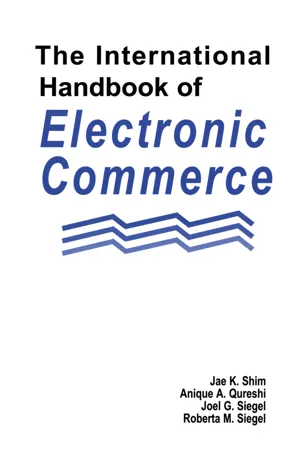
The International Handbook of Electronic Commerce covers that hot topic - e-commerce! It is designed to assist managers in implementing electronic commerce in their organizations, improving its efficiency and viability, and safeguarding and maintaining e-commerce systems. The book is designed as a practical how to guide, offering extensive examples to illustrate practical applications. The tools and techniques in this handbook can be adapted outright or modified to suit individual needs. Checklists, email and website addresses, exhibits, illustrations, and step-by-step instructions enhance the handbook's practical use.
Among the topics discussed are: what electronic commerce is all about; the Internet and access provider industry; Intranets and Extranets; marketing and advertising; electronic data interchange; electronic banking and payment systems; network security; legal, taxation, and accounting issues of e-commerce.
The combination of growth in the commercial utilization of the Internet, the rapid changes in technology, and the complexity of management have expanded the scope of duties of business managers. To remain competitive, businesses and their managers must maintain a presence on the Internet. The InternationalHandbook of Electronic Commerce provides readers with a compendium of the latest in current technologies and applications.
eBook - ePub
The International Handbook of Electronic Commerce
- 320 pages
- English
- ePUB (mobile friendly)
- Available on iOS & Android
eBook - ePub
The International Handbook of Electronic Commerce
About this book
Chapter 1
What E-Commerce is All About
This chapter introduces the benefits and drawbacks of e-commerce in terms of costs, implementation, competition, public policy and governmental issues, legal concerns, management strategies, organizational aspects, business processes, networking, the Internet, Intranets and Extranets, marketing, advertising, business and commercial use, customer support, electronic payments and fund transfers, and future developments.
Preliminary Considerations
Advantages
The short-term and long-term advantages of e-commerce include:
- Lower transaction costs
- Less paperwork for transactions like ordering, billing, and customer service
- More customer feedback
- More opportunities for satisfying customer needs
- Improved monitoring of consumer satisfaction.
- Ease of business with the existing customer base.
- New markets composed of new customers
- Ability to customize business activities and solutions for large customers.
- Enhancement of the company’s image
- Simplified communication
- Creation of business value using gathering, organizing, selecting, synthesizing, and distribution—any point in the value chain—to adapt sales, marketing, outbound and inbound logistics, and manufacturing processes to give better value.
Although online business transactions have much potential, there are some drawbacks, including inadequate online payment instruments, poor security, and insufficient directories. A further disadvantage is that it’s not easy to foster trust between businesses and consumers because there is no personal contact in accessing a Web site.
Public Policy and Legal Issues
Among the public policy issues arising in e-commerce applications are pricing for services, privacy, and access. For instance:
- What should be the proper cost to access information?
- How should global data traffic be monitored to protect information privacy?
- What government regulations are needed to prevent online fraud and violations of privacy? Some governmental restrictions associated with e-commerce relate to export of encryption hardware and software. However, it probably would not be advisable for the government or even a trusted independent party to have a master encryption key.
Among the legal issues related to e-commerce are company privacy, customer confidentiality, export controls on cryptographic products, and taxation.
Cost Control
E-commerce reduces operating costs by improving coordination and communication in manufacturing, sales, and distribution. Further cost reductions that enhance competitive position may also ensue from better operating efficiencies and downsizing.
Used as a communications medium the Internet may lower costs; for instance, issuing purchase orders in electronic form can eliminate rekeying of certain information.
Digital products like software can actually be delivered over the Internet, eliminating the need for packaging and printed documentation. Product upgrades may be automatically transmitted to the customer. Online electronic catalogs save time and eliminate the costs of printing and mailing.
Before undertaking any e-commerce, do a cost-benefit analysis. Ask yourself how long a payback period you’ll need to recoup your initial investment—although this may be difficult to determine for some time after you begin e-commerce. The long term is more important than the short term. Some benefits to be sought include more accurate information, more efficiency, and better customer service.
Competition
You can improve your competitive position with e-commerce by offering more options and features, adapting to variability in customer demand, providing more and better products and services, shortening the product life cycle, and eliminating geographic boundaries.
Starting Up and Making Changes
A pilot study can identify potential problems beforehand. Once implementation is complete, almost all the problems will be identified.
E-commerce may require your company to make such changes as product innovations, total quality management (TQM), reengineering, and time compression. To achieve both internal objectives and customer satisfaction, TQM demands flexibility in responding to customer needs as well as quality improvement. Reengineering may require redesigning the company’s organizational structure and processes to improve quality and reduce time and cost. Time should be reduced at every point from design to delivery and beyond to servicing. Flexibility in manufacturing can allow for mass customization to satisfy unique customer needs.
Management Strategies
The impact of e-commerce on areas like pricing, type of product or service offered, consumer interfaces, distribution, and sales will affect management tactics. E-commerce can benefit your company’s bottom line through growth in the customer base, greater efficiencies, and information-based products leading to changes in management processes or strategies, both short term and long term, and even organizational structure. You must determine how much to spend on e-commerce technology and what products or services, new or old, should be offered. You must analyze how to reach and service the most desirable customers. Keep in mind in making these decisions your company’s unique situation as well as the overall business environment.
Clearly, then, as manager you must keep up with what trends are emerging in technology, changing customer tastes, and new competition. This is how you identify and deal with your outside threats.
You thus must specify the objectives your company wants to achieve through e-commerce. To do this you must:
- Formulate a strategy for e-commerce, taking into account corporate difficulties, management objectives, and company strengths.
- Think about how technology can be integrated into high-value-added areas like sales and marketing, customer relationships, and distribution.
- Identify, measure, and plan how to minimize the risks associated with e-commerce. Emphasize projects that have a high rate of return. Ask how customer value will not only be added but also clearly communicated.
The direction and success of your company’s e-commerce will depend on your strategy.
Organizational Aspects
E-commerce allows businesses and individuals to share information. With e-commerce, new businesses can open with minimal investment in infrastructure. But implementing e-commerce may call for changes in corporate infrastructure, business processes, and daily business practices. These may affect organizational structure, information, and communications.
How to manage organizational changes to achieve more efficiencies is a key consideration. Companies must respond to changing market conditions by optimizing process design and being open to innovations in structure. That means you need reliable performance measures.
Web pages must be properly maintained. Information technology may be useful as a tool in support, operations, business policy and strategy, and reengineering.
The production infrastructure must concentrate on products, whether the products are physical merchandise or information. The distribution infrastructure supports the transfer of products or services from company to customers. The services infrastructure integrates support functions like security, customer support, and payment processing.
Work flow and process analyses are good ways to start making the organizational framework more efficient and effective. Make sure operating units are using a common data platform to coordinate and communicate to accomplish your overall business goals.
Business-to-business transactions for such services as banking and EDI are less costly over the Internet than was over private networks. The lower costs also allow small businesses to use electronic processes. Business-to-business (inter-organizational) commerce offers the following business applications:
- Distribution control. E-commerce improves how shipping documents—purchase orders, shipping notices, bills of lading, and claims—are transmitted. It also enhances the timeliness and accuracy of the data in these documents.
- Inventory management. E-commerce takes less time between order and shipment. Inventory information is transmitted instantly. There is better tracking and therefore better audit of documents. As a result, inventories can be reduced, inventory turns over faster, and stocking of merchandise is better.
- Supplier relationships. E-commerce makes it possible to reduce both the number of your suppliers and the cost of ordering from them. Fewer staff are needed to process purchase orders, further reducing cycle time.
- Payment management. By linking businesses with suppliers and distributors, e-commerce enables electronic transmission of payments, which implies more accurate computation of invoices, faster invoice processing, and lower transaction costs.
- Channel management. In e-commerce changes in conditions and circumstances are communicated faster among trading associates. You can post on an electronic bulletin board such data as prices, quantities available, service terms, and technical specifications. Electronic linking of manufacturing information with global distributors and resellers lowers manhours and time along with sharing more reliable data.
You can link a point-of-sale terminal to a central distribution center through the use of scanners, bar code systems, and satellite communications networks. Such systems lower inventory costs, inventory stocking time, and manufacturing costs; improve service, inventory management, and inventory control; add to sales growth; reduce delivery costs; lower the price structure; and reduce selling costs.
Most documents between e-commerce trading partners stay in electronic form from point of origin to receipt. EDI thus reduces cost, processing time and mistakes.
Intraorganizational e-commerce has as its objective helping the business to provide high customer value by carefully monitoring the integration of functions within the company. Among the functions it monitors are:
- Sales force effectiveness and efficiency. E-commerce improves data flow between the manufacturing and selling functions and between sellers and buyers. Integration of the sales function with other parts of the organization provides better data for making decisions, as about competitive markets. This makes it easier to set corporate strategy. More reliable information is collected faster, allowing for better evaluation.
- Management-employee communication. Management can communicate with staff through bulletin boards, videoconferencing, and electronic mail. Technology thus can provide employees with more timely information so they can do their jobs better.
- Electronic publishing. E-commerce helps a business to improve publications like product or service descriptions or catalogs, personnel policies, and production guidelines.
Intranets make it possible to publish and access key corporate data affecting the business itself, such as data related to research and development, capital and human resources, project status, internal memos and documents, internal reports and analyses, salesperson performance statistics, order tracking, or shipping dates.
Consumer-to-business e-commerce relates to how customers become aware of the goods or services you offer. Merchandise in your electronic catalog can be bought with electronic cash or other secure payment mechanisms. Information may be downloaded free or for a fee. E-commerce has advantages over factory ordering because it eliminates intermediary steps so the producer can maintain less inventory. Lower distribution costs can mean lower selling prices.
E-commerce allows consumers to communicate with each other, as in industry news groups or ISP chat rooms. It also facilitates investment services through online brokerage and personal finance services.
Security
Information safety is essential for the integrity of the entire system. We must be on guard against security breaches and fraud. That is why security problems must be identified, detected, controlled, and counteracted promptly. How good is the security of Web sites and transactions? Is industrial espionage something to worry about? Security issues to be monitored include:
- The hosting environment
- Unauthorized access, by level
- Methods of recording electronic transactions
- How electronic payments are processed and approved
- How on-line balances are verified
- How electronic audit confirmations are tracked
Security measures include firewalls guarding company information from outside invasion and transaction validation. To assure security with the payment services infrastructure, information going over the network must be encrypted and authenticated. Encryption makes data content indecipherable to anyone except the one who is to receive it. Soon sharing digital certificates with encryption algorithms will emerge. Authentication assures that customers are who they say they are.
Standards are being developed quickly. They include Secure Socket Layer (SSL) for safeguarding inf...
Table of contents
- Cover
- Title Page
- Copyright Page
- Dedication
- Acknowledgements
- Table of Contents
- About the Authors
- What This Book Will do For You
- Introduction
- Chapter 1—What E-Commerce is All About
- Chapter 2—The World Wide Web and E-Commerce
- Chapter 3—The Internet and the Access Provider Industry
- Chapter 4—Intranets and Extranets
- Chapter 5—Marketing and Advertising
- Chapter 6—Electronic Data Interchange
- Chapter 7—Electronic Banking and Payments
- Chapter 8—Network Security
- Chapter 9—Legal Aspects of E-Commerce
- Chapter 10—Taxation of E-Commerce
- Chapter 11—Assurance Services
- Chapter 12—Establishing a Presence on the Web
- Chapter 13—Web Servers
- Chapter 14—A Review of HTML Editors
- Chapter 15—Web Site Hosting Services
- Glossary
- Index
Trusted by 375,005 students
Access to over 1.5 million titles for a fair monthly price.
Study more efficiently using our study tools.
Frequently asked questions
Yes, you can cancel anytime from the Subscription tab in your account settings on the Perlego website. Your subscription will stay active until the end of your current billing period. Learn how to cancel your subscription
No, books cannot be downloaded as external files, such as PDFs, for use outside of Perlego. However, you can download books within the Perlego app for offline reading on mobile or tablet. Learn how to download books offline
Perlego offers two plans: Essential and Complete
- Essential is ideal for learners and professionals who enjoy exploring a wide range of subjects. Access the Essential Library with 800,000+ trusted titles and best-sellers across business, personal growth, and the humanities. Includes unlimited reading time and Standard Read Aloud voice.
- Complete: Perfect for advanced learners and researchers needing full, unrestricted access. Unlock 1.5M+ books across hundreds of subjects, including academic and specialized titles. The Complete Plan also includes advanced features like Premium Read Aloud and Research Assistant.
We are an online textbook subscription service, where you can get access to an entire online library for less than the price of a single book per month. With over 1.5 million books across 990+ topics, we’ve got you covered! Learn about our mission
Look out for the read-aloud symbol on your next book to see if you can listen to it. The read-aloud tool reads text aloud for you, highlighting the text as it is being read. You can pause it, speed it up and slow it down. Learn more about Read Aloud
Yes! You can use the Perlego app on both iOS and Android devices to read anytime, anywhere — even offline. Perfect for commutes or when you’re on the go.
Please note we cannot support devices running on iOS 13 and Android 7 or earlier. Learn more about using the app
Please note we cannot support devices running on iOS 13 and Android 7 or earlier. Learn more about using the app
Yes, you can access The International Handbook of Electronic Commerce by Jae K. Shim,Anique A. Qureshi,Joel G. Siegel,Roberta M. Siegel in PDF and/or ePUB format, as well as other popular books in Business & Business General. We have over 1.5 million books available in our catalogue for you to explore.