- 360 pages
- English
- ePUB (mobile friendly)
- Available on iOS & Android
eBook - ePub
About this book
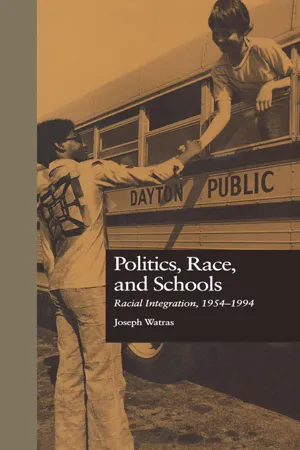
First Published in 1997. Focusing on a case study from the civil rights movement, the author illuminates the issues and problems that emerge when schools are used to advance social equality. He examines the political controversies surrounding the racial desegregation of public and private schools in Dayton over a 40-year period during which the city initiated several nationally recognized programs to overcome segregation. The book also discusses racial integration in public and religious schools in different parts of the United States during that time. It describes experiences in public schools, Catholic schools, and private schools covering individually guided education, ethnic studies, magnet schools, compensatory education, and the New Futures Program funded by a private foundation. The text is innovative in its survey of the relationships between city administrators, public school officials, and Catholic and private school educators. It also provides important analysis of how curriculum changes have affected desegregation and examines the role of private philanthropies in education.
Information
Part I
Federal Courts, School Desegregation, and Religion
The National Context
Chapter One
The Politics of Racial Desegregation
The racial desegregation of schools should have been a controversy about the best way to make one nation out of many peoples. Instead, the issue became the conflict between the authority of the federal government and the principle of local control. The racial desegregation of schools was the cornerstone in a civil rights movement designed to overturn the legal separation of African Americans and whites. After the U.S. Supreme Court made its decision in Brown v Board of Education in 1954, lawyers for the NAACP sought to cast the federal government in the role of upholding the U.S. Constitution. On the opposite side, conservatives in southern states saw their “massive resistance” as a means to uphold their legal rights. As a result, racial integration became a legal concern more than a moral or a spiritual one.
At first, the NAACP was indefatigable. In 1955, Thurgood Marshall decided the NAACP would go after resistant school officials in each state one by one: “Those white crackers are going to get tired of having Negro lawyers beating ’em every day in court” (Ashmore 1994, 111).
As Marshall predicted, until 1974, the NAACP won a string of victories that expanded the definition of school desegregation. In the 1950s, southern communities interpreted the U.S. Supreme Court’s decision to mean that black children had to have the opportunity to attend white schools. As a result, communities such as Greensboro, North Carolina, adopted open enrollment policies that created token desegregation. Ruling these policies to be inadequate in 1968, the U.S. Supreme Court used Green v New Kent County to say there had to be some results. In 1971, in Swann v Charlotte-Mecklenburg, the court approved arithmetic ratios to measure racial balance and accepted busing as a means to achieve it. The court turned its attention to northern school districts in 1972 in Keyes v School District No. 1, Denver, Colorado. Here, the school district was guilty of de jure segregation even when the state had not had laws requiring racially separate schools.
Through these cases, the NAACP sought to expand the rights black children derived from the due protection clause of the U.S. Constitution. At first, the lawyers sought only to forbid officials from forcing children to attend racially segregated schools. Since the original 1954 decision relied on social science evidence to show the inferiority of segregated education, it implied that black children had a right to an integrated education. Segregated schools appeared to deny black children the freedom to grow and develop fully. The NAACP pushed the courts in this direction. Opponents to school desegregation used quasi-legal principles of state’s rights or of local control to justify the continued operation of segregated schools.
Massive Resistance
In 1954, the U.S. Supreme Court asked officials in various states to participate in discussions about the effects of its Brown decision. None of the officials from states in the deep South responded. They refused to recognize the order as valid, and they thought that participation in such a debate would imply an obligation to comply. Instead, in states like Georgia, the legislature passed bills making it a felony for any state or local official to spend public monies on an integrated school. In September 1954 the Mississippi legislature passed a state constitutional amendment allowing the legislature to abolish public schools and provide tuition grants to school children to attend private schools. In 1955 the Mississippi legislature made it unlawful for any white person to attend a racially integrated elementary or high school. Politicians in states such as Texas, Tennessee, and North Carolina that bordered the South had less success in passing similar laws (Bartley 1969, 67–81).
Beginning in small towns and rural communities, business people formed citizens councils to resist school integration and to restrict African American suffrage. These groups began to flourish and move into the cities. In February 1956 twelve thousand people attended a rally in Montgomery, Alabama, supporting the council movement. Similar meetings took place in other southern states (Bartley 1969, 82–106).
The southern white elite resisted integration differently. In 1956 one hundred and one U.S. congressional representatives from the states of the former Confederacy signed the “Declaration of Constitutional Principles.” Commonly known as the “Manifesto,” the document approved of states that resisted forced racial integration by any lawful means and warned against the dangers of judicial encroachment. Originating from South Carolina’s Strom Thurmond, the declaration lent respectability and the appearance of legality to “massive resistance” (Bartley 1969, 108–125).
Public figures often described the justification for massive resistance in different ways, but they made the theory into a southern rallying cry. They used the word “interposition” to say that states could nullify orders from the federal government. Interestingly, the test of the doctrine happened in Arkansas. This state had a tradition of moderation in racial matters. No political hopeful campaigned against the Brown decision during Arkansas’ 1954 primary election (Bartley 1969, 68, 126–149, 251).
Little Rock, Arkansas
In 1954 the Little Rock school board instructed the superintendent to construct a plan to comply with the U.S. Supreme Court. A year later, the board rejected the superintendent’s suggestion of integrating the senior high schools. They opted for a more restricted plan with two phases. The first was to open Central High to a few black students in September 1957. The second was to allow a few black students to enter the white junior high schools in 1960. They did not set dates for the integration of the elementary schools. Unfortunately, although Central High School was a prestigious white school, working class people lived in the neighborhood. The elite whites who supported the desegregation program lived on the other side of town served by Hall High School, untouched by the plan. To mute dissent, the school officials continually stressed that this plan was the minimum required by the law. However, class antagonisms added to racial problems (Freyer 1984, 15–18).
In January 1956 the Little Rock school board began registration for the opening of a new but segregated building, Horace Mann High School. Thirty black students showed up to enroll. When school officials rejected the children’s applications, the parents formally appealed to the NAACP for aid. In February 1956 NAACP lawyers sued in U.S. District Court claiming the school board prevented the black children from attending schools near their homes. Lawyers for the school board argued that the board was providing a slow and orderly program of integration. On 28 August 1956, the judge decided not to interfere as long the school board worked in good faith (Freyer 1984, 41–57).
Unfortunately, political events in Arkansas made peaceful desegregation impossible. In 1955, James Johnson used the school desegregation controversy in Hoxie, Arkansas, to become a candidate for governor. Later, in January 1957, Johnson advocated the adoption of a state constitutional amendment threatening state officials who carried out federal laws requiring integration. Fearing that a strong segregationist stance would alienate his allies in East Arkansas, Governor Orval Faubus tried to remain neutral. When segregationists threatened his reelection, Faubus used the concept of interposition to appear moderate and to bolster his popularity among conservatives (Freyer 1984, 41–68).
Legal authorities agreed that the idea of interposition was absurd. Nonetheless, Faubus formed a committee to evaluate Arkansas’ responsibility to comply with Brown II. The committee endorsed the theory of interposition and listed eighteen factors for pupil assignment, excluding race. Faubus endorsed the committee’s recommendations and won the 1956 primary election by a landslide (Freyer 1984, 68–82).
Before the desegregation of Central High School began in September 1957, Faubus tried to stop it. Testifying in state chancery court, he said he had reports of black and white children obtaining guns in preparation for the impending school desegregation. Although Faubus won the injunction in state court, the federal judge directed the school board to go on (Ashmore 1994, 126–130).
Unswayed, on 2 September 1957 Governor Faubus ordered troops from the National Guard to go to the high school. As the black students entered the building, the troops turned them away. Faubus said the schools should continue as they had until the court case ended. To preserve peace, the school board passed a resolution asking black students not to come to Central High for a time (Blossom 1959, 73–84).
On 24 September 1957 U.S. President Dwight Eisenhower ordered a detachment from the 101st Infantry from Fort Campbell, Kentucky, to replace the Arkansas National Guard at Central High School. He acted to prevent interference with the orders of the court. Pictures in the papers showed troops pushing white students toward the school with fixed bayonets pointed inches from their backs. The troops escorted nine black children into the school building. Many students stayed away. Only 1,250 students out of 2,000 enrolled in Central High attended the first few days (Blossom 1959, 116–127).
Within Central High, some white students tried to welcome the black students. A few days before the integration took place, a white student wrote in the school newspaper urging her colleagues to obey the law and maintain public order. The most publicized incident took place during the baccalaureate services at the end of the year when a white student spit in the face of a black student. The police let the white boy walk away, but they arrested two black students who demanded that they stop him (Bates 1962).
In June 1958 the judge granted the Little Rock school board the opportunity to halt the desegregation of Central High. The U.S. Circuit Court of Appeals overruled him, and the U.S. Supreme Court affirmed the appeals court decision. Faubus closed all senior high schools in Little Rock. The school board agreed to lease the public school facilities to the Little Rock Private School Corporation, but the federal courts rejected this plan. Schools supported by state funds could not bar black children from attending. Nonetheless, in October, a private high school opened, and its enrollment grew to about 800 students. In all, the superintendent estimated that 500 children stayed home during the 1958–59 school year (Blossom 1959, 184–187).
The next year proved better. Little Rock schools opened in August 1959 without federal assistance. Local police maintained order (Freyer 1984, 158–163).
By ordering in federal troops, President Eisenhower proved he would enforce court orders. Consequently, during the fall and winter of 1958–59, massive resistance lost its former prominence in southern politics. As a result, a moderate save-the-schools movement in the cities enlisted middle-class supporters. School people and business leaders tried to prevent extremists from closing schools rather than desegregate them (Bartley 1969, 320–337).
Most important, during the controversy in Little Rock, all officials made legal arguments about racial justice. They did not raise questions about morality. As a result, the means, obedience to the law, became more important than the end, racial integration. Furthermore, when people on both sides of the issue looked to the courts for answers, they began to argue about what powers the judges should assume in a democracy. Liberals looked to the justices to engage in broad policy making. Segregationists asked the courts to exercise the least authority possible (Freyer 1984, 172–174).
Although people in Little Rock lost their reputation for moderation, civil rights protests followed a different path in other southern states. The effort to racially integrate the schools in Greensboro, North Carolina illustrates these differences.
Greensboro, North Carolina
North Carolina’s governor appointed a biracial advisory committee in 1954 to preserve the public schools. The committee reported that the public would not accept integrated schools. Among its recommendations, the committee suggested that the state board of education give up any authority for assigning students. The hope was that if local school boards assumed all such responsibilities, each would have to appear in court. In the fall Luther Hodges assumed the governor’s office. He asked the legislature to enact the committee’s recommendations. Hodges suggested that individual communities begin private schools to replace the public ones (Bagwell 1972, 84–88).
In 1955 Governor Hodges made a statewide address asking all citizens to support voluntary segregation. His attorney general announced that his office would help a local board to maintain segregated schools. Because of these statewide pressures, the Greensboro school board decided to maintain a segregated system. On 8 September 1956 a record turnout of voters for a special election adopted two segregationist amendments to the state constitution. The first offered tuition grants to children who wanted to attend segregated private schools. The second permitted local communities to close their public schools (Bagwell 1972, 89–97).
NAACP civil rights lawyers challenged the new pupil assignment plan in four North Carolina communities. State officials decided that some desegregation had to take place if the statutes were to withstand continued litigation. As a result, local boards adopted resolutions that allowed students to choose to go to any school. If a student wanted to attend a segregated public school but none was available, the board extended a tuition grant to attend a private school. On 23 July 1957 the Greensboro board approved the transfers of six black students to two previously all-white schools. School boards in Charlotte and Winston-Salem voted to approve similar requests (Bagwell 1972, 97–104).
The Greensboro community prepared for a peaceful transition. The newspapers were conciliatory. A ministerial alliance asked the community to support the desegregation. School officials visited other cities, such as Louisville, Kentucky, and Baltimore, Maryland, to see what officials in those systems did to ease desegregation. Greensboro school people held workshops on human relations for school personnel. The superintendent urged any school employees who disagreed with the board’s decision to remain quiet or leave the system. Finally, to prevent violence, the city assigned extra police to patrol the schools on the opening day. When school opened in September 1957, only 100 to 250 white people stood around the school to taunt the handful of black children that police escorted into the school. Otherwise, the transition was uneventful (Bagwell 1972, 110–119).
As the national mood came to support increased integration, Greensboro business, civic, religious, and educational leaders asked the school board for more than token racial desegregation. In 1963 the Greensboro school board adopted a freedom of choice plan that altered enrollment patterns quickly. In the 1962–63 school year, thirty-five black students enrolled in one previously white school. The next school year, 1963–64, the number of black students in white schools rose to 200 in twelve buildings. By 1964–65 five hundred black students attended sixteen schools in Greensboro (Bagwell 1972, 120–124).
The experiences similar to those in Greensboro happened in most towns or cities that underwent desegregation. However, cities where people resisted loudly and violently dominated the newspapers (U.S. Commission on Civil Rights 1976). As a result, the public image of school desegregation was one where crowds of angry people threatened black children. Despite these pictures, the children were not the most vulnerable group. School desegregation threatened black educators everywhere.
The Plight of Black Teachers
In 1958 the NAACP awarded the Springarn Medal for contributions to racial advancement to the nine African American children who integrated Central High School in Little Rock, Arkansas, and to Daisy Bates, then president of the Arkansas NAACP. The award symbolized that school desegregation was central in the NAACP’s strategy to all forms of segregation. Unfortunately, the bulk of trained African Americans in southern communities were school teachers employed by the school districts. Consequently, they had to sit by silently as the cities and states resisted the federal orders. If they did not, they lost their jobs and their careers (Lomax 1962, 124–125).
Segregationists described the NAACP as an organization of intruders from New York City who did not represent the interests of southern African Americans. As a result, the legislatures of several states took direct action to prevent teachers from supporting the NAACP. They abolished teacher tenure and prohibited schools or other state agencies from employing members of the NAACP (Bagwell 1972, 135–143).
Because of such laws, white teachers and administrators replaced African American teachers and administrators as school desegregation advanced in southern states. In some southern districts, the racial desegregation of schools meant the elimination of black principals and the demotion of black teachers. In 1965 Florida had the most such teacher displacements because of the way the state used the National Teacher Examination for promotion or tenure (Commission on Professional Rights 1970, 7).
The use of the National Teachers Exam as a tool of segregation extended back to 1940. Then, the NAACP won a verdict from the U.S. Court of Appeals that prohibited Virginia schools from paying black teachers less than equally qualified white teachers. This forced school boards to find legitimate ways to distinguish the pay rates. Florida and South Carolina turned to the National Teachers Exam. For example, the Palm Beach County, Florida, schools divided teachers into four salary groups. No blacks were in the highest group, and although 60 percent of the black teachers were in the lowest salary group no whites were there. Despite these segregative effects, federal courts sustained the practices. The tests were objective and graded by machines that could not tell if a paper came from a black or from a white person (Baker 1995).
In 1965 the NAACP contended that the U.S. Department of Health, Education, and Welfare (HEW) should prevent school districts from displacing black teachers during school desegregation. In the resulting publicity, the Office of Education announced that they considered the systematic firing of black teachers a viola...
Table of contents
- Cover
- Half Title
- Title Page
- Copyright Page
- Contents
- Series Editor’s Introduction
- Introduction
- Part I: Federal Courts, School Desegregation, and Religion: The National Context
- Part II: Racial Desegregation in Dayton, Ohio: City Government, Schools, and Churches
- Part III: Curriculum, Caring, and Social Reform
- Index
Trusted by 375,005 students
Access to over 1.5 million titles for a fair monthly price.
Study more efficiently using our study tools.
Frequently asked questions
Yes, you can cancel anytime from the Subscription tab in your account settings on the Perlego website. Your subscription will stay active until the end of your current billing period. Learn how to cancel your subscription
No, books cannot be downloaded as external files, such as PDFs, for use outside of Perlego. However, you can download books within the Perlego app for offline reading on mobile or tablet. Learn how to download books offline
Perlego offers two plans: Essential and Complete
- Essential is ideal for learners and professionals who enjoy exploring a wide range of subjects. Access the Essential Library with 800,000+ trusted titles and best-sellers across business, personal growth, and the humanities. Includes unlimited reading time and Standard Read Aloud voice.
- Complete: Perfect for advanced learners and researchers needing full, unrestricted access. Unlock 1.5M+ books across hundreds of subjects, including academic and specialized titles. The Complete Plan also includes advanced features like Premium Read Aloud and Research Assistant.
We are an online textbook subscription service, where you can get access to an entire online library for less than the price of a single book per month. With over 1.5 million books across 990+ topics, we’ve got you covered! Learn about our mission
Look out for the read-aloud symbol on your next book to see if you can listen to it. The read-aloud tool reads text aloud for you, highlighting the text as it is being read. You can pause it, speed it up and slow it down. Learn more about Read Aloud
Yes! You can use the Perlego app on both iOS and Android devices to read anytime, anywhere — even offline. Perfect for commutes or when you’re on the go.
Please note we cannot support devices running on iOS 13 and Android 7 or earlier. Learn more about using the app
Please note we cannot support devices running on iOS 13 and Android 7 or earlier. Learn more about using the app
Yes, you can access Politics, Race, and Schools by Joseph Watras in PDF and/or ePUB format, as well as other popular books in Education & Education General. We have over 1.5 million books available in our catalogue for you to explore.