eBook - ePub
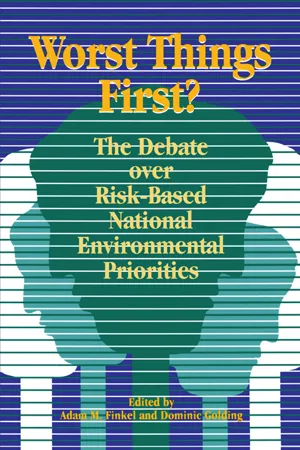
Worst Things First
The Debate over Risk-Based National Environmental Priorities
- 368 pages
- English
- ePUB (mobile friendly)
- Available on iOS & Android
eBook - ePub
Worst Things First
The Debate over Risk-Based National Environmental Priorities
About this book
For any government agency, the distribution of available resources among problems or programs is crucially important. Agencies, however, typically lack a self-conscious process for examining priorities, much less an explicit method for defining what priorities should be. Worst Things First? illustrates the controversy that ensues when previously implicit administrative processes are made explicit and subjected to critical examination. It reveals surprising limitations to quantitative risk assessment as an instrument for precise tuning of policy judgments. The book also demonstrates the strength of political and social forces opposing the exclusive use of risk assessment in setting environmental priorities.
Information
PART I:
Introduction
Conference Background and Overview
1
Should We—and Can We—Reduce the Worst Risks First?
With the benefit of hindsight, each of the major substantive changes in national priorities for environmental protection in the United States has arguably had a quality of inevitability. At roughly ten-year intervals starting in the late 1960s, the major thematic focus of governmental action on (and public interest in) the environment has changed palpably, from the early efforts to combat overtly visible pollution in waterways and urban airsheds, to the battle against lower levels of more highly toxic contaminants in waste sites and the food chain, to the now-established concern about global ecological stress. At each watershed, however, one focus replaced another with few dramatic signs of upheaval, only a gradual consensus that each adaptation represented an idea whose time had come.
In the early 1990s, the next idea-whose-time-had-come in environmental protection did not portend a specific change in our national priorities, but rather involved changing the way the nation changes its environmental agenda. The need for such a meta-change has been expressed in many forums at many times, but perhaps never so succinctly as Granger Morgan put it in a 1993 article in Scientific American: “Americans, [many advocates in industry and the U.S. Environmental Protection Agency (EPA)] say, demand that enormous efforts be directed at small but scary-sounding risks while virtually ignoring larger, more commonplace ones.” According to these advocates, Morgan wrote, “risk analysts and managers will have to change their agenda for evaluating dangers to the general welfare” (Morgan 1993).
Examining the premise that society is misdirecting its environmental efforts is one of the main objectives of this book. If its validity is accepted for the moment, however, then it follows that what we in the United States call our “national environmental priorities” may not be worthy of any title that implies reasoned, conscious choices on society’s part. Rather, whatever occupies us most—flammable rivers in the late ’60s, abandoned waste sites in the late ’70s, global climate change and ozone depletion in the late ’80s—becomes our priority, rather than the other way around.
The observation that the United States sets its environmental priorities either by bureaucratic inertia (“We spent $X on this problem last year, so we need to spend $X plus five percent this year”) or by reflexive response to the “crisis of the month” is itself hardly an earth-shattering one. Nonetheless, beginning in the early part of this decade, that observation was repeated by the leadership of EPA, members of Congress, and influential media outlets sufficiently often that it became a kind of mantra for those anticipating another watershed in our environmental protection system. Metaphors began to proliferate to describe this ostensibly sorry state of affairs, ranging from Senator Daniel P. Moynihan’s criticism of environmental policy as captive to “middle-class enthusiasms,” to media criticisms of governmental policies under such headlines as “The Big Cleanup Gets It Wrong” (Main 1991), to EPA Administrator William K. Reilly’s description of the federal effort as akin to a game of “Space Invaders,” where the obvious strategy is to never take your finger off the button that controls an inexhaustible supply of electronic bullets and fires at whatever targets appear on the screen.
Of course, the nation has an array of policies that many Americans would agree are not working optimally. But for government to declare war on any problem—be it drug abuse, the federal deficit, or the environmental “adhocracy”—may not bring us any closer to a social consensus that we should, in fact, purposively change our actions, let alone a consensus on exactly what we should do instead. Even to move from a common diagnosis of a problem to agreement that anything at all should be done about it is harder than it might appear; in the case of environmental protection, as soon as we consider taking collective responsibility for setting our national priorities, we have to imagine also taking responsibility for paying relatively less attention to certain specific problems than we currently pay.
We might be able to escape from this bind (that any solution will gore someone’s ox) if we carefully established a system that made some problems relatively low-priority while ensuring that we did not disinvest in any area in absolute terms—in other words, if we could agree to expand the “environmental pie” as a prerequisite for carving it up in a conscious fashion. But even though considering the benefits of priority setting per se may not be anathema to any important group of stakeholders (as the chapters from the diverse collection of authors in this volume generally indicate), taking the next step—considering any specific plan or general philosophy for actually setting priorities—promises to be highly controversial.
This volume, and the conference from which it is drawn, explores the controversy over what approach we should use to set our nation’s environmental priorities and presents alternative strategies for achieving the common but vague (and subjective) goal of improving the efficiency and fairness of our environmental protection efforts.
THE ANNAPOLIS CONFERENCE ON RISK-BASED PRIORITY SETTING
By the fall of 1991, when the Center for Risk Management at Resources for the Future (RFF) decided to convene a group of people with a stake in this country’s environmental policy to discuss the issues surrounding our national priorities, momentum throughout the United States had been growing for several years to do something about the nation’s haphazard priority-setting process. More specifically, momentum was building for “something” to be organized around a science-based ranking of environmental problems and a reallocation of resources toward the greatest risk reduction opportunities identified by this ranking.
Some of the signs of the growing appeal of these ideas were rather diffuse. For example, there was a subtle but definite growth in the shared perception that the easy work of environmental protection was largely over and that, with the passing of the era of opaque skies and flammable rivers, the remaining increments of pollution reduction were sufficiently harder to extract that frugality was crucial.
In some circles, another perception was growing that the benefits of continued efforts to reduce certain high-profile risks were being overstated—in effect, that many of our resources were being devoted to squeezing out incremental reductions in risks that may not have warranted attention in the first place. Any of a dozen or more editorials by Philip Abelson or Daniel Koshland in Science over the last five years, or any of a spate of recent books, has denounced a national environmental protection system allegedly driven by “chemophobia” or “toxic terror.”
While the debate over the worthiness of individual environmental programs raged on unresolved, examples from other sectors of public policy were cropping up that made analysis-driven priority setting seem a more obvious context for playing out these arguments. The various proposals to control national health care costs and expand the number of insured Americans by eliminating reimbursement for low-priority interventions (as in the controversial Oregon plan) were prime examples of a growing willingness to confront such “tragic choices,” (Calabresi and Bobbitt 1978) as were similar decisions to close certain military bases.
In the particular arena of priority setting for environmental protection, comparative risk assessment was emerging as the dominant methodological approach for structuring the analysis to support resource reallocation. Since comparative risk assessment is a functionally and semantically controversial method, the next section of this chapter provides some background information.
Comparative Risk Assessment: The Method behind the Policy
Risk assessment is a multidisciplinary method (for practitioners it is more like a mind-set or even a way of life) for estimating the probability and severity of hazards to human health, safety, and the natural environment. The ability to assess risks in a technically sound manner and to communicate such findings in a rich yet comprehensible fashion may require knowledge from various fields, including physiology, chemistry, statistics, toxicology, engineering, economics, and psychology. Risk assessments produce several complementary types of output:
• Numerical estimates of the magnitude of the assessed risk. These estimates are made either in units of probability (for example, a 1 in 100,000 chance that an individual will suffer an adverse effect1) or of consequence (for example, an estimate of 500 adverse effects occurring across an entire population).
• Qualitative descriptions of the type of adverse effect associated with the estimate of magnitude. These descriptions can be as straightforward as the hazard of lung cancer, which is almost invariably fatal, or as complicated as a description of all the ramifications of a five-degree rise in global mean temperature.
• Discussions of the knowledge base on which the predictions of hazard are made. These can be as simple as a narrative statement of how sure the analyst is that the assessment is valid, or as complex as a full quantitative treatment of the uncertainty in the probabilities generated.
Beginning in the 1960s, risk assessment was applied initially to all of the various decision problems that involve coping with risks viewed one at a time, notably: the setting of permissible exposure or emissions limits for particular substances or pollutant sources; the determination of desired cleanup levels at particular hazardous waste sites; or decisions about whether certain substances in commerce should be banned, restricted, or left unregulated.
Beginning in the late 1980s, comparative risk assessment emerged as a distinct methodology, building on the existing scaffolding provided by risk assessment. Comparative risk assessment is simply the act of evaluating two or more risks simultaneously and juxtaposing the results for the purposes of examining whether the relative effort devoted to each risk should be changed.2
A paradigm case of comparative risk assessment can be found in an issue of Fortune (Main 1991). According to this article, it is grossly inefficient for the United States to spend $6 billion or more annually cleaning up hazardous waste sites, which EPA estimates together probably cause fewer than 500 excess cancer deaths per year, when we are spending only approximately $100 million per year to control indoor radon, which may cause as many as 20,000 excess annual cancer deaths. This example also shows how, by adding some economic analysis, comparative risk assessment can be transformed into comparative cost-benefit analysis to support a policy of risk-based reprioritization of societal resources.
At the Annapolis conference, various authors distinguished further between the “hard” and “soft” versions of comparative risk assessment. Although different observers’ definitions of these two variants may not match precisely, the basic features of the hard version involve the use of expert panels to generate “best estimates” of the most probable magnitude of various risks, focusing on quantifiable dimensions such as the number of fatalities or the size of affected geographical areas. The experts then compare the sizes of the risks to either the current or potential costs of reducing each risk and recommend priorities designed to achieve the “biggest bang for the buck” in reducing risk, given resource constraints. For example, dividing the cost figures by the risk estimates in the preceding paragraph suggests that the United States currently devotes $12 million to each potential victim of hazardous waste pollution, compared to only $5,000 per potential victim in the case of indoor radon; proponents of the hard version might well argue that we could save many more lives at $5,000 per person if we transferred inefficient risk reduction resources to radon control out of the hazardous waste program.
In contrast, the soft version starts from the premise that risk is multidimensional and represents the confluence of a variety of public values and attitudes. A soft ranking of risks, therefore, would tend to be more impressionistic than formulaic; it might use the number of fatalities as a rough starting point, but would modify the ranking by folding in various factors, such as the qualities of dread, mistrust, and uncertainty associated with each risk, the equity (or lack thereof) in how each risk is borne by various individuals and subpopulations, and the perceived benefits the risky substance or activity confers. According to proponents of the soft version, the only way to incorporate such factors, and enhance the legitimacy of the resulting priorities or risk rankings, is to give the public equal stature with the experts from the early stages of the analysis.
Backdrop to the Conference
Superimposed upon the growing receptivity to “rational” priority setting were several very specific events, which together formed the backdrop for the Annapolis conference. Some of the details of these events are more thoroughly described by various authors in this volume; here, we provide a brief accounting of the chronology leading up to the conference.
In 1987, concerned about whether EPA was making the best use of its budget and society’s resources, then-EPA Administrator Lee Thomas asked a group of senior EPA officials to rank thirty-one environmental problems of interest to EPA by the size of the risks that the problems pose to humans and ecosystems. The resulting report, Unfinished Business: A Comparative Assessment of Environmental Problems (U.S. EPA 1987), concluded that the environmental problems that seemed to present the greatest ecological and health risks often were not the problems to which Congress or EPA had devoted the greatest attention. Rather, the study found, environmental priorities seemed better aligned with public and political perceptions of the seriousness of environmental risks.
Soon after William K. Reilly became EPA administrator in early 1989, he charged the EPA Science Advisory Board (SAB) to review and evaluate the methods and findings of Unfinished Business. The SAB released a four-volume study in September 1990, entitled Reducing Risk: Setting Priorities and Strategies for Environmental Protection (U.S. EPA 1990). This study reinforced the earlier conclusion that Congress and the public often fixate on environmental problems that experts believe pose little or no threat and, at the same time, ignore other problems that experts believe to be most serious. In a speech at the National Press Club announcing the release of the report, Reilly outlined a strategic plan that required each EPA program office to develop and justify its annual budget requests by specifying the risk reduction goals (and environmental indicators for tracking those goals) it intended to achieve.
Then in early 1991, President George Bush released the fiscal year 1992 budget for the United States. The budget contained (among several narrative statements heralding new themes in the administration’s approach to budgeting and regulation) a treatise called Reforming Regulation and Managing Risk Reduction Sensibly (U.S. OMB 1991). This narrative introduced to the federal budgeting process an approach championed by the Office of Management and Budget (OMB) that encourages agencies to set their priorities in line with quantitative measures of the cost-effectiveness (primarily, the cost-per-life-saved) of proposed interventions. Authors in this volume generally refer to this treatise as epitomizing the hard version of comparative risk assessment.
Also in early 1991, EPA produced a report entitled Environmental Investments: The Cost of a Clean Environment (U.S. EPA 1991a), which was a first attempt to estimate the total cost that industries and municipalities must incur to comply with federal pollution control programs. The absolute size of these aggregate expenditures ($115 billion annually at the time of the report’s release, with a projected rise to $185 billion annually by the year 2000) and their relative...
Table of contents
- Cover Page
- Half Title page
- Title Page
- Copyright Page
- Series Page
- Contents
- Foreword
- Preface
- Acknowledgments
- Part I: Introduction
- Part II: The EPA Paradigm
- Part III: Three Alternative Paradigms
- Part IV: Conclusions
- Appendix Conference Attendees
Trusted by 375,005 students
Access to over 1.5 million titles for a fair monthly price.
Study more efficiently using our study tools.
Frequently asked questions
Yes, you can cancel anytime from the Subscription tab in your account settings on the Perlego website. Your subscription will stay active until the end of your current billing period. Learn how to cancel your subscription
No, books cannot be downloaded as external files, such as PDFs, for use outside of Perlego. However, you can download books within the Perlego app for offline reading on mobile or tablet. Learn how to download books offline
Perlego offers two plans: Essential and Complete
- Essential is ideal for learners and professionals who enjoy exploring a wide range of subjects. Access the Essential Library with 800,000+ trusted titles and best-sellers across business, personal growth, and the humanities. Includes unlimited reading time and Standard Read Aloud voice.
- Complete: Perfect for advanced learners and researchers needing full, unrestricted access. Unlock 1.5M+ books across hundreds of subjects, including academic and specialized titles. The Complete Plan also includes advanced features like Premium Read Aloud and Research Assistant.
We are an online textbook subscription service, where you can get access to an entire online library for less than the price of a single book per month. With over 1.5 million books across 990+ topics, we’ve got you covered! Learn about our mission
Look out for the read-aloud symbol on your next book to see if you can listen to it. The read-aloud tool reads text aloud for you, highlighting the text as it is being read. You can pause it, speed it up and slow it down. Learn more about Read Aloud
Yes! You can use the Perlego app on both iOS and Android devices to read anytime, anywhere — even offline. Perfect for commutes or when you’re on the go.
Please note we cannot support devices running on iOS 13 and Android 7 or earlier. Learn more about using the app
Please note we cannot support devices running on iOS 13 and Android 7 or earlier. Learn more about using the app
Yes, you can access Worst Things First by Adam M. Finkel,Dominic Golding in PDF and/or ePUB format, as well as other popular books in Politics & International Relations & Ecology. We have over 1.5 million books available in our catalogue for you to explore.