This is a classic work of archaeology by one of the premier figures in the field. First published in 1971, A.M. Snodgrass'The Dark Age if Greece is the most comprehensive and coherent account available of this period of ancient Greece.
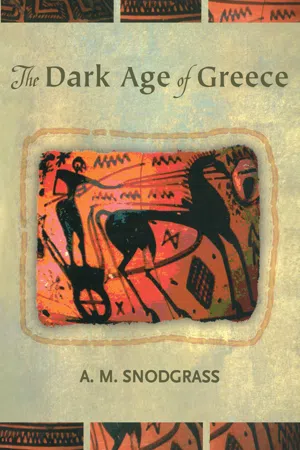
eBook - ePub
The Dark Age of Greece
An Archeological Survey of the Eleventh to the Eighth Centuries B.C.
- 496 pages
- English
- ePUB (mobile friendly)
- Available on iOS & Android
eBook - ePub
The Dark Age of Greece
An Archeological Survey of the Eleventh to the Eighth Centuries B.C.
About this book
Information
1
The Concept of a Dark Age
‘There is a far-off island of knowledge, or apparent knowledge; then darkness; then the beginnings of continuous history.’ These words of Gilbert Murray’s, appearing first in 1907,1 fittingly embodied a doctrine which is largely the property of the present century. The period between the fall of the Mycenaean civilization and the rise of Archaic Greece, once its general nature and broad chronological limits had been agreed upon, was coming naturally to attract the name of a dark age2; but this rough delineation had only really become possible with the advent of modem archaeological methods. For the ancient authors all, in one way or another, fall short of giving the sequence of events that is described by Murray’s words; and to scholars of earlier generations – even perhaps to some of Murray’s contemporaries — the use of such an absolute term as ‘dark age’ would have seemed tendentious. Even today, the name – originally applied to Greece and the Aegean – is used only sparingly by students of those civilizations further to the East which, at the same period, seem to have experienced a parallel course of events to that in Greece; while there are several scholars who, on various grounds, would question the aptness of the term even for the Aegean. On a superficial level, there is no denying that the archaeologist, with his sequence of a Mycenaean period, a dark age, and an Archaic period, is using a different language from that which served the ancient Greeks for describing their own past. Nevertheless, in tracing the growth of this conception the proper place to begin is with the Greeks themselves. For their view of what was, to them, the comparatively recent past does at times embrace elements of the modern theory. The fact that no ancient author explicitly combines these elements, to give a coherent picture of a dark age, is not in itself proof that the Greeks did not know of, or believe in, such a period. Earlier generations of scholars, who did not themselves envisage such a picture, were not inclined to look for traces of it in the ancient literature.
A
But first, the basic elements of the modern doctrine of the dark age may be stated, at the risk of anticipation. To begin with, there is the matter of the passage of time: the solid fact that, between the end of the Mycenaean civilization (whether we equate that event with the positive signs of destruction, or with the later and vaguer point at which identifiably Mycenaean cultural traits disappear), and the rise of the Hellenic world to a level which we can see to be roughly comparable, several centuries elapsed. This fact, slow to emerge, is now universally accepted; what is debated is the competence of our evidence for determining cultural level. It is one thing to prove that a long period of time elapsed between two comparatively well-explored cultural phases, and another to show that that period was dark. Mere lack of information about a period makes it dark in one sense for us; but we must not confuse this sense with the darkness real and serious enough to have been apparent to the people who lived at the time. It is this alone which gives true meaning to the phrase ‘dark age’, and it is this which cannot be accepted without positive and laborious proof. The modern doctrine would hold that the following characteristics were present in the post-Mycenaean period : first, a fall in population that is certainly detectable and may have been devastating; secondly, a decline in or loss of certain purely material skills; thirdly, a similar decline or loss in respect of some of the more elevated arts, of which the apparent loss of the art of writing is the most striking to us, although to contemporaries this need by no means have been so; fourthly, a fall in living-standards and perhaps in the sum of wealth; fifthly, a general severance of contacts, commercial and otherwise, with most peoples beyond the Aegean area and even with some of those within it. To these features, some would add a growth of acute insecurity. If all of these could be proved to be characteristic of this period, no one would dispute the aptness of the name ‘dark age’. Our first purpose is to see how far, if at all, Greek literature reflects awareness of such a picture.
%The Literary Evidence
The Homeric poems, for all the uncertainties and provisos which must attend discussion of them, will be agreed to show a consistent attitude on one point. The Trojan War and its aftermath, which form their subject-matter, are represented as having happened in ‘better’ times, in a heroic age long since passed. The favourite illustration of this is perhaps the poet’s reference (Iliad XII, 447) to a hero’s throwing a stone ‘which two men of today could scarcely have lifted’; but throughout the Iliad and Odyssey there are passages which describe the prowess and wealth of the characters in a way apparently designed to impress an age which was unaccustomed to such standards. But in this respect the Homeric poems are merely an unusually fine example of a widespread tendency to weave legends – not always enshrined in literary form – around a heroic past. Not only may these legends exaggerate or distort the historical realities, and thus overstate the difference between the past age and the present one; but, equally important, it is not a necessary precondition of such legends that there should be any sharp historical decline from the period remembered as a heroic age to the period when the legends grow up. Sir Maurice Bowra in his comparative study, The Meaning of a Heroic Age,3 points out that many different circumstances can lead to the establishment of this kind of concept; conquest or disaster may be the commonest preludes to it, but there are also known cases where migration, political change or religious conversion appear to have provided the impetus. Since the memory of the Greek heroic age was apparently for a long time kept alive by the settlers in Ionia, to whose tradition Homer was almost certainly heir, the attitude of the Homeric poems to the past could, even today, be ascribed as plausibly to migration as to any catastrophic fall in material standards. Neither the one influence nor the other is really detectable in the poems; even if Homer had positively stressed the poverty or misery of his own times, which he does not, one could have pointed out that within the context of the heroic age itself, Nestor more than once recalls the greater days of his own youth, two generations previously (see especially Iliad I, 260). The laudator temporis acti is too deeply engrained in human nature to be taken as a reliable independent witness, whether he speaks through the mouth of the poet or of one of his characters. Homer consistently avoids overt reference to events and circumstances ar or after the fall of his heroic society; inferences that can be extracted from his text by later scholars are another matter. The poems ‘ignore the movements of people in the period after the fall of Mycenae’; they portray ¢a period of stability’,4 even where analysis suggests that that period must be post-Mycenaean. This is why a reading of the Homeric poems is not enough to suggest either that a dark age had descended on, and still enveloped, the world in which the poems were shaped; or that such an age had come and gone in the interval since the heroic age.
Hesiod is in a very different case. One of the most famous of all his passages is that which describes the five races or generations of man (Works and Days, 110f.). After the depiction of the primitive races of Gold and Silver, there follow in turn the race of Bronze, fierce warriors with bronze weapons and bronze houses; the race of Heroes, the contemporaries of the expedition of the Seven against Thebes and the Trojan War; and then: ‘I wish that I could no longer be among the men of the Fifth Race, but had either died sooner or been born later. For now it is the race of Iron…’. The presence of the race of Heroes, in what is almost certainly an older sequence, is clearly anomalous, and must be the result of an interpolation, probably by Hesiod himself, possibly by a predecessor. Although it is not specified whether the Heroes used bronze or iron, the sequence of Hesiod’s last three races is tolerably well confirmed by the archaeological evidence of metallurgical practice, a fact whose significance is questionable.5 But it remains to be asked how far Hesiod’s picture provides grounds for the modern theory of a dark age. He speaks disparagingly, in moral rather than material terms, of the race of Iron among whom he says he lives, by comparison with what had gone before. But when did he live? The answer of most recent scholarship is that he flourished after the end of what can reasonably be called the dark age; perhaps the most general point of agreement would be that he was alive in 700 BC, whether the greater part of his life extended before or after that date. This is a date at which many of the skills and arts lost in the post-Mycenaean period had returned to Greece; at which foreign contacts in almost every direction except that of Egypt had been resumed; at which the art of writing had certainly been revived; and at which there is every sign that the population was speedily increasing. Hesiod does not explicitly acknowledge any of these signs of returning prosperity, and may not even have regarded them as such; but he nevertheless hints – in so far as his language does not merely reflect the influence of Epic – at the presence of some of them in the Works and Days : as when he treats sea-borne commerce as a serious (if inferior) alternative to agriculture (lines 617–94); when he shows familiarity with the idea of a walled city (246); and perhaps in the far-flung geographical references in the Theogony. If the accepted dating of Hesiod is sound – and it depends on criteria wholly different from those which we have mentioned – then we must look rather to local or personal explanations for his gloomy picture of the race of Iron: his father’s unfortunate choice of land to settle on, the remoteness of his situation in the hills of southern Boeotia, or the private injustices he had evidently suffered. The tempo of events at this period, which in many ways seems to us startlingly rapid, was apparently too slow, at least in Askra, to attract the notice of Hesiod. The Works and Days suggests, as the Homeric poems clearly imply, the poet’s knowledge that the better past was at some considerable remove of time; but this in itself does not betoken a dark age.
The early poets were, of course, much nearer to the critical events than the first extant Greek prose-writers, but it is the latter who provide the more fruitful field of enquiry in respect of the dark age. Not only were the historians among them expressly concerned with such questions as this, but the passage of time could itself prove an ally to these later writers. It is notoriously difficult to place current or very recent periods in their historical perspective; later generations, provided that they have the necessary evidence, can make comparisons with the succeeding, as well as the preceding, age. In the pages of Herodotus, it is true, we shall look largely in vain for such historical interpretations of the remoter past; this although in the opening chapters of the Histories he goes out of his way to consider events of the heroic age, before and including the Trojan War, as a potential source of the great conflict between the Greeks and Persians (1, 1–5). But Herodotus makes isolated observations that are of great relevance to our purpose. One, in these opening chapters, is that ‘the cities which in ancient times were great, have most of them become small; and those which in my time were great, were formerly small’ (1, 5, 4) – an obvious enough conclusion for any Greek who was familiar with legend and the Epic poets, and one from which he might infer a major upheaval in the state of things which had prevailed in the heroic age. But such a bouleversement was in any case not a matter of doubt among educated Greeks of the Classical period; it was the sort of thing that saga and folk-memory could apprehend more clearly than a prolonged dark age; it did not necessarily lead to a dark age, and we may doubt whether anybody thought that it had. Also valuable is Herodotus’ observation ‘I believe that Hesiod and Homer belong four hundred years before me in time, and not longer’ (11, 53, 2). Much of the interest of the statement lies in the last three words. They suggest that Herodotus is dissenting from a common opinion which favoured an earlier dating for the poets; the suggestion is reinforced by the next sentences, which disagree with the accepted view on an allied matter, and then repeat that the dating proposed for Hesiod and Homer is the historian’s own personal opinion. Since Herodotus accepted the more or less orthodox view that the Trojan War had taken place about 800 years before his time, that is in the thirteenth century BC (11, 145, 4), his down-dating of Homer to the ninth century becomes a significant step. He is purposely dissociating the Homeric poems, by a long period of time, from the events which formed their subject-matter, and anyone who does this is faced with the difficulty of finding events to place in the intervening space. Scholars in the nineteenth century, who had mistakenly rejected this opinion of Herodotus’ in pursuit of a much earlier date for Homer, found themselves revising their view in the face of new evidence, and thus treading the same path that Herodotus had apparently followed.6 It is not chance that this process, in the later case, coincided with the acceptance of the idea of a dark age; but it was hardly possible for Herodotus to take any steps along this road. To him, and perhaps to others in his time, it was an accepted fact that the sea-power of Minos of Crete, and therefore presumably the Trojan War which happened ‘in the third generation after his death’ (VII, 171, 1),belonged in an age too early to be called human history; Herodotus specifically implies this in 111, 122, 2. If the heroic period could be dismissed as being beyond the frontiers of true knowledge, then the immediately post-heroic period was no longer in a special case.
Nevertheless, the problems of the Classical historians on this issue must have been intense; particularly for those writers – perhaps the majority – who more or less followed Herodotus in his later dating of Homer, but who did not share his scepticism about the heroic age. The heroic age had left nothing worth remembering later than about two generations after the Trojan War, and there was little if any of the historical age which could be placed before Homer; if the interval was neither ‘heroic’ nor ‘historical’ what could it have been like? In the century after Herodotus, Theopompus of Chios widened the gap and accentuated the difficulty by bringing Homer down to the seventh century, so that he no longer stood even at the dawn of the ‘historical’ period. It may have been partly in reaction to this quandary that some later scholars fell back once again on a much earlier date for Homer, though they mainly based their conclusions on internal evidence from the poems. Eratosthenes, for example, placed the Homeric poems only a century after the Trojan War; Aristarchus made Homer contemporary with ...
Table of contents
- Cover Page
- Title Page
- Copyright Page
- Table of Contents
- Preface
- Illustrations
- Abbreviations
- Foreword to the new edition
- 1 The Concept of a Dark Age
- 2 The Regional Pottery-styles
- 3 The Chronology of the Early Iron Age in Greece
- 4 The Grave
- 5 Iron and Other Metals
- 6 External Relations
- 7 The Internal Situation
- General Index
- Site Index
Trusted by 375,005 students
Access to over 1.5 million titles for a fair monthly price.
Study more efficiently using our study tools.
Frequently asked questions
Yes, you can cancel anytime from the Subscription tab in your account settings on the Perlego website. Your subscription will stay active until the end of your current billing period. Learn how to cancel your subscription
No, books cannot be downloaded as external files, such as PDFs, for use outside of Perlego. However, you can download books within the Perlego app for offline reading on mobile or tablet. Learn how to download books offline
Perlego offers two plans: Essential and Complete
- Essential is ideal for learners and professionals who enjoy exploring a wide range of subjects. Access the Essential Library with 800,000+ trusted titles and best-sellers across business, personal growth, and the humanities. Includes unlimited reading time and Standard Read Aloud voice.
- Complete: Perfect for advanced learners and researchers needing full, unrestricted access. Unlock 1.5M+ books across hundreds of subjects, including academic and specialized titles. The Complete Plan also includes advanced features like Premium Read Aloud and Research Assistant.
We are an online textbook subscription service, where you can get access to an entire online library for less than the price of a single book per month. With over 1.5 million books across 990+ topics, we’ve got you covered! Learn about our mission
Look out for the read-aloud symbol on your next book to see if you can listen to it. The read-aloud tool reads text aloud for you, highlighting the text as it is being read. You can pause it, speed it up and slow it down. Learn more about Read Aloud
Yes! You can use the Perlego app on both iOS and Android devices to read anytime, anywhere — even offline. Perfect for commutes or when you’re on the go.
Please note we cannot support devices running on iOS 13 and Android 7 or earlier. Learn more about using the app
Please note we cannot support devices running on iOS 13 and Android 7 or earlier. Learn more about using the app
Yes, you can access The Dark Age of Greece by A.M. Snodgrass in PDF and/or ePUB format, as well as other popular books in Social Sciences & Greek Ancient History. We have over 1.5 million books available in our catalogue for you to explore.