- 266 pages
- English
- ePUB (mobile friendly)
- Available on iOS & Android
eBook - ePub
About this book
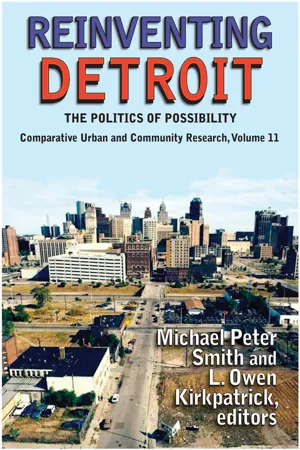
This book addresses the questions of what went wrong with Detroit and what can be done to reinvent the Motor City. Various answers to the former-deindustrialization, white flight, and a disappearing tax base-are now well understood. Less discussed are potential paths forward, stemming from alternative explanations of Detroit's long-term decline and reconsideration of the challenges the city currently faces. Urban crisis-socioeconomic, fiscal, and political-has seemingly narrowed the range of possible interventions. Growth-oriented redevelopment strategies have not reversed Detroit's decline, but in the wake of crisis, officials have increasingly funnelled limited public resources into the city's commercial core via an implicit policy of "urban triage." The crisis has also led to the emergency management of the city by extra-democratic entities. As a disruptive historical event, Detroit's crisis is a moment teeming with political possibilities. The critical rethinking of Detroit's past, present, and future is essential reading for both urban studies scholars and the general public.
Information
Part I
Theoretical and Epistemological Frameworks
1
Rereading Detroit: Toward a Polanyian Methodology
L. Owen Kirkpatrick and Michael Peter Smith
The case of Detroit sits uneasily within the analytic confines of existing models of urban change. Such models tend to epistemologically prioritize urban growth, irrespective of whether the analyst's attention lingers on its potential pitfalls or payoffs. The paradigmatic statements that constitute the canon of urban studies thus invariably emerge from the crucible of social expansion and economic intensification. But the story of Detroit—its chronic population decline, long-term economic contraction, and acute social and fiscal distress—challenges the explanatory boundaries of the dominant schools of thought. Hence, it is not uncommon, in both popular and academic discourse, for Detroit to be implicitly or explicitly dismissed as anomalous.
While Detroit is certainly an extreme case of urban decline and abandonment, we do ourselves a disservice by categorizing it as anomalous, and thus outside the purview of our theoretical models. First, avoiding an analytic reconciliation between general processes and a particular outcome, no matter how extreme, is not a compelling strategy. The key, notes Peck, is to engage with, rather than avoid, "the tensions between holistic, integral modes of analysis and the difference-finding methodologies that yield exceptional or disruptive cases" (2013b: 1546). Second, there is an empirical imperative to account for shrinking and distressed cities, the ranks of which are large and growing in the global North (Oswalt 2006). Third, dismissing Detroit as a social or fiscal anomaly serves to camouflage the fact that the city may well represent the leading political edge and/or logical endpoint of advanced (postcrisis) neoliberal austerity. In sum, an approach is needed that can theoretically integrate a wide range of empirical cases (including Detroit) into a framework of urban change under conditions of advanced neoliberalism. We propose that the work of Karl Polanyi can be used as an effective foundation for such an approach.
While Polanyi's core ideas—such as embeddedness and the double movement—have long been staple concepts in the fields of economic anthropology and economic sociology, they have frequently appeared in the study of cities and regions, as well. But despite the broad appeal of Polanyi's thought across a variety of city-related disciplines (urban studies, geography, urban and regional planning, urban sociology), his theory and methods are rarely developed in a sustained or systematic manner with respect to the urban condition (Peck 2013a: 1537). One recent exception can be found in the field of economic geography, where Polanyian approaches are being (re)cast and (re)considered. This exception yields several useful guidelines for developing a Polanyi-inspired analysis of the Detroit case.
We begin by noting that developing such an approach will involve more than the mechanistic transposition of Polanyi's original concepts onto the domain of the modern metropolis. Our task is neither so simple nor so straightforward. If we were to fashion ail overly rigid Polanyian model for the purpose of analyzing cities—in all of their undulating, polymorphic, interconnected, and multi-scalar complexity—the framework would surely crack from the pressure. Rather, a more fluid approach is required "that is forgiving, flexible, and responsive both to normatively informed exploration and to empirically conditioned elaboration" (Peck 2013a: 1540). When deployed in this manner, a Polanyian perspective takes the form of a "reflexive methodology, rather than a fixed framework or template"' (Peck 2013b: 1547). With this reflexivity in mind, we begin with a brief inventory of the theoretical, conceptual, and methodological insights that a Polanyian orientation affords us in the Detroit case. We continue with an overview of the ways in which the Detroit case, in turn, helps us identify possible lacunae in the Polanyian perspective vis-a-vis urban and regional analysis.
Rereading Detroit through the Lens of Polanyi
A Polanyian orientation theoretically illuminates several pivotal aspects of the Detroit case—including the city's historical trajectory, contemporary political and economic dynamics, and possible futures. But this is not purely a deductive process, as even the strongest and most complementary linkages between the theory and the city demand flexibility in applying one to the other.
The Double Movement, Embeddedness, and the City
We begin with the notion of the double movement. According to Polanyi, the contours of modern history resemble a pendulum, which swings between two opposed sociopolitical forces (Polanyi 2001: 138-40). On one hand are those who seek to expand the reach of markets by limiting social and political intrusions (the laissez-faire movement). On the other are those who seek to mitigate the disruptive impact of markets on social life (the protective countermovement). Ultimately, struggles over the double movement hinge on the proper relationship between markets, communities, and the state—a relationship Polanyi conceptualized in terms of embeddedness. According to this formulation, economic activity is naturally embedded within a dense thicket of social, moral, and regulatory expectations and restrictions (Ibid.: 60). "Market society" (which first arose in the early nineteenth century) is characterized by the efforts of powerful entities to invert this traditional relationship by "liberating", or disembed-ding, markets from a range of constraints imposed via community engagement, cultural tradition, and state intervention.
Polanyi primarily deployed these concepts on the scale of the nation state; a country's level of embeddedness is largely determined by national variables, such as its position within the global economy, the nature of its political system, and the substance of its national policies. Embeddedness at this scale is also understood in terms of social structure; for Polanyi, a country is a "social unit" that, "in the long run, [is] even more cohesive than the economic unit of class" (2001: 255). All of this is not to say that Polanyi turned a blind eye to sub-national scales. For instance, The Great Transformation (1944/2001) includes detailed empirical discussions of local struggles over (dis)embeddedness.1 "Trade unions, Chartism, the cooperative movement, [and] Owenism are [identified by Polanyi as] local reactions to the devastation wrought by the market" (Burawoy 2003: 237).
A certain image of urban political economy emerges from Polanyi's corpus. Market forces are unleashed on the scales of the national (via laissez-faire policies) and international (via global economic and geopolitical pressures). Simultaneously, however, "we also see counter movements that have sought to check, control, or modify the impact of market forces" (Block 2008: 2), many of which unfold on subnational levels (i.e., neighborhood, city, region, state/province). In this view, urban struggles influence national levels of embeddedness, but only in the aggregate. Local protective efforts can take myriad forms, notes Burawoy, "[b]ut setting out along local tributaries, they eventuallyflow into national movements'' (2003: 237; emphasis added). This is a telling analogy; just as water "seeks its own level," embeddedness is assumed to flow from struggles at various scales into the vessel of the state, where it settles at a uniform level—a single, undifferentiated surface stretching smoothly across the entirety of a territorially bounded society. For a time, this image roughly aligned with urban reality in the United States. This is merely to say that for a good portion of the twentieth century, intergovernmental transfers provided a socioeconomic and socio-spatial floor under which cities were not generally allowed to fall; the well-being of urban communities was pegged to the nation state (via the War on Poverty, infrastructural interventions, etc.).
Today, the image of embeddedness "seeking its own level across a national territory is no longer accurate. Under conditions of neoliberalism, cities are cut loose from the protectionary embrace of the nation state. For better or worse, cities are set adrift and left to sink or swim by their own devices. Those that succeed—such as growing cities and those otherwise looked upon favorably by financial markets—are in a good position to provide their citizens with basic public services and infrastructure systems. Cities that cannot tread water, on the other hand, are locked out of capital markets and left without assistance from higher scales of governance, as authorities are no longer compelled by the norms of embeddedness to blunt the sharpest edges of uneven development. So a rather new image emerges; instead of embeddedness being evenly distributed across a national territory, we find a highly variegated inter-urban geography characterized by sharp peaks and deep valleys.
Despite the fact that the geography of embeddedness has changed since Polanyi's first implicit mappings, his core concepts can still play an invaluable role in its navigation. Take, again, the double movement. Polanyi's ambitious intellectual agenda drew his focus to macro political economies. But when we emphasize sub-national scales of governance, we are presented with new ways of thinking about the double movement. For instance, the jagged and irregular geography of urban embeddedness can be interpreted as the socio-spatial fragmentation of the double movement. And once we allow for the geographical splintering of the double movement, we must also grant the possibility of its segmental breakdown (an issue to which we'll return below). The concept of embeddedness can be similarly modified. Gemici proposes a useful interpretive inflection in the concept of "gradational embeddedness"—according to which the "degree of embeddedness changes from one type of [social unit] to another" (2008, 9). In sum, Polanyi's core concepts can be utilized to explore new, radically uneven geographies of urban and regional (dis)emebeddedness. From this perspective, there are no anomalous cases; all cities can be explained in terms of their imbricate position within sociopolitically fragmented, gradationally embedded spaces.
Modes of Socioeconomic Integration in Detroit
We make a significant analytic advance when our models explicitly attend to extreme inter-urban variation. This is certainly true with respect to the double movement, as some cities have managed to maintain rather high levels of embeddedness (despite countervailing national trends), while others have been unable to protect their most vulnerable communities from the vicissitudes of the market. But while concepts such as gradational embeddedness help us assess inter-urban (between cities) variation, we need to introduce additional analytic tools in order to gain purchase on patterns of intra-urban (within cities) variation. For this more granular task, we turn to the four principle types of economic behavior: exchange, redistribution, reciprocity, and householding (Polanyi 2001: 45-58). These foundational activities represent "modes of socioeconomic integration" that form the basic building blocks of societies. As a rule, according to Polanyi, the economic sphere of a given society is comprised of a hybrid mix of these four types of socioeconomic behavior. For our purposes, the concept allows us to systematically explore the "various social and institutional ways in which provisioning for material wants have been (and can be) organized" in Detroit (Peck 2013b: 1555).
Of the four principle forms of socioeconomic activity, market exchange is both the newest and most cocksure. Only bursting onto the scene in the early nineteenth century, exchange is a form of economic behavior based on individual self-interest. Famously identified as the essential, eternal core of human nature by Adam Smith, our "propensity to truck, barter, and exchange" is believed to provide the social-psychological groundwork for a completely disembedded market society. But Polanyi insists that economic reality is much different than the idealized image projected by economic orthodoxy. Actually existing economies are never unadulterated constructs (of one type or another), but rather are partial and hybrid. Purity of the sort peddled by mainstream economics, argues Polanyi, is a dangerous illusion, as it "means no less than the running of society as an adjunct to the market" (Polanyi 2001: 60). In a typical capitalist city, market exchange is the dominant form of economic activity. Other forms of socioeconomic integration do not disappear (as many economists would predict), but they must live in the long shadow of the market, and the illusion remains intact. But in shrinking cities such as Detroit, where markets are contracting and capital is in full retreat, the illusion can be shattered quite dramatically. The retreat of capital and markets opens up a space that is filled not only with other forms of socioeconomic activity (e.g., reciprocity, householding), but also with various forms of hybridized exchange, such as diverse cooperative ventures (worker and consumer), local trading systems, alternative (local) currencies, underground exchanges, and informal markets (Gibson-Graham 2006a: xiii).
Second, systems of redistribution are "typically marked by appropriational movements to and from a recognized central authority, tribal or governmental" (Peck 2013b: 1556). Under Keynesianism, when cities suffered economic dislocation, the most adversely affected communities could expect to be the beneficiaries of a (relatively) progressive system of taxation and redistribution. The socioeconomic and institutional space being opened up in Detroit by retreating markets, however, is not being filled by the public safety net. Redistribution still occurs, but not in the progressive, Keynesian sense. In Detroit, the key central authority is no longer the federal government, but rather an EM who enjoys vast, near dictatorial control over municipal resources. Furthermore, the direction of redistribution has, in effect, been reversed. The welfare state sought to establish a system of cross subsidies benefitting poor and marginalized urban communities. Appropriation and redistribution under conditions of neoliberal austerity, by contrast, seek to transfer resources from poor and working class urban communities to extra-local financial entities. In Detroit, all collectively held and bargained assets are in danger of being privatized so as to better meet the city' s financial obligations—including, but not limited to, public infrastructure networks and service system assets, natural resources and amenities, cultural artifacts, and public pensions and health benefits.
With markets in retreat and progressive patterns of redistribution a thing of the past, there is a critical void with respect to the "provisioning of material wants" in Detroit. It appears that this void is being filled, in significant measure, by burgeoning systems of reciprocity. "Reciprocal modes of integration", reports Peck, "are embedded in recurring, social logics of give-and-take [and are] predicated on broadly symmetrical social relations" (2013b: 1556). Pro to typically embodied in the "gift rel...
Table of contents
- Cover
- Half Title
- Title
- Copyright
- Contents
- Introduction—Reinventing Detroit: Urban Decline and the Politics of Possibility
- Part I: Theoretical and Epistemological Frameworks
- Part II: How We Got Here: Cities, the State, and Markets
- Part III: Where We Are: Fiscal Crisis, Local Democracy, and Neoliberal Austerity
- Part IV: Where We Are Going: Pitfalls and Possibilities
- About the Contributors
- Index
Trusted by 375,005 students
Access to over 1.5 million titles for a fair monthly price.
Study more efficiently using our study tools.
Frequently asked questions
Yes, you can cancel anytime from the Subscription tab in your account settings on the Perlego website. Your subscription will stay active until the end of your current billing period. Learn how to cancel your subscription
No, books cannot be downloaded as external files, such as PDFs, for use outside of Perlego. However, you can download books within the Perlego app for offline reading on mobile or tablet. Learn how to download books offline
Perlego offers two plans: Essential and Complete
- Essential is ideal for learners and professionals who enjoy exploring a wide range of subjects. Access the Essential Library with 800,000+ trusted titles and best-sellers across business, personal growth, and the humanities. Includes unlimited reading time and Standard Read Aloud voice.
- Complete: Perfect for advanced learners and researchers needing full, unrestricted access. Unlock 1.5M+ books across hundreds of subjects, including academic and specialized titles. The Complete Plan also includes advanced features like Premium Read Aloud and Research Assistant.
We are an online textbook subscription service, where you can get access to an entire online library for less than the price of a single book per month. With over 1.5 million books across 990+ topics, we’ve got you covered! Learn about our mission
Look out for the read-aloud symbol on your next book to see if you can listen to it. The read-aloud tool reads text aloud for you, highlighting the text as it is being read. You can pause it, speed it up and slow it down. Learn more about Read Aloud
Yes! You can use the Perlego app on both iOS and Android devices to read anytime, anywhere — even offline. Perfect for commutes or when you’re on the go.
Please note we cannot support devices running on iOS 13 and Android 7 or earlier. Learn more about using the app
Please note we cannot support devices running on iOS 13 and Android 7 or earlier. Learn more about using the app
Yes, you can access Reinventing Detroit by Michael Peter Smith in PDF and/or ePUB format, as well as other popular books in Politics & International Relations & Development Economics. We have over 1.5 million books available in our catalogue for you to explore.