eBook - ePub
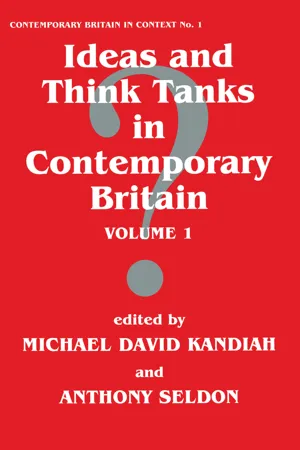
Ideas and Think Tanks in Contemporary Britain
Volume 1
- 216 pages
- English
- ePUB (mobile friendly)
- Available on iOS & Android
eBook - ePub
Ideas and Think Tanks in Contemporary Britain
Volume 1
About this book
This study looks at the influence of ideas and think tanks in Britain, contemplating how ideas have shaped politics and society. The purveyors of ideas for change - the think tanks - are examined, and academics and participants vieww are recorded in a number of interviews.
Information
The Influence of Collectivist Ideas
ANTHONY SELDON interviews BERNARD CRICK
SELDON: We are looking at the influence of ideas, and specifically collectivist ideas, on British post-war policy making. I wonder whether you have any general comment about the extent to which British post-war policy has been ideas-driven?
CRICK: I am going to speak personally and one’s age is important for one’s perspective – having been a biographer, I make that point. I was 15 in 1945 and it took me a year to catch the spirit of the times and to change from a child Tory into a child socialist, and now a democratic socialist. I think reading one of Harold Laski’s books by chance and a socialist schoolmaster had some influence. One certainly believed then that a new world was beginning after 1945, and that it was ideas-driven. It took one a long time to realise that a lot of the institutions of the welfare state were a product of the war and to learn and appreciate, this is later wisdom of course, Richard Titmuss’ dictum that the war did more to accelerate social change than the rhetoric of the Labour Party (although he made his fair contribution to the rhetoric of the Labour Party). We inherited a lot of wartime assumptions, and were optimistic despite the general unhappiness of everyday life. I think it is a very good British trait on the whole: a sort of sardonic scepticism that we have somehow muddled through and can now do better.
It took us a little time to realise how well the war effort had been mobilised compared to that of the totalitarian powers. The morale and adaptability of a free people who agree to be led for the duration of an emergency is far greater than that of people only ever used to command and constraint. What I am getting at is this: we inherited a belief in the effective and beneficent workings of the central state, if it was controlled by the right people, and also in particular the doctrines then associated with the Labour Party (which Mr Blair now wishes to lose or de-emphasise) universal welfare provision, full employment and nationalisation. We did not see nationalisation as anything particularly novel, it seemed to be the common sense which had emerged from the war. The railways were working again and could be turned into a national system under national ownership, whereas before the war the four private companies had been on the edge of bankruptcy. It seems universally necessary to subsidise public services out of taxation for national priorities. The specific doctrine that we all talked about at the LSE was administrative, though I was always more interested in political ideas. One of the best seminars going was by a man called William Robson, a public lawyer, who studied ‘the public corporation’.
This public corporation seemed to me a marvellous device, immune from direct ministerial interference and from the vagaries of the market. Now this may seem, in the light of my well-known interest in political ideas, to be rather an odd thing to say, but I am sure looking back on it that we were all vastly impressed by the nationalisation Acts. But in the mode of the Morrisonian ‘public corporation’, not the vague but passionate left wing dogmas of control by workers and trade unions.
So it was I think this old Fabian tradition, allied with the confidence of a civil service who before the war had viewed any planning as at best a necessary evil, but during the war had rather enjoyed it and done it well. They enjoyed managing and planning things, so the public corporation was just a concrete example of a general belief in planning, democratic planning, at that time. The economist Evan Durbin’s The Politics of Democratic Socialism (1942) certainly had a great, though I do not know whether a direct, influence. I think we read him a bit later, but everybody was talking about him. So that was our belief: that there was a theory of democratic planning. Of course, if you try to look for the literature, you find that the ‘theory’ hardly exists. There was no theory of planning, there was a belief in planning.
SELDON: Could you define a ‘political idea’? What is an idea and how does it differ from any other category?
CRICK: I think ideas are of two kinds, and in life they are very often conflated and a great deal of confusion arises because of this. We can mean principles, and sometimes we do, or we can mean general perceptions that shape our view of reality. For instance, I can not see any moral content, any ideal content whatever, in the concept of Parliamentary sovereignty. But it is in fact an extremely important concept, both as an organisational concept and because it affects people’s perceptions. In 1776 Lord North said ‘Sovereignty cannot be divided’, when compromise proposals were brought to him by American merchants. He was as thick as they come really as a speculative mind, but he had this great big presupposition of ‘sovereignty’. As I was saying about planning, that was a dominant political idea: we thought the world could be planned and had been planned. But to turn that into a moral principle would seem to be wrong, or rather then one is talking about a different kind of idea, as when people say ‘Ah, but nationalisation should not be any end of its own, only a means towards an end’. The end was supposed to be egalitarian, but also a free society, an egalitarian, liberal society. But the implementation is frightfully more complicated and difficult than the annunciation.
A few years ago I wrote a pamphlet with David Blunkett called Labour’s Aims and Values. It was one Neil Kinnock should have written, but somehow he never got round to it, so rather than waste my work as a ‘ghost’, I persuaded David Blunkett to come on board and for us to make an ‘alternative statement’ in our voices. We said ‘aims and values’, because both of us saw that one can talk about ‘aims’ as moral objectives, but one must also talk about ‘values’ – how one pursues these aims; as when one says ‘Well, does the end really justify the means?’ or ‘There are these objectives I ought to pursue, but my values prevent me from pursuing them in this particular way’. So I think we both had reasonably clear aims and values. The interesting thing about the post-war British Left is that whatever muddle people sometimes stumbled into, clearly the aims were socialist and egalitarian, but the values have been liberal in a good old-fashioned sense of not willing to coerce people or to remove possibilities of choice.
SELDON: In making that statement, are you describing the reality of, let’s say, the first twenty-five years of the post-war Labour Party, or are you really describing what you would have liked it to have been like?
CRICK: No, I think that was the reality. One can illustrate the general point by introducing another commonplace of political thought -the idea of preconceptions. Very often people are idea-driven, but they are often not aware of how much they are idea-driven, the preconceptions that they have. In a very simple sense, the public corporation that dominated thinking about the running of Britain in the 1940s and 1950s did not change with the fall of the Labour government, the Conservatives carried it on afterwards. The Conservative preconception, the dominant Conservative preconception at that time, was that it mattered vitally who governed, but it did not matter all that much how the government was conducted. There was not this modern Thatcherite/Keith Joseph-like old-fashioned Liberalism. There was not that kind of prejudice against state intervention as far as people on the Right were concerned as long as the right kind of people sat on the public boards; people on the Right were after all gentlemen, a traditional governing class with a strong sense of history, a strong sense of national integration. It was a very real preconception.
Now that sounds boringly sociological, but in fact it could be justified in moral terms (as I often have to remind my students), because after all it was the Burkian doctrine of experience: things were done best by people who had learned how to do them from actual experience, Oakeshott later said that the belief that certain things can be taught from books – like cookery, sex and politics – was ideology. We do not learn such things from books, we learn them by experience and by modifying the experiences. So my general feeling is that people are ideas-driven even when they are not aware of it. One could go on to the Thatcherites, where it becomes explicit.
SELDON: So that is the difference, that Thatcherism is more clearly traceable to particular texts, and articulated to a greater degree by the influential figures who capitalised on that process like Joseph and Howe? It was more of a muddy amalgam than the Labour Party’s experience post-war?
CRICK: Yes, a muddy amalgam in a sense. But those two tendencies have been with the Conservatives for a long time, one saw that big business began to move to the Conservatives after 1886. The connection grew through the 1900s – Joe Chamberlain and all that. As big business came into the traditional party of the small gentry, the aristocracy, the big landowners, one had this amalgam of the Burkian experience and the enterprise culture and beliefs of the market. But it was remarkable, looking back, how rarely free market principles were invoked by English Conservatives in the late 1940s and really throughout the 1950s. There was a little bit, but most old Tories were very ill at ease with American Republicans. Then there was this gradual quantitative change if you like, that became a qualitative change. Most free-market ideas were there already, but not as the major theme, certainly not in print. We all know the paradox of the old Conservative Burkian doctrine: a suspicion of setting things down too rigidly, indeed almost of setting things down in print at all. We found it extremely difficult to find books to assign to our students on Conservatism, we had to go back to Robert Cecil and a book by L.S. Amery written in the late 1920s.
SELDON: Why do you think the dominant elite in the Conservative Party changed its ideas towards greater absorption in and articulation of free market ideas?
CRICK: I think because of the changing character of the Conservative Party in having to compete more aggressively: it had to go in for a degree of party organisation. That is not a slur, I think it is sociologically accurate. After all, why not have organisation in the suburbs, so people can come and talk suburban rather than landed experience, or rather big business. There was a curious alliance in the country of the big men at the very top of the business classes and the old land-owning class, but gradually more and more people came into Conservative seats whose experience was not of that kind. I mean, many had been to Public Schools, brought up to have the manners of the ‘gentle tradition’, an altruistic tradition, which has had a tremendous effect on culture etc. I simply think that there came a time when this pressure within the party, this impatience with the old guard, was I suppose symbolised in Macmillan.
Here, of course, one has come to a very paradoxical figure, because Macmillan held himself up as a very model of a successful entrepreneur, somebody standing in the entrepreneurial tradition going back to his grandfather and the great publishing family. In fact, ‘Mac’, marrying into the Cavendishes, appeared the very epitome, the archetypal image, of the very laid-back person who had in fact a heart of steel and great determination when the time came – the sort of Baroness Orzcy myth of the British aristocrat. I think that some of the younger businessmen and some of the younger and middle generation of Conservative MPs got a bit impatient with all that benign old foolery. Now, had he succeeded politically of course, of those two tendencies of the Conservative Party, the old one might have continued much longer.
There is a lot of luck and contingency in this. But then, once a contingent event opens the door to a set of ideas, then the ideas become very powerful. There is a lot of political contingency as to what ideological road to take. If Willie Whitelaw had been more energetic he could have beaten Thatcher for the leadership and the old guard’s control continued, ‘One Nation’ Conservatism might have continued. Look at the difference between the way Major is dealing with the Scottish question and the way both Macmillan and Heath dealt with the very much more minor Welsh question. There was a bit of a panic in the 1960s when Plaid Cymru won some extra seats. Macmillan and Heath threw money at the problem and bought off Plaid Cymru by giving them Welsh television and entrenching the language in the education system of North and West Wales. They were shrewd old devils, those sceptical old Tories, because they saw through the nationalist rhetoric and saw that that was what they really wanted, the culture. Much more important and the dreadful threat to nationalists, when you come to think of it, was that a Welsh Parliament such as Labour promised would have a majority of Neil Kinnock-type Welsh – non-Welsh speaking. Heaven forbid, thought the Nationalists, that they should be under a majority of nonWelsh speaking Welsh! The old Tories saw this. The new Tory instinct is, in contrast, very ideological: it believes in general rules like ‘market principles everywhere’ and a comprehensive British nationalism. It has a sense of heritage but no sense of actual history, and talks about the Union, viewing Scotland as a threat, as if Britain is a centralised state, whereas the old Tories always knew that if it was a centralised state it was a most peculiar kind of centralised state, with a different local government system, a different legal system and even a different established church in Scotland somewhat similarly Wales, Northern Ireland.
SELDON: So the change in the 1970s is social change within the party, combined with a degree of contingency and the availability of these other ideas, which have always been latent but which now become active?
CRICK: Exactly. If one is dealing with ideas in politics, it means of course dealing with the behaviour of political parties, and the behaviour of political parties is very much affected by the behaviour of the other parties. So I think there was a sense not merely in the Conservative Party but in the country at large, that the Thatcherite cry about Britain being over-governed made a good deal of sense, especially when Labour’s policies under Michael Foot appeared to lurch so far to the left. On the one hand we desperately want governments to do things for us, on the other hand we desperately want governments to keep off our back in certain areas. Public opinion perpetually oscillates between these two poles. Either extreme is ludicrous. But there was a general feeling growing not merely that the state was taking too much, but that it was not really able to deliver the goods by doing so – a kind of powerlessness of state power. There were the series of balance of payments crises, or the strange prestige Harold Wilson attached to not devaluing the pound; dreary stuff, but these were very powerful national symbols which discredited the idea that the state could control the economic environment. Wilson spoke about being 'blown off course', and I think he was opening the door, perhaps realistically, but he was certainly opening the door: we now have a most incredible state of affairs, compared with when I was young, in which the state is able to persuade most of the country that it has no responsibility for levels of unemployment, or that it has virtually no responsibility for levels of poverty.
SELDON: Could we just come back to ideas in either or both senses, and pinpoint the ideas of the post-war Labour government? You have said that these were essentially Fabian ideas?
CRICK: I find it very difficult to remember when we first started to say ‘Alas! There are no thinkers now’. In the Labour government in the 1950s, after all, people who were in their forties and fifties, had been reading books of the late 1920s and early 1930s. So they were still talking about Tawney, Laski, Cole, Brailsford, and even Kingsley Martin. Even Orwell I think begins to fit into this picture, perhaps not as a direct influence, but he was very typical of the kind of socialist moral argument abounding. But it is very difficult to think of anybody post-war, there seemed to be no writers. So, ‘Oh dear, Evan Durbin tragically killed in a bathing accident in 1946’, many of us said, ‘supposing that had not happened he would have been a major thinker’. Of course that was slightly daft. In a way we were thinking of ‘thinkers’ as people who write books. Because the subject is taught in universities, you have to turn to books. I found it very difficult to look at the general ideas of p...
Table of contents
- Cover Page
- Half Title Page
- Title Page
- Contents
- Introduction
- Political Ideas since 1945, Or How Long was the Twentieth Century?
- The Beveridge Strait-jacket: Policy Formation and the Problem of Poverty in Old Age
- The Nature and Impact of Think Tanks in Contemporary Britain
- The Social Market Foundation
- ‘Blueprint for a Revolution'? The Politics of The Adam Smith Institute
- The Institute of Economic Affairs: Undermining the Post-War Consensus
- Witness Seminar
- Interviews
Trusted by 375,005 students
Access to over 1.5 million titles for a fair monthly price.
Study more efficiently using our study tools.
Frequently asked questions
Yes, you can cancel anytime from the Subscription tab in your account settings on the Perlego website. Your subscription will stay active until the end of your current billing period. Learn how to cancel your subscription
No, books cannot be downloaded as external files, such as PDFs, for use outside of Perlego. However, you can download books within the Perlego app for offline reading on mobile or tablet. Learn how to download books offline
Perlego offers two plans: Essential and Complete
- Essential is ideal for learners and professionals who enjoy exploring a wide range of subjects. Access the Essential Library with 800,000+ trusted titles and best-sellers across business, personal growth, and the humanities. Includes unlimited reading time and Standard Read Aloud voice.
- Complete: Perfect for advanced learners and researchers needing full, unrestricted access. Unlock 1.5M+ books across hundreds of subjects, including academic and specialized titles. The Complete Plan also includes advanced features like Premium Read Aloud and Research Assistant.
We are an online textbook subscription service, where you can get access to an entire online library for less than the price of a single book per month. With over 1.5 million books across 990+ topics, we’ve got you covered! Learn about our mission
Look out for the read-aloud symbol on your next book to see if you can listen to it. The read-aloud tool reads text aloud for you, highlighting the text as it is being read. You can pause it, speed it up and slow it down. Learn more about Read Aloud
Yes! You can use the Perlego app on both iOS and Android devices to read anytime, anywhere — even offline. Perfect for commutes or when you’re on the go.
Please note we cannot support devices running on iOS 13 and Android 7 or earlier. Learn more about using the app
Please note we cannot support devices running on iOS 13 and Android 7 or earlier. Learn more about using the app
Yes, you can access Ideas and Think Tanks in Contemporary Britain by Michael David Kandiah, Anthony Seldon, Michael David Kandiah,Anthony Seldon in PDF and/or ePUB format, as well as other popular books in Politics & International Relations & European Politics. We have over 1.5 million books available in our catalogue for you to explore.