- 288 pages
- English
- ePUB (mobile friendly)
- Available on iOS & Android
eBook - ePub
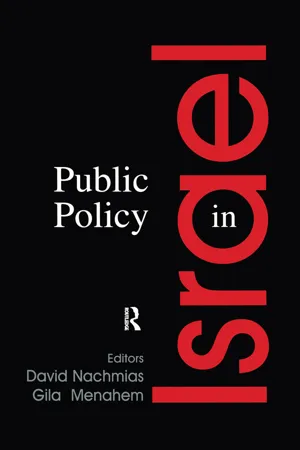
Public Policy in Israel
About this book
An examination of the current Israeli government, covering public policies such as health, housing and transport. The volume covers the institutional as well as the political and the bureaucratic framework within which public policies have been made and implemented.
Information
PART I
THE INSTITUTIONAL AND POLITICAL CONTEXT
Governance and Public Policy
As the state of Israel is celebrating its 50th anniversary, a pervasive sense of uncertainty and apprehension over the future direction of foreign and domestic public policies overshadows its impressive achievements. The peace process initiated by the Labour-led coalition government has stalled, and the domestic roles of the state, its scope, boundaries and its governing institutions have been profoundly challenged in ways that would have appalled the nation’s founding elite. Political reforms and economic liberalization measures have been implemented and a new generation of leaders, more pragmatic and technocratic in orientation and less compelled by traditional ideologies and party organizations, have ascended to power positions. According to astute observers of Israeli politics, the second republic has been emerging.1 At the same time, economic, social and political cleavages have intensified, resulting in public policies characterized by greater contradictions, fragmentation and incoherence.
In democracies, perhaps inevitably, public policies tend to be contradictory and to exhibit a certain measure of fragmentation and incoherence as a consequence of the political inclination of policy-makers to pursue mutually inconsistent objectives at one and the same time.2 Even on occasions when the design of an optimal policy is feasible and political expediency is temporarily restrained, the problem of dynamic inconsistency prevails. That is, there is always a discrepancy between the optimal policy in the long run and the optimal policy at any given time.3 In this context, institutional designs make a great difference. Properly conceived and implemented, they can lessen policy contradictions, moderate fragmentation and reduce incoherence.4
Since the early 1980s, divisive issues of institutional design have penetrated the Israeli public agenda. In the absence of a written constitution, a ‘constitutional revolution’ to protect human and civil rights and to expand the power of judicial review of legislation through basic laws has been evolving. Closed primaries were introduced by the political parties, and, most consequently, an electoral reform for direct election of the prime minister was passed by the Knesset and implemented in the 1996 general election.5 The high saliency of institutional choice issues has been primarily due to persisting policy deadlocks coupled with more general but forceful demands for government effectiveness and accountability. In this introductory section, we first discuss the general caveats concerning institutional designs in a context of democratic governance and policy-making. Next, the major institutional arrangements that prevailed from the pre-state era until very recently are critically examined. In the third section we describe the decline of political parties and the resulting consequences on coalition governance and public policy. Next, the political reforms of the 1990s and their redistributive consequences are examined. In the fifth section the institutionalization of public bureaucracy in the policy process is discussed. We conclude with some general propositions on institutional designs.
POLITICAL INSTITUTIONS AND GOVERNANCE
Political institutions structure the processes through which policy decisions are formulated and implemented and these in turn strongly affect the polity’s governing capacity.6 The institutional structure of the polity is of particular importance because it shapes the public policymaking process, determining which issues and problems are accorded consideration and in what order of priority.7 The effects of political institutions can be either direct or mediated by the broader socioeconomic structure within which they operate. Political institutions embody not only legal, procedural arrangements but also substantive, normative aspirations. Indeed, no one set of political institutions is optimal for all democracies (for instance, parliamentary versus presidential), in all situations (nation-building or developed), nor is any country’s specific choice of institutions everlasting. As inefficiencies in governing capability mount, the legitimacy of existing institutional arrangements declines and proposals for reform penetrate the public agenda. Although the specifics of the reforms vary, their general objective, at least in rhetoric, is similar: to enhance government accountability and effectiveness. The responsiveness of the political elites to widespread demands for reform is in itself a distinct measure of governing capabilities. Failure to respond sensibly and in a timely fashion may lead to a legitimacy crisis and even civil strife.
At the very fundamental level of governing capabilities is the fusion or separation of executive and legislative power. In general, parliamentary systems institutionalize more fusion of power and greater centralization of decision-making in the cabinet. Prime ministers are selected by the legislature, and their tenure in office depends on the confidence of the legislature. The wider the legislative support, the higher is the concentration of executive power. Generally, party cohesion is relatively strong with the party leadership having a variety of disciplinary measures over individual legislators, including the placement in the party list in proportional representation systems; party endorsement and campaign financing in single-member constituency systems; and advancement to ministerial positions or other remunerative public offices. The cabinet is composed chiefly of veteran politicians who are also members of the legislative branch, and nearly all are assigned by the prime minister to head executive departments. Such institutional arrangements lead to the formation of grand, consensual public policies, such as the welfare state in Western parliamentary democracies, that are relatively coherent, congruent and stable over time. Notwithstanding differences in emphasis among governments between and within parliamentary democracies, public education, nationalized health services, social security, housing, public transport and social welfare are all examples of policies deriving from the general, continuous and relatively consistent commitment to the welfare state.
THE INSTITUTIONAL ENDOWMENT OF ISRAEL
The institutional endowment bequeathed by the Israeli founding elite was not designed for an accountable and effective government. Provisional governing institutions and arrangements were adapted in haste, as a temporary expedient reflecting the pre-state institutional order as well as the lowest common denominator of consensus, in order to meet the pressing exigencies of national security, massive immigration and state-building. Although the declared policy intention of the founding elite was to replace the transitional order by permanent political institutions anchored in a written constitution, political expediency prevailed. The first legislative authority of the new state decided in its first session that it would function as an established parliament to be called the First Knesset. The pre-state electoral system was adopted: a single national constituency and a pure proportional representation rule with an extremely low threshold – 1 per cent of the national vote before the 1992 election and 1.5 per cent since. This electoral rule suited well the voluntary structure and the inclusive political culture of the emerging Israeli polity. The founding elite also made the greatly significant decision not to frame an inclusive written constitution. A piecemeal, consensual approach to the designing of a constitution emerged thus avoiding the imposition of losses to the politically organized religious minority that intensely opposed a democratic-secular constitution, and at the same time minimizing limitations on government power. The Knesset was called to enact a set of basic laws that in due course would constitute part of the inclusive constitution. However, since the adoption of the piecemeal approach in 1950, only 11 basic laws have been passed, and even more significantly many lack limiting clauses or entrenched provisions requiring that changes be made only by special majorities in the Knesset. Consequently, they are legally inappropriate for eventual inclusion in a constitution.8
Within this institutional setting, the ‘party state’ emerged. The political parties with their strong oligarchic organizations penetrated extensively and intensively almost all organized social and economic activities, thus institutionalizing themselves as the exclusive policy-makers and monopolizing the public agenda and the policy process. Following the general elections, the head of the largest party in the Knesset was almost always (with one notable exception) asked to form a governing coalition and, with his or her eventual success, become the prime minister with immense power in policy formation endowed in this position. To the extent that the prime minister shared policy-making power with others, it was mostly with the heads of other parliamentary parties who were either actual or potential partners in coalition governments. In fact, even the heads of the traditional big opposition parties were not excluded. During the national emergency of 1967, the head of the leading right-wing opposition party Gahal, the late Menachem Begin, was asked by a Labour-led coalition to join the decision-making processes. Similarly, the heads of the small extreme left-wing parties, whose constituencies were predominantly Israeli Arab citizens, were often called to join negotiations over policies affecting their constituencies.
The central tendency induced by the institutional make-up of the parliamentary system was reinforced by two additional factors: the general vision of the state by the political elites as a welfare state, and the centralized labour union, the Histadrut. From pre-statehood, the dominant political elites envisaged Israel as a welfare state in the broadest sense, responsible for the well-being of its citizens. Since its establishment the state has provided an extensive assembly of public goods and social services, thus creating an unusually large public sector in comparison to other parliamentary democracies. Whereas many of these services – such as education, housing, social security, social welfare, water supply and infrastructure projects – were provided directly by government ministries and agencies, others – such as electricity, telephone and public transport – were supplied by subsidized monopolies established and controlled by political parties. The glaring exception were health services provided by the Histadrut to approximately three-quarters of the population and controlled by the Labour party that formed all the national governments until 1977.
Until national independence, the Histadrut was the key mechanism to allocate resources for absorbing new immigrants, building and supporting new settlements for immigrants, providing security, promoting economic development and employment, providing health services, education, pension funds, cultural and sports activities. Following independence, the provision of health services remained in the control of the Histadrut along with indirect control over agricultural settlements, the kibbutzim, and the ownership of powerful economic conglomerates such as Gal, Koor and Bank Hapoalim, to this day the largest bank in Israel. These vast resources were controlled by the Histadrut’s chief executive, always the head of the largest political party elected by the membership. Until the early 1990s the Histadrut was entirely controlled by the Labour party.
Thus, during its first three decades, Israel had an electoral system with a proportional rule that invariably rendered the head of the dominant Labour party remarkably powerful in policy-making, checked only by the need to reach agreements over policy issues with coalition partners and the head of the Histadrut. As Knight pointed out, an important role that institutions play in every society is to help individuals form expectations concerning the behaviour of others and of governing institutions.9 In the first three decades of the Israeli polity, the extensive penetration of the state into the lives of its citizens led to almost unlimited expectations from the prime minister and, to a lesser extent, from leaders of other political parties and the head of the Histadrut. Significantly, the expectations were congruent with the institutional structure that granted, to the political elite, policy-making power pertinent to almost all aspects of life.
THE DECLINE OF POLITICAL PARTIES
Since the early 1980s the ‘party state’ has been transforming into a more complex, differentiated, open and pluralistic society. These processes were accompanied by policy deadlocks leading to a variety of reforms, including party reforms to select Knesset nominees and an electoral reform to direct election of the prime minister. The 1996 election resulted in the most highly fragmented party representation in the polity’s history. The electoral strength of the two biggest parties, Labour and Likud, markedly declined. Smaller, sectarian parties increased their power in the Knesset leading, because of coalition-building constraints, to a significant symbolic and tangible redistributive policy outcome. Meanwhile, the direct election of the prime minister reinforced the already existing tendency of candidate-centred campaigns and issues and f...
Table of contents
- Cover Page
- Half Title page
- Title Page
- Copyright Page
- Contents
- Acknowledgement
- Part I The Institutional and Political Context
- Part II Issues of Governance
- Part III Selected Policy Areas
- Abstract
- Index
Trusted by 375,005 students
Access to over 1.5 million titles for a fair monthly price.
Study more efficiently using our study tools.
Frequently asked questions
Yes, you can cancel anytime from the Subscription tab in your account settings on the Perlego website. Your subscription will stay active until the end of your current billing period. Learn how to cancel your subscription
No, books cannot be downloaded as external files, such as PDFs, for use outside of Perlego. However, you can download books within the Perlego app for offline reading on mobile or tablet. Learn how to download books offline
Perlego offers two plans: Essential and Complete
- Essential is ideal for learners and professionals who enjoy exploring a wide range of subjects. Access the Essential Library with 800,000+ trusted titles and best-sellers across business, personal growth, and the humanities. Includes unlimited reading time and Standard Read Aloud voice.
- Complete: Perfect for advanced learners and researchers needing full, unrestricted access. Unlock 1.5M+ books across hundreds of subjects, including academic and specialized titles. The Complete Plan also includes advanced features like Premium Read Aloud and Research Assistant.
We are an online textbook subscription service, where you can get access to an entire online library for less than the price of a single book per month. With over 1.5 million books across 990+ topics, we’ve got you covered! Learn about our mission
Look out for the read-aloud symbol on your next book to see if you can listen to it. The read-aloud tool reads text aloud for you, highlighting the text as it is being read. You can pause it, speed it up and slow it down. Learn more about Read Aloud
Yes! You can use the Perlego app on both iOS and Android devices to read anytime, anywhere — even offline. Perfect for commutes or when you’re on the go.
Please note we cannot support devices running on iOS 13 and Android 7 or earlier. Learn more about using the app
Please note we cannot support devices running on iOS 13 and Android 7 or earlier. Learn more about using the app
Yes, you can access Public Policy in Israel by David Nachmias,Gila Menahem in PDF and/or ePUB format, as well as other popular books in Politica e relazioni internazionali & Pianificazione e sviluppo urbano. We have over 1.5 million books available in our catalogue for you to explore.