Dick Houtman argues that neither authoritarianism nor libertarianism can be explained by class or economic background, but rather by position in the cultural domain-- what he calls cultural capital. Although he examines all of the statistics and arguments of the conventional approaches with care and concern, Houtman convincingly demonstrates that the conclusions drawn from earlier studies are untenable at a more general theoretical level. Despite differences among advocates of class explanations, their theories are based on largely identical research findings--in particular a strong negative relationship between education and authoritarianism. Unobstructed by the conclusions these authors felt called upon to draw from the findings themselves, Houtman configures them in a new way. The hypotheses derived from this new theory allow for a systematic, strict, and competitive testing of original theses without ignoring the value of and earlier research. After demonstrating that authoritarianism and libertarianism cannot be explained by class or economic background, Houtman examines the implications of this argument for today's death of class debate in political sociology. He holds it to be unfortunate that the relevance of class to politics is typically addressed by studying the relation between class and voting. This conceals a complex cross-pressure mechanism that causes this relationship to capture the net balance of class voting and its opposite, cultural voting, instead of class voting. He argues that references to a decline in class voting may be basically correct, but dogmatic reliance on the relation between class and voting to prove the point systematically underestimates levels of class voting and produces an exaggerated picture of the decline.
eBook - ePub
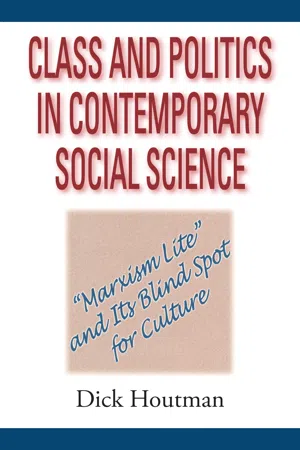
Class and Politics in Contemporary Social Science
Marxism Lite and Its Blind Spot for Culture
- 224 pages
- English
- ePUB (mobile friendly)
- Available on iOS & Android
eBook - ePub
Class and Politics in Contemporary Social Science
Marxism Lite and Its Blind Spot for Culture
About this book
Information
1
“Marxism Lite”: Modernity, Industrialism, and Culture
The Marxist interpretation of society seems in decline throughout the industrialized world. Its emphasis on economic factors as the driving force of history … is of diminishing value as scarcity diminishes and new problems emerge.
—Ronald Inglehart, “Value Change in Industrial Societies”
1.1 Introduction
Especially after the dramatic collapse of Communism behind what was once the Iron Curtain, symbolized about fifteen years ago by what has since come to be known as the Fall of the Wall, Marxism has been widely viewed as politically bankrupt. Nowadays there is a tendency to conclude that Marxist social scientific theories are similarly no longer to be taken seriously. All things considered, however, this is an odd notion.
After all, political ideas ought to be measured by quite different standards than social scientific theories: they do not have to be “true.”1 The only thing that matters is whether they can inspire social movements, political elites, and voters to work toward a better world. They can only play this role as long as there is a discrepancy with the surrounding social reality. Once political ideals are realized, this discrepancy disappears and they consequently lose their significance as sources of inspiration for political action and fade into history’s oblivion. Social scientific theories, however, should not be judged by their capacity to inspire political action. What matters is that they accurately represent reality: the effort to capture a certain similitude between scientific theories and the reality outside them is the guiding principle of science. Of course we find certain theories beautiful or attractive for aesthetic, political, or other reasons, but in the end, as the English say, the proof of the pudding is still in the eating.
The value of a social scientific theory might thus be said to diminish as the discrepancy with the surrounding social reality grows, whereas the value of a political idea only increases. This is why it is somewhat surprising that nowadays with the world more capitalistic than in the 1960s or 1970s, Marxism should have lost so much of its political standing in Western societies. It is even more surprising to see how many social scientists conclude that ever since the collapse of Communism, Marxist social scientific theories are also no longer “true.” The most surprising thing of all, however, is that many of the non-Marxist theories now considered superior are just as based on the assumption that culture is solely a reflection of material states of affairs as their Marxist counterparts were. It is this assumption, as it is elaborated in several influential contemporary social scientific theories, that occupies a central place in this study. None of these theories are Marxist, but they do nonetheless all work from the point of departure that people’s values are shaped by their economic position or background. This is why they are referred to as “Marxist lite” theories in this book.
By way of introduction, this chapter addresses several issues that are crucial to a proper understanding of the theme of this book and how I approach it. I focus on the sociological roots of the above-mentioned materialist assumption in Section 1.2, formulate the research questions addressed in this study in Section 1.3, and briefly outline my approach in Section 1.4.1 close this introductory chapter with a discussion of the data files I use in Section 1.5 and the further structure of the book in Section 1.6.
1.2 Modernity as Industrialism
1.2.1 Conflict Sociology and Functionalism
Very few periods in the history of sociology have been as consequential as the 1960s, which marked the end of a lengthy period of intellectual domination by American structural functionalism with Talcott Parsons (Harvard) and Robert Merton (Columbia) as its leading spokesmen. The question of exactly what happened in this period and why, and what the effects were, is still dividing sociology today. Should the events at the time be predominantly viewed as intellectual or as cultural and political developments? Was it the start of a crisis in sociology or indeed the birth of a new and better sociology? And if so, how does this new and better version differ from its predecessor? Have sociology and politics since become more intertwined or less? And has this done any damage to sociology or not? These are a few of the important questions whose answers are still controversial and probably always will be (Cole 2001; Horowitz 1993; Lemert 1995; Lopreato and Crippen 1999; Seidman 1994).
These questions go beyond the scope of this book and will thus remain unanswered here. Only one ramification of the turbulence of the 1960s needs to be addressed to put the themes examined in this study in their proper perspective. It has to do with the tendency since that time, especially evident in American sociology textbooks, to contrast functionalism and conflict sociology as two diametrically opposed paradigms. It is undisputed that sociology has since been characterized far more than before by theoretical pluralism. It is also undisputed that conflict sociology and functionalism are two of the most influential theoretical approaches. It is ironic, however, that precisely because conflict sociology has since been so widely accepted as an attractive alternative for functionalism, important similarities between the two should have faded into the background.2
This is obvious from the very way Durkheim and Marx have been presented for the past three decades, once again mainly in American textbooks, as the respective founders of functionalism and conflict sociology (e.g., Conklin 1984; Macionis and Plummer 1997). Durkheim is viewed in this connection as a go-between linking Comte’s work on the importance of a moral consensus for the preservation of social order and modern functionalism. Marx is depicted as the nineteenth-century founder of conflict sociology, in which coercion rather than moral consensus is viewed as the underlying cause of order and stability. Although this depiction is not entirely erroneous, it is one-sided and problematic.
In line with Collins (1975), perhaps the most influential conflict sociologist since the second half of the 1970s, one might wonder whether it is accurate to view Marx as the most important founder of the conflict paradigm. Collins himself seems to attach greater importance to Weber, who had much less of a tendency than Marx to reduce every conceivable disharmony in society to the conflict of interest between labor and capital (1986:11, 1992:7). As a questionable result of the fact that it is nonetheless common practice to cite Marx and Marx alone as the founder of conflict sociology, many textbooks give the impression that conflict sociology is little more than Marxist conflict sociology. It is more important for this study, however, that the construction of this opposition between Durkheim and Marx has caused two important similarities between them to fade into the background.3 They can largely be traced back to the influence of Saint-Simon on both of them.
1.2.2 Marx and Durkheim: A World of Difference?
The analysis of modern society as an industrial society is central to the sociology of Saint-Simon (1760–1825). In his view, industrialism heralds a new era in history, with all the ramifications this might have for social relations. He has no doubt about who will be the winners and the losers in this new type of society. The nobility and the clergy are the most significant losers. They might well have occupied dominant positions in medieval society, but they no longer have a role of any importance to play in industrial society. Their parasitic and essentially useless military, political, and religious activities are replaced by a far more important one: contributing to industrial production (Kumar 1978; Manuel 1956).
According to Saint-Simon, the winners in the industrialization process are those who contribute to the preservation and expansion of industrialism. More than anyone else, they are the occupational categories responsible for the discovery and application of new technologies—inventors, scientists, industrialists, workers, and artisans. These changes in power relations are inevitable because an industrial society requires meritocracy. In this type of society, it is hardly possible to avoid rewarding people and giving them positions in society on the grounds of their skills and expertise. The importance of ascribed features such as social background and family ties is thus inevitably reduced under the influence of industrial development by achieved features like these. An industrial society is inevitably an open society.
Marx is not only strongly influenced by German philosophers and British political economists, but also by French thinkers like Saint-Simon. He was especially open to this influence during his stay in Paris in the 1840s (Coser 1977:56–62). Marx conceptualizes modern society as a capitalist society. Its dynamics stem from the contradiction between the development of technology—the forces of production—and capitalist property relations—the relations of production. Since entrepreneurs have no choice in a system of capitalist relations but to strive to reduce their costs by way of technological innovation and exploitation of the working class, this contradiction inevitably increases. The same holds just as inevitably true of the intensity of the struggle between labor and capital. It will ultimately mean the end of capitalism. This then is Marx’s social theory in a nutshell (Marx and Engels 1948 [1848]; Marx 1967 [1867]).
Like Saint-Simon, Marx sees modern society as an industrial society. He too feels its dynamics come from the development and application of new technology—the development of the forces of production. We have seen, however, that Saint-Simon awards a central position to the conflict between the two dominant estates of the old society, the nobility and the clergy on the one hand, and the two industrial classes, labor and capital, on the other. It is true that Marx adopts Saint-Simon’s notion of antagonistic relations, but he uses it to drive a wedge between the two industrial classes: he does not position labor and capital side by side countering the nobility and clergy, but sees them as countering each other. Thus the relation between labor and capital is not depicted—as in the work of Saint-Simon—as characterized by common interests and mutual dependence, but as based upon conflicting economic interests. Localizing the central social conflict in the heart of industrial society itself results in Marx’s familiar depiction of modern society as a capitalist society.
In The Division of Labor in Society (1964 [1893]), Durkheim explains that shared values and norms can only constitute the basis for social cohesion in premodern societies. Partly because of the influence of industrial development, this mechanical type of solidarity is subject to erosion. In modern society, which consequently, also according to Durkheim, “is, or tends to be, essentially industrial” (1964 [1893]:3), social cohesion can no longer be based upon this kind of cultural similarity between people. Durkheim’s central idea is that in this new type of society, solidarity comes instead from economic and functional differences between people: differences in capacities and occupational activities, as are manifested in the industrial division of labor. It is indeed the awareness of the mutual dependence this implies that is at the foundation of the social cohesion of industrial societies: mechanical solidarity is replaced by organic solidarity (Durkheim 1964 [1893]).
Because of this influential analysis, Durkheim cannot simply be viewed as a go-between linking Comte and functionalism. In essence, as Gouldner rightly notes, The Division of Labor in Society should be construed as a critique of Comte: “In his Division of Labor … Durkheim was not gropingly moving toward an appreciation of shared moral norms; he was, in fact, moving away from Comte’s emphasis on their significance in modern society” (1958:xiii). It is precisely when he disagrees with Comte and holds that in industrial society, shared values and norms can no longer function as sources of social cohesion that Saint-Simon acts as Durkheim’s most important source of intellectual inspiration. Since in the end both industrial classes have an interest in the preservation and expansion of industrialism, in Durkheim’s opinion this is exactly what serves as the basis for the social cohesion of modern society (Fenton 1984:16).
In short, Saint-Simon’s influence is evident in the work of Marx as well as Durkheim. Their analyses consequently have more in common than one might think, judging from most modern textbooks. Both of them see modern society primarily as an industrial society; they both localize the engine of social development in the heart of the industrial system, which they consequently view as the central institution of modern society. But of course there are also important differences between the analyses of Marx and Durkheim. The most striking one pertains to how they conceptualize the relation between labor and capital; Marx sees it as antagonistic and Durkheim as cooperative. Marx consequently views exploitation, labor conflicts, and class struggle as normal and inevitable side effects of capitalism, whereas Durkheim sees them as abnormal excrescence. A somewhat deeper analysis of this difference soon reveals it to be a direct result of a second important similarity between the two. What similarity is this?
1.2.3 Industrialism and Culture: Marx and Durkheim on “Being” and “Consciousness”
Durkheim does not view conflicts between labor and capital as inevitable, but as resulting from a faulty organization of the industrial system. They can and should be avoided by organizing the system in a rational manner. This is his underlying line of thought when he propagates cooperation between labor and capital. He does so under the title “Some Notes on Occupational Groups” in the foreword to the second edition of The Division of Labor in Society (1964 [1893]:1–38). It is precisely the corporations Durkheim propagates here that can nourish the awareness of mutual dependence and thus further the industrial peace and reinforce organic solidarity.4
Durkheim’s opinion on the abnormality of exploitation, strikes, and class struggle is not based on how frequently they occur. After all, whether strikes are only occasional or a society is plagued for years by class struggle does not affect Durkheim’s answer to the question of whether they are “normal” or not. They simply are not normal. Just like employers who feel they have a right to exploit their workers, workers who feel there is an unsolvable clash of interests with “capital” bear witness, according to Durkheim, to a lack of insight into their shared interests. Although they cannot rightly be blamed, since this misunderstanding is due to the improper organization of socioeconomic life, the lack of insight still remains. Since it goes against the true nature of industrialism, Durkheim refers to the resulting conduct (strikes, exploitation, class struggle, and so forth) as pathological.
The notion of organic solidarity consequently plays a paradoxical role in Durkheim’s analysis. Though according to him it is the normal course of affairs in an industrial society, in reality it is such a rare occurrence that in the foreword referred to above, he feels the need to recommend specific steps to reinforce it. His analysis thus leaves the possibility that though organic solidarity is quite normal, it nonetheless does not exist, as he indeed makes explicit in The Rules of Sociological Method: “A phenomenon can … persist throughout the entire range of a species although no longer adapted to the requirements of the situation. It is then normal only in appearance. Its universality is now an illusion since its persistence, due only to the blind force of habit, can no longer be accepted as an index of a close connection with the general conditions of its collective existence” (1964 [1895]:60–61).
Marx’s assessment of these phenomena is diametrically opposed to Durkheim’s. Industrial peace and cooperation between labor and capital are not normal at all, as Durkheim claims. In fact they are quite abnormal. This assessment is also independent of the extent of class struggle or industrial peace in a society. This is why, according to Marx, workers who feel they have the same interests as the capitalist entrepreneurs they work for have a false class consciousness: they lack rational insight into the true nature of capitalist society. Only workers who—like Marx himself—are able to totally comprehend capitalism and rationally translate their insight into a political struggle against capitalism have a true class consciousness.
In Durkheim’s perspective, in short, there does not necessarily have to be organic solidarity for it to be normal, and from Marx’s angle true class consciousness and class struggle also do not have to exist to be normal. Their ideas may in...
Table of contents
- Cover Page
- Class and Politics in Contemporary Social Science
- copy
- Contents
- Preface
- 1. “Marxism Lite”: Modernity, Industrialism, and Culture
- 2. What is Actually a “Class”?
- 3. What About Occupational Self-Direction?
- 4. Is Postmaterialism Really Different from Libertarianism?
- 5. Why Are There So Many Postmaterialists in Affluent Countries?
- 6. Who Votes for Whom? And Why Exactly?
- 7. Has There Really Been a Decline in Class Voting? Class Voting and Cultural Voting in Britain, 1974-1997 (with Peter Achterberg)
- 8. Conclusion: “Marxism Lite” and Its Blind Spot for Culture
- Appendix: Secondary Data Sources
- References
- Index
Trusted by 375,005 students
Access to over 1.5 million titles for a fair monthly price.
Study more efficiently using our study tools.
Frequently asked questions
Yes, you can cancel anytime from the Subscription tab in your account settings on the Perlego website. Your subscription will stay active until the end of your current billing period. Learn how to cancel your subscription
No, books cannot be downloaded as external files, such as PDFs, for use outside of Perlego. However, you can download books within the Perlego app for offline reading on mobile or tablet. Learn how to download books offline
Perlego offers two plans: Essential and Complete
- Essential is ideal for learners and professionals who enjoy exploring a wide range of subjects. Access the Essential Library with 800,000+ trusted titles and best-sellers across business, personal growth, and the humanities. Includes unlimited reading time and Standard Read Aloud voice.
- Complete: Perfect for advanced learners and researchers needing full, unrestricted access. Unlock 1.5M+ books across hundreds of subjects, including academic and specialized titles. The Complete Plan also includes advanced features like Premium Read Aloud and Research Assistant.
We are an online textbook subscription service, where you can get access to an entire online library for less than the price of a single book per month. With over 1.5 million books across 990+ topics, we’ve got you covered! Learn about our mission
Look out for the read-aloud symbol on your next book to see if you can listen to it. The read-aloud tool reads text aloud for you, highlighting the text as it is being read. You can pause it, speed it up and slow it down. Learn more about Read Aloud
Yes! You can use the Perlego app on both iOS and Android devices to read anytime, anywhere — even offline. Perfect for commutes or when you’re on the go.
Please note we cannot support devices running on iOS 13 and Android 7 or earlier. Learn more about using the app
Please note we cannot support devices running on iOS 13 and Android 7 or earlier. Learn more about using the app
Yes, you can access Class and Politics in Contemporary Social Science by Dick Houtman in PDF and/or ePUB format, as well as other popular books in Social Sciences & Political Process. We have over 1.5 million books available in our catalogue for you to explore.