- 286 pages
- English
- ePUB (mobile friendly)
- Available on iOS & Android
eBook - ePub
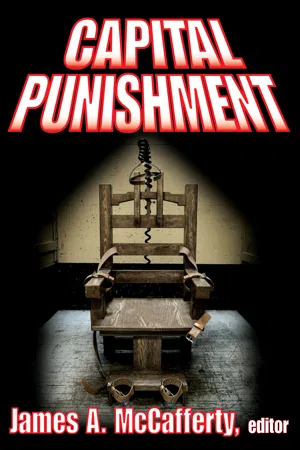
Capital Punishment
About this book
Numerous people face legal execution in the United States. Their presence in death rows throughout the country refutes a basic premise of our judicial system, for the use of capital punishment denies the existence of universal rehabilitation. There is another paradox-juries continue to sentence men and women to death; yet few ever get executed. Whether one is for or against capital punishment, one cannot approach the issue without deep emotion and conviction. James McCafferty provides an even-tempered, eminently reasonable discussion of the issue with balanced commentary from both sides of the debate. McCafferty presents not only empirical data and analyses of the nature of capital punishment, but provides perspectives on the larger issues of our approach to lawbreakers and their rehabilitation. The claims of both those who want to retain capital punishment and those who want to abolish it are included. The arguments consider whether capital punishment deters crime as well as the question of discrimination. A wealth of references, an extremely useful bibliography, and a final chapter delineating the legal issues facing the courts at the time the book was originally published in 1972 complete this unusually incisive and balanced study. Capital Punishment remains an important volume in the field of criminal justice. It seeks to educate rather than propagandize. It is intended for use in numerous courses in sociology and political science as well as in law schools. Anyone wishing to gain a perspective on what remains a controversial issue more than thirty years later would be well advised to study this work by world-class scholars.
Information
Subtopic
SentencingI Facts and Figures
An understanding of the death penalty needs to be based on some fundamental facts and figures. Therefore, it is appropriate to begin this controversy with a statement about the origins of capital punishment. The first article is taken from Hugo Adam Bedau’s vigorous anthology, The Death Penalty in America. Bedau has compressed into a few pages a description of capital punishment as it existed under English criminal law, with its monstrous list of capital offenses, in the sixteenth century. Conviction for any of these offenses called for a death sentence; in those rare instances when the sentence was not imposed, lands and property, together with all right of inheritance, were forfeited.
Bedau’s background article explains the derivation of the death penalty laws in the American colonies and the effort by the colonists to move away from this English heritage through a redefinition of the crime of murder. It details the development of new methods of execution and provisions for private execution. Courts were given the option to sentence defendants to death or to life imprisonment at this time, a procedure offering the first opportunity in Anglo-Saxon history to recognize differences in culpability.
The second article included in this section is by Walter C. Reckless. It brings together the legal status of capital punishment in the world and in the United States as well as the available factual insights into the deterrent effect. Reckless’s article reviews data and research that shed light on the effect of abolition and the restricted use of the death penalty on homicide and crimes of violence. Reckless uses the official United States government executions reports as well as studies by Clarence H. Patrick and James A. McCafferty to build a statistical base for his article. He shows that there is no evidence that capital punishment provides deterrence. Using studies of homicide rates in contiguous states, Reckless notes that the evidence shows no discernible effect of capital punishment. Nor do homicide rates appear to change in periods before, during or after abolition. In those states which impose capital punishment, according to Reckless, there is no significant increase in murders before or after an execution.
The Reckless article offers a beginning point from which the reader can determine if there has been a major change in policy toward the death penalty.
1 General Introduction
Hugo A. Bedau
From The Death Penalty in America, edited by Dr. Hugo Adam Bedau. Copyright © 1964, and 1967 by Hugo Adam Bedau. Reprinted by permission of Doubleday & Company, Inc.
American criminal law was not created out of nothing by the original colonists and the Founding Fathers. Rather, it took its shape directly from English criminal law of the sixteenth, seventeenth and eighteenth centuries. In order to appreciate the structure that this tradition imparted to the American law of capital punishment, it is necessary to review, if only briefly, the experience in England with the death penalty during our nation’s formative years. Accordingly, in the following paragraphs, we shall examine the main features of the capital laws of England as a foundation for a study of the pattern of capital laws in colonial America. With this background of English and early American law in mind, we will then be in a position to appreciate the major American innovations in capital punishment developed during the past century and a half (privacy of executions, redefinition of the crime of murder, new methods of execution, and optional death penalties), innovations that give distinctive shape to this mode of punishment as it now exists in our country.
Capital Punishment in England and America: “The Bloody Code”
By the end of the fifteenth century, English law recognized eight major capital crimes: treason (including attempts and conspiracies), petty treason (killing of a husband by his wife), murder (killing a person with “malice”), larceny, robbery, burglary, rape and arson.1 Under the Tudors and Stuarts, many more crimes entered this category. By 1688 there were nearly fifty. During the reign of George II, nearly three dozen more were added, and under George III the total was increased by sixty. The highpoint was reached shortly after 1800. One estimate put the number of capital crimes at 223 as late as 1819. It is impossible to detail here the incredible variety of offenses involved. Crimes of every description against the state, against the person, against property, against the public peace were made punishable by death. Even with fairly lax enforcement after 1800, between 2,000 and 3,000 persons were sentenced to death each year from 1805 to 1810.2
Conviction of a capital offense, whether or not sentence was executed, resulted in attainder: forfeiture of all lands and property, and denial of all right of inheritance (“corruption of blood”). Although appeal of the death sentence itself to a higher tribunal was all but impossible, the descendants of an executed criminal occasionally succeeded in appealing the attainder.
The usual mode of execution was hanging, though there were several crimes for which this was deemed insufficient. The bodies of pirates were hung in chains from specially built gibbet irons along the wharves of London. Throughout England, the rotting corpses of executed criminals dotted the countryside, a grim warning to other malefactors. Executions were always conducted in public and often became the scene of drunken revels. Thackeray’s vivid description is famous; he wrote in part:
I must confess . . . that the sight has left on my mind an extraordinary feeling of terror and shame. It seems to me that I have been abetting an act of frightful wickedness and violence, performed by a set of men against one of their fellows; and I pray God that it may soon be out of the power of any man in England to witness such a hideous and degrading sight. Forty thousand persons (say the Sheriffs), of all ranks and degrees—mechanics, gentlemen, pickpockets, members of both Houses of Parliament, street-walkers, newspaper-writers, gather together before Newgate at a very early hour: the most part of them give up their natural quiet night’s rest, in order to partake of this hideous debauchery, which is more exciting than sleep, or than wine, or the last new ballet, or any other amusement they can have. . . .3
Traitors, whether guilty of petty or high treason, were subject to especially aggravated forms of execution. Burning to death was the fate of many a woman convicted of killing her husband. As late as 1786, a crowd of thousands watched as one Phoebe Harris was burned at the stake. But the worst punishment was reserved for criminals guilty of high treason. When Sir Walter Raleigh touched the headsman’s sword, he is supposed to have quipped, “ ’Tis a sharp medicine.” Beheading was the least of it. The standard practice, according to the great authority on English law, Sir William Blackstone, consisted of drawing, hanging, disemboweling, and then beheading, followed by quartering.4 In 1812, this death sentence was pronounced in England on seven men convicted of high treason:
That you and each of you, be taken to the place from whence you came, and from thence be drawn on a hurdle to the place of execution, where you shall be hanged by the neck, not till you are dead; that you be severally taken down, while yet alive, and your bowels be taken out and burnt before your faces—that your heads be then cut off, and your bodies cut into four quarters, to be at the King’s disposal. And God have mercy on your souls.5
This “bloody code,” as Arthur Koestler has called it, with its scores of capital offenses and almost daily public executions, was considerably mitigated by benefit of clergy and the Royal prerogative of mercy. Benefit of clergy arose from the struggle between church and state in England, and it originally provided that priests, monks and other clerics were to be remanded from secular to ecclesiastical jurisdiction for trial on indictment of felony. In later centuries, this privilege was applied in ordinary criminal courts to more and more persons and for an ever larger number of felonies. Eventually, all persons accused of capital crimes were spared a death sentence if the crime was a first felony offense and if it was clergyable, provided only the criminal could recite the “Neck verse” (the opening lines of Psalm LI), this being construed by the court as proof of his literate (and thus clerical) status. Benefit of clergy became in effect the fictional device whereby first offenders were given a lesser punishment.6
A far different practice having a comparable effect was the trial court’s frequent recommendation to the Crown that mercy be granted. Such recommendations were natural enough, since the judge had no alternative upon the conviction of an accused but to sentence him to death; all felonies carried a mandatory death penalty. Because the court’s plea for mercy was usually granted (even during the years when Parliament was increasing the number of capital crimes!), hundreds of persons convicted and sentenced to death were not executed. Instead, they were transported to the colonies. During the last decade of the eighteenth century, in London and Middlesex alone, more than two-thirds of all death sentences were reversed through the Royal prerogative of mercy. Although death sentences issued annually throughout England sometimes ran in the thousands, by the 1800’s executions apparently never exceeded seventy.7
Near the end of his Commentaries, Blackstone paused to reflect on the system of criminal justice whose workings he had so thoroughly described (and which has been only summarily outlined above). He said, speaking particularly of the methods of execution,
Disgusting as this catalogue may seem, it will afford pleasure to an English reader and do honor to the English law, to compare it with that shocking apparatus of death and torment to be met with in the criminal codes of almost every other nation in Europe.8
It would never have occurred to Blackstone to measure England’s criminal law by that prescribed in her colonies across the Atlantic. But were he to have made the comparison, he would have found it somewhat less than flattering to the mother country.
The American colonies had no uniform criminal law. The range of variation during the seventeenth and eighteenth centuries, so far as capital punishment is concerned, was considerable. It may be gauged from the differences in the penal codes of Massachusetts, Pennsylvania, and North Carolina. The earliest recorded set of capital statutes on these shores are those of the Massachusetts Bay Colony, dating from 1636. This early codification, titled “The Capitall Lawes of New-England,” lists in order the following crimes: idolatry, witchcraft, blasphemy, murder (“manslaughter, committed upon premeditate malice, hatred, or cruelty, not in a man’s necessary and just defense, nor by mere casualtie, against his will”), assault in sudden anger, sodomy, buggery, adultery, statutory rape, rape (punishment of death optional), man-stealing, perjury in a capital trial, and rebellion (including attempts and conspiracies).9 Each of these crimes was accompanied in the statute with an Old Testament text as its authority. How rigorously these laws were enforced is not known, nor is it known why the rest of the nearly three dozen capital laws in the Mosaic Code were not also adopted in the Bay Colony.
In later decades, this theocratic criminal code gave way in all but a few respects to ...
Table of contents
- Cover Page
- Halftitle Page
- Title Page
- Copyright Page
- Contents
- Preface
- Introduction
- Part I Facts and Figures
- Part II The Issues
- Part III Proponents of Capital Punishment
- Part IV Opponents of Capital Punishment
- Part V Attack on the Death Penalty
- For Further Reading
- Index
Trusted by 375,005 students
Access to over 1.5 million titles for a fair monthly price.
Study more efficiently using our study tools.
Frequently asked questions
Yes, you can cancel anytime from the Subscription tab in your account settings on the Perlego website. Your subscription will stay active until the end of your current billing period. Learn how to cancel your subscription
No, books cannot be downloaded as external files, such as PDFs, for use outside of Perlego. However, you can download books within the Perlego app for offline reading on mobile or tablet. Learn how to download books offline
Perlego offers two plans: Essential and Complete
- Essential is ideal for learners and professionals who enjoy exploring a wide range of subjects. Access the Essential Library with 800,000+ trusted titles and best-sellers across business, personal growth, and the humanities. Includes unlimited reading time and Standard Read Aloud voice.
- Complete: Perfect for advanced learners and researchers needing full, unrestricted access. Unlock 1.5M+ books across hundreds of subjects, including academic and specialized titles. The Complete Plan also includes advanced features like Premium Read Aloud and Research Assistant.
We are an online textbook subscription service, where you can get access to an entire online library for less than the price of a single book per month. With over 1.5 million books across 990+ topics, we’ve got you covered! Learn about our mission
Look out for the read-aloud symbol on your next book to see if you can listen to it. The read-aloud tool reads text aloud for you, highlighting the text as it is being read. You can pause it, speed it up and slow it down. Learn more about Read Aloud
Yes! You can use the Perlego app on both iOS and Android devices to read anytime, anywhere — even offline. Perfect for commutes or when you’re on the go.
Please note we cannot support devices running on iOS 13 and Android 7 or earlier. Learn more about using the app
Please note we cannot support devices running on iOS 13 and Android 7 or earlier. Learn more about using the app
Yes, you can access Capital Punishment by James A. McCafferty in PDF and/or ePUB format. We have over 1.5 million books available in our catalogue for you to explore.