- 159 pages
- English
- ePUB (mobile friendly)
- Available on iOS & Android
eBook - ePub
About this book
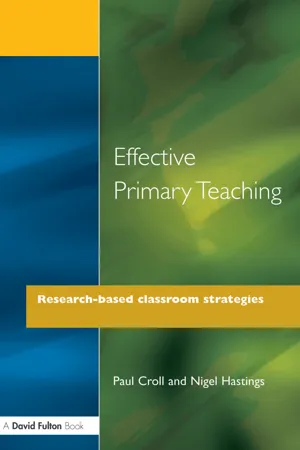
First Published in 1996. This book is concerned with bringing the findings of educational research to bear on the practical problems faced by teachers in primary school classrooms. We take as our starting point a number of claims which we shall develop in more detail through the book: Teachers matter, relationship between teaching behaviour and educational outcomes, any attempt to improve education mist be concerned with outcomes, there is no single one 'best' approach, teaching situations have important aspects in common, teaching is a thoughtful activity that demands considerable intellectual engagement, and reflective and self-critical analysis.
Information
Chapter 1
Teachers Matter
Paul Croll and Nigel Hastings
Introduction
In this book we are concerned to bring the findings of educational research to bear on the practical problems faced by teachers in primary school classrooms. We take as our starting point a number of claims which we shall develop in more detail in this chapter and in Chapter 10.
- Teachers matter: what teachers do makes a difference to the classroom experiences of themselves and their pupils and, through these, to the outcomes of education.
- Any attempt to improve education must concern itself with outcomes, broadly defined. We have included the term 'effective' in our title because it focuses us on the effects of teaching and on the importance of finding ways to describe and measure these effects.
- There is now a body of educational research which provides evidence on the relationship between teaching behaviour and educational outcomes and which is highly relevant to the practical day-by-day decisions which teachers must make in classrooms. These studies are robust in the sense of being consistent, generalisable and widely replicated.
- There is no evidence to suggest that there is a single 'best' approach to teaching and teaching approaches will always need to be flexible, both with regard to the needs of particular classroom situations and the strengths and preferences of individual teachers. However, the notion of teaching strategies, a repertoire of types of approach supported by evidence on their consequences, provides a way in which research results can inform decisions about which strategies might be most fru itful in particular circumstances.
- Teaching situations have important aspects in common and it is therefore possible to take lessons from one situation which are applicable to another. Doing this in a systematic and generalisable fashion is one of the purposes of educational research.
- Teaching is more than a skilled activity or practical accomplishment.It is also a thoughtful activity which demands considerable intellectual engagement and reflective and self-critical analysis. It is a premise of this book that such analysis is best conducted in the context of an awareness of the widest range of research evidence on the consequences for educational outcomes of different types of classroom practice.
In the chapters which follow, the contributors consider the research evidence for effective primary classroom teaching in a variety of areas. Some of these are concerned with questions of overall strategies within the primary classroom for managing teaching and learning. Consequently there are chapters dealing with classroom organisation (especially the organisation of classroom seating), patterns of teacher interaction with pupils (especially the balance of whole class, small group and individual interaction), strategies for behaviour management, approaches to pupil motivation and strategies for effective group work. There are also chapters dealing with more specific issues either in the curriculum or with regard to groups of children. Chapter 7 considers evidence on approaches to teaching reading and Chapters 8 and 9 deal respectively with teaching children with special educational needs and teaching high attaining children.
The eight chapters which consider the evidence about different aspects of teaching emphatically do not add up to a prescription for a single approach to effective teaching. Rather, they present a series of studies which have implications for strategies in particular areas. However, there are some common themes running through them and the strategies which arise from them, while not adding up to a single approach to teaching, have a resonance with one another. Part of the argument to be presented here is that teachers do not typically have to trade-off effectiveness in some areas or for some groups of children against lack of effectiveness elsewhere. The sorts of strategies which can be shown to be effective for, for example, children with learning difficulties or children who have problems learning to read, also have benefits for all children in the class. Similarly, achieving improved levels of academic outcomes is typically associated with improved rather than worsened behavioural or social outcomes.
This book is directed at a number of audiences. First, we want to address primary school teachers who are in the front line of efforts for educational improvement and who, we hope, can make use of the strategies presented here. The book is intended to be useful to all primary school teachers and especially to people on in-service courses and to students on courses of initial teacher education as they start to work in classrooms. Second, we want to address education managers and policy makers at all levels. While the strategies presented here are essentially classroom level approaches, they also need response and discussion at whole school and broader levels. Although the book emphasises the things which are within the control of individual teachers it is not intended to suggest that they are only issues for individual teachers. The approaches suggested here are likely to be most effective when done in co-operation with colleagues, when part of whole-school policies and when appropriately supported and resourced. Third, we want to address our own colleagues in institutions of higher education concerned with teacher education and educational research. It is our contention that in higher education we have paid too little attention to using research evidence on teaching to inform programmes of initial education for new teachers and also paid too little attention in our research to conducting studies which would support the practice of teaching. We wish to draw to the attention of teacher educators the evidence that now exists on effective teaching approaches and to emphasise its relevance for teacher education. We also wish to use the discussions of research evidence which follow to highlight the gaps in carefully established empirical findings about teaching and to encourage educational researchers to see supporting teachers and improving teaching effectiveness as important priorities.
Teachers matter
It is a paradox of much discussion of teaching that it appears to simultaneously celebrate and play down the influence of individual teachers on educational outcomes. The everyday discourse of teachers contains many elements which appear to be strongly predicated on the assumption that teachers differ with regard to their behaviour, attitudes and so on and that such differences have educationally relevant outcomes. The folklore of teaching includes stories of the early years teacher who never failed to have all children reading by the time they left her class. New teachers are told that they will improve with experience. Teacher educators placing students in school are concerned that they should have host teachers who will provide appropriate models. Discussion in staffrooms, in headteacher conferences and at the school gates deals with 'good' and 'effective' and 'committed' teachers, with the clear implication that others must be less good, less effective and less committed.
However, alongside this celebration of teacher efficacy goes a discourse which places the key determinants of educational outcomes outside the control of teachers and of schools more generally. Here, educational outcomes are seen as depending on the characteristics children bring to school with them; either innate characteristics of the children themselves, or factors arising from the circumstances of their families and home environments.
This type of attribution of the causes of educational success and failure can be seen in the large-scale interview survey of primary school teachers conducted by Croll and Moses (1985). The interviewers asked teachers about children identified as having either learning difficulties or behavioural problems in the classroom. In the case of learning difficulties, 71 percent were described by the teacher as being due to innate, 'within child' factors such as ability or attitude. In a further 30 per cent of cases the child's home and family background was blamed for difficulties with learning. In less than three per cent of cases the teachers identified aspects of the teaching the child received or the school they were in as related to the difficulties with learning. (Teachers could make more than one attribution of causality so these figures do not add to 100 percent.)
With regard to behavioural problems, within child factors and home and family characteristics again dominated the explanations offered. Within child factors were said to be a reason for 31 per cent of behavioural problems and home and family characteristics for 66 per cent. As with learning difficulties, in less than three per cent of cases did teachers explain behavioural problems in terms of classroom or school factors.
These results are not surprising in view of the considerable emphasis placed in the study of education on the importance of psychological explanations (e.g. intelligence, personality, attitude) and sociological explanations (social class and, more recently, gender and ethnicity). Such explanations are not necessarily wrong and both family background and the individual attributes of particular children are undoubtedly extremely important with regard to educational outcomes. However, explanations which focus on these factors have two major limitations from an educational perspective.
In the first place such explanations are, in the case of particular children, very hard to establish with any confidence. Teachers' knowledge of the personal circumstances of their pupils are often very vague (Abbott, 1996), and, in the case of characteristics such as intelligence, are almost always speculative. In many cases explanations of this sort are essentially circular: a child's poor work is attributed to low ability and the evidence for low ability is the work the child produces; a child's emotional outbursts are attributed to an unhappy home situation as evidenced by the child's behaviour.
Secondly, whatever the truth of attributions of causality involving home and innate characteristics, these are things which teachers and schools can do very little about, and therefore easily take on the characteristics of, at best, excuses and, at worst, negative expectations of how a child can behave or perform. In this book we are concerned to focus on the things that teachers can influence and want to stress that teacher behaviour can improve educational experiences for themselves and for their pupils.
Later in this chapter we shall look in more detail at some of the research which has been conducted relevant to effective teaching. Here we will briefly state the reasons for thinking that, with regard to important educational outcomes, teachers matter.
There is ample evidence that teaching outcomes differ in ways that can be attributed to teacher actions. A substantial body of research evidence now shows that the amount of progress made by individual pupils, after allowing for their level of initial achievement and background variables such as social class, differs very considerably between different teaching situations. For example, the study by Neville Bennett and his colleagues at the University of Lancaster comparing different teaching styles found that, across three different curriculum areas, the progress made over one school year by children taught by different groups of teachers varied by an amount equivalent to between three and five months of academic progress (Bennett, 1976). It is important to note that, although this study attracted considerable criticism and the results were later modified (Aitken, Bennett and Hesketh, 1981), these criticisms and the re-analysis of the results in no way affected the initial finding of considerable differences in the progress made by children taught by different teachers.
The ORACLE project at the University of Leicester also found considerable differences in academic outcomes associated with different approaches to teaching. With regard to the progress pupils made in language, reading and mathematics, groups of teachers were associated with different levels of progress and these effects were generally consistent across the different subject areas. Controlling for variables such as the socio-economic characteristics of the pupils, class size and the presence of 11 + examinations made no difference to these differential effects (Galton and Croll, 1980).
More recently, research by Mortimore and his colleagues in London has looked at the relationship between school experience and educational attainment. They found that the school a child attended accounted for nearly a quarter of the variation between children in the rate of their reading progress. Moreover, the most effective schools performed at about 25 per cent above average and the least effective schools at about 20 per cent below average on a series of indicators of academic performance (Mortimore, Sammonds, Stoll, Lewis and Ecob, 1988).
Two further points should be made about the evidence for differential effectiveness in academic outcomes. The first is that the relative influence of socio-economic, school and teacher factors differs considerably between studies focusing on overall level of performance and studies focusing on pupil progress (what is sometimes characterised as 'value added'). The influence of schools and teachers is shown to be much stronger when progress from an initial starting point is the outcome to be studied, while socio-economic factors are stronger with regard to overall levels of performance. Effectiveness, as conceptualised in this book, is essentially about change rather than about a simple snapshot of performance at a particular point in time.
Second, a distinction can be made in principle between the effects of factors operating at school level; types of school organisation, school policies, quality of leadership and so on; and factors operating at classroom and teacher level, such as class organisation and teaching strategies. Although these are potentially interlinked, the picture to emerge from research is that it is the classroom level factors which are the most important and that when these are incorporated into an overall measure of school effects, real differences due to classroom practice can appear to be diluted or unstable over time.
The studies discussed so far have only been presented in terms of academic outcomes but some of them, and in particular the London research, have also considered non-academic outcomes such as self concept, behaviour, attendance and attitude to school. In these areas there were also very considerable differences between the most and least effective schools. Other research on the relationship between teacher behaviour and classroom organisation and the behaviour of pupils has been conducted by Kevin Wheldall (one of the contributors to this volume) and his colleagues (Wheldall and Glynn, 1989; Merrett, 1993). These studies, which will be referred to in more detail in Chapters 3 and 6, show clearly how teachers can make a considerable impact on the behaviour of children in their classes.
The question of the impact of teaching approaches on classroom behaviour raises another important feature of a concern for strategies for effective teaching. We have considered educational outcomes so far principally in terms of the consequences of teaching for children's academic attainment. Another important aspect concerns the nature of the classroom situation and the quality of the classroom experience of both teachers and children.
There is a considerable amount of evidence that many teachers find teaching a stressful experience and that aspects of pupil behaviour are a major feature of teacher stress. The largest scale recent study of teacher experience of classroom problems related to children's behaviour is the research for the Elton Committee on School Discipline (DES, 1989). Two-thirds of the primary school teachers in the study said that inappropriate pupil talk was a daily problem and the same proportion said that pupils preventing others working was a daily problem. A fifth of teachers said that work avoidance by pupils was a daily problem. In a survey of primary teachers by Wheldall and Merrett (1988), over a half said that they spent more time than they should on problems of classroom order and control
It is worth noting that these are not the major incidents which go to make up headlines but the day-to-day niggle of minor but frequent and persistent difficult behaviour. The work of Kevin Wheldall and his colleagues, discussed elsewhere in this book, has shown how directed interventions by teachers can dramatically reduce the incidence of such problems, while the studies of school and teacher effectiveness have shown how schools and classrooms serving similar catchment areas can differ considerably with regard to them. A recent survey of research evidence in this area concluded that, 'The dominant influence on the classroom motivation and behaviour of a very large majority of pupils appears to be the teacher' (Galloway, 1995, p52).
Educational outcomes
Central to the arguments developed in this book is the claim that the study of education should have a concern with educational outcomes as one of its central features. Implied in this is that educational outcomes should be identifiable. By this we do not mean that they necessarily have to be measured (although they frequently will be) but that a discussion of outcomes should revolve around evidence which can be offered for public scrutiny.
As we said in the introduction to this chapter, we want outcomes to be 'broadly defined' and to encompass a wide range of academic, personal, social and behavioural aims which teachers and others may have as their purposes for schooling. Many of the outcomes with which we are concerned are to do with aspects of academic performance; attainment in reading or mathematics and so on. However, other outcomes may relate to children's behaviour in the classroom and elsewhere or to the amount of time that children spend engaged in curriculum activities or teachers spend on curriculum instruction.
A common distinction made in studies of teaching effectiveness is between 'process' variables and 'product' variables. Processes are educational activities (for example, teacher questions, use of ability groups, pupil task engagement) and products are educational outcomes (for example, reading ages, public examination results or National Curriculum attainment levels). But in many situations it may not be clear whether particular variables should be regarded as a process or a product. In particular, aspects of teacher and pupil activity in classrooms may be regarded as educational processes in the sense that they are ongoing educational activities which may influence outcomes such as achievement. But they may also be regarded as educational products in that they may reflect the aims of teachers and be influenced by other educational processes. In the chapters which follow, in defining outcomes broadly we shall include as relevant educational outcomes variables such as pupil time on-task, motivation, co-operative behaviour and so on, while recognising that for other purposes they may also be treated as processes.
Clearly an approach to effective teaching which takes outcomes as an essential criterion for effectiveness depends on a high degree of commonality in educational purposes. If we are to use evidence on the effectiveness of different teaching approaches with regard to outcomes to inform decisions about teaching then we need agreement that these outcomes are important. We shall argue that there is such a degree of commonality in educational aims arising from the shared professional values of teachers, the common features of primary classrooms as social settings and the external constraints within which teachers work.
Studies of teachers' aims and values concur in showing that teachers virtually all share a commitment to, on the one hand, high standards in the basic skills of literacy and numeracy and, on the other to the personal and...
Table of contents
- Cover
- Title
- Copyright
- Contents
- Notes on Contributors
- 1 Teachers Matter
- 2 Teacher—Pupil Interaction in the Classroom
- 3 A Place for Learning
- 4 Group Work and Co-operative Learning
- 5 Classroom Motivation
- 6 Effective Classroom Behaviour Management
- 7 Teaching Reading in the Primary Classroom
- 8 Special Educational Needs
- 9 Differentiation? Working with More Able Children
- 10 Teaching and Research
- References
- Index
Trusted by 375,005 students
Access to over 1.5 million titles for a fair monthly price.
Study more efficiently using our study tools.
Frequently asked questions
Yes, you can cancel anytime from the Subscription tab in your account settings on the Perlego website. Your subscription will stay active until the end of your current billing period. Learn how to cancel your subscription
No, books cannot be downloaded as external files, such as PDFs, for use outside of Perlego. However, you can download books within the Perlego app for offline reading on mobile or tablet. Learn how to download books offline
Perlego offers two plans: Essential and Complete
- Essential is ideal for learners and professionals who enjoy exploring a wide range of subjects. Access the Essential Library with 800,000+ trusted titles and best-sellers across business, personal growth, and the humanities. Includes unlimited reading time and Standard Read Aloud voice.
- Complete: Perfect for advanced learners and researchers needing full, unrestricted access. Unlock 1.5M+ books across hundreds of subjects, including academic and specialized titles. The Complete Plan also includes advanced features like Premium Read Aloud and Research Assistant.
We are an online textbook subscription service, where you can get access to an entire online library for less than the price of a single book per month. With over 1.5 million books across 990+ topics, we’ve got you covered! Learn about our mission
Look out for the read-aloud symbol on your next book to see if you can listen to it. The read-aloud tool reads text aloud for you, highlighting the text as it is being read. You can pause it, speed it up and slow it down. Learn more about Read Aloud
Yes! You can use the Perlego app on both iOS and Android devices to read anytime, anywhere — even offline. Perfect for commutes or when you’re on the go.
Please note we cannot support devices running on iOS 13 and Android 7 or earlier. Learn more about using the app
Please note we cannot support devices running on iOS 13 and Android 7 or earlier. Learn more about using the app
Yes, you can access Effective Primary Teaching by Paul Croll,Nigel Hastings in PDF and/or ePUB format, as well as other popular books in Education & Classroom Management. We have over 1.5 million books available in our catalogue for you to explore.