This practical and comprehensive book for Inclusion Coordinators (SENCOs) covers all the essential aspects of how to manage inclusion more effectively. It informs coordinators about how to move inclusive policy and practice forward, within a range of educational settings. It views inclusion from an equal opportunities perspective, relating to all pupils, irrespective of their ability, disability, age, gender, ethnicity, language and background.
The book explores appointing an inclusion coordinator, the role of the inclusion coordinator, time management for inclusion coordinators, and what an inclusion policy should contain. It covers auditing inclusive practice, reviewing and evaluating inclusion, OFSTED inspecting inclusion, and the role of the governor for inclusion. It also deals with additional target setting; using the revised P scales and the Emotional Behavioural Development (EBD) scales to track and monitor pupil progress; enhancing barrier free learning and participation opportunities; and what to include in a parents/carers guide on inclusion.
- 86 pages
- English
- ePUB (mobile friendly)
- Available on iOS & Android
eBook - ePub
About this book
Information
Part 1
Strategic Direction and Development of Inclusion
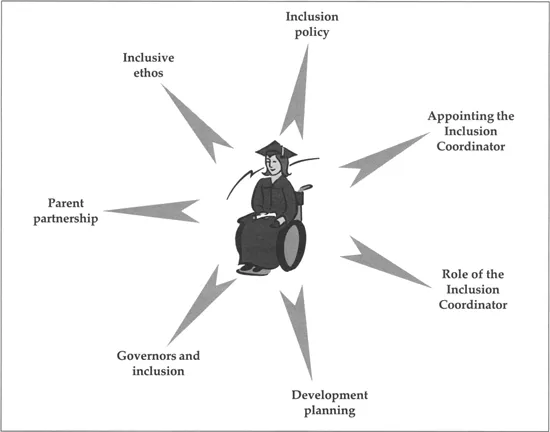
Developing an Inclusive Ethos
Inclusive schools are not focused solely on special educational needs (SEN). They endeavour to create a culture that values all children for what they can achieve and move away from describing children in negative terms for what they cannot do. They focus on a child’s strengths and abilities, and accept human difference as normal.
When developing an inclusive school ethos a good initial starting point is to discover if all school stakeholders share a common understanding about what the term inclusion actually means. Therefore, it is a useful exercise to ask key participants to complete the phrase:
Inclusion is …
Only after examining all the responses can a school ethos be developed.
Villa and Thousand (1995), and the DfEE (2000a) in the training programme for teaching assistants (TAs), focus on the associated feelings of inclusion and exclusion. Another valuable exercise to undertake with staff and pupils in a school is to ask two questions:
• How does it feel to be included?
• How does it feel to be excluded?
Each of these questions is likely to elicit the following answers.

If someone is included they feel wanted, loved, positive, secure, confident, accepted, happy, liked, appreciated, valued, useful, content and at ease.
If someone is excluded they feel rejected, isolated, lonely, inferior, different, worthless, hurt, frustrated, angry, upset, resentful, unhappy, useless, neglected and hard done by.
The purpose behind this second exercise is to raise awareness, increase understanding and change attitudes. It is always beneficial to have past pupils with a diversity of individual needs talking about their experiences of inclusion and exclusion in education and society.
A Policy for Inclusion
The governing body and the head teacher are responsible for determining the school’s inclusive policy and approach; for establishing the appropriate funding and staffing necessary for inclusive provision; and for overseeing inclusive practice within the school.
The Index for Inclusion (Booth and Ainscow 2000) is a valuable audit tool that can support schools in establishing their current position in relation to inclusive culture, policy and practice.
From this point, the inclusion aspects and priorities that need further development can be targeted in the SDP in order to move the school forward in improving educational inclusion.
The development of an inclusion policy is a collaborative process that should involve staff, governors, pupils and parents in its formulation. All stakeholders should be familiar with the contents of the inclusion policy, and relate its guiding principles to their everyday practice.
It is important that the school’s inclusion policy is not seen solely as being just for the benefit of SEN and disabled pupils: this policy also reflects the provision made for girls and boys, minority ethnic and faith groups, travellers’ children, asylum seekers and refugees, EAL pupils, gifted and talented pupils, ‘looked after’ children, disaffected pupils, sick children, young carers, children from families under stress, pregnant schoolgirls and teenage mothers.
Schools may be well advised to review related existing policies such as the equal opportunities policy, the SEN policy, the teaching and learning policy, the behaviour and anti-bullying policy and the assessment policy, to see how inclusive they already are. Where best practice exists in relation to educational inclusion, these schools have a ‘stand alone’ inclusion policy, which does however make reference to the other relevant school policies. An example of a school’s inclusion policy can be found in the Appendix.
What Should be in a School Inclusion Policy?
General rationale | how the policy links to the school’s general aims, philosophy, mission statement, admission arrangements; why the policy is necessary. |
Aims and objectives | guiding principles to inclusive provision and objectives employed to achieve inclusion. |
Definition of inclusion | this will reflect national and local definitions in relation to the school’s context. |
Coordinating inclusion | name the INCO; outline roles/responsibilities of INCO, governing body, head teacher, teachers/LSAs. |
Inclusive provision | in-class, out-of-class, pastoral support, setting/grouping arrangements, mentoring, peer tutoring, curriculum entitlement and access; and extra-curricular/out-of-school opportunities, links with other schools. |
Specialist provision | specify any specialist facilities, equipment, expertise the school has to ensure physical and curriculum access. |
External support | outline of arrangements for external support services involvement, e.g. service level agreement, brief outline of input/provision from education, health, social services, voluntary organisations, i.e. nature of outreach work. |
Resource allocation | explanation of how resources are allocated to meet inclusion; outline of expenditure breakdown. |
Assessment procedures | arrangements for assessment, identifying and targeting underachieving/minority groups; monitoring and reviewing pupil progress. |
Professional development | outline of how school will provide training for teachers/support staff. |
Parent partnership | arrangements made for fostering positive parental links/support; outline of how parental concerns/complaints are addressed. |
Evaluating policy | success criteria/evidence of impact of policy. |
(CSIE 1996:14–18)
Evaluating the Effectiveness of the Inclusion Policy
Evidence that the inclusion policy has been effective will need to be gathered annually. The governing body, the head teacher, parents, the LEA and OFSTED, prior to inspection, will want to know how inclusive practice has improved within the school.
Evidence will show that all stakeholders are familiar with the policy and refer to it regularly to inform their practice. The policy will need to indicate that it has had a positive impact upon the sc...
Table of contents
- Cover
- Title Page
- Copyright Page
- Table of Contents
- Acknowledgements
- Abbreviations
- Introduction
- Part 1: Strategic Direction and Development of Inclusion
- Part 2: Teaching and Learning in Inclusive Schools
- Part 3: Developing Positive Inclusive Relationships
- Part 4: Staff Deployment and Resources to Promote Inclusion
- Appendix: Example of a School Inclusion Policy
- Key Addresses of Official Agencies
- Bibliography
- Index
Trusted by 375,005 students
Access to over 1.5 million titles for a fair monthly price.
Study more efficiently using our study tools.
Frequently asked questions
Yes, you can cancel anytime from the Subscription tab in your account settings on the Perlego website. Your subscription will stay active until the end of your current billing period. Learn how to cancel your subscription
No, books cannot be downloaded as external files, such as PDFs, for use outside of Perlego. However, you can download books within the Perlego app for offline reading on mobile or tablet. Learn how to download books offline
Perlego offers two plans: Essential and Complete
- Essential is ideal for learners and professionals who enjoy exploring a wide range of subjects. Access the Essential Library with 800,000+ trusted titles and best-sellers across business, personal growth, and the humanities. Includes unlimited reading time and Standard Read Aloud voice.
- Complete: Perfect for advanced learners and researchers needing full, unrestricted access. Unlock 1.5M+ books across hundreds of subjects, including academic and specialized titles. The Complete Plan also includes advanced features like Premium Read Aloud and Research Assistant.
We are an online textbook subscription service, where you can get access to an entire online library for less than the price of a single book per month. With over 1.5 million books across 990+ topics, we’ve got you covered! Learn about our mission
Look out for the read-aloud symbol on your next book to see if you can listen to it. The read-aloud tool reads text aloud for you, highlighting the text as it is being read. You can pause it, speed it up and slow it down. Learn more about Read Aloud
Yes! You can use the Perlego app on both iOS and Android devices to read anytime, anywhere — even offline. Perfect for commutes or when you’re on the go.
Please note we cannot support devices running on iOS 13 and Android 7 or earlier. Learn more about using the app
Please note we cannot support devices running on iOS 13 and Android 7 or earlier. Learn more about using the app
Yes, you can access Developing Inclusive School Practice by Rita Cheminais in PDF and/or ePUB format, as well as other popular books in Education & Education General. We have over 1.5 million books available in our catalogue for you to explore.