- 108 pages
- English
- ePUB (mobile friendly)
- Available on iOS & Android
eBook - ePub
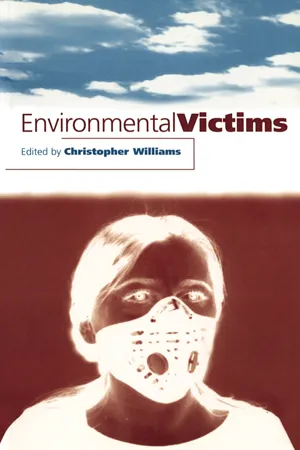
Environmental Victims
About this book
This study looks at environmental problems from the perspective of the victims. The bottom line consequences are often damaging to the health of individuals or communities and they raise a wide range of issues concerning justice, international and environmental law, public health, occupational health and health policy, social policy and welfare, international relations and security. All of these issues are addressed by the contributors, and the work is designed for a spectrum of readers, whether concerned with industrial hazards and occupational health, relevant agreements or treaties, environmental refugees, or the roles of state, business and other actors.
Information
Part One
Concepts
Chapter 1
An Environmental Victimology
INTRODUCTION
I do not want to be a victim, and all steps should be taken to guard against my victimization.
If I am a victim, I want all available help, and expect government, industry, and community to come to my aid.
I do not want to be revictimized by governments, companies, courts, or the medical and legal professions.
The expression of these demands from the Permanent Peoples’ Tribunal on Industrial and Environmental Hazards and Human Rights in Bhopal (PPT, 1992: 13) reflects the urgent need to address environmental victimization, not only in the form of obvious disasters as at Bhopal, but also the ‘creeping disasters’ such as traffic pollution. Law is one form of response, but, as is lucidly argued by Peter Yeager in The Limits of Law (1991), even in state-of-the-art countries such as the US, statutes alone can never fully address the problems posed by environmental crime. The difficulties experienced in implementing statutory compensation in Bhopal provide a poor-nation perspective (BGIA, 1992). There is an obvious need for social justice approaches to parallel formal legal processes.
THE LIMITS OF ‘ENVIRONMENTAL JUSTICE’
The ‘environmental justice movement’ has provided the most prominent alternative in recent years, at least in the US (see Bryant, 1995; Hofrichter, 1993; Capek, 1993). Yet, although generating valuable insights and an effective basis for informed environmental activism, its broader application is limited, principally for three reasons.
First, ‘environmental justice’ relies greatly on subjective (often self-) definitions of victimization. This may work well in relation to activism, but ultimately the development of justice perspectives, legal or social, requires objective bench-marks. Without objective definitions, how do we apply victim conceptualizations when (i) victims will not self-define? What of the ‘manic denial’ of the Mormons in Nevada, who accept the health problems resulting from nuclear testing as a necessary sacrifice for the good of the state (Gallagher, 1993: 217), or the Indian who attributes lead poisoning to karma, not to the illegal smelter next door? How do we accord victim status when (ii) victims cannot self-define, for example, with the unborn child or when the outcome is severe intellectual disability from radiation or lead pollution (Williams, 1997). How do we formally identify victims when (iii) national or community leaders will not acknowledge the victimization of those they govern? In the case of cross-border acid rain and the nuclear power disaster at Chernobyl, European governments did not argue for redress because they did not want to encourage precedents that might later be applied in reverse. What of the individuals among the Mescalero Apaches in New Mexico who will eventually suffer health problems because their leaders encourage the importation of hazardous toxic waste to reap the short-term cash rewards?
Second, ‘environmental justice’ bases its key arguments on (i) assumptions about power relationships and (ii) group identities, which (iii) reflect the gender, class, and ethnic structures of US society.
(i) The assumption of the powerless as victim and the powerful as victimizer can lead to a stereotyped view that omits the victimization of those with power and wealth. If wealth and perpetrating environmental crime always go hand-in-hand, how do we conceptualize the Czech industries that polluted rivers then flowing through wealthy Germany, or the threat posed to Norway from Russia’s decaying nuclear weapon facilities, or people in Hong Kong and Taiwan who suffer the pollution from mainland China?
(ii) When group identity is the prerequisite of analysis, this can omit the victimization of those scattered within populations who may be vulnerable because, for example, of their clinical status. The link between background radiation from nuclear testing and babies born with Down’s Syndrome (Bound et al, 1995: 164–170) involves mothers whose only group identity is that they are over 40, and the true victim group is their unborn children. Class, wealth, race, neighborhood, and gender (of the victims) are irrelevant concepts.
(iii) North American group identities are often not applicable in other settings. For example, the link between minority ethnic groups, poor neighborhoods, and pollution is less strong in regions such as Sweden, China, or the former Soviet Union. Moscow, home to the Russian ethnic power elite, is both one of the wealthiest and one of the most polluted regions in the country. In some settings, standard assumptions about the vulnerability of minority groups seem incorrect. While US research shows that minority ethnic groups suffer more from lead pollution, a study in the UK revealed that Asian children in a London borough suffered less than their white peers (Lansdown and Yule, 1986: 115). Later in this book, Sharon Stephens (1996) argues that the environmental justice frame does not readily embrace a global perspective on children.
Third, because environmental justice usually adopts an activist stance, it often lacks academic objectivity. This puts it in a weak position to address conceptual conundra that are familiar to traditional victimology – for example, ‘victim participation’ in, or ‘victim precipitation’ of, the circumstances that cause their suffering. Truck drivers who have respiratory ailments because of particulates in exhaust emissions are an obvious case. There are limitations on how activist arguments – often reflecting what the victimologist Ezzat Fattah (1992: 12) has dubbed ‘missionary zeal’ – will bring about the necessary changes in thinking among hardened politicians for whom self-interest is usually the primary motivation.
Most importantly, the activist position, often manifest as ‘nonviolent direct action,’ leads to an avoidance of any discussion of violent victim resistance. It may be that most responses in the US have been nonviolent (see Hays et al 1996: 163), but that is not so within a global view. Understanding the violent spirals surrounding environmental victimization is crucial, and, as will be argued later, will probably be the most distinctive feature of a victimology perspective.
ENVIRONMENTAL VICTIMOLOGY
The ‘environmental justice’ approach has played a vital role in generating an awareness of the human dimensions of environmental change, mobilizing action, and in amassing data. However, its shortcomings propose that other, complementary perspectives now need to be developed. Although currently an unfashionable area of academic study, victimology is the obvious direction to look. The UN Declaration on Victims of … Abuse of Power (1985) provides a starting point, and appears prescient of the likely concerns of an environmental view. It relates specifically to:
persons who … have suffered harm … through acts or omissions that do not yet constitute violations of national criminal laws but of internationally recognised norms relating to human rights (in Fattah, 1989).
An environmental perspective fits within the framework of ‘Radical Victimology’ (Mawby and Walklate, 1994: 8, 13), which is broadly concerned with human rights, abuses of power, and human suffering irrespective of whether the circumstances are within the ambit of law.
This chapter therefore proposes working definitions, embraces a brief critique of the ‘environmental justice’ approach, consolidates an emerging epistemology, and outlines issues that could be the concern of an environmental victimology in the future. Finally, it raises the question as to whether, in the context of the scale and nature of environmental victimization, ‘justice’ or ‘security’ is the guiding principle.
DEFINITIONS
Who Are ‘Environmental Victims’?
The notion of victims in relation to the environment has been applied very loosely. The study entitled Victims of the Environment (Rossi et al, 1983) only concerns natural disasters such as tornadoes and earthquakes, in which there are no apparent perpetrators. In the headline ‘Brain Damage Found in Victims of Bhopal Disaster’ (British Medical Journal, 1994: 359), meanwhile, the meaning is very different since the environmental factors were not natural and there were clearly culpable entities. Michael Reich adopts the term ‘victims,’ giving it the same meaning, throughout his book Toxic Politics: Responding to Chemical Disasters (1991). In an editorial in Down to Earth, India’s environmental magazine, Anil Agarwal wrote recently of his experience of cancer: ‘I was speaking not just as an environmental activist, but also as an environmental victim’ (1995: 4). The term therefore arises naturally in discussion of contemporary environmental problems, but without sufficient precision for academic purposes.
Surprisingly, ‘environment’ is rarely defined clearly in law or international declarations (Birnie and Boyle, 1992: 2). Through usage, it is now generally taken to comprise four components: chemical, physical, micro-biological, and psychosocial (Lee, in Bullock et al, 1988: 275). The importance of the latter is in relation to corporate abuses of power that manipulate the other three components. An example would be cigarette advertising aimed at children or developing countries.
When formally conceptualizing ‘environmental victims,’ it is helpful to exclude those more accurately described as ‘environmental casualties’ – those who suffer as a result of natural disasters. Implicit in the etymology of ‘casualties’ is the notion of chance, while the concept ‘victims’ embodies the idea of suffering caused by a deliberate or reckless human act (including an act of omission). Some circumstances that appear natural may, if analyzed in greater depth, be a consequence of human acts. Those killed by the flooding of the Yangtze River in 1995 may have been victims of deforestation and soil erosion that precipitated the surge (Bird, 1995: 2). Environmental suffering that has affected many generations, such as iodine deficiency, might not be seen as victimization until power relationships are examined. Why are the communities that suffer iodine deficiency forced to live on land that cannot sustain human life properly? Later in this book, Peter Penz (1996) and Meena Singh (1996) further develop the possibilities in relation to transnational victimization and environmental refugees.
Environmental law usually embodies the principle that the outcome of an act must have been ‘reasonably foreseeable’ for it to constitute an offense. So far, however, most environmental law relates to damage to the physical world, not human injury. If we are considering human injury as a specific outcome, it seems more appropriate to borrow from common law in relation to personal injury offenses, for example assault, where the principle is whether an act is deliberate or reckless. Reckless behavior may not embody foreseeing a specific outcome, simply that an act could, by its nature, be dangerous to others. The distinction is important. Many claims for compensation for environmentally mediated injury fail because the perpetrator maintains that it was impossible to foresee a specific outcome. For example, the dumping of a particular substance may be excused because it was not known, at the time, to be hazardous (the specific negative outcome was not ‘foreseeable’). Yet, in the same circumstances, it might be claimed that to dump the substance was reckless because it was not proven safe. In the light of the inability of science to keep up with the problems it causes, this common-sense precautionary principle seems more in accord with human well-being. It is the tradition of common law on personal injury, not environmental protection, that has at its heart the direct well-being of humans.
Intergenerational responsibility must be implicit in any conceptualization because of the time-latent nature of much environmental victimization. The UK Congenital Disability (Civil Liabilities) Act 1976, for example, embraces environmentally mediated injury causing ‘predisposition (whether or not susceptible to immediate prognosis) to physical or mental defect in the future.’ There needs also to be an assumption that both victims and perpetrators might be individuals or groups. Moreover, as will be argued later in relation to causation, it is more appropriate to phrase a definition ‘consequence of’ rather than ‘caused by.’
The outcome of victimization is better described as ‘injury’ rather than ‘suffering.’ Injury, as an ‘adverse health effect’ caused by environmental factors, is neatly defined by Christiani (Chivian et al, 1993: 15): ‘any effect that results in altered structure or impaired function, or represents the beginnings of a sequence of events leading to altered structure or function.’ Implicit in the term ‘injury’ is a relationship between two events (cause and effect) that culminate in tangible harm; suffering implies less acute general experiences that might be tolerated without actual injury. This distinction also addresses the debate, common now in poorer countries, that people must endure some environmental suffering for the benefit of economic development, such as dam building. This is an arguable trade-off, but in no justice system is it acceptable to trade off the infliction of human injury (or causing death) against economic benefit.
This restriction to ‘injury’ therefore creates a much narrower frame of reference than that used within the environmental justice debate. Later in this book, Peter Penz argues well for a broadening of the definition when considering transnational dimensions (1996). Pragmatically, if an aim of a victim conceptualization is to change policy, then governments are more likely to respond in relation to tight, manageable definitions, which may be stretched a little, than to ‘catch all’ concepts that might appear to carry a host of hidden ramifications. As a starting point, ‘environmental victims’ can therefore be defined as:
those of past, present, or future generations who are injured as a consequence of change to the chemical, physical, microbiological, or psychosocial environment, brought about by deliberate or reckless, individual or collective, human act or act of omission.
The etymology of ‘victim’ embodies ‘sacrifice,’ and this underlying meaning provides a helpful insight. Environmental victims are often, in effect, sacrificed for the benefit of a more powerful entity. It is common for industrial polluters to argue that the environment of a few downstream/downwind individuals must be sacrificed for the greater good of improving national economies or providing employment. It is an interesting coincidence that we find the US government talking formally of toxic no-go areas as ‘environmental sacrifice zones’ (Walker, 1988: 8). It is even more chilling to find that the local term for children downwind of US nuclear test sites in Nevada, who were born with birth defects, is ‘the sacrifice babies’ (Gallagher, 1993: 217).
What is an ‘Environmental Cause’ of Victimization?
Arguing causation is the prerequisite of establishing victim status. Although it is convenient for an activist to talk of problems as ‘environmentally caused,’ a cause in relation to the definition of ‘environmental victim’ (above) is human interaction with the environment, not the environment itself – ‘environmentally mediated’ would be a more apt term, but as yet this has no legal meaning. The understanding of causation requires greater clarity.
Initially, there is a conceptual legacy within law that must be challenged -the requirement that cause and effect must be adjacent. The law is usually framed in terms such as ‘proximate cause,’ ‘immediate violence,’ or ‘a continuing, operating, and substantial cause’ (Emmet, 1984: 60), reflecting the rule of criminal jurisprudence cause proxima non remote spectatur. Existing law has therefore been weak at conceptualizing the indirect nature of environmental victimization. Causal understandings of ‘interjacency’ are needed – embracing space, time, and multiplicity and interaction of causes and effects – that reflect the ‘creeping disasters’ or, in the UNICEF term ‘slow emergencies,’ which now threaten human safety. Court judgments provide one source of evolving concepts, such as that of ‘major contributory cause.’ Toxic Torts (Pugh and Day, 1992) provides a number of examples, which can inform a victimology perspective.
Another approach to the problem can derive from the philosophy of law: the importance of how the causa...
Table of contents
- Cover
- Half Title
- Title Page
- Copyright Page
- Table of Contents
- Abbreviations and Acronyms
- List of Contributors
- Acknowledgements
- Introduction
- Final Statement to the Tribunal
- PART ONE: CONCEPTS
- PART TWO: CASE STUDIES
- PART THREE: SOLUTIONS
- Annexe: Charter of Rights Against Industrial Hazards Permanent Peoples’ Tribunal on Industrial Hazards and Human Rights
- Index
Trusted by 375,005 students
Access to over 1.5 million titles for a fair monthly price.
Study more efficiently using our study tools.
Frequently asked questions
Yes, you can cancel anytime from the Subscription tab in your account settings on the Perlego website. Your subscription will stay active until the end of your current billing period. Learn how to cancel your subscription
No, books cannot be downloaded as external files, such as PDFs, for use outside of Perlego. However, you can download books within the Perlego app for offline reading on mobile or tablet. Learn how to download books offline
Perlego offers two plans: Essential and Complete
- Essential is ideal for learners and professionals who enjoy exploring a wide range of subjects. Access the Essential Library with 800,000+ trusted titles and best-sellers across business, personal growth, and the humanities. Includes unlimited reading time and Standard Read Aloud voice.
- Complete: Perfect for advanced learners and researchers needing full, unrestricted access. Unlock 1.5M+ books across hundreds of subjects, including academic and specialized titles. The Complete Plan also includes advanced features like Premium Read Aloud and Research Assistant.
We are an online textbook subscription service, where you can get access to an entire online library for less than the price of a single book per month. With over 1.5 million books across 990+ topics, we’ve got you covered! Learn about our mission
Look out for the read-aloud symbol on your next book to see if you can listen to it. The read-aloud tool reads text aloud for you, highlighting the text as it is being read. You can pause it, speed it up and slow it down. Learn more about Read Aloud
Yes! You can use the Perlego app on both iOS and Android devices to read anytime, anywhere — even offline. Perfect for commutes or when you’re on the go.
Please note we cannot support devices running on iOS 13 and Android 7 or earlier. Learn more about using the app
Please note we cannot support devices running on iOS 13 and Android 7 or earlier. Learn more about using the app
Yes, you can access Environmental Victims by Christopher Williams in PDF and/or ePUB format, as well as other popular books in Política y relaciones internacionales & Ecología. We have over 1.5 million books available in our catalogue for you to explore.